
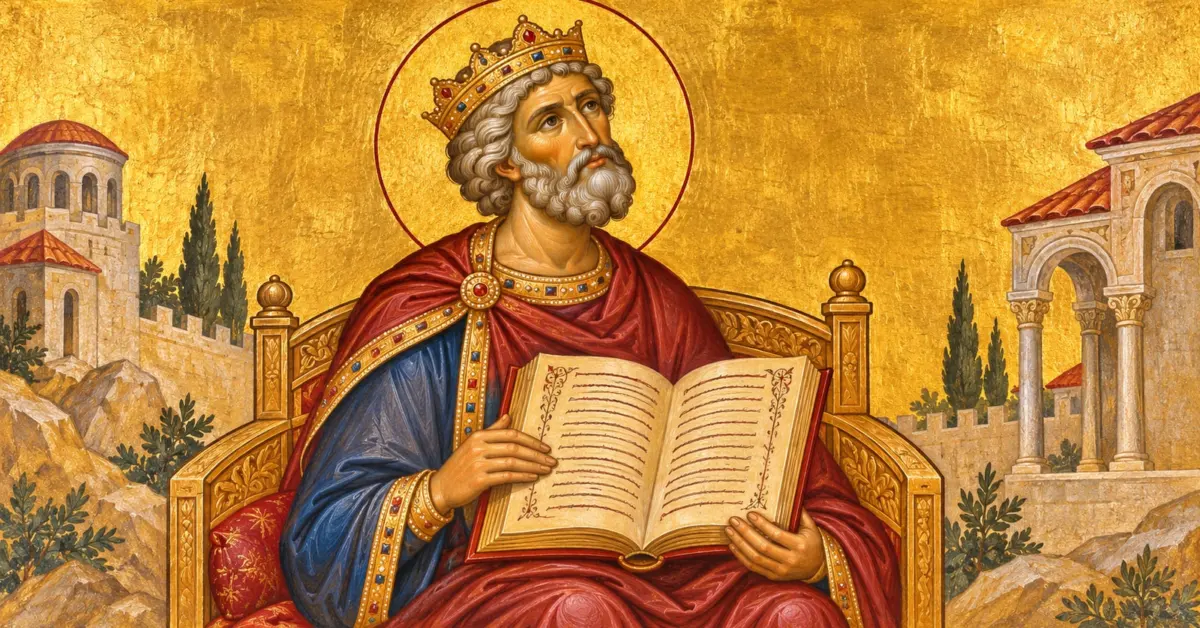
The Psalter is the prayer book of the Church. For reading in church it is divided into twenty sections called kathismata. The word comes from the Greek for “to sit”, because the faithful could sit while the psalms were read. Each kathisma is divided in turn into three parts, called stases, and after each stasis “Glory… Both now…” and “Alleluia” are said. The First Kathisma contains the first eight psalms. Each of them has its own article in our series, with the commentary of the Holy Fathers. Here we look at them together, as the Church reads them: one after another, as a single prayer.
When the First Kathisma is read
The First Kathisma opens the weekly reading of the Psalter. It is usually read at Saturday evening Vespers, the service with which the Lord’s day begins, and in Great Lent also at Wednesday Matins. At the vigils of feasts the typikon, that is, the order of services, usually prescribes only its first stasis, of which a few chosen verses are sung in parishes. The faithful know it by its first words: “Blessed is the man.” Among the chosen verses are also lines from Psalms 2 and 3, so that even someone who has never read the Psalter has heard its beginning without knowing it.
In parishes the kathisma is usually shortened, so the eight psalms are heard in full mostly in monasteries. But whoever reads them at home on Saturday evening prays together with the whole Church, which at that hour opens the Psalter.
The first stasis: Psalms 1, 2 and 3
Psalm 1 is the gate of the Psalter. It begins with the word “Blessed” and shows from the start where the road leads for the one who prays with the psalms. Saint Gregory of Nyssa sees in it three steps of the spiritual life: separation from evil, meditation on the law of God “day and night”, and likeness to God, which the psalm shows through the tree “planted by the brooks of waters”, whose leaf does not fall.
Psalm 2 speaks of the nations and the kings of the earth who rise up “against the Lord, and against his Christ”. Brenton’s “Christ” renders the Greek christos, “the Anointed”, which in Hebrew is “Messiah”; that is why the Church has always read this psalm as a prophecy of the Lord. So the Apostles themselves read it, in the prayer they offered after they had been threatened for preaching the name of Jesus[1]. Psalm 1 begins with “Blessed is the man”, and Psalm 2 ends with “blessed are all they that trust in him”. Blessed Theodoret of Cyrus shows that the first psalm ends with the perishing of the way of the ungodly, and the second begins with those who rose up against the Saviour. So the two psalms stand together, between two beatitudes.
Psalm 3 is the first psalm whose title is tied to the life of David. He spoke it when he was fleeing from Jerusalem before his son Absalom, who had risen against him to take his kingdom. Hemmed in on every side, David lies down in the midst of danger and rises with his hope in God: “I lay down and slept; I awaked; for the Lord will help me.” With this psalm the Church opens the Six Psalms of Matins, the set of chosen psalms read in silence at the beginning of the morning service.
The second stasis: Psalms 4, 5 and 6
The second stasis contains three prayers of a man who lives under God’s gaze from morning to evening and through the night. The Church herself uses them in this way in her services.
Psalm 4 is an evening prayer. The man who has passed through affliction can say: “thou hast made room for me in tribulation”, that is, God has enlarged his heart in the midst of distress. The psalm teaches him to be angry only at sin, to examine his heart in the evening, upon his bed, and to seek the light of God’s countenance, not empty goods. It ends with the words “I will both lie down in peace and sleep.” With it begins Great Compline, the service after supper on the weekdays of Great Lent.
Psalm 5 is a morning prayer: “In the morning thou shalt hear my voice: in the morning will I wait upon thee.” The one who prays enters God’s house with fear, not because of his deeds but “in the multitude of thy mercy”, and asks Him to make straight his way among those who lay snares for him. The Church begins the First Hour, the short service after Matins, with this psalm, and its words are also heard when the priest and deacon enter the altar before the Divine Liturgy.
Psalm 6 is the prayer of repentance. The man does not ask not to be rebuked, but to be corrected gently, as by a father and a physician: “O Lord, rebuke me not in thy wrath.” He weeps at night, “I shall wash my bed every night”, and at the end he senses that God has heard the voice of his weeping. At Great Compline it follows directly after Psalm 4: once the man has examined his heart upon his bed, Psalm 6 puts into his mouth the lament for his sins, upon the same bed.
The third stasis: Psalms 7 and 8
Psalm 7 brings us back to the revolt of Absalom, like Psalm 3. A faithful friend of David, Hushai, persuaded Absalom not to pursue David at once, but first to gather his whole army, and so David gained time to escape. Yet David does not put his hope in his friend, but in God: “O Lord my God, in thee have I trusted.” He confesses that he has not returned evil to those who did him evil, and leaves judgement to God. Saint John Chrysostom says that here is the greatest thing in the opening of the psalm: it is good not to do wrong, but far better not to take revenge for the wrong one has suffered. In the second tone, at Sunday Matins, the prokeimenon, that is, the verse from the psalms sung before the Gospel, is taken from this psalm: “Arise, O Lord my God, according to the decree which thou didst command, and the congregation of the nations shall compass thee.”
Psalm 8 ends the kathisma in wonder: “O Lord, our Lord, how wonderful is thy name in all the earth!” Saint John Chrysostom shows its link with the psalm before. Psalm 7 ended with a promise, “I will sing to the name of the Lord most high”, and in Psalm 8 David fulfils his promise. There one man was speaking, “O Lord my God”; here many speak, “O Lord, our Lord”. The psalm looks at the heavens, the work of God’s fingers, asks “What is man, that thou art mindful of him?” and marvels at the honour God has given to man. Christ Himself spoke a verse of it when the children praised Him in the temple on the day of His entry into Jerusalem: “Out of the mouth of babes and sucklings thou hast perfected praise”[2]. That is why this verse is the prokeimenon of Matins on Palm Sunday. The opening verse of the psalm is the prokeimenon of the Sixth Hour on Great Friday, the hour at which the Lord was crucified. The Apostle Paul shows that the words about man, made a little lower than the angels and crowned with glory, find their perfect fulfilment in Christ[3].
The kathisma therefore begins with the blessedness of the man who walks in the way of God and ends with the glory of human nature, which Christ took upon Himself. Between them stand the prayers of a persecuted man, who lies down and rises with God, weeps for his sins and does not take revenge on his enemies.
The troparia and prayer after the kathisma
For the private reading of the Psalter, at home or in the cell, the Slavonic and Romanian Psalters, and English Psalters translated from the Slavonic, such as A Psalter for Prayer (Jordanville), contain a short order after Psalm 8. It is not added to the kathisma read at Vespers, where the service continues with the little litany and “Lord, I have cried”. The usual beginning prayers are said: “Holy God”, “All-holy Trinity” and “Our Father”. Then three troparia, that is, short church hymns, are read in the first tone, with a hymn to the Mother of God. After them “Lord, have mercy” is said forty times, followed by a prayer. We give the texts below in our own translation from the Slavonic.
The troparia are troparia of compunction, that is, of a heart broken for its sins. Having read eight psalms, the one who prays turns back to himself and sees himself as a sinner. The first troparion joins the confession of Psalm 50, “I was conceived in iniquities”[4], to the humility of the publican in the Lord’s parable, who stood afar off and would not lift up so much as his eyes unto heaven[5].
Conceived in iniquities, I, the prodigal, dare not look up to the height of heaven; but, emboldened by Thy love for mankind, I cry: O God, cleanse me, a sinner, and save me.
The second troparion starts from the word of the Apostle Peter, “if the righteous scarcely be saved”[6], and from the parable of the labourers hired for the vineyard. In the parable, those who came at the eleventh hour, shortly before the end of the day, received the same wage as those who had “borne the burden and heat of the day”[7].
If the righteous man is scarcely saved, where shall I, the sinner, appear? I have not borne the burden and heat of the day; but number me, O God, with the hirelings of the eleventh hour, and save me.
The third troparion, after “Glory…”, is the prayer of the prodigal son in the Lord’s parable, who had wasted his substance in riotous living and returned to his father, saying: “Father, I have sinned against heaven, and before thee”[8].
Make haste to open to me Thy Father’s embrace, for I have spent my life as a prodigal. Looking upon the unfailing riches of Thy compassion, O Saviour, despise not now my impoverished heart; for to Thee, O Lord, I cry with compunction: I have sinned against heaven and before Thee.
After “Both now…” comes the hymn to the Mother of God, who is called “the hope of Christians” and asked to pray unceasingly, with the heavenly powers, for the forgiveness of our sins and the amendment of our life.
The prayer after the kathisma is addressed to God the Father. It thanks Him for not disdaining human nature, “held fast in the darkness of sin”, but enlightening the world first through the law and the prophets, and then through His Only-begotten Son. Then it asks:
…grant us, O God, with a watchful and sober heart to pass through the whole night of this present life, awaiting the coming of Thy Son and our God, the Judge of all, that we may be found not lying down and sleeping, but awake and roused to the doing of Thy commandments, and may enter together into His joy…
This life is called here a night, through which we pass awaiting the coming of the Lord. The prayer asks that He may find us awake, as the Lord says: “Blessed are those servants, whom the lord when he cometh shall find watching”[9]. And “may enter into His joy” recalls the word of the master in the parable of the talents to the faithful servant: “enter thou into the joy of thy lord”[10]. When the prayer is read in the evening, the words about night and vigilance teach us to see even the body’s rest in the light of awaiting the Lord.
How the kathisma ends in Greek Psalters
The troparia and prayer above are found in the Slavonic Psalter, and the Romanian Psalter has the same troparia and the same prayer in its own language. In the Greek editions of the Psalter that we have consulted, they do not appear. After each stasis “Glory… Both now…”, “Alleluia” and “Lord, have mercy” are said, and the kathisma ends without troparia and without a prayer.
Yet the practice has Greek roots. The Russian scholar Tatiana Afanasyeva shows that Byzantine Psalters with troparia and prayers after the kathismata appear in Greek manuscripts no earlier than the second half of the eleventh century, but the prayers in them were not the same in every book. The Slavs received this practice in the thirteenth century, in the monasteries of the Holy Mountain of Athos, where they lived close to the Greeks, and the Slavonic Psalter has kept it to this day, as has the Romanian. Whoever prays from the Slavonic or Romanian Psalter and whoever prays from the Greek one therefore reads the same psalms in the same division; but in the Slavonic and Romanian tradition they end with a prayer of repentance and of vigilance.
How we pray with the First Kathisma
Whoever wishes to begin reading the Psalter can begin here, on Saturday evening, together with the Church. There is no need to read all eight psalms at once. One can read a single stasis, with “Glory… Both now…” at the end, and keep from it a single verse to carry in one’s mind, as the Desert Fathers did.
The First Kathisma teaches a man to pray at every hour of the day. In the morning he can rise with Psalm 3 and Psalm 5. In the evening he can examine himself with Psalm 4 and weep for his sins with Psalm 6. When he is wronged, he can say with Psalm 7, “in thee have I trusted”, without taking revenge. And when he looks at the sky, he can ask with Psalm 8: “What is man, that thou art mindful of him?”
After the eight psalms, the troparia lead the one who prays to humility. Whoever reads them with faith can ask, with the prayer at the end of the kathisma, to pass the night of this life with a wakeful heart, so as to enter into the joy of his Lord.
Sources
- The Septuagint Version of the Old Testament, translated by Sir Lancelot Charles Lee Brenton, London, 1844. New Testament quotations from the King James Version.
- Saint Gregory of Nyssa, On the Inscriptions of the Psalms, Part I, ch. 1; Romanian translation in Scrieri II, PSB 30, Bucharest, 1998.
- Saint John Chrysostom, Homilies on the Psalms, Romanian translation by Laura Enache, Iași, Doxologia, 2011, Homily on Psalm 7, pp. 91–131; Homily on Psalm 8 (PG 55), from the Russian edition Творения святого отца нашего Иоанна Златоуста, vol. 5, Saint Petersburg, Theological Academy, 1899.
- Blessed Theodoret of Cyrus, Commentary on the Psalms; Romanian edition by Florin Stuparu, Bucharest, Sophia, 2018 (from the translation printed at Buzău in 1840), Psalm 2, pp. 12–17.
- The articles of the series “The Psalter Explained” on Psalms 1–8, with the other patristic sources given in each of them.
- The troparia and prayer after the First Kathisma: Псалтирь по кафизмам (azbyka.ru), compared with the Romanian Psalter (acatiste.ortodoxia.ro and psaltireaprooroculuidavid.wordpress.com); English translation ours.
- Greek Psalters consulted: Ψαλτήριον (imks.gr) and Ψαλτήριον – Κάθισμα Πρώτον (orthodox-prayer-book.org).
- Т. И. Афанасьева (Tatiana Afanasyeva), “Устав о пении Псалтири и его влияние на славянскую традицию этой богослужебной книги XIII–XIV вв.” (“The Rule of the Singing of the Psalter and Its Influence on the Slavic Tradition of This Liturgical Book of the 13th–14th Centuries”), Slověne, vol. 12, no. 1, 2023, pp. 7–41 (on Psalters with troparia and prayers, p. 18).
