
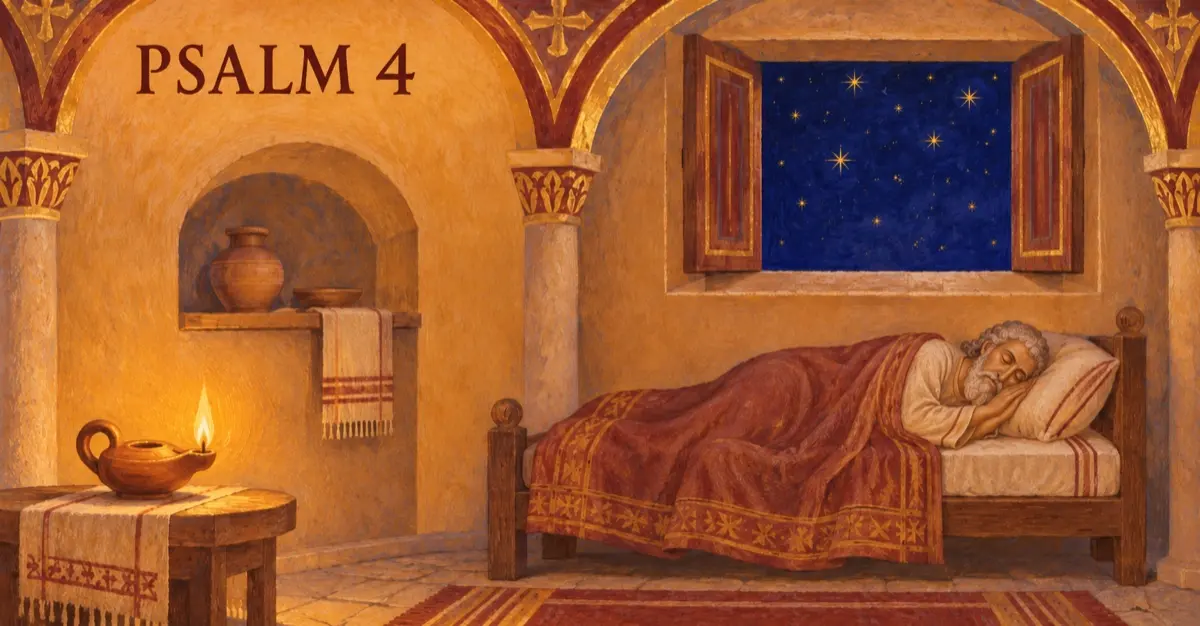
Psalm 4 is the prayer of a man who has passed through affliction and has come to know the mercy of God within it. In it David speaks with God, then turns towards men and teaches them how to pray, how to master their anger, how to search their heart in the evening, and where to seek the true good things. The psalm ends with a man who lies down in peace. The Church reads it in the evening service, just as the morning service begins with Psalm 3.
In this article
The text of the psalm
We give the psalm in the translation of Sir Lancelot Brenton (1844), made from the Septuagint, the Greek Old Testament from which the Holy Fathers interpreted the psalms. The verses are numbered as in the Orthodox Psalter, where the title counts as the first verse.
- For the end, a Song of David among the Psalms.
- When I called upon him, the God of my righteousness heard me: thou hast made room for me in tribulation; pity me, and hearken to my prayer.
- O ye sons of men, how long will ye be slow of heart? wherefore do ye love vanity, and seek falsehood? Pause.
- But know ye that the Lord has done wondrous things for his holy one: the Lord will hear me when I cry to him.
- Be ye angry, and sin not; feel compunction upon your beds for what ye say in your hearts.
- Offer the sacrifice of righteousness, and trust in the Lord.
- Many say, Who will shew us good things? the light of thy countenance, O Lord, has been manifested towards us.
- Thou hast put gladness into my heart: they have been satisfied with the fruit of their corn and wine and oil.
- I will both lie down in peace and sleep: for thou, Lord, only hast caused me to dwell securely.
Psalm 4 in the services of the Church
Psalm 4 opens the second stasis of the first kathisma, together with Psalms 5 and 6. A kathisma is one of the twenty sections into which the Psalter is divided for reading in church, and each kathisma has three stases.
The Church also gives it a place of its own, in the evening service. Compline is the service after supper, the last prayer of the day. Great Compline, which is served above all on the weekdays of Great Lent, begins with six psalms: Psalms 4, 6, 12, 24, 30 and 90. The first of them is Psalm 4. Its last verse, “I will both lie down in peace and sleep”, is the prayer of a man who ends his day in the hands of God. In the morning the Church begins with Psalm 3 and with the words “I lay down and slept; I awaked”. In the evening she prays with Psalm 4 to fall asleep in peace.
“For the end, among the Psalms”
Blessed Theodoret of Cyrus shows that Aquila and Theodotion, who translated the Old Testament into Greek after the Septuagint, rendered “for the end” as “to the Giver of victory”, and Symmachus as “of victory”. Theodoret says that “for the end” means that the things prophesied will be fulfilled after a long time. So it is here as well, for at the end of the psalm David speaks of the resurrection from the dead: “I will both lie down in peace and sleep.”
According to other interpreters, Theodoret adds, David sang this psalm as a song of victory to God, after the victory over Absalom. In Psalm 3 David said: “Many say concerning my soul, There is no deliverance for him in his God.” Now, escaped from danger, he turns to those who had mocked him and says to them: “O ye sons of men, how long will ye be slow of heart?” The commentary handed down under the name of Saint Athanasius the Great says the same: David dedicates this psalm to the victor, after the victory over his enemies.
Euthymios Zigabenos is the Byzantine monk who gathered into his commentary on the Psalter the words of the Fathers before him. His commentary was printed with the notes of Saint Nicodemus the Hagiorite, in an edition that appeared after the saint’s death. In one of these notes Saint Nicodemus brings the word of Saint Gregory of Nyssa about this title. Victory over the devil is the end of the whole struggle. Therefore the psalm shows beforehand the end of the labours and the crown of victory, so that the one who strives may look to this end and be strengthened in Him who gives the victory.
“When I called upon him, the God of my righteousness heard me”
The verb of the Septuagint here means “to call upon”, to call upon God in prayer. For “to cry” the Septuagint uses another word, the one in Psalm 3, “I cried to the Lord with my voice”, and the one in the fourth verse of this psalm, “the Lord will hear me when I cry to him”.
The Greek text has one more nuance, which Brenton keeps. It says “the God of my righteousness heard me”, in the third person, as the Slavonic Psalter has it too. Only in the following words does David turn directly to God: “thou hast made room for me in tribulation.” First he confesses that God has heard him, then he speaks with Him.
Saint John Chrysostom begins his homily on this psalm by showing what the first words teach us. David does not say only that he was heard. He teaches us how we can be heard at once, even before we have finished our prayer. He did not say “after I called”, but “when I called”. God is not won over by a multitude of words, says Saint John, but by a pure soul and by good works. To be heard, however, does not always mean to receive at once the thing asked for. God hears the prayer and gives what is profitable for us, at the fitting time.
“The God of my righteousness.” Saint John shows that David does not speak here out of pride. He wishes to teach us that God did not hear him because he was king, but because of his life. Whoever comes to God with righteousness does not go away empty-handed, however small and insignificant he may be. Saint John also explains the word “righteousness”. Here it is not a single virtue, but the whole of virtue, like the righteousness of Job. Just as we call a balance just when it stays level whatever is weighed in it, so a man is righteous who remains the same in all the circumstances of life.
Blessed Theodoret says that David was not in the habit of proclaiming his own righteousness and good works. Therefore “the God of my righteousness” means here “the God of my just request”.
Saint John Chrysostom dwells here at length on prayer. Someone might ask: if I am righteous, why do I still need prayer? Does God not know what I need? Saint John answers that prayer is the bond of love that unites us with God. It trains us to converse with Him. Whoever spends much time in the company of a wise man gathers much from him. How much more does he gather who converses with God in unceasing prayer!
Saint John also shows how careless we are. When we have to speak with an important man, we prepare our bearing, our walk and our clothing. When we stand before God, we yawn, we doze and we turn in every direction, and when we bend our knees, our mind wanders about the market place. The man who learns to speak with God with reverence, says Saint John, becomes an angel on earth. God does not look at the beauty of words, but at the beauty of the soul. With Him there is no need of doorkeepers and intermediaries to open the door for us. He stands ready to hear us wherever we call upon Him: at table, on the road, in bed or in the law court.
“Thou hast made room for me in tribulation”
The Greek word means “thou hast enlarged me”: thou hast brought me out into a broad place, thou hast given me room to breathe. Affliction straitens the heart, and God enlarges it.
Saint John Chrysostom shows how much these words contain. David did not say, “thou hast made the affliction pass”, or “thou hast removed the temptations”. He said that the affliction remained, and that he was brought out into a broad place. Here the wisdom and power of God are seen. He does not only deliver us from afflictions. He also gives us ease in bearing them while they remain.
How can there be breadth in affliction? Saint John answers with the examples of Scripture. God did not quench the flames of the furnace into which the three youths had been cast, but He set them in a broad place in the very midst of them. He did not kill the lions to free Daniel from fear. The furnace was heated hotter, the beasts were ready to tear, and the righteous enjoyed greater calm.
Saint John speaks also of another breadth: when the soul is set free from the passions. Many people have a life of plenty, yet carry in their soul the most harmful passions and live straitened by them. A man sick with fever feels more oppressed when he satisfies all his desires, and becomes well when he restrains himself a little. So it is in life: nothing gives us more breadth than the suffering that detaches us from earthly things. Saint John brings here the word of the Apostle Paul, who says that tribulation works patience, and patience experience, and experience hope (Romans 5:3–4). God heard David, says Saint John, not by giving him wealth, nor victory over his enemies, but breadth in the midst of affliction.
Blessed Theodoret says that God often allows causes of affliction to come upon the saints. After the trial He makes them known as strivers, and in the very midst of the temptations He gives them all consolation. Theodoret brings here the word that God spoke to the Apostle Paul: “My grace is sufficient for thee: for my strength is made perfect in weakness” (2 Corinthians 12:9).
The commentary of Saint Athanasius says that God not only brought David out of the strait place, but helped him come into a great breadth. When he was fleeing from Absalom through the wilderness and the mountains, Ziba and Barzillai brought him food and garments, and he was like the three youths in the furnace and like Daniel among the lions. Saint Athanasius adds a profound word: when we know the causes of our afflictions and temptations, then above all we are enlarged.
Euthymios Zigabenos shows what breadth God gave to David. He gave him such greatness of soul that he commanded his soldiers to spare the son who was persecuting him (2 Kingdoms 18:5).
“Pity me, and hearken to my prayer”
“Pity me, and hearken to my prayer.” Saint John Chrysostom observes that David had spoken above of righteousness, and now he speaks of mercy. Between them there is a great harmony. Even if we were to do thousands of good works, it is still by the mercy of God that we are heard. The righteousness of life is man’s response to the grace of God and does not make mercy a debt that God owes us. Besides righteousness, we need a humble heart. The sinner who prays with humility can obtain great things, and the righteous man who draws near with pride can lose many good things. So the parable of the publican and the Pharisee shows.
Here too Saint John says what prayer God does not hear: prayer against our enemies. God has commanded us to forgive those who sin against us. How shall we ask forgiveness for our own sins, if we ask God to punish others? Prayer made for those who wrong us is the language of the angels, says Saint John. When we utter it, the angels stand and listen in silence.
Blessed Theodoret says that the righteous man is never sated with prayer. Even after he has been heard and has received mercy, he perseveres in prayer, for he knows what profit comes to him from it.
“O ye sons of men, how long will ye be slow of heart?”
David now turns towards men. Saint John Chrysostom shows whom he calls “sons of men”: those who live in wickedness and are drawn towards evil. By nature we are all sons of men. By grace we are sons of God, and it is fitting that we keep His image through our life.
Brenton renders “slow of heart”; the Greek word means literally “heavy of heart”. The heavy of heart are, according to Saint John, the hardened, the carnal, those bound to the earth. Nothing makes the heart heavy like evil desire and clinging to worldly things. Saint John says that such a heart might be called a heart of clay. The soul was set as a charioteer to hold the reins of the body and to raise it towards heaven. When the charioteer lets himself be dragged by the horses over the precipice, what hope of escape remains?
Saint John shows that the soul is not heavy by nature. It is light and tends upwards, and we make it heavy against its nature. That is why the prophet rebukes: had the heaviness been natural, there would have been nothing to rebuke.
“Wherefore do ye love vanity, and seek falsehood?” Saint John says that “vain” is what has only a name, without the thing itself. Such were the gods of the pagans, and such are the glory, the wealth and the power of this world. They bear the name of good things, but they beguile and deceive. Therefore the Preacher also says: “Vanity of vanities; all is vanity.”
Blessed Theodoret puts an exhortation into the mouth of David: O men, know from what has been done for me the Ruler and Master of all. Cast away your vain thoughts. Theodoret says that David calls “heavy of heart” those who will not look up towards God and see His dispensations. They are like those whose heads are heavy with drunkenness, who can no longer open their eyes.
The commentary of Saint Athanasius says that these words are addressed to those who thought they would lay hands on the righteous man by the multitude of their troops. Their hope, it says, was vain and false.
“The Lord has done wondrous things for his holy one”
“But know ye that the Lord has done wondrous things for his holy one.” The Greek says literally “the Lord has made wondrous his holy one”. Saint John Chrysostom shows the wisdom of the prophet. David brings men to the knowledge of God by the clearest way: by his own example. I am the servant of the true God, he tells them. Learn from me His power and His providence.
Saint John shows that God makes Himself known by two ways. One is creation: the heaven, the earth, the sun and the order of all things. The other, clearer still, is His servants and what befell them. So God taught the Egyptians through Abraham, and other nations through other saints. What does “made wondrous” mean? He made His servant known, radiant and renowned. So He did with the three youths, with Daniel in the lions’ den and with Jonah in the belly of the whale. Everywhere He delivers with wonders, says Saint John, but not everyone, only the holy one. Saint John speaks here of the wonders by which God makes Himself known to others as well. Scripture, however, also remembers the righteous who were not spared torments and death, but remained faithful to the end (Hebrews 11:35–38).
Blessed Theodoret says the same: God did not deliver David in an ordinary way from the dangers that had fallen upon him, but made him radiant and renowned through victory. Theodoret also explains the word “holy one”. David uses it here in place of “innocent”, that is, one who had in no way wronged his enemies, but had been wronged by them.
The commentary of Saint Athanasius says to those who relied on their multitude: learn how wondrous the Lord has shown the one who put his hope in Him.
“The Lord will hear me when I cry to him.” Saint John Chrysostom shows that God does not help once, twice or three times, but unceasingly, if we call upon Him. Why then are many not heard? Saint John answers that sometimes we ask for unprofitable things, and then it is better not to be heard. At other times we pray with sloth, and God delays the gift to make us more zealous. Neither the Apostle Paul nor Moses received all they asked for. Therefore we must not stop praying, nor despair when we are not heard, but persevere, for God works all things for our profit.
“Be ye angry, and sin not”
Saint John Chrysostom says that the prophet wishes to bring men to the knowledge of God, but first he wishes to heal their soul. A corrupt life is a hindrance to the knowledge of divine things. Just as a cataract on the eye darkens the sight, so a mind seized by wickedness darkens the understanding.
“Be ye angry, and sin not.” Saint John shows that David does not forbid anger, for anger is useful against injustice and negligence. He cuts away unjust anger, anger without reason. Moses set in the Law the commandment “Thou shalt not kill”. David goes deeper and cuts away the very mother of murder, anger, the root from which the evil springs. In the same way, says Saint John, Christ bridled anger, saying that whoever is angry with his brother without a cause is in danger of judgement (Matthew 5:22).
Saint John says that there is also a righteous anger. A father is angry with his son out of care, in order to correct him. He who is angry in order to avenge himself is angry without cause. Anger does not become righteous merely because we are convinced that we are in the right. It is known by its purpose and by the way we behave towards the one with whom we are angry. Anger was not given to us that we might sin, but that we might restrain those who sin. It must be a remedy for the passions, not a passion. When the remedy becomes poison, it is as if someone took the scalpel meant to cut away the wounds of others and made wounds all over his own body.
Blessed Theodoret interprets thus: be angry with those who rise up unjustly against you, when you see that they prosper, but do not add evil to evil. Do not let yourselves be tempted to believe, nor persuade others, that all things go on without order and without the providence of God. The commentary of Saint Athanasius says that David speaks these things to those of his household and to all men: if anger stirs within us, let us make it inactive by compunction of heart, in silence.
Saint Nicodemus the Hagiorite brings in his notes, from the collection of commentaries of Niketas, bishop of Heraclea, the word of Saint Basil the Great as well. Anger moved rightly, against sin, gives courage, patience and self-control. When it departs from right judgement, it becomes madness. The holy Apostle Paul takes up the words of the psalm in the Epistle to the Ephesians and adds the exhortation that the sun should not go down upon our wrath (Ephesians 4:26).
“Feel compunction upon your beds”
“Feel compunction upon your beds for what ye say in your hearts.” The Greek word means to be pierced in heart, to repent.
Saint John Chrysostom gives this verse one of the most beautiful interpretations of the homily. In the evening, he says, when you prepare for sleep, there is great quiet and no one is present. Then set up within yourself the court of conscience. Demand of yourself an account of the evils you desired during the day, of the vexations you caused your neighbour, of the corrupt desires you received. No friend troubles you then, no servant annoys you, no crowd of affairs hurries you.
Saint John observes that David does not speak here of evil deeds and words, but of what is said in the heart. If evil thoughts, which have not yet come to deed, must be judged in this way, how much more our deeds and words. We keep our money accounts with care, so that forgetfulness may not confuse us. In the same way, he says, let us every evening make up the account of our deeds. Let us not lie down until we have examined everything we did wrong during the day.
Saint John also shows the fruits of this work. The soul that fears the evening judgement will take care not to sin again. If we do this unceasingly, in a single month we shall acquire the habit of virtue. Saint John brings here the word of the Apostle: if we would judge ourselves, we should not be judged (1 Corinthians 11:31). The judgement of oneself of which he speaks is true repentance, which changes life.
Saint John calls this verse a twofold medicine. “Be ye angry, and sin not” guards us from falling. “Feel compunction upon your beds” heals us after we have fallen. Blessed Theodoret says the same: the time of night, freed from the clamour outside, gives great quiet to the thoughts, and then it is fitting to examine what was said and done during the day and to heal the wounds by the medicine of compunction.
“Offer the sacrifice of righteousness”
“Offer the sacrifice of righteousness, and trust in the Lord.” Saint John Chrysostom shows that it is not enough to depart from evil. We must also do good. Those whom Christ condemned because they did not feed the hungry were not thieves, nor covetous. They were condemned because they did not give alms.
The sacrifice of righteousness, says Saint John, is the greatest sacrifice offered to God. It needs no money, no knife, no altar and no fire. Neither poverty nor place hinders it. Wherever you are, you can offer this sacrifice, being yourself priest and altar, knife and victim.
Blessed Theodoret sees here the passage from the sacrifices of the old Law to the spiritual sacrifice. Righteousness united with hope in Him is more desirable to God than the sacrifice of a hundred and a thousand oxen. Theodoret shows that many desire wisdom and righteousness, but, being deprived of true piety, gather no fruit from them. Therefore the Holy Spirit commands through David that we offer the sacrifice of righteousness and trust in the Lord. Theodoret brings here the word of Christ about the vine and the branches: the Father takes away the branch that bears no fruit in Christ (John 15:1–2).
The commentary of Saint Athanasius says that David teaches us here how to overcome our enemies: by doing righteousness and offering it as a sacrifice to God.
“And trust in the Lord.” Saint John Chrysostom says that whoever has God as his helper fears no one. The things of this present life are like shadows and dreams: they appear and vanish, and while they last they bring much trouble. Hope in God is immortal and unshaken.
“Who will shew us good things?”
“Many say, Who will shew us good things?” Saint John Chrysostom says that it is not the few and wise who speak thus, but the multitude without discernment. Some seek only wealth, pleasure and glory, and ask: where are the good things of God, if I am poor and sick, while another lives in luxury? Others doubt the providence of God, because they see so much confusion in the world. They act, says Saint John, like a man who at noon looks for the sun and doubts that there is light.
Blessed Theodoret says that these are the “heavy of heart”, who are weighed down by trials and do not believe in the providence of God. The commentary of Saint Athanasius says that so speak men who pay no heed to the dispensations of God.
“The light of thy countenance, O Lord, has been manifested towards us”
David’s answer comes at once. Brenton renders “has been manifested”; the Greek word means “has been signed”, “has been marked”. Saint John Chrysostom observes the word chosen. David did not say “has appeared”, nor “has shone”, but “has been signed”. Just as what is marked upon the forehead is seen by all and cannot be hidden, so, O Lord, Thy providence is seen. By light he means here the protection, the care and the help of God.
The commentary of Saint Athanasius gives this verse a Christological meaning, that is, one referring to Christ. The Light of the world is Christ. He taught us to know the true good things, from which we gain the gladness of mind and heart. Euthymios Zigabenos brings the word of Saint Cyril of Alexandria: Christ is the light of the countenance of the Father, and Christians bear His sign, for they are called after His name.
Blessed Theodoret puts into the mouth of the faithful an answer full of hope: we, who have received the radiance of Thy knowledge and have been enlightened by Thy rays, have sufficient consolation of hope even in the dangers raised against us.
“Thou hast put gladness into my heart”
“Thou hast put gladness into my heart.” Saint John Chrysostom puts into the mouth of David these words: Thou hast taught me true wisdom, Thou hast taught me to despise earthly things and to know those that are true and abiding. Before I delight in the good things to come, Thou hast given me wings with the hope of them.
Saint John observes that David did not say simply “Thou hast given gladness”, but “into my heart”. His gladness does not come from outward things, from gold, from abundant tables or from power. That is the gladness of the eyes, not of the heart. Many who have all these things carry in their soul the furnace of despondency. The gladness of the righteous lies in an understanding heart, which thinks on incorporeal things.
Saint John also shows why God does not now give the full reward. This life is the time of contests, and the life to come is the time of crowns. Parents give little children shoes and ornaments, and when they grow up, they give them greater things. So too has God done. To the people of the Old Testament He gave chiefly earthly good things, and to us, through Christ, He has promised the heavenly ones. The righteous of the Old Testament too had the hope of the heavenly homeland, as the Epistle to the Hebrews shows (11:13–16).
“They have been satisfied with the fruit of their corn and wine and oil.” Saint John says that God does not leave us deprived even of bodily good things. When David mentions corn, wine and oil, he mentions together with them the rain, the seasons, the fruitfulness of the earth and the course of the sun and the moon. From these three fruits the wise man rises to the whole ocean of the providence of God.
Blessed Theodoret sees here a rebuke of ingratitude. Those who ask “Who will shew us good things?” delight every day in the fruits of the earth and yet murmur. Saint Nicodemus the Hagiorite notes that some interpreters have understood the corn and the wine as an image of the Body and Blood of the Lord, and the oil as an image of the Holy Chrism and of the oil of Baptism.
“I will both lie down in peace and sleep”
The psalm ends with peace. In its first meaning, the verse speaks of the rest of the man who trusts in God. Saint John Chrysostom says that nothing brings so much peace as the knowledge of God and the acquiring of virtue, which drives out the inner war of the passions. The man who does not have this peace in his soul is more wretched than those caught in wars, even if outwardly no one troubles him. The hardest war is the one within. The worm that gnaws the wood from inside destroys it faster, and cities fall more often through strife among citizens than through enemies from outside.
Saint John gives the example of the envious man. No one fights with him, but he fights alone with himself and sharpens his thoughts more keenly than a sword. The same happens with the lover of money. For such men even sleep, the harbour God has opened to all men, is closed. The righteous man, however, delights both when he is awake, and at night he receives sleep with great joy.
Saint John also explains the word that Brenton renders “both”, and which means literally “together”. It means “gathered into myself”, not divided into a thousand cares, nor scattered in the world. Brenton renders the next word “only”; the Greek means “apart”, “alone”. According to Saint John, it means separated from the wicked. The soul is harmed by the company of the wicked, as the body is harmed by corrupted air. Therefore Saint John exhorts: seek the desert in the very midst of the city. Flee the wicked and follow the good, and you will grow in virtue.
Where Brenton has “to dwell securely”, the Greek says “hast settled me in hope”. Blessed Theodoret sees in these words a prophetic opening as well, towards death and the hope of the resurrection. Scripture here calls death “sleep”. Many people fall into afflictions, are wronged by the wicked and end their life without having received any help. David teaches them not to grieve, for death is yoked with hope, and after death there will be the reward. Euthymios Zigabenos shows that Saint Gregory of Nyssa and Saint Cyril of Alexandria saw here a prophecy of the resurrection of the dead. The body rests in the tomb, separated from the soul, but “in hope”, awaiting the day when it will be united with it again.
Saint Nicodemus the Hagiorite also brings in his notes the word of Saint Gregory of Nyssa: since Christ became man, destroyed the one who brought war and reconciled us with the Father, the departure of the saints from this life takes place in peace.
So we understand why the Church reads this psalm in the evening. The man who lies down after searching his heart and being reconciled with God falls asleep in peace. His sleep each night is a preparation for the last sleep, which he will also sleep in the hope of the resurrection.
How we pray with Psalm 4
Psalm 4 is an evening prayer. Whoever reads it before going to bed can do what Saint John Chrysostom exhorts: examine his day, judge his thoughts, repent of them and fall asleep in peace, gathered into himself and with his hope in God.
The psalm is also the prayer of one in affliction. God does not always remove the affliction, but He can enlarge the heart in the midst of it, as He enlarged the three youths in the furnace. The one in straits can say: “thou hast made room for me in tribulation.” Saint Athanasius says that we are enlarged above all when we know the causes of our trials. And even when we do not understand them, we can ask God for strength, enlightenment and help to pass through them.
The psalm teaches us how to pray: with righteousness and humility, with perseverance and without anger against our enemies. It teaches us to be angry only with sin. It also teaches us not to seek vain good things, but the light of the countenance of God, which gives gladness to the heart.
Whoever reads this psalm with faith can make it his own prayer: that God may hear him when he cries, enlarge his heart in affliction, guard him from a heavy heart, teach him to offer the sacrifice of righteousness, and lay him down in peace, in the hope of the resurrection.
Sources
- The Septuagint Version of the Old Testament, translated by Sir Lancelot Charles Lee Brenton, London, 1844. New Testament and other Scripture quotations from the King James Version.
- Saint John Chrysostom, Homilies on the Psalms, Romanian translation by Laura Enache, Iași, Doxologia, 2011, Homily on Psalm 4.
- Saint Athanasius the Great, Commentary on the Psalms (Russian: Толкование на псалмы), Moscow, Blagovest, 2011 (from Works in Four Volumes, vol. 4, Sergiev Posad, 1902–1903), Psalm 4, pp. 18–19.
- Blessed Theodoret of Cyrus, Commentary on the Psalms; Romanian edition by Florin Stuparu, Bucharest, Sophia, 2018 (from the translation printed at Buzău in 1840), Psalm 4, pp. 19–22.
- Euthymios Zigabenos, Commentary on the Psalter, vol. I (Psalms 1–69), Romanian translation by Metropolitan Veniamin Costachi, Iași, 1850, from the edition prepared by Saint Nicodemus the Hagiorite and published after his death, Constantinople, 1819–1821, with the notes of Saint Nicodemus; reissued as Psaltirea în tâlcuirile Sfinților Părinți, vol. 1, Egumenița.
