
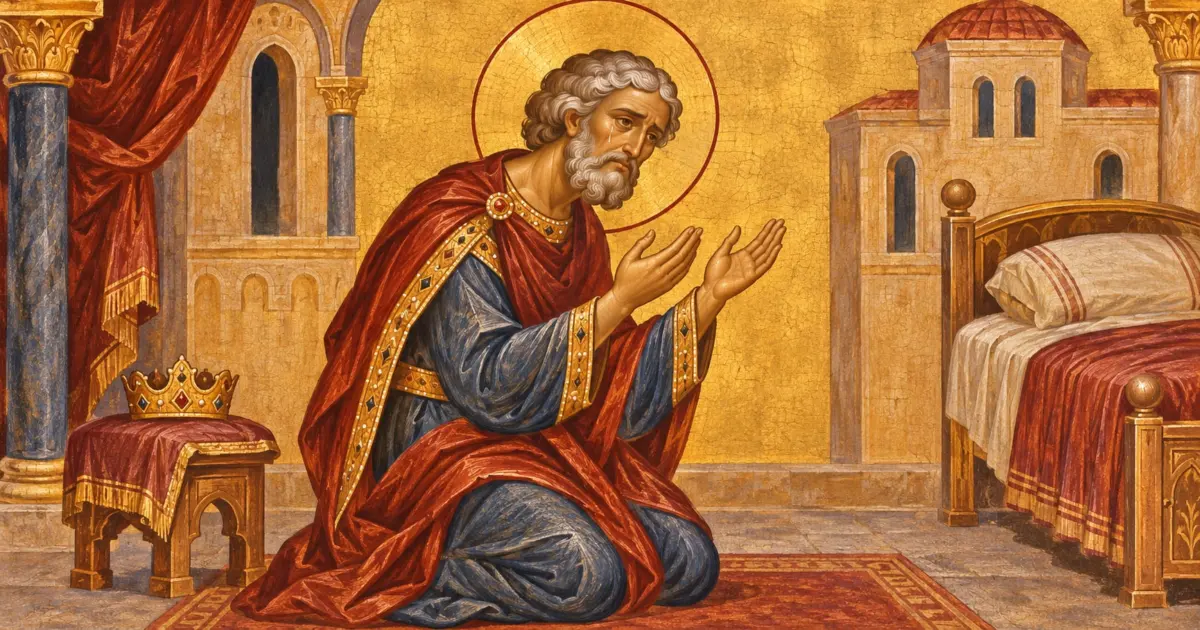
Psalm 6 is the prayer of a man who has come to know his sin and asks God to heal him. He does not ask to escape all correction, but to be corrected gently, as by a father and by a physician. He weeps at night upon his bed, and at the end he feels that God has heard his weeping. The Holy Fathers saw in this psalm one of the purest examples of repentance in Scripture.
The text of the psalm
We give the psalm in the translation of Sir Lancelot Brenton (1844), made from the Septuagint, the Greek Old Testament from which the Holy Fathers interpreted the psalms. The verses are numbered as in the Orthodox Psalter, where the title counts as the first verse.
- For the end, a Psalm of David among the Hymns for the eighth.
- O Lord, rebuke me not in thy wrath, neither chasten me in thine anger.
- Pity me, O Lord; for I am weak: heal me, O Lord; for my bones are vexed.
- My soul also is grievously vexed: but thou, O Lord, how long?
- Return, O Lord, deliver my soul: save me for thy mercy's sake.
- For in death no man remembers thee: and who will give thee thanks in Hades?
- I am wearied with my groaning; I shall wash my bed every night; I shall water my couch with my tears.
- Mine eye is troubled because of my wrath; I am worn out because of all my enemies.
- Depart from me, all ye that work iniquity; for the Lord has heard the voice of my weeping.
- The Lord has hearkened to my petition; the Lord has accepted my prayer.
- Let all mine enemies be put to shame and sore troubled: let them be turned back and grievously put to shame speedily.
Psalm 6 in the services of the Church
Psalm 6 closes the second stasis of the first kathisma, after Psalms 4 and 5. A kathisma is one of the twenty sections into which the Psalter is divided for reading in church, and each kathisma has three stases.
The Church also reads it at Great Compline. Compline is the service after supper, the last prayer of the day. Great Compline is served above all on the weekdays of Great Lent and begins with six psalms: Psalms 4, 6, 12, 24, 30 and 90. Psalm 6 is the second of them. In the evening, after Psalm 4 has urged a man to search his heart upon his bed, Psalm 6 puts into his mouth the weeping for sins, upon the same bed.
The same opening words, “O Lord, rebuke me not in thy wrath, neither chasten me in thine anger”, also begin Psalm 37, one of the six psalms with which Matins begins in its usual order.
“For the eighth”
Brenton's “for the eighth” renders the Greek “concerning the eighth”. The Fathers interpreted this word spiritually as a foretelling of the eighth day, of the Resurrection and of the age to come. Blessed Theodoret of Cyrus explains the title thus. The present life turns in weeks of seven days: it begins from the first day, ends on the seventh, and returns again to the first. Therefore Scripture calls “the eighth day” the state to come, the age that comes after the reckoning of weeks and has no end. Theodoret shows that the psalm received this title because it mentions death and judgement: “For in death no man remembers thee: and who will give thee thanks in Hades?”
The commentary handed down under the name of Saint Athanasius the Great says that “the eighth” means nothing other than the day of the Resurrection of Christ. On that day we shall receive the fruits of our labours, and our enemies will turn back in shame and confusion. It also shows that David sang this psalm after he had spent a long time in the repentance he offered for his sin.
Euthymios Zigabenos, the Byzantine monk who gathered into his commentary on the Psalter the words of the Fathers before him, adds that David does not offer the psalm for himself alone, but also in the name of all of us, to God, who will judge the world in the eighth age. The commentary of Euthymios was printed with the notes of Saint Nicodemus the Hagiorite, in an edition that appeared after the saint's death. In one of the notes Saint Nicodemus brings the word of Saint Gregory of Nyssa about the eighth day. It comes after earthly time is ended and is followed by no other day, for it remains in the endless age. Night no longer interrupts it, for another Sun gives it light, He who shines the true light. Those who share in His light He makes other suns as well, for then the righteous shall shine as the sun. Saint Nicodemus adds that Saints Athanasius, Cyril, Basil and Gregory also called the eighth day the Lord's day after the Resurrection and the age to come. The title of the psalm urges us not to look to the present age, which is counted in sevens, but to the eighth, the one that is to come.
So we understand why a psalm of repentance bears this title. The one who weeps now for his sins looks to the last day and hastens to be healed while he still has time.
“Rebuke me not in thy wrath”
The Greek verb that Brenton renders “chasten” means to correct, to train by punishment.
Saint John Chrysostom begins his homily on this psalm with an explanation. When you hear of the wrath and anger of God, do not imagine in Him any human passion. Such words belong to His condescension, that is, to the way in which God comes down to the measure of our understanding. When we speak with people of another nation, we use their language. When we speak with a child, we speak as he does, and even if we were a thousand times wise, we come down to his littleness. Sometimes we even make signs of anger, to correct the infant. So too God does not fit His word to His own dignity, but to the profit of those who listen.
Saint John brings here the example of physicians. They cut and cauterize not in anger, but in order to heal the sick. They are not angry with those who suffer, but have pity on them, freeing them from their diseases. So, says Saint John, “rebuke me not in thy wrath” means: do not demand justice for my sins, nor vengeance for my wrongdoings.
Blessed Theodoret says that David does not pray not to be rebuked, but not to be rebuked in wrath. He does not ask not to be punished, but not to suffer punishment in anger. Theodoret puts these words into his mouth: punish me as a father, not as a judge; as a physician, not as a torturer. Do not measure the punishment by the sin, but mingle justice with love for mankind.
Euthymios Zigabenos raises a question here. Scripture says: “Blessed is the man whom the Lord has reproved” (Job 5:17). Why then does David flee from rebuke? Euthymios answers with Saint Basil the Great: the prophet does not flee rebuke and punishment in general, but rebuke in wrath. He fears lest, being unable to bear such punishment, he should fall into despair. He asks to be corrected with measure and gentleness, so as to escape the torments of the judgement to come.
Saint Nicodemus brings in his notes also a profound word of Saint Gregory of Nyssa. David looks to the fearful torments and prays not to be exposed then, at the judgement, by that wrath. Therefore he chooses to uncover his sin himself now, through confession. He punishes himself through repentance and brings his hidden sin to light, so that the wrath at the end may not bring it to light.
“Pity me, O Lord; for I am weak”
Saint John Chrysostom says that we all need this prayer, even if we had thousands of good deeds and had reached the summit of righteousness. The prophet says in another psalm that no one living shall be justified before God (Psalm 142:2), and the Apostle Paul says that he knows nothing against himself, yet is not thereby justified (1 Corinthians 4:4).
We all need mercy, says Saint John, but not all of us are worthy of it. Mercy seeks the one who does something in order to receive mercy. If it came upon all alike, no one would be punished any more. Therefore, when we sin, let us ask ourselves whether we repent, whether we are becoming better, whether we have departed from sin. For the one who repents to be saved means to be saved by mercy. Repentance does not buy the mercy of God; it is the response of the man who opens himself to its working.
Saint John also shows here why people who commit the same sin do not receive the same punishment. In a sin not only the deed is weighed, but also the will with which it was done, the circumstance, the cause and what followed it: whether the man persisted in the sin or repented. Eve and Adam both ate from the tree, but they did not receive the same punishment. David killed and committed adultery, and yet he received forgiveness. He was counted worthy of salvation through tears and groaning, as he says in this very psalm: “I shall wash my bed every night.”
What does “I am weak” mean? Blessed Theodoret says that such a cry befits those who have sinned, for weakness goes before sin. If the mind within us does not grow weak, the passions do not rise up against us. As long as the charioteer is healthy and holds the horses with skill, they cannot run wild. The commentary of Saint Athanasius says the same: no soul falls into sin before it has lost its strength.
Saint John Chrysostom adds another meaning. The weakness here is also the frailty that comes from trials. Affliction borne with thanksgiving becomes a ground for great mercy and makes God merciful and compassionate.
“Heal me, O Lord”
“Heal me, O Lord; for my bones are vexed.” Saint John Chrysostom observes that David did not say “forgive my sins” or “pardon them”, but “heal me”. He asks God to close his wounds. By the bones, says Saint John, he means the whole strength of man, and by the vexation he means the wound.
Saint John gives here an example taken from the art of physicians. When someone is ill, there are present the physician, his art, the patient, the disease and the power of the remedies. If the will of the patient is united with the will of the physician, with his art and his remedies, the patient overcomes the disease. If he fights together with the disease against the physician, he gives himself up to death. With earthly physicians it happens that the disease remains, even when the patient wishes to be healed, because human art sometimes fails. With God it is not so. If you stand with the Physician, the wound always receives healing, for here the divine power is at work, which overcomes nature, diseases and all wickedness. Therefore the prophet draws near to God as to a physician and says with groaning: “Heal me, O Lord.”
Blessed Theodoret says that “bones” here names the thoughts. The bones are drier by nature and carry the body. So too the thoughts direct and carry the life of man. Their vexation, says Theodoret, shook David and made him unsteady. Therefore he prays to obtain the love of God for mankind, so as to receive healing.
“My soul also is grievously vexed.” Saint John Chrysostom shows how a man is troubled by the passions. When the winds rage over the sea, they stir it to the depths, bring the sand to the surface and endanger the sailors. In the same way, when our soul is troubled by lust, by anger or by afflictions, the body too is shaken, everything in us becomes a prey to the storm, and the eyes no longer see in order.
Saint John says, however, that this vexation does not come out of nowhere, like the wind on the sea, but from our own sloth and negligence. The furnace of lust is not kindled unless you light the flame and feed it: unless you let your gaze run after strange beauties, unless you feed your body with luxuries and drown your mind in wine. Nor is this enough. There must be added unceasing prayers, the company of the saints and of virtuous people, measured fasting, simple food, occupation with necessary things and, above all, the fear of God, the thought of the judgement to come and of the good things promised. Through these, says Saint John, you can bridle unbridled lust and calm the raging sea.
“But thou, O Lord, how long?”
Saint John Chrysostom says that this “how long?” is not the voice of impatience or discouragement. It is the voice of the pain of a man who can no longer bear the weight of trials. Blessed Theodoret says the same: David does not murmur, but, as one in torment, prays that God may hasten His help. The commentary of Saint Athanasius sees in these words also how long the repentance of David was.
Saint John also observes how often the prophet repeats the word “Lord”. He utters it as a ground of forgiveness and grace. This is our greatest hope, he says: the ineffable love of God for mankind, who is ever ready to forgive.
“Return, O Lord, deliver my soul.” Blessed Theodoret says that this “return” is taken from the custom of angry people, who turn away their face and will no longer look at those who have wronged them. David prays: attend to me and do not turn Thy face from me. Saint John Chrysostom shows that David asks here for two things: that God may turn towards him and deliver his soul. This is the care of the righteous: to be reconciled with God. Most people ask for one thing only, to enjoy the prosperity of the present. For the righteous nothing is more precious than the salvation of the soul.
“Save me for thy mercy's sake.” Blessed Theodoret puts these words into the mouth of David: I do not rely on myself, nor do I set my righteousness before Thee, but I pray to obtain salvation for Thy mercy's sake. The commentary of Saint Athanasius says that we ought to ascribe our salvation to the mercy of God.
“For in death no man remembers thee”
“For in death no man remembers thee: and who will give thee thanks in Hades?” The Greek word that Brenton renders “give thee thanks” means to praise God, to thank Him. The same word also means “to confess”, and the Fathers read in these words also the call to confess our sins and to repent while we are alive.
Saint John Chrysostom shows that David does not limit the life of man to the present one, for he knew the teaching about the resurrection. He knew, however, that after departing from here there is no longer a time for repentance. The rich man in the Gospel confessed his fault and repented in Hades, but it profited him nothing, because the fitting time was past. The foolish virgins wished to buy oil, but no one would give it to them any more. Therefore the prophet prays to be cleansed of his sins here, so as to have boldness at the fearful judgement.
Blessed Theodoret says that God has appointed life and labour here, and there the examination and the reckoning of what has been done. It is a property of the eighth age that it no longer gives people time for good or evil deeds. Each one will reap there the fruits of the seed he has sown in himself here. Theodoret puts these words into the mouth of David: since the time of my repentance has become long, I fear lest death, in which there is no confession, should overtake me before Thy mercy. Therefore I ask that Thy mercy may hasten.
Theodoret and Saint John Chrysostom add here the same teaching. It profits us nothing to set before God only our weakness, our vexation or His goodness, unless we also set before Him our own labours. To the love of God for mankind we must add our own deeds. Therefore David at once tells what he himself does.
“I shall wash my bed every night”
“I am wearied with my groaning; I shall wash my bed every night; I shall water my couch with my tears.” Saint John Chrysostom gives this verse one of his most beautiful interpretations. Let those who live a modest life hear, he says, how the king clothed in purple repented. He did not only weep, but laboured in groaning. He did not only shed tears, but washed his bed as well. And not one day, or two or three, but every night. He speaks not only of the past, but of the future too, for from his fall onwards he did this all his life. These tears came after the sin with the wife of Uriah, after the prophet Nathan had rebuked him and David at once confessed his sin (2 Kingdoms 12:13).
We do otherwise, says Saint John. We weep for a day, often not even for a whole day, and then we give ourselves again to laughter and pleasure. If we do not wish to weep here, we shall have to weep there, there without any profit, here with much gain. Christ said of those over there that there shall be weeping and gnashing of teeth. Of those who weep here He said: “Blessed are they that mourn: for they shall be comforted” (Matthew 5:4).
Saint John then turns those who have beds of silver towards the bed of David. The king's bed was not studded with precious stones, nor gilded, but washed with tears. His nights were not nights of rest, but nights of weeping. By day many cares drew him away, and the time that all give to rest he made a time of confession. It is good to weep at any time, says Saint John, but especially at night, when no one can rob you of this wonderful and holy delight. Those who have tasted it know how much joy the springs of tears bring. These tears can quench the unquenchable fire.
Saint John also shows their fruits. Those who keep vigil in this way till the field of the soul and, using tears as rain, make the seeds of virtue grow. A bed watered with tears is a stranger to all wickedness. The one who sheds such tears counts the things of earth as nothing and makes his mind brighter than the sun. He enters the house of God with great boldness, speaks gently to his neighbour, and anger, lust, the love of money and envy no longer master him. The groans and tears of the night sink these passions like wild beasts hidden in their lair.
Saint John adds a word that concerns us all: do not think that I say these things only for monks. The exhortation is for those in the world, and more for them than for monks, because they have greater need of the remedies of repentance.
Blessed Theodoret puts these words into the mouth of David: I know how great and grievous are the things in which I have sinned, and therefore I weep always. The bed defiled by that iniquity I will wash always with tears, trying to cleanse it through them. Even if I obtain forgiveness, I will not cease to do this.
The commentary of Saint Athanasius says just as piercingly: for a single night in which I sinned, I have spent many nights watering my bed with tears. Saint Nicodemus brings in his notes, from the collection of commentaries of Niketas, bishop of Heraclea, the word of another interpreter: for a few drops of sweetness, David shed bitter tears every day like a river.
“Mine eye is troubled because of my wrath”
“Mine eye is troubled because of my wrath.” Saint John Chrysostom says that David here calls the eye of the soul an eye, the power that judges and reasons. The awareness of his own sins troubled him, because he always had his faults before his eyes and remembered the wrath of God. Blessed Theodoret and the commentary of Saint Athanasius say the same: the eye here is the mind, the eye of the soul. That is why David mentioned a single eye.
Saint John shows that this vexation is blessed. Such vexation is the mother of calm, and such fear is the ground of fearlessness. Whoever is troubled in this way overcomes every storm. The soul that lives without compunction of heart is like a ship without ballast, left to the mercy of the winds: it sinks easily. Saint John also gives the example of the helmsman. As long as he is anxious for the passengers, all are at peace. If he lies down and sleeps without care, he brings great trouble upon all. So the man who struggles and trembles with fear settles his mind in peace, while the one who gives himself to the sleep of negligence prepares his own shipwreck.
“I am worn out because of all my enemies.” The Greek says literally “I have grown old”. Saint John Chrysostom says that this means “I have grown weak because of my enemies”. Our life is a struggle with a thousand enemies, and they grow stronger when we fall into sins. The Apostle Paul says that we wrestle not against flesh and blood, but against the spirits of wickedness (Ephesians 6:12). Nothing makes the powers of the soul grow old like sin. Therefore, says Saint John, when you have grown old through sin, renew yourself through repentance.
Blessed Theodoret puts these words into the mouth of David: heavier than all to me are the insults of my enemies. They consume me and waste me away and bring old age upon me before its time. The commentary of Saint Athanasius says that David speaks here of the time of his suffering, which was reckoned to him for reward, because it was long.
“Depart from me, all ye that work iniquity”
“Depart from me, all ye that work iniquity; for the Lord has heard the voice of my weeping.” Saint John Chrysostom says that this is no small road leading to virtue: flight from the wicked. Christ commanded us to cut off even the eye or the hand that causes us to stumble (Matthew 5:29–30). Saint John understands here our closest friends, whom we count as necessary as our own members, but whose company brings us no profit, only harm. Even if someone wore a crown, he says, if he harms us, let us not value his friendship.
Saint John adds that this is the fruit of repentance and the gain of tears. The contrite heart is no longer mastered by any passion. The one who repents and is heard by God can easily do good and put away from himself the company of the wicked.
Euthymios Zigabenos shows that, after he had felt the help of God, David took courage and commands his enemies to flee from him, both the visible ones and the invisible ones, that is, the demons.
“For the Lord has heard the voice of my weeping.” Saint John observes that David did not say simply “has heard my voice”, but “the voice of my weeping”. The voice does not mean here the loudness of the cry, but the disposition of the mind, and the weeping is not only of the eyes, but also of the soul.
“The Lord has hearkened to my petition; the Lord has accepted my prayer.” Blessed Theodoret puts these words into the mouth of David: let those no longer mock me who do not see their own iniquities and rejoice in my falls, for I have obtained divine mercy. The commentary of Saint Athanasius understands these words as the joy of the man who had been rejected for his sin and has now been heard and accepted.
“Let all mine enemies be put to shame and sore troubled”
“Let all mine enemies be put to shame and sore troubled: let them be turned back and grievously put to shame speedily.” Saint John Chrysostom says that this prayer brings great profit to the enemies themselves. If those who run on the road of wickedness are put to shame and turn back, it means that they stop in their wickedness. When we see a man heading towards a precipice, we hasten to stop him and cry out to him: “Stop, man, where are you going? A precipice awaits you!” In the same way David prays that the wicked may turn back from the road of wickedness. Euthymios Zigabenos shows that other interpreters too understood these words as a prayer for the good of the enemies, that they might repent and be corrected.
Blessed Theodoret puts these words into the mouth of David: cease reviling me and, since you pay no heed to your own iniquities, be filled with shame and confusion, for the judgement of God is just and full of fear.
Saint John Chrysostom ends his homily by turning to each one of us. Let us hasten to put away the wickedness within us, so that the disease may not grow. The wounds of sins, if they are neglected, become greater and can bring death, and even eternal death. If we pluck out the small ones from the beginning, the great ones no longer grow. Had Judas condemned his love of money from the beginning, he would not have come to the betrayal. When we see a small flame kindling in a house, we are alarmed and run to put it out. Wickedness, says Saint John, takes hold of the soul faster than this fire. Therefore let us not be careless with small sins, but stop them with resolve, so that we may be freed from the great ones and obtain the good things to come.
How we pray with Psalm 6
Psalm 6 is the prayer of repentance. Whoever has fallen and feels the weight of sin can say with David: “O Lord, rebuke me not in thy wrath.” He does not ask not to be corrected, but to be corrected as by a father and healed as by a physician. Saint John Chrysostom assures him that, if he stands with the Physician, his wound always receives healing.
The psalm is also an evening prayer. Whoever reads it before sleep can make of his bed, like David, a place of confession and of tears. Saint John says that this exhortation is above all for those who live in the world.
The psalm reminds us that this life is the time of repentance and of amendment through deeds, and therefore we must not put off our return to God. This teaching does not set aside the prayer of the Church for the forgiveness and repose of the departed. Looking towards the eighth day, the one who prays with this psalm hastens to be healed while he still has time.
Whoever reads this psalm with faith can make it his own prayer: that God may have mercy on him in his weakness, heal his bones and his troubled soul, turn His face towards him, receive his tears and let him hear, at the end, that the Lord has heard the voice of his weeping.
Sources
- The Septuagint Version of the Old Testament, translated by Sir Lancelot Charles Lee Brenton, London, 1844. New Testament quotations from the King James Version.
- Saint John Chrysostom, Homilies on the Psalms, Romanian translation by Laura Enache, Iași, Doxologia, 2011, Homily on Psalm 6, pp. 76–90.
- Saint Athanasius the Great, Commentary on the Psalms (Russian: Толкование на псалмы), Moscow, Blagovest, 2011 (from Works in Four Volumes, vol. 4, Sergiev Posad, 1902–1903), Psalm 6, pp. 23–24.
- Blessed Theodoret of Cyrus, Commentary on the Psalms; Romanian edition by Florin Stuparu, Bucharest, Sophia, 2018 (from the translation printed at Buzău in 1840), Psalm 6, pp. 25–27.
- Euthymios Zigabenos, Commentary on the Psalter, vol. I (Psalms 1–69), Romanian translation by Metropolitan Veniamin Costachi, Iași, 1850, from the edition prepared by Saint Nicodemus the Hagiorite and published after his death, Constantinople, 1819–1821, with the notes of Saint Nicodemus; reissued as Psaltirea în tâlcuirile Sfinților Părinți, vol. 1, Egumenița.
