
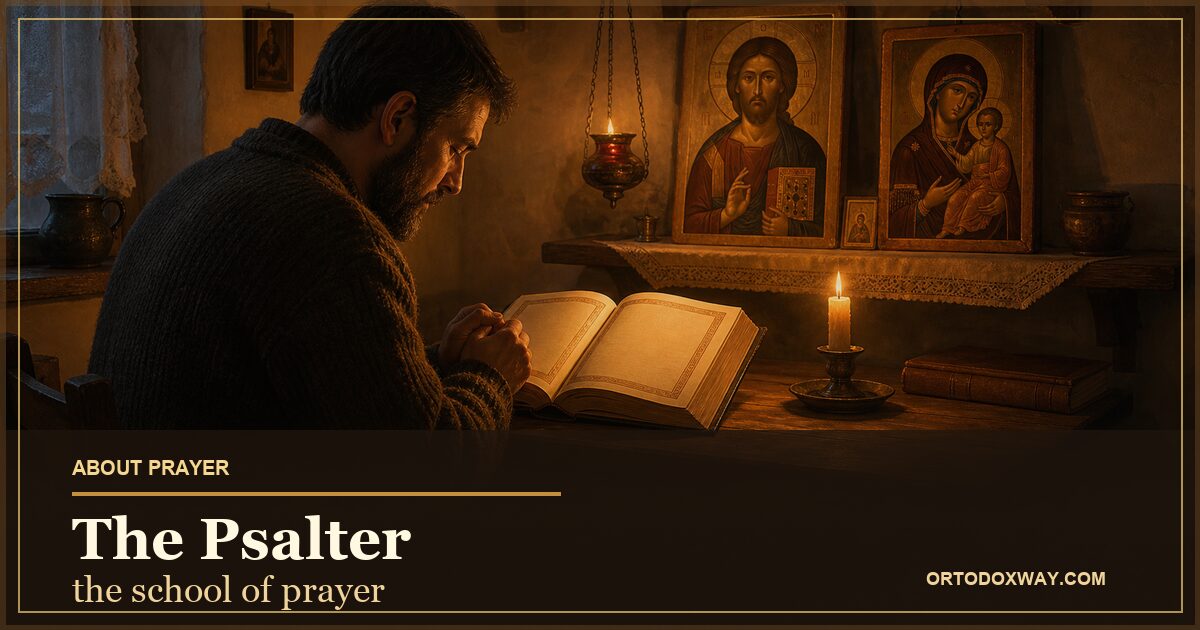
There is no book the Church recites more often than the Psalter. It is heard at every service, from Vespers to Matins, in the Hours, in the all-night vigil and in the cell; the liturgical day opens with psalms and closes with psalms. No other text has entered so deeply into the prayer of the Christian that it can no longer be parted from it. And the reason is not a matter of chance: the Psalter is, in a manner all its own among the books of Scripture, at once the word of God to man and the word of man to God. The other books speak to us; the psalms give us words to speak. To speak of the Psalter and of its reading, therefore, is not to speak of a mere pious reading, but of the very learning of prayer — of the school in which the Church raises her children to pray.
The question before us, then, is not only what the Psalter is, but how it is read as prayer, and why it has remained, for all the Fathers, the chief book of the inner life.
The Book the Church Never Ceases to Recite
The Psalter contains the hundred and fifty psalms appointed by the Holy Spirit through the voice of the prophets, and above all of the holy Prophet David. In the order of the Church they are divided into kathismata, to be passed through with attention in the course of the week and of the Fast. But the place of the Psalter is not confined to its reading on its own: it is the very fabric of which nearly the whole service of the Church is woven. With psalms the faithful enter the church, with psalms the heart is prepared before the Mystery, with psalms the departed are accompanied; and the hymnography itself — the stichera, the troparia, the canons — grows, as from a root, out of the words of the psalms.
More than this: the psalms are the prayer the Lord Himself prayed. From the Cross, the Saviour spoke with the words of the psalmist. The one who opens the Psalter does not, therefore, enter some general book of religious reflections, but the prayer of the Church from the beginning — the voice with which the patriarchs prayed, and the prophets, the apostles, the martyrs, and all the company of the venerable from the desert until today. To pray with the psalms is to join one’s own voice to this unbroken voice.
All of Scripture Gathered into a Single Book
The first thing the Fathers say of the Psalter is its all-embracing character. What is scattered through the other books of Scripture — prophecy, history, law, exhortation — is gathered together in the psalms and turned into song. St. Basil the Great, in the discourse he set before his commentary on the psalms, says it plainly:
“The prophets,” says St. Basil, “the historians, the law, give each a special kind of teaching, and the exhortation of the proverbs furnishes yet another. But the use and profit of all are included in the book of Psalms. There is prediction of things to come; there our memories are reminded of the past; there laws are laid down for the guidance of life; there are directions as to conduct. The book, in a word, is a treasury of sound teaching, and provides for every individual need.”
— St. Basil the Great, Homily on Psalm 1
And for this reason the Psalter opens with the call to unceasing meditation upon the law of God, which is the very foundation of a life of prayer:
“Blessed is the man that walketh not in the counsel of the ungodly, nor standeth in the way of sinners, nor sitteth in the seat of the scornful. But his delight is in the law of the LORD; and in his law doth he meditate day and night.” (Psalm 1:1-2)
Whoever attends to this beginning understands that the Psalter is not a book to be read once, but one to be meditated upon “day and night” — a daily food, not a passing reading.
Why We Read It: The Mirror in Which the Soul Sees Itself
Here the Fathers touch the deepest mystery of the Psalter. The words of the other books of Scripture we utter as the words of others — of the prophets, of the saints, of the Lord. But the psalms, when we say them, become our own words. Whatever the movement of the soul — repentance, grief, fear, hope, thanksgiving, joy — finds in the Psalter its fitting word, as though it had been written for the very moment we are living. Herein lies its power to teach us prayer: it gives us speech precisely when, of ourselves, we would not know what to say.
St. Athanasius the Great, in his Letter to Marcellinus on the Interpretation of the Psalms, explains this property through the image of a mirror. He writes that the psalms serve the one who sings them as “a mirror, wherein he sees himself and his own soul.” He even shows which psalm answers to which condition of the soul, naming for Marcellinus a particular psalm for each need.
This, at its heart, is the work of the Psalter as a school of prayer: it does not leave us alone before our own inability to pray, but sets upon our lips the word inspired by the Spirit, which, in the saying of it, we make the word of our own heart.
How the Fathers Used It: Psalmody, the Root of Unceasing Prayer
Nowhere is it clearer what it means to read the Psalter as prayer than in the life of the desert. In the communities and the cells of the wilderness, psalmody was the labour of every hour: the psalms were said during work, were woven together with prostrations, and filled the night of vigil. From this ceaseless reciting of the psalms grew the order of the common services, with their appointed number of psalms, and the custom of passing through the Psalter by kathismata.
But the deepest significance of psalmody lies in its having been the root from which the short and unceasing prayer of the heart drew its life. The Fathers saw that, out of the multitude of the psalms, the soul is borne naturally toward a single short word, which it can hold unceasingly in the mind. St. John Cassian, who set down in writing the teaching of the fathers of Egypt, shows in his Tenth Conference how such a verse of the Psalter can become the foundation of prayer at all times — the verse:
“O God, make speed to save me: O Lord, make haste to help me.” (Psalm 69:1)
And the reason this very word was chosen he himself makes clear:
“…this verse has not unreasonably been picked out from the whole of Scripture… it contains an invocation of God against every danger, it contains humble and pious confession, it contains the watchfulness of anxiety and continual fear, it contains the thought of one’s own weakness, confidence in the answer, and the assurance of a present and ever ready help.”
— St. John Cassian, Conferences, X
Here is the bond the hesychast tradition has never lost: psalmody feeds the mind and gathers it, and from this labour there can be born, by grace and by attentiveness, the short word of unceasing prayer. The two are neither parted nor do they replace one another. The Psalter remains the wide frame within which the mind grows accustomed to the speech of prayer; the short prayer is the seed that takes root in the heart. Whoever severs the prayer of the mind from psalmody is in danger of forgetting the very root out of which it grew.
The Psalter as Weapon and Healing
The Fathers knew the psalms not only as song but as a weapon in the unseen warfare. The word inspired by the Spirit has power over the passions and over the unseen enemies, putting them to flight and scattering their devices. The tradition describes the psalm as the calm of the soul and the author of peace, that stills the turmoil and seething of thoughts, a refuge in the fears of the night and a rest from the toils of the day, that puts the demons to flight and summons the angels to our aid. St. Basil the Great, gathering these gifts in his homily, calls the psalm “a city of refuge from the demons.”
Yet a caution is in order, which the same tradition supplies: the very psalm that is a weapon against the demons reconciles those who are at enmity. The Psalter is not a tool by which one might do harm to another, nor a recitation possessing power of its own, apart from repentance and a life according to God. Whoever would use it as an incantation — to harm another, or to gain some worldly advantage by the mere outward counting of psalms — has fallen from its purpose and made of prayer a superstition. The weapon of the psalms is turned against the passions within us and against the evil one, not against our neighbour.
How the Psalter Is Read: Order and Attentiveness
From all that has been said there follows, of itself, the manner in which the Psalter ought to be read.
With attentiveness, not in haste. The profit lies not in the number of psalms brought to an end, but in the mind that attends to the words. The Fathers counsel that the psalms be read with understanding, that the mind may grasp the sense of each one. A psalm said while the thought wanders elsewhere remains upon the lips and does not descend into the heart.
Making the words of the psalm one’s own. This is the very mystery shown above: we do not read about another’s prayer, but pray ourselves through the word of the psalmist. When the psalm speaks of repentance, we repent; when it gives thanks, we give thanks; when it cries out from the depth of affliction, we too cry out.
With a steadfast rule. The Fathers praise measure and constancy more than bursts of fervour without sequel. A psalm, or a kathisma, read each day at an appointed time accustoms the soul to prayer more than much reading done rarely. The word of the psalms, repeated day by day, settles slowly into the depth of the mind, until it comes to rise of itself in the hour of temptation or of affliction.
The goal toward which this practice leads is uttered by the psalmist himself:
“Thy word have I hid in mine heart, that I might not sin against thee.” (Psalm 118:11)
And whoever reads the Psalter with humility does not trust in his own labour, but asks of God the very understanding of the words he says:
“Blessed art thou, O LORD: teach me thy statutes.” (Psalm 118:12)
The Psalter in the Daily Rule and in the Prayer of the Heart
All of this comes to life only when the Psalter finds its place in the rule of every day. The tradition of the Church urges the Christian to a steadfast order of prayer, morning and evening, and the psalms are woven deeply into this order: psalms of repentance, of petition, and of thanksgiving run through the prayer of the Church from end to end. The most natural way to join the Psalter to one’s daily prayer is, therefore, to add to the customary rule a psalm, a stasis, or a kathisma, according to each one’s strength, read with composure. Some, with a blessing and with order, come to pass through the whole Psalter in the course of the week; others keep a smaller, but steadfast, measure.
Here, however, measure is more fitting than fervour: a small and steadfast rule, set according to each one’s strength, profits more than a great one, taken up out of zeal and abandoned after a few days. Better a single psalm read day by day, with attentiveness, than a whole kathisma said once and then let go.
In the ascetic tradition one often meets a simple order, by which psalmody and the short prayer uphold one another: after the opening prayers a psalm, a stasis, or a kathisma is read, and then for a time the prayer “Lord Jesus Christ, Son of God, have mercy on me, a sinner” is said, usually upon the prayer rope. The psalms gather and feed the mind, while the prayer of Jesus rests it in few words. When the mind grows weary in the short prayer, psalmody revives it; and when the psalms have gathered it, it returns more naturally to the calling upon the Name of the Lord. The two are not parted, but uphold one another, like two wings of one and the same prayer.
It must nevertheless be said that what is set in order here is the outward order — the measure, the alternation, the constancy. The simple saying of the prayer of Jesus together with the psalms is open to every Christian and asks no special technique; it is done with humility and with repentance, without seeking feelings or high states, which are not gained by force and ought not to be sought. The Psalter remains, here too, the patient school that prepares the soul: whoever has grown accustomed to pray with the psalms, with attentiveness and with humility, finds in them the good foundation upon which, in its own time, unceasing prayer is laid.
Conclusion: The Person Made into a Psalter
The Psalter is, in a manner all its own among the books of Scripture, the school in which a person learns prayer — not merely to say prayers, but to become himself a person of prayer. Whoever reads it long and with attentiveness comes to bear the word of the psalms in the depth of his heart, so that all the movements of his soul may rise toward God through the voice inspired by the Spirit. The psalm gathers him from his scattering, stills him, raises him from repentance to thanksgiving, and unites him, in song, to the unceasing praise of the angels.
For this reason the Church has not ceased, and will not cease, to recite the Psalter. In it, the word of God becomes the word of man, and man, receiving this word into his heart, becomes a voice of God in the world. The reading of the Psalter is not, therefore, one rule among many, but the very lifelong learning of prayer — the way the Fathers have left worn smooth for us toward Him who “inclineth His ear” to the voice of those who call upon Him.
A living image of how the Psalter can form an entire household appears in the life of Saint Macrina and the family of Saint Basil the Great.