
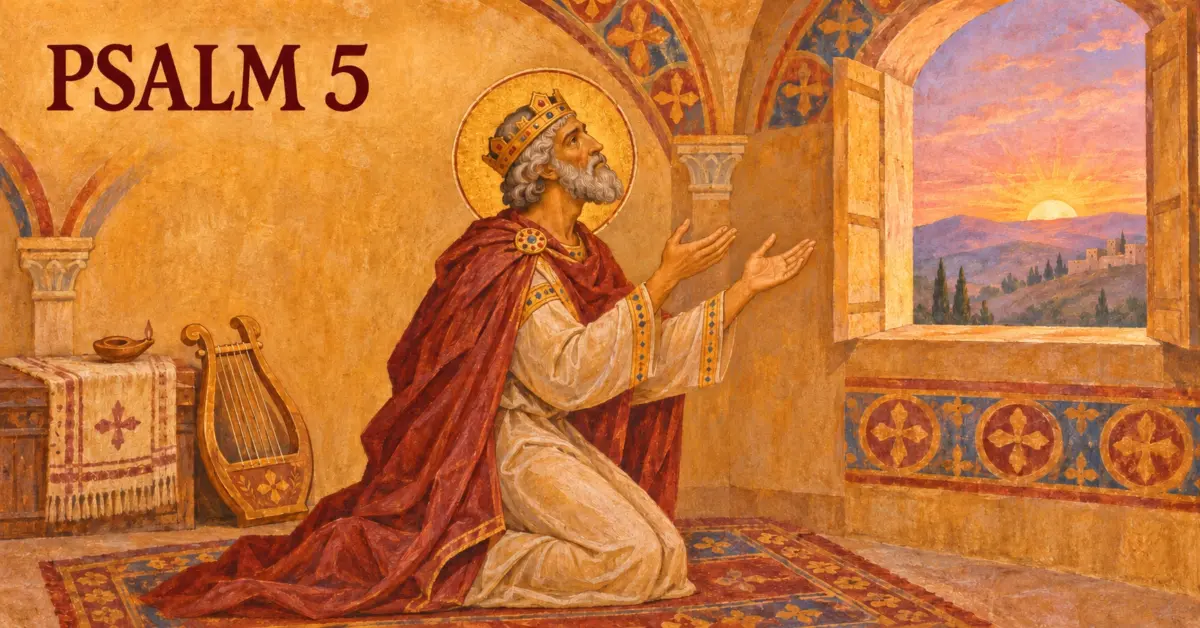
Psalm 5 is a morning prayer. The one who prays it presents himself before God at the beginning of the day, enters His house with fear and asks Him to make his way straight among those who lay snares for him. The Holy Fathers heard in this psalm the voice of the Church, the bride of Christ, praying for the inheritance promised to her. The psalm ends with the gladness of those who hope in God and with the crown He sets upon the head of the righteous.
In this article
The text of the psalm
We give the psalm in the translation of Sir Lancelot Brenton (1844), made from the Septuagint, the Greek Old Testament from which the Holy Fathers interpreted the psalms. The verses are numbered as in the Orthodox Psalter, where the title counts as the first verse.
- For the end, a Psalm of David, concerning her that inherits.
- Hearken to my words, O Lord, attend to my cry.
- Attend to the voice of my supplication, my King, and my God: for to thee, O Lord, will I pray.
- In the morning thou shalt hear my voice: in the morning will I wait upon thee, and will look up.
- For thou art not a God that desires iniquity; neither shall the worker of wickedness dwell with thee.
- Neither shall the transgressors continue in thy sight: thou hatest, O Lord, all them that work iniquity.
- Thou wilt destroy all that speak falsehood: the Lord abhors the bloody and deceitful man.
- But I will enter into thine house in the multitude of thy mercy: I will worship in thy fear toward thy holy temple.
- Lead me, O Lord, in thy righteousness because of mine enemies; make my way plain before thy face.
- For there is no truth in their mouth; their heart is vain; their throat is an open sepulchre; with their tongues they have used deceit.
- Judge them, O God; let them fail of their counsels: cast them out according to the abundance of their ungodliness; for they have provoked thee, O Lord.
- But let all that trust on thee be glad in thee: they shall exult for ever, and thou shalt dwell among them; and all that love thy name shall rejoice in thee.
- For thou, Lord, shalt bless the righteous: thou hast compassed us as with a shield of favour.
Psalm 5 in the services of the Church
Psalm 5 stands in the second stasis of the first kathisma, between Psalms 4 and 6. A kathisma is one of the twenty sections into which the Psalter is divided for reading in church, and each kathisma has three stases.
The Church also gives it a place of its own, at the beginning of the day. The First Hour is the short service of prayer read in the morning, after Matins. It begins with three psalms: Psalms 5, 89 and 100. The first of them is Psalm 5, with the verse “In the morning thou shalt hear my voice”. In the evening the Church prays with Psalm 4 to fall asleep in peace. In the morning she lifts up her voice to God with Psalm 5. At the Royal Hours of Great Friday, the First Hour also begins with this psalm, followed by Psalms 2 and 21.
The words of the psalm are heard also at the beginning of the Divine Liturgy. When the priest and the deacon enter the altar, after the prayers at the entrance of the church, they say the words of this psalm about entering the house of God and being led in the way of His righteousness.
“Concerning her that inherits”
The title of the psalm speaks of “her that inherits”, that is, of the one who receives the inheritance. Blessed Theodoret of Cyrus says that the other translators of Scripture also rendered the title in the same way. She that inherits is in general the Church of God and, in a particular way, every soul that lives in true piety. Theodoret brings here the word of the Lord, who at the Judgement will call the blessed of His Father to inherit the kingdom prepared for them from the foundation of the world (Matthew 25:34). He brings also the word of the Apostle Paul: if we are children, then we are also heirs of God and joint-heirs with Christ (Romans 8:16–17).
Saint John Chrysostom begins his homily on this psalm with a comparison. When someone receives an earthly inheritance by a will, he takes a thousand steps: he examines the deeds, copies the documents, counts the money. When the spiritual testaments, the Holy Scriptures, are opened before us, we remain indifferent, because the inheritance is not material. Let us then open the testament, says Saint John, and see what inheritance has been left to us and on what conditions.
The inheritance, says Saint John, is the things which “eye hath not seen, nor ear heard, neither have entered into the heart of man” (1 Corinthians 2:9). The commentary handed down under the name of Saint Athanasius the Great says the same: the heir is the God-loving soul or the Church, and her inheritance is these good things. They will be given to us fully in the age to come. God acts like earthly lawgivers, who entrust the father's estate only to heirs who have come of age. Until then He has left us the Scriptures, in which He tells us what we must do so as not to lose our inheritance.
The conditions of the testament, says Saint John, are not hard. “All things whatsoever ye would that men should do to you, do ye even so to them” (Matthew 7:12). Do you want to be praised? Praise others too. Do you want to be shown mercy? Show mercy too. Do you want to be loved? Love too. Many young and strong people care for years for sick old men in order to receive from them an uncertain inheritance. Here, says Saint John, it is a matter of heaven and, before heaven, of being pleasing to God.
Saint John shows also who the heiress is: the Church, the bride of Christ. The Apostle Paul says that he espoused the faithful to one husband, to present them as a chaste virgin to Christ (2 Corinthians 11:2). An earthly bridegroom loses the strength of his love after the first days. Our Bridegroom loves us unceasingly, and His longing grows day by day. He did not come to the bride in His glory, lest He frighten her, but clothed in the same garment as she, taking flesh and blood. He did not call her up to Himself, but came down to her Himself. He found her full of defilement, cleansed her, anointed her, clothed her and raised her to heaven. For her the inheritance is prepared. Therefore, says Saint John, the prophet speaks in this psalm in her name, like an advocate who says from the start on whose behalf he pleads.
Euthymios Zigabenos is the Byzantine monk who gathered into his commentary on the Psalter the words of the Fathers before him. He shows that “for the end” may refer to the last days, in which the Lord became man and the shadow of the Law came to an end. The Church is called the heiress, says Euthymios, because she is ever inheriting and never ceases to inherit.
“Hearken to my words, O Lord”
“Hearken to my words, O Lord, attend to my cry.” Saint John Chrysostom says that the bride calls the Bridegroom “Lord”. She calls Him so as her Bridegroom and as the Master of all. She asks for help to keep the commandments and not to lose her inheritance, and she asks with boldness, because she asks for things that He too wishes to give her.
Here too Saint John says what words it is not fitting to bring into prayer. Whoever prays against his enemies or against those who have grieved him does not speak the words of man, but of the devil. When you say “Hearken to my words, O Lord”, speak the words of a meek man who loves mankind.
Blessed Theodoret says that the Church of God and every soul that lives in true piety are beaten by many waves on every side. Yet they overcome them and swim above the storm, because they call upon divine help. The prophet teaches us here how it is fitting to pray. Theodoret also explains the words “hearken” and “ears”. Scripture is accustomed to name the works of God by human members: the power that sees it calls “eyes”, and the power that hears it calls “ears”.
The “cry” does not mean here a loud voice. Saint John Chrysostom says that it names the disposition of the mind, just as God asked Moses, who was silent, why he cried to Him (Exodus 14:15). Where Brenton has “attend to my cry”, the Greek says “understand my cry”: David did not say “hear my cry”, but “understand” it. Blessed Theodoret says the same: “cry” names the diligence of those who pray and prayer made with fervour.
“Attend to the voice of my supplication.” Saint John observes that the one who prays must stand before God as a man who implores, not as an accuser. Whoever prays against his enemy is more like an accuser than one who prays. The prophet does not bring his prayer until he has made it worthy of being heard. So let us too, says Saint John, prepare our prayer so that it may be a prayer and not an accusation.
“My King, and my God”
Saint John Chrysostom says that the Church did not call Him simply “the King”, but “my King and my God”, and by this she showed her love. The Apostle Paul says of the righteous of the Old Testament that God is not ashamed to be called their God (Hebrews 11:16).
“For to thee, O Lord, will I pray.” Who does not pray to God? asks Saint John. Many seem to pray, but they do it to be seen by men. The Church prays to God alone and leaves aside all human things. Euthymios Zigabenos puts these words into the mouth of the Church gathered from the nations. She had once prayed to many false gods, and now she prays only to the true God.
“In the morning thou shalt hear my voice”
“In the morning thou shalt hear my voice: in the morning will I wait upon thee.” The Greek verb that Brenton renders “wait upon” means literally “I will stand before thee”. Saint John Chrysostom sees here the diligence of a soul pierced with love. From the beginning of the day I will do this work, says the prophet. Let those hear this, says Saint John, who begin their prayer only after a thousand other affairs. The Church hallows the day to God from its very beginning.
Saint John gives here an example from everyday life. You would not bear that one lower than you should bow before the emperor before you. Yet the sun already bows before God, and you are still asleep and yield the first place to a creature made for your sake. You rise, you wash your hands and your face, and you overlook your unclean soul. As the body is cleansed with water, says Saint John, so the soul is cleansed by prayer. Wash then the soul before the body.
“I will stand before thee” does not concern place, says Saint John, but deeds. God is everywhere, but near Him stands only the one whose deeds are worthy of Him.
Blessed Theodoret puts these words into the mouth of the one who prays: trusting that Thou receivest my prayers, I shake the sleep from my eyelids and, as soon as it grows light, I stand before Thee as before the true King and Master. Theodoret adds that not everyone can say to the God of all, “I will stand before thee.” He says it who, like the great Elijah, has boldness because of his holy life. Elijah declared that he stood before the living Lord.
The commentary of Saint Athanasius calls this a great praise of diligence: to present oneself to God straight from one's bed and to offer Him thanksgiving before the sunrise. Whoever does so, it says, will look upon the divine and holy mysteries that God has prepared for those who love Him.
Euthymios Zigabenos shows why we pray especially in the morning. It is fitting to bless the Lord at all times, but in the morning the mind is more gathered and more quiet. Therefore Christians, as soon as they rise from their bed, give glory and thanks to God.
“For thou art not a God that desires iniquity”
“For thou art not a God that desires iniquity; neither shall the worker of wickedness dwell with thee.” Saint John Chrysostom shows that the prophet says these words to teach those who wish to draw near to God to become like Him. Otherwise they cannot stand near Him. If a wicked man cannot stand in the company of a good man, because their lives are so different, still less can the deceitful man be near God.
Saint John brings here the example of Saint John the Baptist. Shut up in prison, without being seen, he troubled Herodias, and after his death the conscience of the tyrant Herod still trembled. Therefore, says Saint John, let none of those who live in virtue think that he suffers something terrible, even if the wicked plot against him. Those who truly suffer evil are those who do it.
“Thou hatest, O Lord, all them that work iniquity.” Whether slave, free or king, says Saint John, God does not reckon His friends by rank, but by virtue. Many think that the hatred of God is a small thing. Saint John says that to be hated by God is heavier than Gehenna. For those who do not feel this, the prophet adds the punishment as well: “Thou wilt destroy all that speak falsehood.”
Saint John explains who they are that speak falsehood. The prophet so names those who live in wickedness and pursue deceitful things: those who live in pleasures, in gluttony and in the love of riches. Euthymios Zigabenos brings here the word of Saint Dorotheos of Gaza, who says that there are three kinds of lying: one who lies in his thought, one who lies in his word, and one who lies with his very life, hiding his sin under the appearance of virtue.
“The Lord abhors the bloody and deceitful man.” The Greek says literally “the man of blood”, that is, the shedder of blood, the murderer. Saint John Chrysostom says that the prophet here so names the one who plots in secret, the hypocrite who says one thing and thinks another and who, under the appearance of a face full of kindness, hides the wickedness of wolves. Against an open enemy you can guard yourself, but the one who hides his wickedness can do many terrible things. Therefore Christ commanded us to beware of those who come to us in sheep's clothing, but inwardly are ravening wolves (Matthew 7:15).
Blessed Theodoret says that the prophet has set down here a true catalogue of wickedness. God not only forbids iniquity, falsehood, deceit and murder, but also hates those who work them and will not attend to repentance. Theodoret sees in them also all those who in various times have risen up against the Church and could not overcome her, according to the word of the Saviour: “the gates of hell shall not prevail against it” (Matthew 16:18).
The commentary of Saint Athanasius observes the difference between the words. “Thou hatest” is said in the past tense in the Greek, “thou hast hated”, while “thou wilt destroy” is in the future. “Thou wilt destroy” shows something heavier than “thou hast hated”.
“But I will enter into thine house in the multitude of thy mercy”
After speaking of those who cannot stand before God, the one who prays speaks of himself. Saint John Chrysostom says that the Church was chosen from the very midst of such men: from worshippers of idols, sorcerers, murderers and liars. She shows that she was not chosen for her righteousness and good works, but only for the love of God for mankind. Therefore she says: “But I will enter into thine house in the multitude of thy mercy.” Saint John adds that grace and mercy, however, save only those who wish to be saved and receive the gift.
Euthymios Zigabenos sees in these words the humility of David as well. After rebuking the sinners, David says of himself that he will enter the house of God not as a man justified by his own deeds, but as one who has received mercy from God.
The commentary of Saint Athanasius understands the house of God as the heavenly Jerusalem, the mother of the firstborn. The holy temple of God is, it says, the holy and virtuous state of the soul. To it come those who can say with boldness, with the Apostle, that we are the house of Christ (Hebrews 3:6). Euthymios Zigabenos brings here the word of the Lord: “If a man love me, he will keep my words: and my Father will love him, and we will come unto him, and make our abode with him” (John 14:23).
“I will worship in thy fear toward thy holy temple.” Saint John Chrysostom says that the prophet does not worship like many of those who pray: bored, yawning, heavy with sleep. He worships with fear and trembling. Whoever prays thus leaves all wickedness, is led by the hand to all virtue and makes God merciful towards him.
Blessed Theodoret puts these words into the mouth of the one who prays: having obtained Thy love for mankind and being guarded by Thy right hand, I offer Thee unceasing worship in the Church dedicated to Thy glory, and I bear Thy fear in me always. Hoping in Thy love for mankind, I will not endure to deny it.
These are the words the priest says when he enters the altar at the beginning of the Divine Liturgy. He enters the house of God in the multitude of His mercy and worships in His fear.
“Lead me, O Lord, in thy righteousness”
“Lead me” means: guide me on the way. Saint John Chrysostom shows the order of prayer in this psalm. The Church first praised God, proclaimed His hatred of those who do evil and His love for mankind, and told how she was saved. Only then does she turn to petition. By this, says Saint John, she teaches us first to offer God praise and thanksgiving for His benefits, then to ask Him for what we desire, and again to give Him thanks. Euthymios Zigabenos shows that Saint Basil the Great also ordains this: prayer ought to begin with the glorifying of God, not with petition.
Saint John also observes what the Church asks for. She asks for nothing earthly, neither wealth, nor glory, nor power, nor the punishment of her enemies. She asks to be guided in the righteousness of God. Righteousness here names the whole of virtue. There is also a righteousness of men, which consists in keeping outward laws and is imperfect. The Church asks for the righteousness of God, which leads to heaven, and for the help she needs to obtain it.
Saint John says that the prophet rightly said “lead me”. The present life is a road that needs guidance from above. When we enter a strange city, we need someone who knows the way. How much more do we need help from above when we travel towards heaven, that the way may be shown to us, our steps strengthened, and we ourselves led by the hand. Many paths turn aside from the way. Therefore, says Saint John, let us hold fast the right hand of God. To show us the way belongs to Him. To be worthy of being held by that hand belongs to our own effort.
“Make my way plain before thy face.” Blessed Theodoret says that some copies of Scripture have “make thy way straight before me”, and both meanings are good: either that our way be made straight before God, so that we may not turn aside, or that the way of God be made straight before us, so that we may run on it with diligence. Theodoret sees here also the humble-mindedness of the Church. She does not ask that her way be made straight because she is righteous, but because of the enemies who make unjust war upon her. Euthymios Zigabenos shows that the enemies are the visible and the invisible ones, who set stumbling blocks and snares in the way of life, so that a man may turn aside to the right or to the left.
“Their throat is an open sepulchre”
“For there is no truth in their mouth; their heart is vain; their throat is an open sepulchre; with their tongues they have used deceit.” The throat is here the mouth, from which the words come forth. The Apostle Paul brings these words in the Epistle to the Romans, when he shows the state of fallen man (Romans 3:13).
Blessed Theodoret says that closed tombs keep their stench hidden, while open ones let out much stench. So too are the words of the wicked, full of ungodliness and stench.
Saint John Chrysostom turns the word towards each of us. Let your mouth not be a tomb, he says, but a treasury. A tomb corrupts what it receives, while a treasury preserves it. Have in your mouth too the treasure of wisdom, which remains for ever. Saint John observes that the prophet did not say simply “sepulchre”, but “open sepulchre”. Dead bodies we hasten to bury. The wicked do the opposite with their deadly words: instead of burying them in the depth of the heart, they utter them in the sight of all and harm many.
“With their tongues they have used deceit.” Saint John shows here another form of wickedness. Some hide their deceit in the soul, but speak sweet words. Others wrap the deceit in their very words and through them weave their plots.
“Judge them, O God”
“Judge them, O God; let them fail of their counsels: cast them out according to the abundance of their ungodliness; for they have provoked thee, O Lord.” Saint John Chrysostom shows the meekness of this prayer. The prophet did not say “punish them”, but “judge them”, that is, make their wickedness cease. “Let them fail of their counsels” means: make their plots vain. By this, says Saint John, the prophet prays even for them, that God may not let them sink deeper into wickedness. Blessed Theodoret says the same: let them be brought under the judgement of God and learn by experience that what they have woven is a spider's web.
The commentary of Saint Athanasius understands even the words “cast them out” as a prayer for their conversion: drive them out of the abundance of their ungodliness, making them pious.
“For they have provoked thee, O Lord.” The Greek word means “they have embittered thee”. Saint John Chrysostom says that the prophet is not grieved for what he himself suffers, but for God. It is the mark of a wise soul not to seek vengeance for itself and to show zeal when God is insulted. Many do the opposite: they overlook what concerns God and punish with severity the insults brought against themselves. The saints are not so. They cannot bear the insults brought against God, and those brought against themselves they overlook. Blessed Theodoret adds that those who rise up against the ones dedicated to God rise up against God Himself.
“Let all that trust on thee be glad in thee”
“But let all that trust on thee be glad in thee.” Saint John Chrysostom sees here the gain of prayer. It makes some better and holds them back from wickedness. The others rejoice seeing their change and become more diligent themselves.
“They shall exult for ever.” Saint John says that all other joys are no more stable than the waters of rivers. Joy in God remains for ever. No event interrupts it, but it becomes even higher through the very obstacles. Therefore the apostles rejoiced when they were beaten, and the Apostle Paul, when he was near death, called the Philippians to rejoice together with him (Philippians 2:17–18). Christ said the same: “your joy no man taketh from you” (John 16:22).
“And thou shalt dwell among them.” God dwells with those who rejoice in this way, says Saint John. The commentary of Saint Athanasius brings here the promise of the Lord that He and the Father will come to the one who loves Him and make their abode with him (John 14:23). Blessed Theodoret puts these words into their mouth: Thou fillest us with gladness, assuring us that Thou wilt dwell in us and walk in us and make us a house dedicated to Thee.
“And all that love thy name shall rejoice in thee.” The Greek word means “shall boast in thee”. Saint John Chrysostom asks: what human thing is worthy of boasting? The strength of the body does not depend on our will and soon withers. So too youth, beauty, wealth and power. To boast in God and in His love is an adornment better than all, a radiance that surpasses a thousand crowns, even if the one who boasts were in chains. This glory fears neither sickness, nor old age, nor the turmoil of the times, nor death itself. Blessed Theodoret brings here the word of the Apostle: “He that glorieth, let him glory in the Lord” (2 Corinthians 10:17).
“As with a shield of favour”
“For thou, Lord, shalt bless the righteous.” Saint John Chrysostom says that those who live in virtue are often mocked and scorned. Therefore the prophet strengthens the simpler man, so that he may not fall from the good way of life. What harm can the contempt of the whole world bring him, when the Master of the angels Himself praises him? And what profit would he have if all men praised him, but God did not bless him? Saint John brings here Job. He sat on the dunghill, his body full of sores, despised by his friends and tempted by his wife, and yet he was happier than all, because God blessed him.
Where Brenton has “thou hast compassed us as with a shield of favour”, the Greek says “thou hast crowned us as with a weapon of good pleasure”, as the Fathers read it. “Good pleasure” is the good will of God. Blessed Theodoret says that Scripture so names the good will of God, and brings the word of another psalm, that the Lord has been well pleased with His land. Thy good will, says Theodoret, and Thy fatherly love have become for us a weapon that brings victory and a crown of victory.
Saint John Chrysostom says that this is the best and most beautiful weapon, the weapon according to the will of God. His good pleasure takes the place of a shield. The crown woven from it, says Saint John, holds within it mercy, righteousness, grace and glory. He brings here the words of Scripture about the crown of mercy, about the crown of righteousness that the Apostle Paul awaited (2 Timothy 4:8), and about the incorruptible crown (1 Corinthians 9:25).
Saint John shows also a difference. Among men, glory and safety are rarely found together. The mighty of the world are renowned, but walk on slippery ground. Obscure men live in quiet, but without glory. With God, glory and safety are united in the highest degree.
The commentary of Saint Athanasius says that at the end God gives us the crown for our labours and fences us about with it as with a weapon. Euthymios Zigabenos sees in the weapon of good pleasure the Cross of the Lord and the economy of the Incarnation, that is, the work by which the Son of God became man for our salvation.
Saint John ends his homily with an exhortation. This war does not end until the soul is separated from the body. Until then we must bear our weapons at home and in assemblies, at table, in sickness and in health. In the time of sickness above all, when pains trouble the soul and the devil urges us to say a bitter word, it is fitting to strengthen ourselves and to give thanks to God unceasingly. So God crowned Job, who in temptation, in sickness and in poverty offered thanksgiving as a spiritual sacrifice: “the Lord gave, the Lord has taken away: as it seemed good to the Lord, so has it come to pass; blessed be the name of the Lord” (Job 1:21).
How we pray with Psalm 5
Psalm 5 is a morning prayer. Whoever reads it at the beginning of the day can do what Saint John Chrysostom exhorts: wash the soul by prayer before washing the face, and hallow the day to God from its beginning, before all other affairs.
The psalm also teaches us how to pray. First we praise God and give Him thanks, then we ask, and again we give thanks. We do not ask for earthly things, but to be guided on His way. We pray as one who implores, not as an accuser, and we do not ask for the punishment of our enemies, but for their conversion.
Whoever enters a church can say with the psalm: “But I will enter into thine house in the multitude of thy mercy.” He does not enter for his own deeds, but for the mercy of God, and he worships with fear, not with boredom.
Whoever reads this psalm with faith can make it his own prayer: that God may hear him in the morning, receive him into His house, guide him among the snares, guard his mouth that it may be a treasury and not a tomb, give him the joy that is not taken away and crown him with His good pleasure.
Sources
- The Septuagint Version of the Old Testament, translated by Sir Lancelot Charles Lee Brenton, London, 1844. New Testament quotations from the King James Version.
- Saint John Chrysostom, Homilies on the Psalms, Romanian translation by Laura Enache, Iași, Doxologia, 2011, Homily on Psalm 5.
- Saint Athanasius the Great, Commentary on the Psalms (Russian: Толкование на псалмы), Moscow, Blagovest, 2011 (from Works in Four Volumes, vol. 4, Sergiev Posad, 1902–1903), Psalm 5, pp. 20–22.
- Blessed Theodoret of Cyrus, Commentary on the Psalms; Romanian edition by Florin Stuparu, Bucharest, Sophia, 2018 (from the translation printed at Buzău in 1840), Psalm 5, pp. 22–25.
- Euthymios Zigabenos, Commentary on the Psalter, vol. I (Psalms 1–69), Romanian translation by Metropolitan Veniamin Costachi, Iași, 1850, from the edition prepared by Saint Nicodemus the Hagiorite and published after his death, Constantinople, 1819–1821, with the notes of Saint Nicodemus; reissued as Psaltirea în tâlcuirile Sfinților Părinți, vol. 1, Egumenița.
