
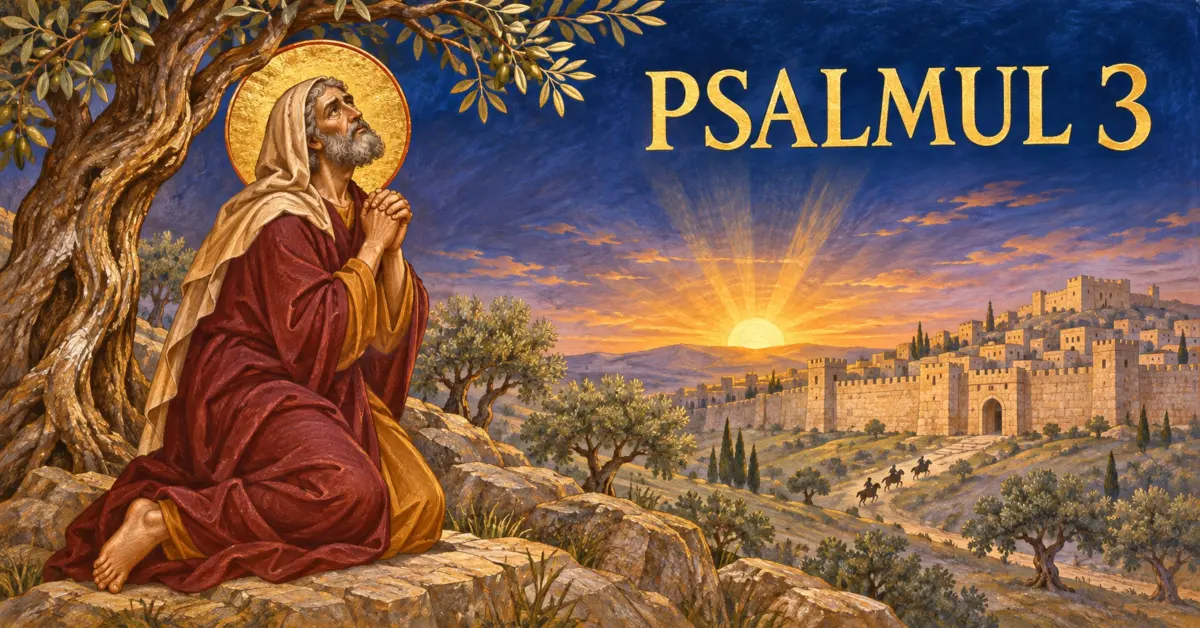
Psalm 3 is the first psalm of the Psalter whose title is tied to an event in the life of David. He spoke it when he was fleeing from Jerusalem before his son Absalom, who had risen up against him to take the kingdom from him. It is the prayer of a man hemmed in on every side, who lies down in the midst of danger and rises up with his hope in God. In the usual order of Matins, Psalm 3 opens the reading of the Six Psalms.
In this article
The text of the psalm
We give the psalm in the translation of Sir Lancelot Brenton (1844), made from the Septuagint, the Greek Old Testament from which the Holy Fathers interpreted the psalms. The verses are numbered as in the Orthodox Psalter, where the title counts as the first verse.
- A Psalm of David, when he fled from the presence of his son Abessalom.
- O Lord, why are they that afflict me multiplied? many rise up against me.
- Many say concerning my soul, There is no deliverance for him in his God. Pause.
- But thou, O Lord, art my helper: my glory, and the one that lifts up my head.
- I cried to the Lord with my voice, and he heard me out of his holy mountain. Pause.
- I lay down and slept; I awaked; for the Lord will help me.
- I will not be afraid of ten thousands of people, who beset me round about.
- Arise, Lord; deliver me, my God: for thou hast smitten all who were without cause mine enemies; thou hast broken the teeth of sinners.
- Deliverance is the Lord’s, and thy blessing is upon thy people.
Psalm 3 in the services of the Church
Psalm 3 follows immediately after the first two psalms and belongs, together with them, to the first stasis of the first kathisma. Yet the Church also gives it a place of its own, in the morning service. Matins is the morning service of the Church. In its opening part the Six Psalms are read, an order of six chosen psalms read in silence, without interruption: Psalms 3, 37, 62, 87, 102 and 142. The first of them is Psalm 3. At its end the verse is repeated: “I lay down and slept; I awaked; for the Lord will help me.” Thus in the morning prayer of the Church the voice is heard of a man who has awakened under the protection of God.
The last verse of the psalm, “Deliverance is the Lord’s, and thy blessing is upon thy people”, is also sung at the vigil, among the chosen verses of “Blessed is the man”.
The flight of David
The history of this flight is written in the Second Book of Kingdoms, called 2 Samuel in the Hebrew numbering. Absalom, the son of David, won the hearts of the people to his side, made himself king in Hebron and marched with an army against Jerusalem. David went out of the city on foot, with his head covered, weeping, going up the Mount of Olives. On the way a man of the house of Saul, Shimei, cursed him and threw stones after him, and David endured it.
Saint John Chrysostom begins his homily on this psalm with a wonder. Emperors raise statues to victorious generals, and cities praise athletes and victors in inscriptions of stone. Yet no one has ever made the image of a fugitive, as David does here, who writes his flight into the very title of the psalm. The names of runaway slaves are made known so that they may be caught, not so that they may be praised. Therefore, says Saint John, we must find the cause of this title, so that the history may become a correction for our own life.
The cause, he says, was the sin of David. David fled from his son because he had departed from purity and from the law of God, which says: “Thou shalt not kill, thou shalt not commit adultery.” He took the wife of Uriah, and Uriah he killed. He brought war into the house of another and stirred up war in his own house. Saint John shows that this is no opinion of his, but the word of God Himself, spoken through the prophet Nathan, who told David that the sword would not depart from his house and that God would raise up evil against him out of his own house (2 Kingdoms 12:10–11). From where the root of the sin came forth, from there came the wound as well. Because he fled from the commandment of God, he became a fugitive.
Blessed Theodoret of Cyrus also ties these afflictions to the twofold transgression of David, adultery and murder. Above all, the divisions within his own house came upon him after the sin, when God allowed the trials from which until then He had guarded him. Yet David was not deprived of divine help. It was then that he wrote this psalm, fleeing from his son, and the Holy Spirit was at work in him in those very days, because of his fervent repentance.
The prophet Nathan had already told David that the Lord had put away his sin (2 Kingdoms 12:13). The afflictions that followed were the consequences of the sin, and David endured them. They did not show that his repentance had been rejected.
Saint John Chrysostom also shows why David fled. He did not flee out of cowardice, but because he feared lest he should kill his son. David spared Absalom as a son, even though those around him did not spare him as a rebel. Saint Gregory of Nyssa learns from this flight that, when we are pursued by evil, even flight from its path can often give us a safe refuge.
The commentary handed down under the name of Saint Athanasius the Great sees in the title a prophetic meaning as well. In this commentary the name David is understood as “the beloved”, and David here stands for the company of the prophets, whom the people of Israel persecuted. As Absalom rose up against his father, so the Jews rose up against the prophets, their fathers. They did not receive the commandments of God, but set themselves against them.
The war within one’s own house
Saint John Chrysostom says that it is more profitable to know the cause of this war than its mere history. Seeing the fall of the righteous man, we are strengthened and guard ourselves against falling. Many even today have such wars in their own house. One is warred against by his wife, another by his son, another by his brother, another by those who serve him. Each one grieves, fights, strikes and is struck, but few consider that, had they not sown sins, thorns and briars would not have grown up in their house.
Saint John speaks here as a spiritual father. God, he says, works like a physician who heals by means of a scalpel. The scalpel does not know what it cuts, but the physician knows the healing that comes through it. In the same way, the one who wounds us does not know the profit that God draws from the trial. His wickedness, however, remains his own sin. Therefore, when those close to us war against us, it is fitting that we first examine ourselves. Christ said to the paralytic He had healed: “Behold, thou art made whole: sin no more, lest a worse thing come unto thee” (John 5:14).
Saint John does not make this a rule without exceptions. Not all men are warred against by those close to them because of their sins. Joseph was persecuted by his brothers without having sinned, and the wife of Job plotted against him, though Job was righteous. This word is not a judgement upon those who are tried, but an exhortation to each of us to seek first his own sin.
Saint John also shows the end of Absalom. He who had exalted himself against his father was left hanging by his hair in the branches of an oak and was pierced in the heart, there where he had devised the murder. Saint Gregory of Nyssa sees a mystery in this event. The hair of Absalom, caught in the tree, stands for the handwriting of sin, which Christ nailed to the wood of the Cross (Colossians 2:14). The three darts point to the Word of God and to the mystery of the Holy Trinity, by which the enemy, the devil, is overcome.
“There is no deliverance for him in his God”
“O Lord, why are they that afflict me multiplied? many rise up against me.” Euthymios Zigabenos, the Byzantine monk who gathered into his commentary the words of the Fathers before him, says that David was greatly grieved on seeing his friends and subjects go over to the side of Absalom. Therefore he lifts up his soul to God and asks Him for what cause those who afflict him have so multiplied.
Saint John Chrysostom shows that harder for David than the rebellion of his son were the words of those around him. Many had been offended at him and were saying that God had forsaken him, as He had once forsaken Saul, and that He was now with Absalom. “There is no deliverance for him in his God.” David suffered more because of them than because of his son. And yet, says Saint John, strengthened upon the rock of faith, he does not fall, but falls upon his knees. He does not weep for himself, but weeps for the perdition of those who had turned against him.
Blessed Theodoret puts the same words into the mouth of David. Many enemies fall upon him from every side, but those grieve him more who mock him and say that he has been left without the providence of God. David, however, knows that God will not lose sight of him, even though he has committed very great sins, and that He will exalt the one who has humbled himself for his sin.
Saint Athanasius shows why those who said “there is no deliverance for him” were mistaken. They looked only at the sin David had committed and did not know his repentance.
In the edition of the commentary of Euthymios Zigabenos there is brought in here, from the patristic collection of Niketas, bishop of Heraclea, the word of another interpreter about the unseen warfare. Before the sin, the demons show God as the lover of mankind, so as to bend man to sin. After the sin, they show Him as just, as One who is not deceived, so that man may despair of salvation and remain in sin. “There is no deliverance for him in his God” is the voice of despair that the enemy whispers after every fall.
“But thou, O Lord, art my helper”
The answer of David is the fourth verse. Blessed Theodoret interprets it thus: I do not rely on the kingdom, nor on dominion, but on Thee, whom I know to be my glory, and I hope that Thou wilt soon raise me up. Euthymios Zigabenos adds that others boast of their race, of their wealth or of their successes. David boasts in God alone. The head that was bowed down because of afflictions God will lift up.
“I cried to the Lord with my voice, and he heard me out of his holy mountain.” Blessed Theodoret says that crying here does not mean a loud voice, but the zeal of the soul. So God spoke to Moses at the Red Sea, asking him why he cried to Him, though Moses was silent (Exodus 14:15). God called crying the prayer of the mind, made with fervour. Saint Athanasius interprets it in the same way: by the voice we must understand the petition that the mind raises to God, the prayer spoken with the mind. He also teaches from this verse that in afflictions a man must not run to anyone else, but to God alone. The holy mountain is Sion, where the tabernacle of God stood. Euthymios Zigabenos and Saint Athanasius add that by the mountain heaven too may be understood. Saint Athanasius shows yet another meaning: the holy mountain may stand for the Only-begotten Son of God. Of this mountain Isaiah prophesies that it shall be made manifest in the last days (Isaiah 2:2), words which the commentary refers to the manifestation of the Lord through His coming into the world.
“I lay down and slept”
The sixth verse is the heart of the psalm. Blessed Theodoret says that Scripture often calls dangers “night”, because those who have fallen into great afflictions feel as though they were in darkness. With the night comes sleep as well. The psalmist shows at once both the affliction and the deliverance from it: “I awaked; for the Lord will help me”, that is, having received divine help, I have risen above the evils that had fallen upon me.
Saint Athanasius understands here the sleep of the mind, through which David fell into sin. “I awaked” means that he was counted worthy of the change that comes from God and rose above the evils that had overtaken him.
Euthymios Zigabenos also brings here the word of Saint Gregory of Nyssa. The verse befits, says Saint Gregory, the one who repents: I slept the sleep of sin, but straightway I awoke, and God took me by the hand. The same meaning is given, according to Euthymios, by Saint Cyril of Alexandria as well. Euthymios shows that others have also seen in this verse a prophecy of the resurrection from the dead.
At Matins, within the Six Psalms, the Church repeats this verse at the end of Psalm 3. The man who lay down the evening before as in a small death rises at dawn and confesses that the Lord has helped him.
“I will not be afraid of ten thousands of people”
“I will not be afraid of ten thousands of people, who beset me round about.” Blessed Theodoret says that it is enough for God to appear, and the tens of thousands are scattered.
Euthymios Zigabenos shows that, according to the historical meaning, those who beset David round about are Absalom and his men. According to the spiritual meaning, they are the demons. Euthymios brings here the interpretation of Saint Maximus the Confessor about the war that the demons wage round about man. From in front they war against us openly, and at other times they beguile us with vain hopes of progress in good. From behind they bring to our remembrance past sins, so as to defile the soul. From the right they war against us in secret, pushing us to do good works beyond measure, so that we may fall into vainglory. From the left they compel us to manifest sin. To the one encircled in this way there remains the word of the psalm: I will not be afraid, for the Lord is my helper.
“Arise, Lord; deliver me, my God.” Euthymios Zigabenos says that God sometimes seems to sleep, because of His long-suffering. The psalmist entreats Him to rise up against his enemies. Euthymios shows that the verse may also be understood as a prophecy of the Resurrection of the Lord, who arose in order to save the human race.
“For thou hast smitten all who were without cause mine enemies; thou hast broken the teeth of sinners.” Blessed Theodoret says that the teeth here signify the strength of the enemies, after the likeness of wild beasts. A beast left without teeth is easily overcome. David asks to be delivered once again, as he had been delivered many times from those who were his enemies unjustly, from Saul to the nations round about. Saint Athanasius says that he has enemies “without cause” who gives them no reason for hatred.
“Deliverance is the Lord’s”
The psalm ends with a confession and a blessing. Blessed Theodoret interprets it thus: not from man do I await deliverance, but from Thee. Saint Athanasius gives the same meaning. Then David prays not only for himself, but also for the people that was at war with him, for that too was the people of God: “and thy blessing is upon thy people.” He asks for them the blessing of peace.
Blessed Theodoret recalls that in the history of the Second Book of Kingdoms too we find David caring greatly for the people and even for the son who wished to kill him. He took more care for peace than for victory over the people. When the army went out to battle, David charged the captains to spare the young man Absalom (2 Kingdoms 18:5).
He who at the beginning of the psalm prayed beset by enemies ends it praying for them. So the true repentance of David is shown: affliction did not make him harsh, but humbled him and enlarged his heart.
Saint Athanasius shows that the whole psalm may also be referred to the entire human race. Man sinned, and for this he was given into the hands of the unseen enemies. Yet he cried out in his afflictions, and God heard him and saved him through the Resurrection of Christ from the dead and through the overthrow of the demons who war against us.
How we pray with Psalm 3
Psalm 3 is a morning prayer. Whoever reads it at the beginning of the day can say with it: I lay down and slept; I awoke, for the Lord has helped me. A day that begins in this way begins with thanksgiving.
The psalm is also the prayer of one afflicted by those close to him. Saint John Chrysostom exhorts such a man to turn his gaze to his own life as well, examining himself, and Blessed Theodoret shows him that God exalts the one who has humbled himself for his sin. Affliction received with repentance becomes, as Saint John says, healing from the hand of the Physician.
When the thought of despair whispers after a fall that “there is no deliverance for him in his God”, a man can answer with the following verse: “But thou, O Lord, art my helper: my glory, and the one that lifts up my head.”
Whoever reads this psalm with faith can make it his own prayer: that God may raise him from the sleep of sin, guard him from the enemies who beset him on every side, give him the courage that is not afraid of ten thousands of people, and a heart which, like that of David, prays also for those who afflict him.
Sources
- The Septuagint Version of the Old Testament, translated by Sir Lancelot Charles Lee Brenton, London, 1844. New Testament and other Scripture quotations from the King James Version.
- Saint John Chrysostom, Homilies on the Psalms, Romanian translation by Laura Enache, Iași, Doxologia, 2011, Homily on Psalm 3.
- Saint Athanasius the Great, Commentary on the Psalms (Russian: Толкование на псалмы), Moscow, Blagovest, 2011 (from Works in Four Volumes, vol. 4, Sergiev Posad, 1902–1903), Psalm 3, pp. 14–17.
- Saint Gregory of Nyssa, On the Inscriptions of the Psalms, part II, chapter XI; Romanian translation with notes by Fr Teodor Bodogae, in Writings, part two, PSB 30, Bucharest, 1998.
- Blessed Theodoret of Cyrus, Commentary on the Psalms; Romanian edition by Florin Stuparu, Bucharest, Sophia, 2018 (from the translation printed at Buzău in 1840), Psalm 3, pp. 17–19.
- Euthymios Zigabenos, Commentary on the Psalter, vol. I (Psalms 1–69), Romanian translation by Metropolitan Veniamin Costachi, Iași, 1850, from the edition of Saint Nicodemus the Hagiorite, Constantinople, 1819–1821, with the notes of Saint Nicodemus; reissued as Psaltirea în tâlcuirile Sfinților Părinți, vol. 1, Egumenița.
