
← Psalm 7 · The Psalter Explained
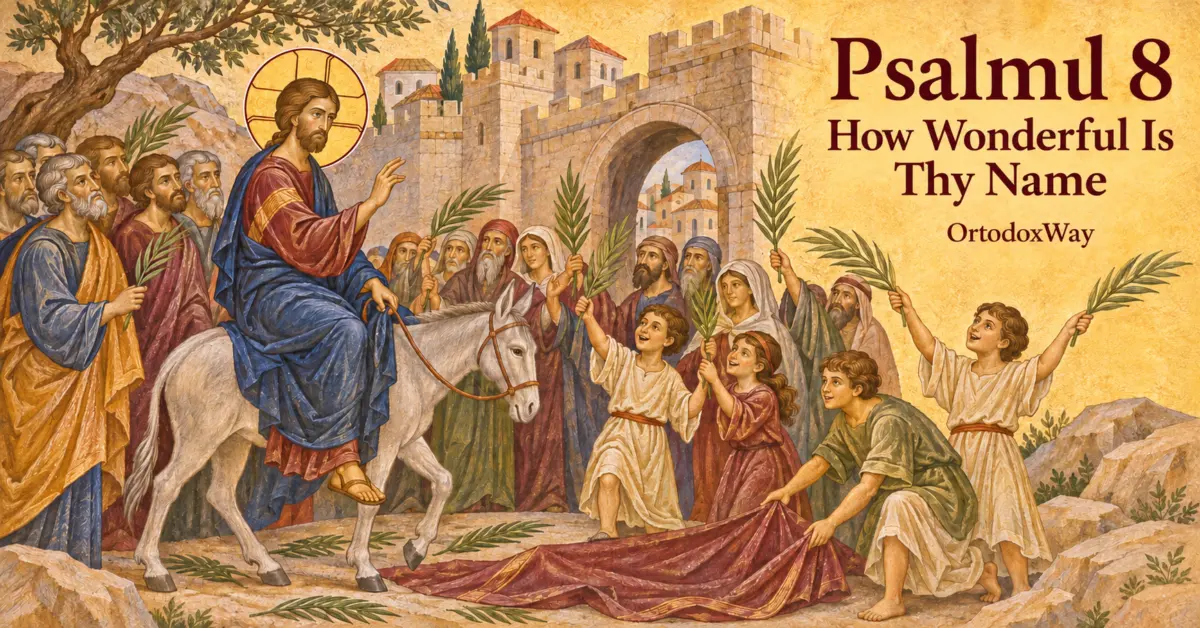
Psalm 8 is a song of wonder. David looks at the sky with the moon and the stars, thinks how small man is before them, and marvels that God nevertheless remembers him and has made him lord over all creatures. The Lord Jesus Christ Himself spoke a verse of this psalm. A few days before His Passion, that is, His sufferings and crucifixion, He entered Jerusalem, and the children in the temple courts cried: “Hosanna to the Son of David!”, that is, “Save, we pray, Son of David!”. This was how the Messiah was to be greeted, the King promised from the line of David. The chief priests and the scribes, the heads of the priests and the teachers of the Law, were indignant and said to Him: “Hearest thou what these say?”. And Christ answered them with Psalm 8: “Have ye never read, Out of the mouth of babes and sucklings thou hast perfected praise?”1. Later the Apostle Paul showed that these words about man, made a little lower than the angels and crowned with glory, find their perfect fulfilment in Christ, Who took our nature2. That is why the Holy Fathers read in this psalm the announcement of the Incarnation and of the honour received by human nature.
In this article
The text of the psalm
We give the psalm in the translation of Sir Lancelot Brenton (1844), made from the Septuagint, the Greek translation of the Old Testament which the Church uses and from which the Holy Fathers interpreted the psalms. The verses are numbered as in the Orthodox Psalter, where the title counts as the first verse. Where Brenton's English departs from the Greek, this is explained below, at each verse.
- For the end, concerning the wine-presses, a Psalm of David.
- O Lord, our Lord, how wonderful is thy name in all the earth! for thy magnificence is exalted above the heavens.
- Out of the mouth of babes and sucklings hast thou perfected praise, because of thine enemies; that thou mightest put down the enemy and avenger.
- For I will regard the heavens, the work of thy fingers; the moon and stars, which thou hast established.
- What is man, that thou art mindful of him? or the son of man, that thou visitest him?
- Thou madest him a little less than angels, thou hast crowned him with glory and honour;
- and thou hast set him over the works of thy hands: thou hast put all things under his feet:
- sheep and all oxen, yea, and the cattle of the field;
- the birds of the sky, and the fish of the sea, the creatures passing through the paths of the sea.
- O Lord our Lord, how wonderful is thy name in all the earth!
Psalm 8 in the services of the Church
Psalm 8 closes the third stasis of the first kathisma, after Psalm 7. The kathismata are the twenty sections into which the Psalter is divided for reading in church, and each has three stases, that is, three groups of psalms. The first kathisma is usually read at Saturday evening Vespers, the service with which the Lord's day begins, and in Great Lent also at Wednesday Matins. In parishes it is usually shortened to a few verses, so that Psalm 8 is heard in full mostly in monasteries.
The brightest place of the psalm, however, is Palm Sunday, the feast of the Lord's entry into Jerusalem. At Matins on that day, before the Gospel, a prokeimenon is sung: a verse from the psalms that prepares the reading, accompanied by another verse called the stichos. The prokeimenon of Palm Sunday, in the fourth tone, is verse 3 of Psalm 8: “Out of the mouth of babes and sucklings hast thou perfected praise.” The stichos is verse 2: “O Lord, our Lord, how wonderful is thy name in all the earth.” Then the Gospel is read which tells of the entry into Jerusalem and of Christ's answer to the chief priests with the words of this psalm3. So the Church sets the psalm beside the event in which it was fulfilled.
“For the end, concerning the wine-presses”
The wine-press is the place or vessel in which grapes are trodden, so that the must runs from them and becomes wine. The commentary handed down under the name of Saint Athanasius the Great explains the title in this way. (We say “handed down under the name” because over the centuries fragments of other commentators were mixed into this book.) Formerly, in the worship of the Law, there was a single vat before the wine-press, that is, the altar in the temple at Jerusalem. After the nations, that is, the peoples who were not Jews, had been called to the faith, there came to be many wine-presses: these are the Churches, which receive the fruits of those made righteous and offer them to the honour of God.
Blessed Theodoret of Cyrus, a fifth-century bishop and interpreter of Scripture, adds that the Lord called Himself a vine when He said: “I am the true vine”4. Those who have believed gather the fruit of this vine and prepare the mystical wine. Through the prophet Isaiah, God had likened His people to a vineyard which He fenced, in which He built a tower and dug a wine-vat, waiting for it to bring forth grapes, but it brought forth thorns5. Then there was a single wine-press; now, says Theodoret, the priests no longer tread the fruits of men on a single altar, but altars have been set up over all the earth and the sea, and their number can no longer be known. Psalm 83 bears the same title, and it speaks of the many altars of God: “thine altars, O Lord of hosts”6.
Euthymios Zigabenos, the Byzantine monk who gathered in his commentary on the Psalter the words of the Fathers before him, says the same in other words. The vine is the Lord, the branches are the Apostles, and the grape is the faith, which is gathered in the churches and yields the teaching like a wine that gladdens the hearts of the faithful.
As for “for the end”, Theodoret shows that other ancient translators of Scripture into Greek put here “to the Giver of victory” or “of victory”. The psalm is therefore a song of victory offered to God, Who overthrew the devil, the enemy and avenger, and brought men out from under his rule.
“O Lord, our Lord, how wonderful is thy name”
Saint John Chrysostom links this psalm with the one before. Psalm 7 ended with a promise: “I will sing to the name of the Lord most high”7. Now David fulfils his promise. There one man was speaking: “O Lord my God”; here many speak: “O Lord, our Lord”. For those who do not believe, says Saint John, God is Lord in one way, because He made them. For us He is Lord in two ways: He made us out of nothing, and we have come to know Him. And whoever understands how God made us His own, who were estranged, enemies and dead, sees that this is the greatest of His benefits.
“How wonderful”: the prophet does not say how much, because he could not measure it. Saint John asks where, then, are those who boast that they can know the essence of God, if the prophet could not grasp even how wonderful His name is. Through this name, he says, death was destroyed, the demons were bound, heaven and the door of paradise were opened, the Holy Spirit was sent, slaves became free, enemies became sons, and strangers became heirs. God became man, and heaven received the earthly nature.
The name of God, however, had not always been wonderful among men. Through Isaiah God had said of His people: “On account of you my name is continually blasphemed among the Gentiles”8. But when the Only-begotten Son came, the name of God became wonderful everywhere, as the prophet Malachi had foretold: “from the rising of the sun even to the going down thereof my name has been glorified among the Gentiles”9. That is why, says the commentary of Saint Athanasius, the prophet marvels at the knowledge of God given to men, for God was no longer known only to those in Judaea. Euthymios adds that David counts himself among the nations when he says “our Lord”, because he foresaw the mystery of the Incarnation and the faith in Christ that was to pass to all the peoples of the world.
“For thy magnificence is exalted above the heavens”
“Magnificence” means majesty, glory. Having spoken of the earth, says Saint John, the prophet turns his word to heaven: the name of God is wonderful below and wonderful above, for not only men but also the angels praise what God has done for men, as they sang on the night of the Lord's Nativity10. And he marvels at something greater still: the nature that was lower than all, human nature, God has raised above all.
Blessed Theodoret says that God has always had this majesty, but men did not always know it; now all know that He rules heaven and earth. And he brings the testimony of the prophet Habakkuk: “His excellence covered the heavens, and the earth was full of his praise”11.
Euthymios Zigabenos brings here the word of Saint Cyril of Alexandria, for whom the “magnificence” is God's becoming man, beyond every mind and not grasped even by the heavenly powers. The commentary of Euthymios was printed with the notes of Saint Nicodemus the Hagiorite, an eighteenth-century monk of the Holy Mountain of Athos, who adds texts from other Fathers. Saint Nicodemus brings here the word of Saint Gregory of Nyssa: the soul that rises and leaves behind everything that can be grasped, as something smaller than what it seeks, comes to understand that God's majesty does not stop at the heavens but is above them, and that the heavens themselves are small heralds of His glory.
“Out of the mouth of babes and sucklings hast thou perfected praise”
To understand the verse we must go back to Palm Sunday. When Christ entered Jerusalem, the crowds that went before Him and followed Him cried: “Hosanna to the Son of David: Blessed is he that cometh in the name of the Lord”12. Then He went into the temple, drove out those who bought and sold there, and healed the blind and the lame. The children in the temple cried out too: “Hosanna to the Son of David!”. The chief priests and the scribes were indignant, and Christ answered them with this verse13. “To perfect praise” means to make praise full and complete. The “sucklings” are infants who are still nursed at their mother's breast.
Saint John Chrysostom asks why the prophet, passing over the other miracles of Christ, chose this one. Because the raising of the dead, the cleansing of lepers and the casting out of demons had been seen before, in another way, in the Old Testament: the prophet Elisha raised a dead boy and cleansed a leper, and David calmed King Saul when the evil spirit tormented him14. But that infants should praise God with clear words had never happened before. And he does not say only “babes”, lest someone understand simple and guileless men, but adds “sucklings”, showing their age by the food they took. More than that, what the Apostles did not yet know, the children sang.
Saint John also sees in these infants an image of the Apostles. Simple men, more voiceless than the fish, they caught the whole world in the net of faith. And he draws a lesson from this for everyone: those who draw near to the teaching of God must be children in soul, as the Lord said: “Except ye be converted, and become as little children, ye shall not enter into the kingdom of heaven”15.
The commentary of Saint Athanasius understands by babes those who are babes in malice, that is, without malice, as the Apostle Paul urges: “be not children in understanding: howbeit in malice be ye children, but in understanding be men”16. Blessed Theodoret sees here the power of God, Who, through men who had not learned the wisdom of the world and through pure and guileless infants, overthrew the evil tyrant, the devil.
“That thou mightest put down the enemy and avenger”
The Greek word that Brenton renders “put down” means to destroy, to bring to an end. The “avenger” is the one who takes revenge, who punishes for a deed. Saint John Chrysostom shows that the other miracles were done so that men might receive benefits and others might learn, but this one was done also to stop the mouths of enemies. Those who persecuted Christ claimed to be defending the honour of God the Father, as if the Son had taken it from Him. That is why, in their own eyes, they were avengers. But the Lord took this justification from them, saying: “He that hateth me hateth my Father also”17. And the children said nothing that could offend them, but confessed the very unity of the Son with the Father: “Blessed is he that cometh in the name of the Lord.” Saint John also notes that the psalm does not say “that thou mightest punish him” but “that thou mightest destroy him”, that is, put a stop to his boldness.
The commentary of Saint Athanasius gives another, deeper meaning. The enemy and avenger is the devil. After pushing man to sin, he himself punishes the one who has sinned, setting before his eyes the greatness of the sin, so as to drive him to despair. Euthymios brings the same word from Saint Maximus the Confessor. The devil is an enemy, because he opposes the commandments of God and persecutes His friends. And he makes himself an avenger, because after bringing men down into sin, he accuses them before God as transgressors of the commandments and demands that they be punished. This enemy was put to shame when he heard the infants praising Christ.
“For I will regard the heavens, the work of thy fingers”
Blessed Theodoret puts these words into the prophet's mouth: Master, the created things are enough to show Thy great work, heaven and earth, moon and sun and their good order, but Thy care, which comes down even to little men, proclaims still more Thy love for mankind. The commentary of Saint Athanasius links the verse with the one before: the chief priests were indignant at the infants who praised, while the prophet looks at a small work of creation, the heavens, and sees how great and how beautiful it is.
Why “fingers” and not “hands”? Saint John Chrysostom answers that the prophet wants to show the ease with which God made all things visible. The stars hang without falling, although nothing stays on high by itself, because the Creator, like a craftsman without equal, made many things beyond the ordinary order of nature. “Thou hast established” means, according to Euthymios, Thou hast set them and made them firm, so that they do not fall from their places. And why does he mention the moon and not the sun? Saint John says that through the moon the prophet shows that God is the Creator of the night as well, which some thought foreign to His work.
Saint John draws from this a testimony about Christ. The same One Who perfected praise out of the mouth of infants also made the heavens. Some heretics, such as Paul of Samosata, a third-century bishop condemned by the Church, taught that Christ began to exist only when He was born of the Virgin Mary. But if He made the heavens, then He was before the heavens, and all the more before Mary.
Brenton's “I will regard” renders the Greek “I will see”. Why the future? Saint John answers that formerly few knew that the Crucified One is the Creator of the heavens, but in time all would know it. Saint Nicodemus also brings the word of Saint Gregory the Theologian, who reads the verse as a promise for the age to come. Now we do not know creation in detail, but see only its shadows; then, when we reach perfection, we shall see the heavens as they will be, and shall understand that what is seen now was only an image of the truth.
“What is man, that thou art mindful of him?”
“To be mindful” means to remember, and “to visit” means to come to someone in order to see him and help him. Having spoken of creation, says Saint John, the prophet passes to the care that God has for man. Man is almost nothing, and was even less after so many sins. And yet for him are all visible things, for him were paradise, the commandments, the punishments, the miracles and the benefits of the time of the Law; for him the Son of God became man. Like a good physician, God left the healthy and came to us, the sick.
Blessed Theodoret notes that the psalm does not speak here of the making of man, but of God's providence. It does not say “thou madest him”, but “thou art mindful of him” and “thou visitest him”. Not only didst Thou bring him into being, he says, but Thou didst also give him a good life; Thou rememberest him, and when he falls into evil, Thou comest to him.
Euthymios says that David spoke this word too about the Lord's becoming man, which he foresaw. Man had gone away from God and broken the commandment, and God remembered him and had mercy on him. More than that, He did not send someone else to visit him, but came Himself, as Isaiah says: “not an ambassador, nor a messenger, but himself saved them”18. For the fallen angels no such mercy was shown, but for fallen man God came down to our lowliness and became man.
“Thou madest him a little less than angels”
Saint John Chrysostom sees here the sentence that followed the first sin, that is, death: through it man was made lower than the angels. But the Only-begotten Son, when He came, destroyed death too. Blessed Theodoret says the same: man is lower than the angels because he became mortal. Euthymios also brings the word of Saint Basil the Great: man is a little lower than the angels because he bears a body of earth, and God arranged this so that, when man grows proud in his mind, he may be humbled by the dust from which he is made. If he is so proud while bearing a heavy body, what would he have done without it?
The Apostle Paul quotes verses 5–7 of the psalm in the Epistle to the Hebrews and adds: “But now we see not yet all things put under him. But we see Jesus, who was made a little lower than the angels for the suffering of death, crowned with glory and honour”19. The commentary of Saint Athanasius says simply that, since Paul clearly interpreted these words of the Saviour, we must be content with his interpretation. Euthymios shows how the words fit Christ. “Thou madest him a little less” shows that the Lord, as man, hungered, thirsted and accepted all the natural weaknesses of the body, without sin. “Thou hast crowned him with glory” signifies, according to Euthymios, the glory of the Godhead. His human nature did not receive it later, as a gift added on; rather, as Saint Nicodemus specifies, it was united with God the Word according to hypostasis, that is, in one and the same Person. And “honour” is the honour given Him by the angels, who ministered to Him after the temptation in the wilderness20, and by those who believed in Him.
“Thou hast crowned him with glory and honour”
Euthymios says that the glory of man is that he was made in the image of God, and his honour that all living creatures and all visible creation were subjected to him. Saint John Chrysostom sees here the honour given to man at his making, when God told him to have dominion over the fish, the birds and all living things21, but above all the new honour which we received after the coming of Christ. Now man has Christ as his head and becomes His body, His brother and joint-heir with Him. The Lord said to us: “I have called you friends”22, and the angels are not ashamed of us, but serve our salvation. Adam was honoured as soon as he was made, without having done anything, neither evil nor good; we, after countless sins, have received a far greater honour.
“And thou hast set him over the works of thy hands”
Euthymios says that God made man king of the visible creation when He told him: “Increase and multiply, and fill the earth and subdue it”23. The commentary of Saint Athanasius goes further. God gave man dominion over all creatures without reason, as to one who resembles Him: just as God is the King of all, so man, having power from the divine image, was set as lord over the things on earth. But another psalm says: “the heavens are the works of thine hands”24. If man was set over the works of God's hands, then perhaps this also announces the ineffable life in heaven of those who will inherit the Kingdom, according to Paul's word: “heirs of God, and joint-heirs with Christ”25.
Blessed Theodoret says that our nature received this honour after God became man, as the Apostle says: “And hath raised us up together, and made us sit together in heavenly places in Christ Jesus”26.
“Thou hast put all things under his feet”
“The cattle of the field” are the beasts that live free in the fields and forests, and “the creatures passing through the paths of the sea” are, according to Saint Basil, whom Saint Nicodemus quotes, the great creatures of the sea. Euthymios shows that David took these words from the Book of Genesis, where God said: “Let us make man according to our image and likeness, and let them have dominion over the fish of the sea, and over the flying creatures of heaven”27. Blessed Theodoret marvels at the wisdom given to man, who with his mind catches not only the beasts of the earth but also the birds on high and the fish in the deep.
Saint John Chrysostom notes something wonderful: man, honoured with dominion before sin, was not deprived of it even after sin. He lost only a small part, the dominion over wild beasts, and even this for his own good. A father who disinherits his son in order to correct him takes the greater part and leaves him little. God did the opposite: He left man the greater part and took only a small part. What use would it be for a man to keep a tame lion beside him? Only to grow proud. That is why God left subject to him the useful animals: the ox that ploughs the land, the sheep that gives him clothing, the beasts of burden, the birds and the fish for food. The wild beasts humble man and remind him of the weakness of his nature and of the sin of our forefather Adam. “What the rod is to a child, the wild beast is to grown men,” says Saint John. And whoever asks why there are wild beasts should ask also why there are in us anger and lust, which tear the one who does not restrain them worse than any beast.
But these words too rise up to Christ. Blessed Theodoret says that God the Word took upon Himself the firstfruits of our nature, that is, the human nature taken from us as a first offering; He made the Church His body and sat above all principality and power, that is, above all the ranks of angels. That is why not only sheep and oxen were subjected to Him, but all creation, visible and invisible, as the Apostle says: “For he hath put all things under his feet. But when he saith all things are put under him, it is manifest that he is excepted, which did put all things under him”28. Such honour, says Theodoret, has human nature received from the God of all.
The commentaries also give a spiritual meaning here. According to Euthymios, the sheep are those of the nations who believed, whom the Lord found wandering like sheep on the mountains where sacrifices were offered to idols, and gathered into one flock. The oxen are those of the Jews who believed, who had borne the heavy yoke of the Law. The birds of the sky are the angels, who are subject to Christ, and the fish of the sea are the demons, who too will be subjected, for “at the name of Jesus every knee should bow, of things in heaven, and things in earth, and things under the earth”29.
“O Lord our Lord, how wonderful is thy name in all the earth”
The psalm ends with the same words with which it began. Euthymios says that this psalm, which prophesies the mystery of Christ, has the shape of a circle. Christ came down from heaven and ascended again into heaven, returning to the glory of the Father; so too the psalm, which began in wonder, ends in the same wonder. Blessed Theodoret says that the prophet put the same words at the beginning and at the end because of the great honour that human nature received from God. And Saint John Chrysostom urges us to say them always, marvelling at God's care for us, at His wisdom and His love for mankind.
How we pray with Psalm 8
Psalm 8 is the prayer of the man who has learned to wonder. Whoever reads it in the evening, looking at the sky and the stars, can say with David: “What is man, that thou art mindful of him?” He does not say it in order to despise himself, but in order to give thanks, because God, Who made the heavens with His fingers, remembered man and came Himself to visit him.
The psalm also teaches us how to draw near to God. The praise that Christ received on Palm Sunday came out of the mouth of infants, not of the learned. Saint John Chrysostom says that whoever draws near to the teaching of God must be a child in soul: pure, without guile and ready to believe.
Whoever has grave sins on his conscience can find strength here too. The devil, the enemy and avenger, pushes man to sin and then sets the sin before his eyes, to drive him to despair. But Christ has destroyed this enemy, and on Palm Sunday the Church puts into our mouths the song of the children: “Hosanna to the Son of David: Blessed is he that cometh in the name of the Lord.” Whoever sings it with faith can end, with David and with the whole Church: “O Lord our Lord, how wonderful is thy name in all the earth!”
Sources
- The Septuagint Version of the Old Testament, translated by Sir Lancelot Charles Lee Brenton, London, 1844. New Testament quotations from the King James Version.
- Saint John Chrysostom, Homily on Psalm 8 (PG 55), from the Russian edition Творения святого отца нашего Иоанна Златоуста, vol. 5, Saint Petersburg, Theological Academy, 1899, Homily 6 on Psalm 8. The Romanian translation (Laura Enache, Iași, Doxologia, 2011, pp. 132–155) was not consulted for this article.
- Saint Athanasius the Great, Commentaries on the Psalms, including fragments attributed to other church writers (Romanian: Tâlcuiri la Psalmi), translated from Ancient Greek by Nun Parascheva Enache, edited by Dragoș Mîrșanu, Patristica series, Iași, Doxologia, 2021, Psalm 8, pp. 86–89. We have used only the passages outside the square brackets; the edition attributes the bracketed fragments to other church writers.
- Blessed Theodoret of Cyrus, Commentary on the Psalms; Romanian edition by Florin Stuparu, Bucharest, Sophia, 2018 (from the translation printed at Buzău in 1840), Psalm 8, pp. 31–34.
- Euthymios Zigabenos, Commentary on the Psalter, vol. I (Psalms 1–69), Romanian translation by Metropolitan Veniamin Costachi, Iași, 1850, from the edition prepared by Saint Nicodemus the Hagiorite and published after his death, Constantinople, 1819–1821, with the notes of Saint Nicodemus; reissued as Psaltirea în tâlcuirile Sfinților Părinți, vol. 1, Egumenița.
- Matthew 21:15–16. ↩︎
- Hebrews 2:6–9. ↩︎
- Matthew 21:1–11, 15–17. ↩︎
- John 15:1. ↩︎
- Isaiah 5:1–7. ↩︎
- Psalm 83:4 (Psalm 84:3 in Bibles that follow the Hebrew numbering). ↩︎
- Psalm 7:18 (Psalm 7:17 in Bibles that follow the Hebrew numbering). ↩︎
- Isaiah 52:5. ↩︎
- Malachi 1:11. ↩︎
- Luke 2:13–14. ↩︎
- Habakkuk 3:3 (3:4 in Brenton). ↩︎
- Matthew 21:9. ↩︎
- Matthew 21:12–16. ↩︎
- 4 Kingdoms 4:32–37 and 5:1–14; 1 Kingdoms 16:23. The First and Fourth Books of Kingdoms in the Septuagint correspond to 1 Samuel and 2 Kings in other editions of the Bible. ↩︎
- Matthew 18:3. ↩︎
- 1 Corinthians 14:20. ↩︎
- John 15:23. ↩︎
- Isaiah 63:9. ↩︎
- Hebrews 2:8–9. ↩︎
- Matthew 4:11. ↩︎
- Genesis 1:26. ↩︎
- John 15:15. ↩︎
- Genesis 1:28. ↩︎
- Psalm 101:26 (Psalm 102:25 in Bibles that follow the Hebrew numbering). ↩︎
- Romans 8:17. ↩︎
- Ephesians 2:6. ↩︎
- Genesis 1:26. ↩︎
- 1 Corinthians 15:27. ↩︎
- Philippians 2:10. ↩︎
