
← Psalm 6 · The Psalter Explained
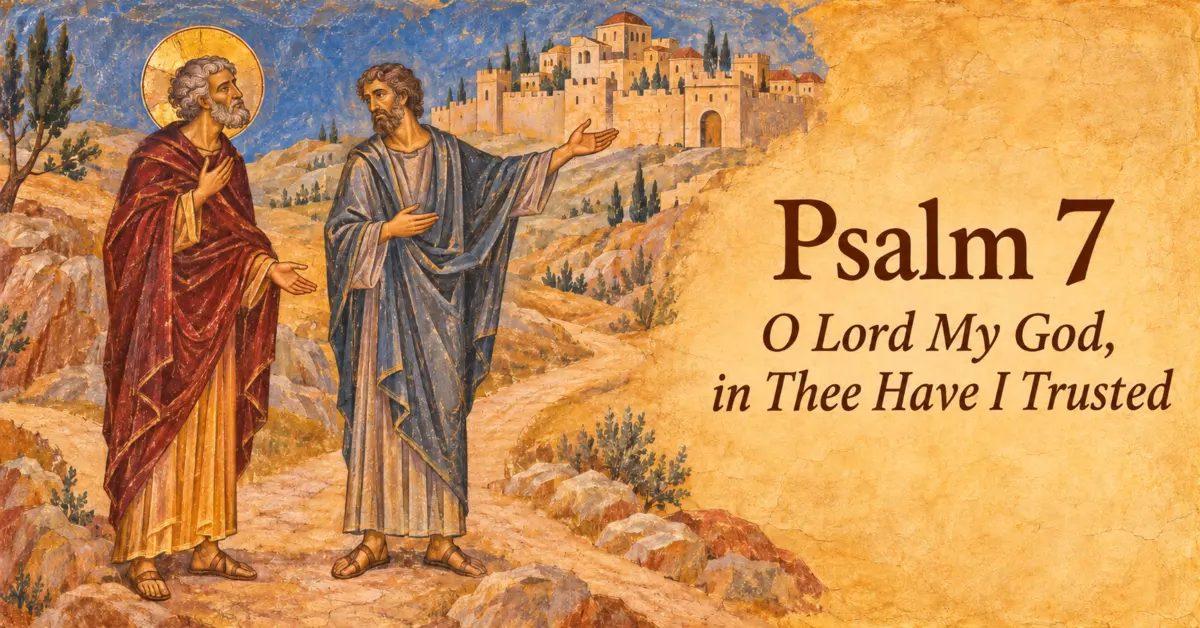
Psalm 7 is the prayer of a man persecuted unjustly. King David, who wrote most of the psalms, had been driven out of Jerusalem by his own son, Absalom, and a faithful friend, Hushai, had foiled the plan that would have destroyed him: he persuaded Absalom not to pursue David at once, but first to gather his whole army, and so David gained time to escape1. Even so, David does not put his hope in his friend, but in God. He asks God to judge him according to his righteousness, confesses that he has not returned evil to those who did him evil, and sees the evil turn back upon the one who devised it. The Holy Fathers found in this psalm a school of hope, of not remembering wrongs, and of trust in the judgement of God.
In this article
The text of the psalm
We give the psalm in the translation of Sir Lancelot Brenton (1844), made from the Septuagint, the Greek translation of the Old Testament which the Church uses and from which the Holy Fathers interpreted the psalms. The verses are numbered as in the Orthodox Psalter, where the title counts as the first verse. Where Brenton's English departs from the Greek, this is explained below, at each verse.
- A Psalm of David, which he sang to the Lord because of the words of Chusi the Benjamite.
- O Lord my God, in thee have I trusted: save me from all them that persecute me, and deliver me.
- Lest at any time the enemy seize my soul as a lion, while there is none to ransom, nor to save.
- O Lord my God, if I have done this; (if there is unrighteousness in my hands;)
- if I have requited with evil those who requited me with good; may I then perish empty by means of my enemies.
- Let the enemy persecute my soul, and take it; and let him trample my life on the ground, and lay my glory in the dust. Pause.
- Arise, O Lord, in thy wrath; be exalted in the utmost boundaries of mine enemies: awake, O Lord my God, according to the decree which thou didst command.
- And the congregation of the nations shall compass thee: and for this cause do thou return on high.
- The Lord shall judge the nations: judge me, O Lord, according to my righteousness, and according to my innocence that is in me.
- Oh let the wickedness of sinners come to an end; and then thou shalt direct the righteous, O God that searchest the hearts and reins.
- My help is righteous, coming from God who saves the upright in heart.
- God is a righteous judge, and strong, and patient, not inflicting vengeance every day.
- If ye will not repent, he will furbish his sword; he has bent his bow, and made it ready.
- And on it he has fitted the instruments of death; he has completed his arrows for the raging ones.
- Behold, he has travailed with unrighteousness, he has conceived trouble, and brought forth iniquity.
- He has opened a pit, and dug it up, and he shall fall into the ditch which he has made.
- His trouble shall return on his own head, and his unrighteousness shall come down on his own crown.
- I will give thanks to the Lord according to his righteousness; I will sing to the name of the Lord most high.
Psalm 7 in the services of the Church
Psalm 7 opens the third stasis of the first kathisma, together with Psalm 8. The kathismata are the twenty sections into which the Psalter is divided for reading in church. Each has three stases, that is, three groups of psalms, after each of which “Glory… Both now…” is said. The first kathisma is read every week at Saturday evening Vespers, the evening service with which the Lord's day begins, and in Great Lent also at Wednesday Matins, the morning service. In parishes it is usually shortened to a few verses of the first stasis, sung with the opening of Psalm 1, “Blessed is the man”, so that Psalm 7 is heard in full mostly in monasteries.
The psalm also has a special place on the day of the Resurrection. At Sunday Matins, before the Gospel, a prokeimenon is sung: a verse from the psalms that prepares the reading, accompanied by another verse called the stichos. The Sunday hymns change each week according to one of the eight tones, that is, eight kinds of melody. In the second tone, the prokeimenon is taken from verses 7–8 of this psalm: “Arise, O Lord my God, according to the decree which thou didst command, and the congregation of the nations shall compass thee.” The stichos is verse 2: “O Lord my God, in thee have I trusted: save me.” We shall see that the Fathers read in these very words the proclamation of the Resurrection.
“Because of the words of Chusi, the son of Jemini”
Brenton's “Benjamite” renders the Greek “son of Jemini”, and it is with this name that the Fathers worked, as we shall see.
The title takes us back to the most sorrowful time in David's life, the same time from which Psalm 3 was born. His son Absalom rebelled, took from him the city and the throne, and David fled into the wilderness2. Saint John Chrysostom says that Absalom was ashamed neither before nature, nor before the upbringing he had received from his father, nor before his old age: the passion for power drove all shame out of him and made him, from a man, a wild beast.
Ahithophel, David's counsellor, had also gone over to Absalom, and he was so skilled in war that, Saint John says, David feared him more than his own son. When he learned of this betrayal, David prayed that God would bring Ahithophel's plan to nothing3. At that very moment Hushai, his friend, came to meet him. Hushai had remained faithful because he was, in Saint John's words, a friend of virtue, not of good fortune. David sent him back to Jerusalem to pretend to be Absalom's servant4. Hushai did not ask himself what would happen to him if he were found out, but put his hope in God.
Ahithophel asked Absalom for twelve thousand men, to pursue David that very night and strike him alone, while he was weary and had few men with him5. The plan was good for Absalom and deadly for David. Hushai first praised Ahithophel for the counsels he had given until then, and then said that this plan was not good: David and his men are mighty and, cornered, will fight like a bear robbed of her cubs, and a first defeat would terrify everyone; better to gather all Israel and let Absalom himself go into battle6. Hushai's counsel required time: until all Israel was gathered, David could escape and assemble his army. Absalom listened to Hushai because, Scripture says, the Lord had ordained that Ahithophel's plan, good though it was, should be brought to nothing7. Hushai at once sent word through the priests, and David crossed the Jordan that same night with all the people8. So he gained time to assemble his army and won the battle that followed9. Ahithophel, seeing his plan rejected, understood how it would all end, went home and hanged himself10.
Saint John draws four lessons from this: not to be troubled when we see the righteous in afflictions, not to change our friendships according to circumstances, to be ready to face danger for virtue's sake, and not to lose hope in the help of God. Wickedness, even if it had the whole world on its side, is weaker than anything, and virtue, even alone, is stronger than anything, because it has God. David came out of the trial purer, like gold from the furnace.
Why “son of Jemini”, when the Book of Kingdoms calls Hushai the Archite? Saint Basil the Great answers that Hushai received the name from his deed. “Jemini” means “the right hand”, and Hushai, by his good counsel, became David's right hand. Scripture is accustomed to name people after their deeds: the Lord called Judas “the son of perdition”11 and the man worthy of His peace “the son of peace”12. Euthymios Zigabenos, the Byzantine monk who gathered in his commentary on the Psalter the words of the Fathers before him, brings this explanation, together with that of Saint Cyril of Alexandria, who sees in Jemini the name of Hushai's tribe. The commentary of Euthymios was printed with the notes of Saint Nicodemus the Hagiorite, an eighteenth-century monk of the Holy Mountain of Athos, who adds texts from other Fathers. We shall meet them several times.
Why does David give thanks “because of the words of Chusi”? Saint John and the commentary handed down under the name of Saint Athanasius the Great answer alike. (We say “handed down under the name” because over the centuries fragments of other commentators were mixed into this book.) David had escaped through what seemed human help, but he ascribes everything to the grace of God. And Hushai's counsel was the very answer to the prayer David had made in the hour of betrayal. Blessed Theodoret of Cyrus adds that the psalm teaches those who are wronged to hope in God, and frightens those who do wrong with His righteous judgement. Euthymios sees in the title a repentance as well: David repents of having leaned his hope for a time on the wisdom of his friend, and the psalm, a cleansing one, returns him to his first hope.
“O Lord my God, in thee have I trusted”
David put his hope not in Hushai, nor in human wisdom, nor in his own mind, but in God. From this Saint John teaches us that, when good is done to us through people, we should give thanks to God. In “my God” he hears love: just as God, though He is God of all, calls Himself in a special way “the God of Abraam, and the God of Isaac, and the God of Jacob”13, so the righteous man calls Him his own.
The prayer seems simple, says Saint Basil, but not everyone can say it. Whoever runs after power, money or the glitter of the world cannot truly say “in thee have I trusted”, for “Cursed is the man who trusts in man”14. As it is not fitting to honour anyone in the place of God, so it is not fitting to put your hope in anyone but Him.
Saint John also shows the meekness of this prayer. David does not ask for his adversary to be punished, only for his own salvation. He does not name his son, and even in time of war he still sees in him his son. He does not say “from those who have plundered my treasures”, but simply “from all them that persecute me”.
Saint Basil then distinguishes “to save” from “to deliver”. Those who are weak need salvation, and they are led to it through faith, as the Lord says: “Thy faith hath saved thee”15. Those who are enslaved need deliverance, and they wait for another to pay the price of their ransom. In the two petitions he sees the two lives: salvation here from persecutors, deliverance there, in the hour of judgement.
“Lest at any time the enemy seize my soul as a lion”
Saint Basil gives this verse an interpretation that awakens the fear of God. God's athletes have struggled all their lives with the invisible enemies. At the end, the prince of this age, that is, the devil, comes to examine them, to take possession of them if he finds in them wounds, stains and traces of sin. But if they are found without wounds and without stains, they will be given rest by Christ, free, as men who have remained unconquered. Only the Lord could say: “The prince of this world cometh, and hath nothing in me”16. It is enough for a man, says Saint Basil, if he can dare to say that the enemy finds in him things few and small.
The commentary of Saint Athanasius also sees the devil in the lion, “the noetic lion”, that is, the invisible, spiritual lion, who plots against our soul. Saint John says that David saw his son enslaved by the devil and prayed not to suffer the same, according to the word of the Apostle: “Your adversary the devil, as a roaring lion, walketh about, seeking whom he may devour”17. This beast takes many forms, but for those who are watchful he becomes weaker than dust. Those who have Christ, who bear the cross on their brow, the fire of the Spirit and the lamp that never goes out, which is almsgiving, he cannot even look upon, but flees backwards.
“While there is none to ransom, nor to save”: David had an army, but without help from above he counted the support of the whole world as nothing, and with that help he did not feel alone, even if abandoned by all.
“O Lord my God, if I have done this”
Here Saint John stops to teach us how to pray so as to be heard: to be worthy of what we ask, to pray according to the laws of God and unceasingly, to ask for what is profitable to us, not for riches and worldly things, and to do our own part. This does not prevent us from asking for what life needs, as the Lord taught us: “Give us this day our daily bread”18. The publican was heard precisely because he prayed as a sinner humbling himself, while Paul, though righteous, did not receive what was not profitable to him19. But we are not heard when we remain willingly in our sins, without repentance, nor when we ask for something against our enemies. Prayer is a medicine, and whoever does not know how to use it gains no benefit from it.
“If I have done this”: David does not dare to name his son's sin. He does not say “did I rise up against my father?”, because he is ashamed for him. Euthymios adds that he was still sparing him and felt pity for him. Nor does he speak out of pride, says Saint John; he is compelled to set forth his innocence because many were judging him by his misfortune.
Blessed Theodoret explains that David does not here confess perfect virtue, but only that he had not wronged these enemies. Saint Nicodemus brings in his notes the word of Saint Cyril of Alexandria, who goes further: perhaps David did not consider himself entirely free of unrighteousness, because he had wronged Uriah, the soldier he had sent to his death in order to take his wife, Bathsheba20; but in the matter of his son he was without fault.
“If I have requited them that requited me evil”
Brenton translates “if I have requited with evil those who requited me with good”, but the Greek says “if I have requited those who requited me evil”, that is, if I have returned evil for evil. This is how the Fathers read it.
Here, according to Saint John, lies the greatest thing in the opening of the psalm. It is good not to do wrong, but far better not to avenge the wrong you have suffered. The Law of the Old Testament permitted “eye for eye, tooth for tooth”, as the measure of punishment in a court of judgement, not as a justification of hatred, for it already commanded not to take vengeance and not to bear a grudge21. David did not break the Law, but went far beyond it. Of Christians even more is asked: to do good to our enemies and to “pray for them which despitefully use you, and persecute you”22. What excuse shall we have, asks Saint John, if after the coming of Christ we do not reach even the measure of those under the Old Law? He and Blessed Theodoret recall Saul, the king before David, who persecuted him out of envy, and whom David had in his hands more than once and spared, though many urged him to strike23.
Christ did not command us to have no enemies, which is not in our power, but not to hate them, which is. When I am hated but do not hate, the other has me for an enemy, but I do not have him. That is why the Apostle says: “If it be possible, as much as lieth in you, live peaceably with all men”24. The roots of enmity are love of money and love of vainglory; whoever rises above them rises above enmity. Saint John gives an image as well: if someone who was drowning were to insult you, you would not leave the shore to drown with him. The one who insults you is caught in the whirlpool of anger. If you endure, you remain in the harbour; if you follow him, you sink not him, but yourself.
“May I then perish empty by means of my enemies”
Brenton's “perish” renders a Greek word meaning “fall away”, and “empty” means empty-handed. David pronounces a judgement upon himself, and Saint John sees in it the boldness of a clean conscience: he would not have called such punishments upon himself if he had not been sure of his innocence.
For Saint Basil, only he falls “empty” who falls from the fullness of the grace of Christ. The righteous man has his life hidden with Christ in God and can say: “Not I, but Christ liveth in me”25. The sinner wallows in the passions of the flesh as in a mire, and the enemy climbs upon him and tramples his life into the ground. The saints have their glory in heaven, where they have laid up their good deeds as in an eternal treasury; whoever glories in wealth, in passing honour or in bodily gifts has his glory in the dust.
Saint Nicodemus also brings in his notes the interpretation of Abba Dorotheos, a great teacher of the monastic life in the sixth century. To fall means to have no more strength to resist; to fall empty, to have nothing good left and to be unable to rise. Our life is the virtues, trampled into the ground when a man thinks only of earthly things. Our glory is the knowledge born of keeping the commandments, laid in the dust when a man no longer thinks of God, but thinks of everything in a fleshly way. Therefore, Abba Dorotheos concludes, let us not return evil, neither by deed, nor by word, nor by a look.
“Arise, O Lord, in thy wrath”
Saint John asks us to understand nothing bodily in “arise”. When Scripture says that God sits, it shows the immovability of His nature and His power as judge and king; when it says that He arises, it shows His power that punishes and crushes evil. Nor is His wrath a passion; it means punishment.
“Be exalted in the utmost boundaries of mine enemies.” Brenton has “mine enemies”, as do some editions of the Septuagint; the Romanian Bible of 1914, the Slavonic Psalter and some Greek Psalters used in church have “thine enemies”, and Saint Nicodemus notes the difference. How is the Most High exalted? Saint John answers that He is exalted in the souls of men. The wicked take His long-suffering for weakness, as the sun seems dark to diseased eyes. David prays that God would show His power, so that they might see His glory: he asks not for vengeance for himself, but for the glory of God.
For the commentary of Saint Athanasius, the “boundaries” of the enemies are the most powerful among them. Blessed Theodoret understands that David asks God to set a boundary to their unjust assault. Saint Basil sees here a good physician, who takes hold beforehand of the edges of the evil and stops the disease from spreading. Saint Nicodemus brings the word of Saint Gregory of Nyssa: the only enemy by nature is evil, and its boundary is destruction, that is, its passing into non-being. Whoever prays thus asks that evil be bounded, so that no road to evil may remain in life.
“According to the decree which thou didst command”
Saint Basil sees two meanings here. The first concerns David's circumstances: God had commanded “Honour thy father and thy mother”26, and his son had broken the commandment. David asks God to arise not to avenge him, but to defend His despised commandment, for the correction of himself and of his son and for the instruction of many. The second concerns the Resurrection of the Lord, which Euthymios links to the word the Lord spoke of His body: “Destroy this temple, and in three days I will raise it up”27. The commentary of Saint Athanasius says plainly that here the prophet proclaims the coming of the Saviour.
Saint John and Blessed Theodoret also give a meaning that concerns us all: what You have commanded us, to help those who are wronged, show us Yourself in deed.
“And the congregation of the nations shall compass thee”
Here too, says Saint John, we must imagine nothing human. The Jews praised God standing in a circle in the temple, so “shall compass thee” means “shall sing to Thee, shall offer Thee great praise”. Blessed Theodoret interprets it in the same way.
The commentary of Saint Athanasius sees here the faith of the Church in Christ. “For this cause do thou return on high” means “return on high for the sake of this congregation”. The height is either the Cross, upon which Christ ascended for our sins, or the Ascension into heaven, where He went to appear now in the presence of God for us28. Saint Basil says the same: for the sake of the congregation gained by Thine incarnation, return to the glory which Thou hadst before the world was29.
That is why the Church chose these verses for Sunday Matins: Christ has risen from the dead, and the Church, the congregation of the nations, stands around Him and praises Him.
“The Lord shall judge the nations”
To those who think that everything happens by chance, the psalmist shows, according to Saint John, that over our deeds watches the Providence of God, that is, His care, which calls us to account. There are two judgements: one to come, common to all and open, and one now, by which God calls each one to account in particular, to awaken the careless.
Saint Basil shows how just this judgement will be: we shall not all be judged alike, because circumstances differ. Sin committed willingly is heavier than sin into which circumstances have drawn us. Of two men fallen into the same sin, the one raised with good parents, teachers, the word of God and examples of purity will receive a heavier punishment than the one raised in a corrupt home.
“Judge me, O Lord, according to my righteousness”
How can David ask to be judged according to his righteousness, when he says in another psalm: “Enter not into judgment with thy servant, for in thy sight shall no man living be justified”30? Saint John answers that there it is a matter of the judgement in which a man's life is set beside the benefits of God, before which no one is righteous. Here David asks to be judged only in his case with men, and his righteousness is that he did not stretch out his hands to wrongdoing.
He speaks thus because many were judging him by his misfortunes, as Job's friends did, as did the barbarians of Malta who saw the viper hanging from Paul's hand31, and Shimei, who called David a man of blood when he was fleeing from Absalom32. Let us not think, says Saint John, that God loves a man because he is rich and healthy: He loves the one who keeps His commandments33, and here is the time of contests, not of crowns.
Saint Basil sees in these words, which seem boastful, the humility of the psalmist, far from the pride of the Pharisee in the Lord's parable, who boasted of his deeds in his prayer34. There is a righteousness of men, one of angels and one of God, which surpasses every mind; David asks to be judged by the one possible for a man in the flesh. His “innocence”, in Greek “guilelessness”, is simplicity, the absence of cunning, because of which a man often falls into mistakes. David asks God to weigh his righteousness together with human weakness and not to condemn him as one quick to sin.
“Oh let the wickedness of sinners come to an end”
Whoever prays thus, says Saint Basil, is a disciple of the Gospel: he does not ask that sinners perish, but that their wickedness come to an end, as we would ask for the sick that their sickness end.
Punishment stops wickedness, says Saint John, as festering wounds are cleansed by bitter medicines, by burning and by cutting. Therefore let us not weep for those who are punished, but for those who sin unpunished: not sickness is the worst thing, but sickness without a physician. If we were punished every day, the human race would long since have perished and no time for repentance would remain. But as physicians give medicine according to the strength of the patient, not of the wound, God punishes gently and gradually, and often, by punishing one, He brings many to their senses.
“And then thou shalt direct the righteous”: when the wicked are punished, the righteous become more attentive, and from this come two goods: the wicked turn away from evil, and the righteous cleave more closely to virtue. Saint Basil adds that the righteous man too needs God's guidance, so that not even through weakness may he swerve from the rule of truth.
“O God that searchest the hearts and reins”
The reins are literally the kidneys, and in the language of Scripture the most hidden depth of man. Saint Basil says that the heart is the ruling part of the soul, and the reins its passionate part. God searched Abraham's heart when He asked him to sacrifice Isaac, so that it might be shown that he did not love his son more than God, and the reins of Joseph, sold as a slave into Egypt, when he chose purity rather than the pleasure to which his master's wife invited him. Euthymios says that in the heart the movements of anger arise, and in the reins those of desire, from which every sin proceeds.
God has no need of witnesses or proofs, says Saint John, for He Himself knows what is hidden. Let no one ask how He will judge so great a world: He who made it out of nothing can also judge it.
“My help is righteous, coming from God”
Saint John interprets: rightly will help be given me, because I ask nothing unrighteous. So we too should ask for what is according to righteousness. Whoever prays against his enemies, or for riches, beauty and other passing things contrary to the wisdom of the soul, asks against the law of Him who helps. Let us ask in such a way that we also receive.
“Upright in heart”, says Saint Basil, is the one who walks the middle way of virtue, swerving neither towards too much nor towards too little. Whoever falls short of courage falls into fear, and whoever goes beyond it, into reckless daring. The heart is made crooked when it swells with pride or when it collapses into despair.
“God is a righteous judge, and strong, and patient”
Saint Basil says that the psalmist speaks here to those who were troubled, who saw Absalom's rebellion seeming to succeed and began to doubt Providence. Nothing happens without judgement. God is righteous, so let no one speak unrighteousness against Him; He is strong, so let no one think He cannot punish; and if He does not punish at once, it is because He is long-suffering.
His love for mankind shows itself, according to Saint John, first in that He does not send punishment at once, and above all in that He forgives all sins in Baptism and gives us repentance. The commentary of Saint Athanasius also says that God postpones our punishment.
Brenton's “not inflicting vengeance every day” renders a Greek phrase meaning “not bringing wrath every day”. As for this wrath, Saint John sends each of us to his own conscience. Is there a day on which we do not pray lazily and carelessly? Who would stand yawning before a judge and not be punished at once? Punishment would be deserved every day, but the love of God for mankind holds it back.
“If ye will not repent, he will furbish his sword”
To “furbish” is to polish until it gleams. Lest those who hear of His long-suffering grow even more careless, the psalmist at once adds the threat. Are there bows and swords in heaven, asks Saint John? God, who makes the earth tremble merely by looking on it, has no need of weapons. The psalmist uses the names of weapons because of the coarseness of his hearers, to touch their souls: the sword, the bow and the arrows mean punishment.
In these words Saint John also sees a great love for mankind. The psalm does not say that God has loosed the arrow, but that He has bent the bow. Enemies strike in secret; God announces the punishment, delays it and frightens with words, so as not to come to carry it out. So He did with Nineveh, the pagan city to which the prophet Jonah announced its destruction: He bent the bow35, but did not loose the arrow, because the city repented. He speaks to us of Gehenna, that is, of hell, so as not to cast us into Gehenna.
Blessed Theodoret observes the same thing: the sword “will gleam”, not strike, and the bow is bent, not loosed. Saint Nicodemus brings, from the collection of commentaries of Nicetas, bishop of Heraclea, the word of Saint Gregory the Theologian: the sword gleams, but delays; the bow is bent, but holds back its wrath. This is the law of God's judgement: either to save through repentance or to condemn more justly.
“He has completed his arrows for the raging ones”
Brenton's “raging ones” renders a Greek word meaning “those who are burning”, and this is how the Fathers read it. “The instruments of death” are, according to Saint John, the tools that bring death, that is, the arrows. Saint Basil interprets the verse by a likeness taken from nature. The Creator made fire for wood, not for diamond, which fire does not melt. So the arrows of God are made for souls that catch fire easily, because they carry much fuel within them. They are received by those who first received the fiery darts of the devil: carnal love, the desire for money, burning anger, sorrows and the fear that is alien to God, all of which estrange man from Him. Whoever is clothed with the whole armour of God36 remains untouched by the deadly arrows.
Blessed Theodoret says that those will be pierced who have built, as the Apostle says, with wood, hay and stubble, that is, with worthless deeds, which burn at the judgement37. And Saint John observes that by the words “for those who are burning” the psalmist softens the fear he has stirred: God does not stretch out His hand against all, but only against those who make themselves fuel for the fire.
“Behold, he has travailed with unrighteousness”
“Travailed” means suffered the pains of birth: the wicked man is shown as a woman giving birth to unrighteousness. Having spoken of the punishment from above, the psalmist shows, according to Saint John, that wickedness is a punishment to itself, even before punishment. The judgement of conscience is not extinguished in anyone, for it was planted by God in man from the beginning. Ahab, a king and master of all, went about sad and with his head bowed because he coveted the vineyard of his neighbour Naboth, and Judas, after he had betrayed Christ, unable to bear the reproach of his conscience, hanged himself. Whoever wants to take revenge destroys himself before he harms the other. See how easy virtue is and how hard wickedness.
Why are the birth-pangs placed before conception? Saint Basil answers that with women conception comes first, then the pains and the birth, but in the heart the order is different. The senseless impulses of desire and anger are birth-pangs, because they arise suddenly and with pain. Whoever has not mastered his evil thoughts at the moment of such an impulse has conceived trouble, and whoever has kindled wickedness by evil deeds has brought forth iniquity. Saint John sees here the sign that unrighteousness does not belong to our nature, but is foreign to us, and therefore weighs upon us until we are rid of it; Euthymios says the same, that wickedness is not planted by nature, but is born from outside.
Saint Basil also says that David was ashamed to be the father of a lawless child, as if he had said: he is no longer mine, but belongs to the father who made him his own through sin, according to the word “He that committeth sin is of the devil”38. Blessed Theodoret also sees here Ahithophel, who armed the son against a father who had done him no wrong.
“He has opened a pit, and dug it up”
Saint Basil makes a fine distinction here. In Scripture, “pit” is never said in a good sense, and “well” never in a bad one. Joseph39 and Daniel were cast into pits; Abraham and the servants of Isaac dug wells, and the Saviour spoke of the divine mysteries beside a well40. The water in pits comes from outside and falls from above, while in wells there are veins of living water, hidden under the earth, which come to light when the earth is cleared away.
So it is in the soul. A pit is made when the good thoughts that fall into it are corrupted and turned into evil ones; a well is made when the evil thoughts that cover it are cleared away, and then the light shines and good drinking water springs forth. Therefore let each one dig himself a well, according to the word “Drink waters out of thine own vessels, and out of thine own springing wells”41, so that we may be sons of Abraham, Isaac and Jacob, who dug wells. Let us not dig ourselves pits, lest we hear: “They have forsaken me, the fountain of water of life, and hewn out for themselves broken cisterns, which will not be able to hold water”42. In Greek, the “cisterns” of Jeremiah are the same word as the “pit” of the psalm.
Saint John sees here too the love of God for mankind, who ordained that cunning should catch the cunning man, so that at least in this way he might come to his senses. Pharaoh's command to kill the Hebrew infants brought Moses into the very house of his daughter. The true misfortune is not to suffer evil, but to do it, and so the Apostle urges us rather to suffer wrong than to do wrong43.
“His trouble shall return on his own head”
Saint John and Euthymios show how the word was fulfilled upon Ahithophel, who hanged himself, and upon Absalom, who, fleeing on his mule after his army had been defeated, passed under an oak, caught his hair in the branches and was left hanging44. All this, says Saint John, was the judgement of God, not the work of men: instead of a rope, his own hair; instead of a gallows, the oak; instead of an executioner, a dumb beast that brought him there. He was killed by Joab, the commander of David's army, the very man who had once reconciled him with his father.
Saint John does not forget David's grief either. The son wanted to dip his hand in his father's blood, and the father asked the soldiers to spare him45 and wept for him: “My son Abessalom… would God I had died for thee!”46 He asked for his son to be spared from the impulse of nature, while in the psalm he speaks by the inspiration of the Spirit, confessing the judgement of God.
“I will give thanks to the Lord according to his righteousness”
“Give thanks” renders a Greek word that also means “confess”: here it means to praise and to thank. David does not rejoice at the fall of others, says Saint John, but acknowledges the judgement of God: the victories are His, and so he sings to Him, as a king's subjects sing after a victory. Blessed Theodoret puts these words into David's mouth: having been granted such providence, I will ceaselessly praise my Benefactor, telling the righteousness of His judgement. Euthymios adds that David did not rejoice at the death of his son, whom he wept for greatly, but honoured the decision of God.
God has no need of our praises, as He had no need of sacrifices; He accepts them for our salvation. Nothing advances us in virtue, says Saint John, like frequent converse with God, unceasing thanksgiving and His praise.
The long-suffering of God showed itself even towards Absalom, whom He let live a long time, so that he might repent. Saint John ends his homily with the example of David, who did not complain that he was receiving an evil reward for having meditated on the law of God and spared his enemies, but bore everything with one consolation: that nothing was happening without God's knowledge. Let us love God not for His gifts, but for Himself.
How we pray with Psalm 7
Psalm 7 is the prayer of one persecuted unjustly. Whoever is slandered, insulted or wronged can say with David: “O Lord my God, in thee have I trusted”; but, as Saint Basil reminds us, only he can say it truly who does not put his hope in people, in money or in power.
The psalm teaches us to examine ourselves before asking for justice. David can say “if I have requited them that requited me evil” because he did not return evil. Of us Christians even more is asked: to do good to those who do us evil and to pray for them, without returning evil by deed, by word or by a look.
Nor does it teach us to rejoice at the fall of our enemies. The righteous man asks that wickedness come to an end, not the man, and David wept for his son who had wanted to kill him. Whoever prays with this psalm leaves judgement to God, waits with patience and guards himself from digging in his soul a pit instead of a well.
On Sunday morning the Church puts on our lips: “Arise, O Lord my God, according to the decree which thou didst command, and the congregation of the nations shall compass thee.” Whoever reads the psalm with faith can pray that the risen Christ deliver him from the invisible lion, search his heart and reins, and grant him to say at the end, together with David: “I will give thanks to the Lord according to his righteousness; I will sing to the name of the Lord most high.”
Sources
- The Septuagint Version of the Old Testament, translated by Sir Lancelot Charles Lee Brenton, London, 1844. New Testament quotations from the King James Version.
- Saint Basil the Great, Homily on Psalm 7 (PG 29); Romanian translation by Fr D. Fecioru, in Scrieri I, PSB 17, Bucharest, 1986.
- Saint John Chrysostom, Homilies on the Psalms, Romanian translation by Laura Enache, Iași, Doxologia, 2011, Homily on Psalm 7, pp. 91–131.
- Saint Athanasius the Great, Commentaries on the Psalms, including fragments attributed to other church writers (Romanian: Tâlcuiri la Psalmi), translated from Ancient Greek by Nun Parascheva Enache, edited by Dragoș Mîrșanu, Patristica series, Iași, Doxologia, 2021, Psalm 7, pp. 85–86; compared with the Russian edition Толкование на псалмы, Moscow, Blagovest, 2011 (from Works in Four Volumes, vol. 4, Sergiev Posad, 1902–1903), Psalm 7, pp. 25–27.
- Blessed Theodoret of Cyrus, Commentary on the Psalms; Romanian edition by Florin Stuparu, Bucharest, Sophia, 2018 (from the translation printed at Buzău in 1840), Psalm 7, pp. 28–31.
- Euthymios Zigabenos, Commentary on the Psalter, vol. I (Psalms 1–69), Romanian translation by Metropolitan Veniamin Costachi, Iași, 1850, from the edition prepared by Saint Nicodemus the Hagiorite and published after his death, Constantinople, 1819–1821, with the notes of Saint Nicodemus; reissued as Psaltirea în tâlcuirile Sfinților Părinți, vol. 1, Egumenița.
- 2 Kingdoms 17. ↩︎
- 2 Kingdoms 15–18. The Second Book of Kingdoms in the Septuagint corresponds to 2 Samuel in other editions of the Bible. The numbering of some verses varies. ↩︎
- 2 Kingdoms 15:31. ↩︎
- 2 Kingdoms 15:32–37; 16:16–19. ↩︎
- 2 Kingdoms 17:1–4. ↩︎
- 2 Kingdoms 17:5–13. ↩︎
- 2 Kingdoms 17:14. ↩︎
- 2 Kingdoms 17:15–22. ↩︎
- 2 Kingdoms 18. ↩︎
- 2 Kingdoms 17:23. ↩︎
- John 17:12. ↩︎
- Luke 10:6. ↩︎
- Exodus 3:6. ↩︎
- Jeremiah 17:5. ↩︎
- Luke 7:50. ↩︎
- John 14:30. ↩︎
- 1 Peter 5:8. ↩︎
- Matthew 6:11. ↩︎
- 2 Corinthians 12:8–9. ↩︎
- 2 Kingdoms 11. ↩︎
- Leviticus 19:18. ↩︎
- Matthew 5:44. ↩︎
- 1 Kingdoms (1 Samuel) 24 and 26. ↩︎
- Romans 12:18. ↩︎
- Galatians 2:20. ↩︎
- Exodus 20:12. ↩︎
- John 2:19. ↩︎
- Hebrews 9:24. ↩︎
- John 17:5. ↩︎
- Psalm 142:2 (Psalm 143:2 in Bibles that follow the Hebrew numbering). ↩︎
- Acts 28:4. ↩︎
- 2 Kingdoms 16:7. ↩︎
- John 14:21. ↩︎
- Luke 18:11–12. ↩︎
- Jonah 3:4. ↩︎
- Ephesians 6:11, 16. ↩︎
- 1 Corinthians 3:12. ↩︎
- 1 John 3:8. ↩︎
- Genesis 37:24. ↩︎
- John 4. ↩︎
- Proverbs 5:15. ↩︎
- Jeremiah 2:13. ↩︎
- 1 Corinthians 6:7. ↩︎
- 2 Kingdoms 18:9. ↩︎
- 2 Kingdoms 18:5. ↩︎
- 2 Kingdoms 19:1 (2 Samuel 18:33 in Bibles that follow the Hebrew numbering). ↩︎
