
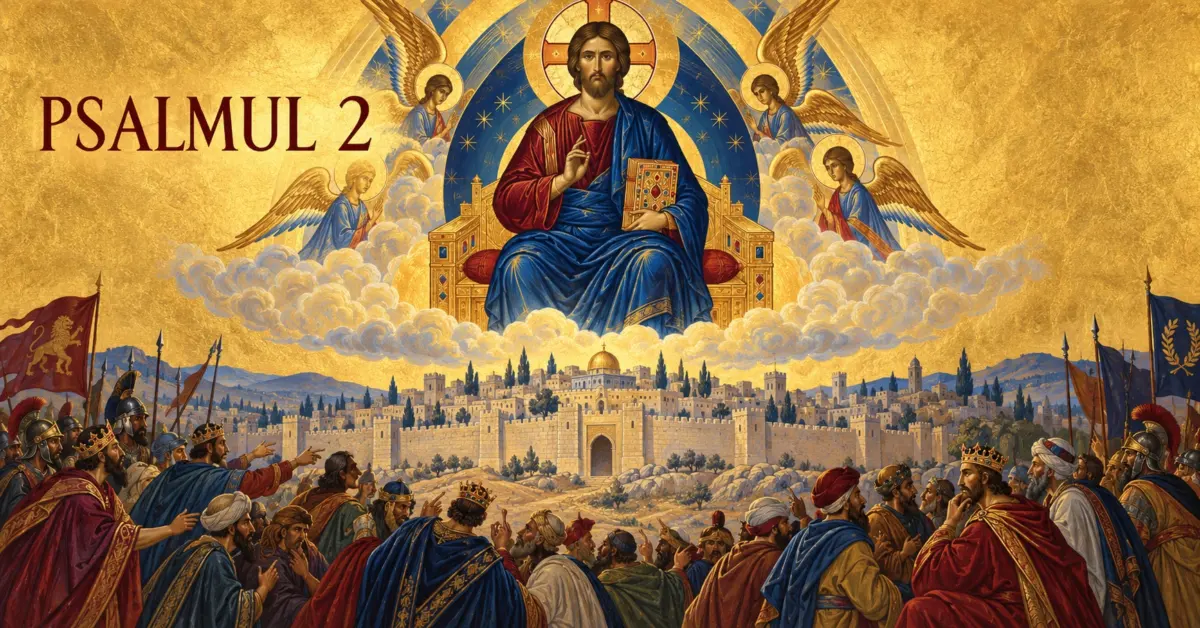
Psalm 2 stands at the beginning of the Psalter, right after “Blessed is the man”. It speaks of the nations and the kings of the earth who rise up against God and against His Anointed. The Anointed is the one whom God has chosen and set apart by anointing for a holy service. In Hebrew the Anointed is called Messiah, and in Greek, Christ. That is why the Church has always read this psalm as a prophecy of our Lord Jesus Christ. The holy Apostles themselves interpreted it in this way, in the prayer they raised after they had been threatened by the rulers of the people.
In this article
The text of the psalm
We give the psalm in the translation of Sir Lancelot Brenton (1844), made from the Septuagint, the Greek Old Testament from which the Holy Fathers interpreted the psalms. The verses are numbered as in the Orthodox Psalter.
A Psalm of David, untitled among the Hebrews
- Wherefore did the heathen rage, and the nations imagine vain things?
- The kings of the earth stood up, and the rulers gathered themselves together, against the Lord, and against his Christ;
- saying, Let us break through their bonds, and cast away their yoke from us.
- He that dwells in the heavens shall laugh them to scorn, and the Lord shall mock them.
- Then shall he speak to them in his anger, and trouble them in his fury.
- But I have been made king by him on Sion his holy mountain, declaring the ordinance of the Lord:
- the Lord said to me, Thou art my Son, to-day have I begotten thee.
- Ask of me, and I will give thee the heathen for thine inheritance, and the ends of the earth for thy possession.
- Thou shalt rule them with a rod of iron; thou shalt dash them in pieces as a potter’s vessel.
- Now therefore understand, ye kings: be instructed, all ye that judge the earth.
- Serve the Lord with fear, and rejoice in him with trembling.
- Accept correction, lest at any time the Lord be angry, and ye should perish from the righteous way: whensoever his wrath shall be suddenly kindled, blessed are all they that trust in him.
Two psalms bound together
Like Psalm 1, this psalm has no title in the Hebrew text. The Orthodox Psalter marks it as a psalm of David and adds that among the Hebrews it is untitled.
In the commentary handed down under the name of Saint Athanasius the Great, the two psalms are bound together by the people they speak of. In Psalm 1 the psalmist named the ungodly, the sinners and the pestilent. In Psalm 2 he shows again those who became partakers of their deeds. Blessed Theodoret of Cyrus adds that Psalm 1 ends with the perishing of the way of the ungodly, and Psalm 2 begins precisely with those who rose up against the Saviour, to show that the end foretold awaits them too. The first psalm begins with “Blessed is the man”, and the second ends with “blessed are all they that trust in him”, so that both stand under the same blessing.
The Church reads them together. Psalm 2 belongs to the first stasis of the first kathisma. A stasis is each of the three parts of a kathisma, after which “Glory… Both now…” and “Alleluia” are said. The first stasis contains Psalms 1, 2 and 3, and according to the Typikon the first kathisma is read at Vespers on Saturday evening. Among the chosen verses of “Blessed is the man” sung at the vigil are two verses of this psalm: “Serve the Lord with fear, and rejoice in him with trembling” and “Blessed are all they that trust in him.”
The Church also reads Psalm 2 on the day of the Passion. On Great Friday the Royal Hours are served, a special form of the Hours with readings from the Prophets, the Apostle and the Gospel on the Passion of the Lord. At the First Hour Psalms 5, 2 and 21 are read. The psalm that speaks of the nations gathered against the Lord’s Anointed thus sounds on the day on which Christ was judged and crucified.
The prophecy of the Passion
There is no need of many words to interpret this psalm, says Blessed Theodoret, because the holy Apostles have left the interpretation themselves. Saints Peter and John had been brought before the Sanhedrin and forbidden to teach any longer in the name of Jesus. When they were let go, they went to their own company, and all together they prayed thus:
“Lord, thou art God, which hast made heaven, and earth, and the sea, and all that in them is: who by the mouth of thy servant David hast said, Why did the heathen rage, and the people imagine vain things? The kings of the earth stood up, and the rulers were gathered together against the Lord, and against his Christ. For of a truth against thy holy child Jesus, whom thou hast anointed, both Herod, and Pontius Pilate, with the Gentiles, and the people of Israel, were gathered together, for to do whatsoever thy hand and thy counsel determined before to be done.” (Acts 4:24–28)
The Apostles name the kings and rulers of the psalm: Herod, and Pontius Pilate, the Roman governor of Judea. Saint Athanasius adds that the rulers who “gathered themselves together” are the companies of the scribes, the Pharisees and the teachers of the Law. All of them gathered together, with a single mind.
The raging, says Saint Athanasius, names an unreasoning mind, rushing blindly ahead. The Greek word describes the snorting and rearing of unruly horses that will not be reined in. And their imagining was vain, he adds, because they did not receive the Saviour of their own people. Blessed Theodoret shows why it was vain: they could not consign to oblivion the One whom they had crucified, for He rose on the third day and became master of the whole world.
The psalm says that they gathered “against the Lord, and against his Christ”. Saint Athanasius says that the plotting against Christ passes over to the Father Himself. If the Father is in the Son and the Son in the Father, blasphemy against the One is blasphemy against the Other as well. The Lord said the same: whoever does not honour the Son does not honour the Father who sent Him (John 5:23).
“Let us break through their bonds”
The third verse gives the words of those who rose up against Christ. Saint Athanasius shows that the psalm leaves the word “saying” unwritten: they gathered against the Lord and against His Christ, saying, “Let us break through their bonds.” They did not want to be within the holy net of which the Lord said that “the kingdom of heaven is like unto a net” (Matthew 13:47). The yoke they wanted to cast off is, says Saint Athanasius, the law of Christ, of which the Lord said:
“Take my yoke upon you, and learn of me; for I am meek and lowly in heart: and ye shall find rest unto your souls. For my yoke is easy, and my burden is light.” (Matthew 11:29–30)
Those who wanted to escape the yoke of God forgot that, by their very nature, they are His creatures and that all things serve Him, as the psalmist says elsewhere: “for all things are thy servants” (Psalm 118:91).
“He that dwells in the heavens shall laugh them to scorn”
Those who crucified Christ believed that they had overcome Him. Saint Athanasius says that they took counsel about senseless things. The One whom they nailed to the Cross and delivered to death is in the heavens and contains all things, so their counsels are shown to be vain and empty. His Father, the Master of all, will give them His just recompense. The words “the Lord shall mock them” mean, says Saint Athanasius, that the Lord will despise them, will hate them and will turn away from them. Laughter and mockery are human words. Said of God, they show that He turns His face away from those who set themselves against Him.
“Then shall he speak to them in his anger.” When? Saint Athanasius answers: when they were saying “let us break through their bonds”. The words spoken in anger are the Lord’s rebukes in the Gospel: “Woe unto you, scribes and Pharisees” (Matthew 23:13), “The kingdom of God shall be taken from you” (Matthew 21:43) and “Woe unto you, lawyers” (Luke 11:52). Blessed Theodoret also sees the fulfilment of the verse in the punishment that came upon Jerusalem, when the Roman army laid waste the city and burned the Temple.
Saint Nicodemus the Hagiorite, in his notes to the commentary of Euthymios Zigabenos, brings in here the distinction Saint Basil the Great made between anger and fury, and adds that in God there is no passion. The anger of God may name a just punishment, and His fury the rebuke that troubles the mind of the one who has sinned.
“But I have been made king”
From the sixth verse onward the Anointed Himself speaks. Sion is the name of the mountain on which Jerusalem stands. Saint Athanasius says that Sion here names the Church. When those of Israel who did not receive Him remained outside, Christ Himself shows them that the faith has passed to the nations. Blessed Theodoret adds that Christ reigns not over one mountain only, but over things visible and invisible and over the whole creation. To Sion He first brought His teaching, and from there, through the Apostles, it reached the whole world. After the Resurrection the Lord told His disciples:
“All power is given unto me in heaven and in earth. Go ye therefore, and teach all nations, baptizing them in the name of the Father, and of the Son, and of the Holy Ghost.” (Matthew 28:18–19)
Christ received this kingdom as man. As God, He has it from eternity. “Declaring the ordinance of the Lord”, Christ declares, says Saint Athanasius, the knowledge of the one God and His commandment.
“Thou art my Son, to-day have I begotten thee”
The seventh verse is one of the Old Testament verses most often quoted in the New Testament. The holy Apostle Paul proclaimed it in the synagogue of Antioch in Pisidia, speaking of the Resurrection of the Lord:
“And we declare unto you glad tidings, how that the promise which was made unto the fathers, God hath fulfilled the same unto us their children, in that he hath raised up Jesus again; as it is also written in the second psalm, Thou art my Son, this day have I begotten thee.” (Acts 13:32–33)
In the Epistle to the Hebrews the same verse shows that the Son is above the angels:
“For unto which of the angels said he at any time, Thou art my Son, this day have I begotten thee? And again, I will be to him a Father, and he shall be to me a Son?” (Hebrews 1:5)
Saint Cyril of Alexandria, whose interpretation Euthymios Zigabenos preserves, shows that the verse has two parts. The words “Thou art my Son” refer to the birth of the Son from the Father before all ages, according to the divinity. The words “to-day have I begotten thee” refer to the economy, that is, to the work by which the Son of God became man for our salvation. “To-day” names a day within time, the day on which this work was fulfilled. All these meanings, that of the Resurrection and that of the Incarnation, concern the saving work of the same eternal Son. He does not begin to exist in time, but, born of the Father before all ages, He is born according to the flesh of the Virgin Mary.
“Ask of me, and I will give thee the heathen”
The Father tells the Son to ask for the nations as an inheritance. Saint Nicodemus the Hagiorite, in his notes to the commentary of Euthymios Zigabenos, brings in the word of Saint Gregory the Theologian: “Truly we, the nations, are the inheritance of Christ, which as God He made and as man He inherited.” One does not ask for what one already has, says Saint Gregory. The Son asks as man, because He became man in order to save, as His own inheritance, those on earth whom Satan had seized.
Blessed Theodoret shows how this promise was fulfilled. First many of the people of Israel believed. The twelve Apostles believed, then the seventy disciples, the hundred and twenty to whom Saint Peter spoke, the five hundred to whom Christ appeared after the Resurrection, the three thousand who received the word of Saint Peter at Pentecost, then the believers whose number came to about five thousand men, and the many tens of thousands of believing Jews of whom Saint James speaks (Acts 21:20). Beside them came the nations from all the world. So the word of the Lord was fulfilled:
“And other sheep I have, which are not of this fold: them also I must bring, and they shall hear my voice; and there shall be one fold, and one shepherd.” (John 10:16)
“The ends of the earth” show how wide this inheritance is. Blessed Theodoret observes that no king of David’s line ever ruled so far. These words fit no one but Christ, whose Gospel has reached the ends of the world.
“Thou shalt rule them with a rod of iron”
In Greek the verb means to shepherd, to lead the flock, as Brenton also notes. Saint Athanasius says that the rod of iron is the Cross: its material is wood, but its power is like iron. He mentions that others saw in the rod the dominion of the Romans. Blessed Theodoret follows this second interpretation and links it to the Prophet Daniel, who had seen the Roman power as iron.
Blessed Theodoret also shows another meaning of the dashing in pieces, which Euthymios Zigabenos develops through the image of the potter. A potter who sees that the vessels he has made of clay have come out useless breaks them before he puts them into the kiln and makes them anew. In the same way Christ breaks the thoughts of the nations through the Gospel, remakes people in the font of Holy Baptism and strengthens them with the fire of the Holy Spirit. In this interpretation the breaking marks the beginning of a new building, and the image of the potter speaks of man being made anew.
“Serve the Lord with fear”
After the prophecy of Christ, the psalm turns to those who rule the earth: “Now therefore understand, ye kings: be instructed, all ye that judge the earth.” Saint Athanasius interprets: understand, and turn to repentance. Blessed Theodoret adds that He who once seemed to reign over a single people is now our King, the King of all.
“Serve the Lord with fear, and rejoice in him with trembling.” Blessed Theodoret says that, rejoicing in our salvation, we should not hope only in God’s love for mankind, but should also fear, because His justice is united with His love. He recalls the word of the Apostle: “Let him that thinketh he standeth take heed lest he fall” (1 Corinthians 10:12). Trembling, he says, means compunction, that is, a broken and humble heart, so that joy in God may not turn into worldly joy.
Saint Nicodemus the Hagiorite, in his notes to the commentary of Euthymios Zigabenos, brings in here the question of Saint John Chrysostom: how can anyone rejoice in God with fear? Saint John answers with the example of the Seraphim. They are always in joy, because they behold the beauty of their Maker, and yet they cover their faces and their feet with their wings, to show their reverence. So joy is mingled with fear in the heart of the man who stands before God as well.
“Accept correction”
Saint Athanasius sees a growth from one verse to the next. “Be instructed” shows progress, and “accept correction” shows perfection. The teaching we must take hold of is, he says, the teaching of the Gospel. Euthymios Zigabenos explains the Greek verb through the image of a man who grasps something in his fist and holds it tight: so must the teaching of the Gospel be kept.
Blessed Theodoret says that knowledge of God alone is not enough for perfection. We must also do the good work, and whoever does so travels on the way that does not stray. As for “the righteous way”, Saint Athanasius says that it is Christ Himself, who said: “I am the way” (John 14:6). It is the way of the righteous which, as Psalm 1 says, the Lord knows.
“Whensoever his wrath shall be suddenly kindled” points to the day of judgment. Euthymios Zigabenos, the Byzantine monk who gathered in his commentary the words of the Fathers before him, says that now God is angry seldom and less than would be fitting, to give sinners time for repentance. On the day of judgment, however, His wrath will be kindled suddenly. Blessed Theodoret adds that even in this life those who labour in virtue have blessedness, but they will receive it truly on that day.
So the psalm ends with a blessing: “blessed are all they that trust in him.” Blessed are those who have placed all their hope in God, who has set His Anointed as King upon Sion.
How we pray with Psalm 2
Psalm 2 suits the times when it seems that the whole world has risen up against Christ and His Church. It shows that the counsels gathered against the Lord are vain and that He who dwells in the heavens remains King. The prayer of the Apostles in the Acts is the pattern of such a prayer. When they were threatened, they did not ask for the punishment of their enemies, but asked for boldness to go on speaking the word of God (Acts 4:29).
The psalm can also be read as a mirror of the heart. Whoever says it can ask himself when he too wanted to break the bonds of the commandments and cast off the yoke of God. The answer is given by the Lord Himself, who says that His yoke is easy and His burden light.
In the morning one can take with him a single verse of the psalm, which the Church sings among the chosen verses of “Blessed is the man”: “Serve the Lord with fear, and rejoice in him with trembling.” Whoever carries it in his mind all day learns to do his work with reverence and to rejoice without forgetting God.
Whoever reads this psalm with faith can make it his own prayer: that God may guard him from the vanity of the world’s counsels, teach him to bear the good yoke of Christ, give him the fear of God together with joy, and number him among the blessed who trust in Him.
Sources
- The Septuagint Version of the Old Testament, translated by Sir Lancelot Charles Lee Brenton, London, 1844. New Testament quotations from the King James Version.
- Saint Athanasius the Great, Commentaries on the Psalms – including fragments attributed to other ecclesiastical writers, Romanian translation by Nun Parascheva Enache, edited by Dragoș Mîrșanu, Iași, Doxologia, 2021, Psalm 2, pp. 74–77. The commentary preserved under the name of Saint Athanasius also contains fragments of other ecclesiastical writers, as the edition notes; we have used only the text the edition attributes to the Saint.
- Blessed Theodoret of Cyrus, Commentary on the Psalms; Romanian edition by Florin Stuparu, Bucharest, Sophia, 2018 (from the translation printed at Buzău in 1840), Psalm 2, pp. 12–17.
- Euthymios Zigabenos, Commentary on the Psalter, vol. I (Psalms 1–69), Romanian translation by Metropolitan Veniamin Costachi, Iași, 1850, from the edition of Saint Nicodemus the Hagiorite, Constantinople, 1819–1821, with the notes of Saint Nicodemus; reissued as Psaltirea în tâlcuirile Sfinților Părinți, vol. 1, Egumenița.
