
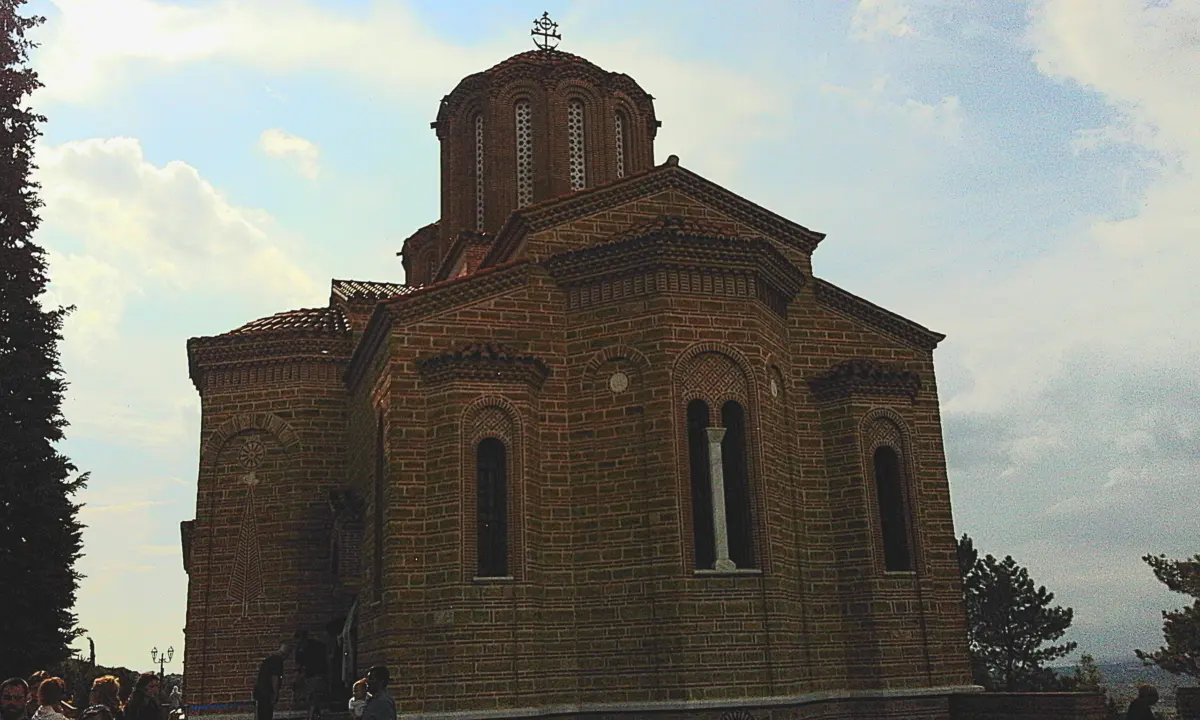
The priest of Farasa in Cappadocia, through whose prayers Christians and Muslims alike were healed, baptized the Venerable Paisios the Athonite, gave him his own name, and went with his flock into exile until his death on Corfu.
On 10 November the Church commemorates the Venerable Arsenios the Cappadocian. "Venerable" is the title the Church gives to saints who lived as monks. Father Arsenios served as a priest for more than fifty years in Farasa, a village in Cappadocia, the region at the heart of Asia Minor, in today's Turkey, where Saints Basil the Great and Gregory the Theologian once lived. In the summer of 1924, a week before the people of Farasa left their homes forever, he baptized an infant and gave him his own name. That infant became a monk on the Holy Mountain of Athos, and the Church honours him today as the Venerable Paisios the Athonite.
Most of what we know about Saint Arsenios was gathered by the Venerable Paisios himself. After transferring his relics in 1958, he went from place to place seeking out the elderly people of Farasa scattered across Greece, and wrote down what he heard from those who had known him. The lines below follow his book, Saint Arsenios the Cappadocian.
In this article
The child pulled from the water
Saint Arsenios was born around 1840 in Farasa, the most important of the six Christian villages of the district that bore the same name. At baptism he was given the name Theodore. His father, Eleftherios, was a teacher, and his mother was called Varvara. Both died while the children were still small, and Theodore and his brother Vlasios were raised by their mother's sister.
One day, as the two brothers were crossing a stream to reach a field, the swollen waters swept Theodore away. Vlasios called on Saint George, whose small chapel stood nearby. At once Theodore was beside him and told him that a horseman dressed as a monk had pulled him out of the water. From that day the child resolved to become a monk. Vlasios too would serve God in his own way, as a teacher of Byzantine chant in Constantinople.
For his schooling Theodore was sent to Niğde, a town in Cappadocia, where he was taken in by a sister of his father who was a schoolteacher. She later sent him to relatives in Smyrna so that he could continue his studies. There he studied Greek and church subjects and learned Armenian, Turkish and a little French. In the holidays he would gather the local children and teach them to read and write from the books of the Church.
Monk and priest in his own village
At about twenty-six, Theodore entered the Monastery of Saint John the Forerunner, also called the Monastery of the Flavians, near Caesarea in Cappadocia. There he was tonsured a monk and given the name Arsenios. Metropolitan Paisios II of Caesarea, himself a native of Farasa, ordained him deacon and sent him back to his home village to teach the children. Around 1870, when he was about thirty, he was ordained priest in Caesarea. He received the rank of archimandrite, an honour the Church gives to priest-monks, and the blessing to be a spiritual father, that is, to hear the confessions of the faithful and guide their souls.
After his ordination he went to Jerusalem to venerate the Tomb of the Lord. When he returned, people began to call him Hadji-Efendi. A "hadji" was one who had made pilgrimage to the Holy Places, and "efendi" was a Turkish word of respect meaning "sir". By this name both the Christians and the Muslims of the district called him for the rest of his life. He went to Jerusalem four more times, and each time he walked five days on foot to the port of Mersin, where he took the ship.
Farasa had lived for centuries under Turkish rule, and the Christians' school was regarded with suspicion. So Father Arsenios ran it with great care, so as not to draw the attention of the authorities. The children had no desks and learned kneeling on goat or sheep skins. Sometimes the lessons were held in a little chapel of the Mother of God carved into the rock, high on a cliff.
The doctor of those who had no doctor
The Venerable Paisios writes that in Farasa and the whole district there was no doctor other than Father Arsenios, who was a teacher and a physician of souls and bodies. He wrote no prescriptions. He would ask the sick person what was wrong, so as to know which prayer to read, sign him with the Holy Gospel and read prayers over him from the Euchologion, the priest's book of prayers. The people of Farasa later said that only in Greece did they learn what it meant to go to a doctor, and those who heard them there were amazed.
When the Euchologion had no prayer for a particular need, Saint Arsenios laid that need before God in the words of the Psalms. He had appointed a psalm for each human need, and the Venerable Paisios preserved this order and handed it on, himself adding the uses for the last two psalms. The first Psalm, which begins "Blessed is the man" and likens the righteous man to a tree planted by the waters, he read when a tree or a vine was planted, that it might bear fruit. The second Psalm he read for those going to councils and meetings, that God might enlighten them. The eighth Psalm he read for those who suffered harm from demons or from wicked people. The Gospel he read for the gravest afflictions, over the blind, the mute and the paralysed, and over those tormented by unclean spirits.
Everyone in need came to him, Christians and Muslims alike. Once they brought him a Turk who could not speak, and while Father Arsenios was reading the Gospel over him, the man began to speak before the reading was finished. Another time, a Turk from a neighbouring village mocked the holy water blessed on the feast of Saint John Chrysostom and found his head turned backwards. They brought him to Saint Arsenios, but Father Arsenios kept him for a week without reading any prayer over him. To his chanter, who wondered at the delay, he said that the man was stubborn and that, if he were healed at once, he would go back and mock the holy water again. After a week he read over him, the man's head returned to its place, and Father Arsenios advised him from then on to bow from a distance to the holy things of the Christians and keep away from them.
Those who could not come would send him a garment of the sick person; he prayed over it and sent it back. For all this he never accepted money or gifts, and he did not even touch money with his hand. To those who insisted he would say: "Our faith is not for sale."
The Venerable Paisios also heard from the people of Farasa about something that happened at a small chapel of the Mother of God built on the edge of a precipice, reached by forty steps cut into the rock and another hundred and twenty wooden steps. After the Divine Liturgy, Father Arsenios stepped out onto the chapel's wooden terrace; a plank came loose from its nails and he fell into the ravine. A peasant who saw him fall hurried down and found him whole but motionless. When he reached out his hand to him, Father Arsenios said: "Don't touch me! Nothing is wrong with me!" He did not stir because he was overwhelmed by what he had experienced: he had felt like an infant in its mother's arms, for a Woman had caught him as he fell.
Asceticism hidden beneath severity
With himself, Saint Arsenios was very severe. He fasted on Mondays, Wednesdays and Fridays, not even drinking water until sunset, and he made prostrations, that is, bows to the ground, also on behalf of those who could not make them themselves. On Wednesdays and Fridays he shut himself in his cell for prayer. On those days no one in Farasa disturbed him, and the sick would take earth from the threshold of his cell and place it on the part of the body that pained them, so as to be healed. He went barefoot almost always and put on shoes only when he had to meet people. He never mounted an animal, however long the journey, and the donkey he took with him carried only the load. On the great feasts they kept vigil all night, from sunset to sunrise, most often only he and his chanter, Prodromos.
He hid his holiness with care. At times he appeared surly, odd, or even greedy at table, so that people would not praise him, and he received unjust blame with joy. Yet his smiling eyes gave him away, and those who had known him for years were not deceived. When someone told him he was a saint, he cut him short with harsh words. They wanted to make him a bishop, and he answered: "I won't become one, because I'm afraid of pride." Not even the request of the Patriarch of Jerusalem, sent through his brother Vlasios, moved him.
The Venerable Paisios says of him that he proclaimed true Orthodoxy with his Orthodox life, and sums him up thus: "Few words, many miracles." Beneath his hard shell he hid his sweet spiritual fruit. He was a very strict father to himself and a very loving father to his spiritual children.
The baptism of August 1924
After the war between Greece and Turkey, the two states agreed in 1923 on an exchange of populations: the Orthodox Christians of Asia Minor were to be moved to Greece, and the Muslims of Greece to Turkey. The people of Farasa were among the last to leave their land. Father Arsenios had known for many years that this day would come, for God had revealed it to him, and he urged the people to save money for the journey. A year before the departure, an anxious woman came to him, and he told her to go about her work in peace, for there was still a year left.
On 25 July 1924, the feast of Saint Anna, a son was born in the house of Prodromos Eznepidis, then the head of the Christian community of Farasa, and his wife Evlampia. This Prodromos was a different man from Father Arsenios' chanter. The child's father greatly loved Father Arsenios, the family's spiritual father. On 7 August, a week before the departure, Saint Arsenios baptized all the unbaptized children of the village, so that, whatever might befall them on the road, they would have received Christ and been born anew in the font of their own homeland.
The parents wanted to give the infant his grandfather's name, Christos, according to local custom. Father Arsenios did not agree. He told them that if it was natural for them to want to leave someone to follow in the grandfather's footsteps, it was just as natural for him to want to leave a monk to follow in his own. Then he turned to the godmother and said: "Arsenios will be his name!"
Whether it was Father Arsenios' prayer that worked here or his gift of seeing what was to come, both reveal his holiness. The child grew up hearing stories about Hadji-Efendi, and at five he was already saying that he would become a monk.
After the baptisms, Father Arsenios spent a whole week digging to hide the sacred vessels, some in the church of the Holy Martyrs Jonah and Barachisios, others in the cemetery, so that they would not be desecrated, since they could not take them along.
The road of exile
On 14 August 1924, after the Turks had driven them out of their houses, the people of Farasa set out. Father Arsenios was past eighty. The village council appointed three young men to accompany him and prepared a mount for him, but he went on foot, as he had all his life. The first stop was at Yahyalı, where they celebrated the Dormition of the Mother of God. There Father Arsenios remembered that he had left on the Holy Table of the church of Saints Jonah and Barachisios a fragment of the relics of Saint John Chrysostom. He went back alone, on foot, to Farasa and back again, sixty kilometres in all, to bring it with him.
The authorities had given them a gendarme to guard them on the road. Between two villages, a Turk on horseback rode up in anger and asked why they did not throw the old priest away somewhere and be rid of him. Father Arsenios only told him to go on his way, and the man fell from his horse some twenty metres further on. The gendarme cried out in Turkish: "Sen sin Aziz!", that is, "You are a saint!", and from then on treated Father Arsenios with every courtesy.
At Niğde, Father Arsenios read the Gospel over the daughter of a rich man, who was tormented by an unclean spirit, and the girl was healed. Her father insisted on giving him money, fearing that she would fall ill again if Father Arsenios did not accept it. Then Saint Arsenios poured the money out on the ground and told him that, if he did not want his daughter to fall ill again, he should gather it with his own hands and give it to the poor. The man did exactly that.
On the ship, he told those who were troubled that they could not keep the fast to eat without worry whatever was in the pot. He himself kept to his barley bread, of which he also gave to others, and asked them not to follow his example, because he was a monk. Already in Farasa he had told them many times that in Greece he would live only forty days and that he would die on an island.
The ship reached Piraeus on the feast of the Exaltation of the Holy Cross, 14 September 1924 according to the old calendar, and the people of Farasa joyfully celebrated the day they set foot on the soil of Greece. They then spent three weeks in a camp surrounded by barbed wire, and in mid-October they were taken to the island of Corfu and settled in the town's old fortress.
Falling asleep in the Lord on Corfu
In the fortress, Father Arsenios lived with the Eznepidis family, the parents of the infant he had baptized. He served the Divine Liturgy twice in the church of Saint George within the fortress and went to venerate the relics of Saint Spyridon and the tombs of the Holy Apostles Jason and Sosipater, who brought the Gospel to Corfu.
A few days later he fell ill. The doctor asked that he be taken to hospital, and with tears he begged his spiritual children to let him die beside them. They took him nevertheless, out of love, believing that he would recover there. In the hospital, the chanter Prodromos offered to wash his clothes, but Father Arsenios told him not to trouble himself, because in two days those clothes would go into the ground. To those who came to see him he spoke about the soul, which needs more care than the body, destined to return to the earth. That was his last sermon.
In those days the Mother of God appeared to him, told him that his departure was near, and showed him the monasteries of the Holy Mountain. He told everything to the chanter Prodromos, with tears of joy. A quarter of a century later, the infant baptized in Farasa would himself go up to the Holy Mountain.
He received Holy Communion and asked to be left alone, so that no one would disturb his prayer. On 10 November 1924 he gave up his soul into the hands of God, holding tightly to his breast the fragment of the relics of Saint John Chrysostom that he had gone back to fetch from Farasa. He left behind nothing but a few worn-out books. Thus, as the Venerable Paisios testifies, what he had foretold to them was fulfilled. It was the day on which the Church also commemorates, among the Apostles of the Seventy, Saint Sosipater, at whose tomb he had prayed shortly before.
They buried him in the town cemetery, in the section set aside for clergy, and his spiritual children placed over the grave a marble slab bearing his name.
The relics at Souroti
In October 1958 the Venerable Paisios, by then a monk, opened the grave on Corfu and took the relics to Konitsa in Epirus, where his family had settled together with other people from Farasa. In 1970 he moved them to the women's Monastery of Saint John the Theologian at Souroti, near Thessaloniki, founded in 1967 with his support and under his spiritual guidance. Since then, those who come to the relics of Saint Arsenios have testified to many apparitions and miracles. On 11 February 1986 the Ecumenical Patriarchate numbered him among the saints and appointed his commemoration for 10 November, the day on which he departed to the Lord. The grave on Corfu was restored in 1995, and a service is held there every year on his feast.
The Venerable Paisios said of him: "My thought tells me that the greatest divine work of the holy Father is only now beginning." He held that, being near to God, Saint Arsenios can now help those who suffer more quickly and more fully than in his lifetime.
The Venerable Paisios fell asleep in the Lord in 1994 at Souroti, and in 2015 the Ecumenical Patriarchate numbered him too among the saints. His grave lies beside the church of Saint Arsenios in the monastery, so that the spiritual heir rests today close to the relics of the one who baptized him.
The life of Saint Arsenios is the life of a monk who lived in the midst of people, in a village under foreign rule, and kept his heart whole for God. He spoke little and hid himself as much as he could, and the working of grace was seen in those he healed. He went with his flock along the road of exile to the very end and died among his own, far from home. Before leaving Cappadocia, he left a monk behind him, as he had wished, and through that monk his name has reached the faithful throughout the world.
Holy Venerable Father Arsenios, pray to Christ our God for us!
Sources
- Venerable Paisios the Athonite, Ο Πατήρ Αρσένιος ο Καππαδόκης, Holy Hesychasterion "Evangelist John the Theologian", Souroti, 1979; English translation: Saint Arsenios the Cappadocian, Holy Monastery "Evangelist John the Theologian", Souroti, 1989 and 2001.
- Pemptousia, The life of Saint Arsenios the Cappadocian, parts 1–3 (translated from the book of the Venerable Paisios).
- Konstantinos P. Thymis, "Ο Άγιος Αρσένιος ο Καππαδόκης (1840-1924) και ο τάφος του στην Κέρκυρα", Orthodoxia News Agency, 10 November 2020.
- Hieromonk Christodoulos the Athonite, Ο Γέρων Παΐσιος, Holy Mountain, 1994 (the list of psalms used by Saint Arsenios); English translation: "Blessing-Psalter of St. Arsenios of Cappadocia", Internet History Sourcebooks, Fordham University.
- Sfântul Arsenie Capadocianul, Romanian edition, excerpts reproduced in the newsletter of the Parish of the Resurrection – Dacia, November 2023.
- Orthodox Church in America, "Venerable Paisios of the Holy Mountain".
