
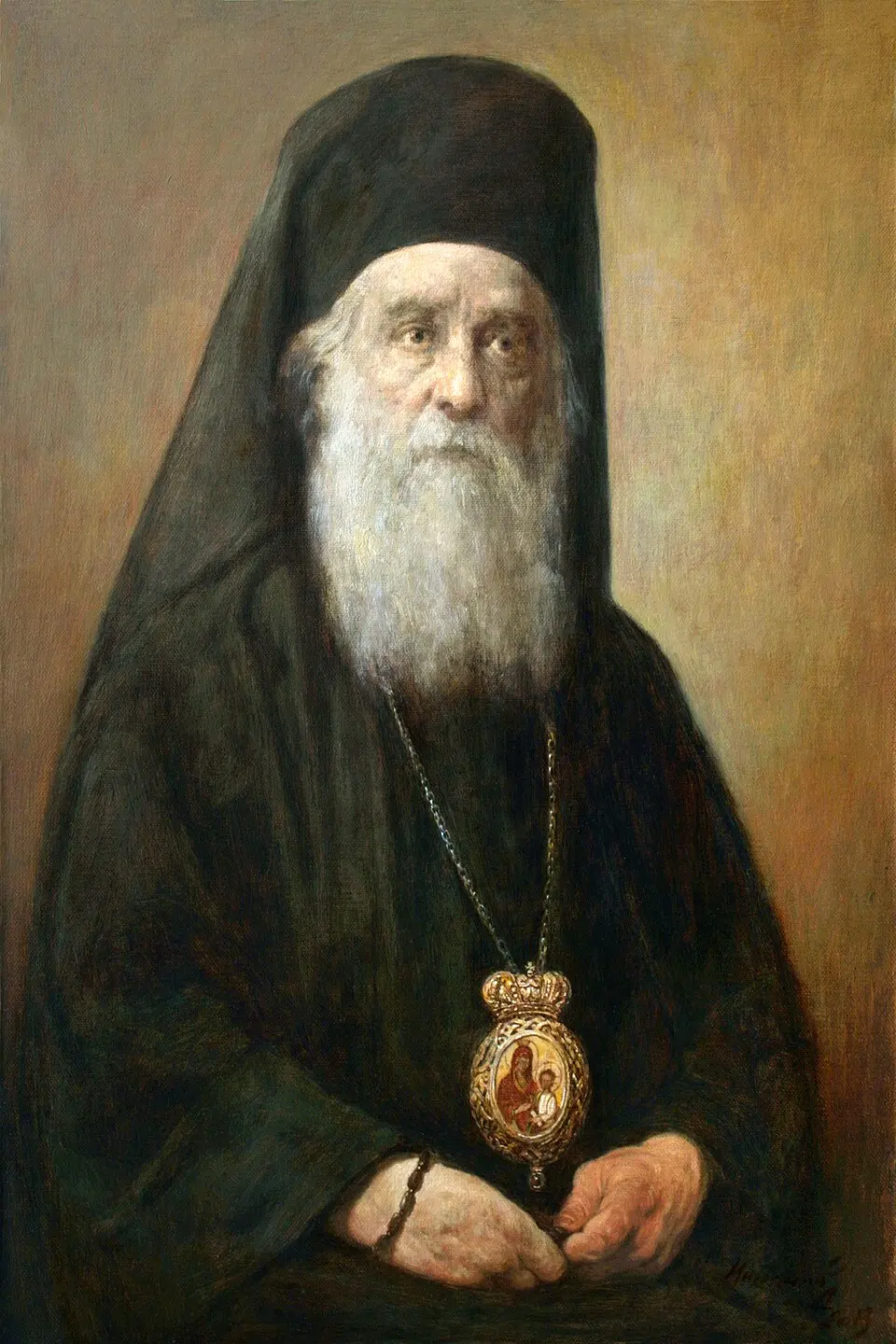
On 9 November the Church commemorates the Holy Hierarch Nectarios the Wonderworker, Metropolitan of Pentapolis, who lived from 1846 to 1920. Most of the faithful know him as a saint quick to help in sickness, and they ask for his prayers above all in grave suffering. Fewer know that he was a bishop driven from his ministry without any trial, that he lived for thirty years under the weight of slander, that he died in a hospital ward for the poor, and that the Patriarchate which had cast him out asked his forgiveness only seventy-eight years after his death.
His life shows how a holy man can be wronged even by those who bear responsibility in the Church, and how God does him justice, often after people have kept silent for a long time.
In this article
The child from Silivria
The saint was born on 1 October 1846 in Silivria, a small town in Thrace not far from Constantinople. At Baptism he received the name Anastasios, and his family, the Kephalas family, was poor and devout. At fourteen he left for Constantinople to work and to continue his schooling, because at home there was nothing to live on.
There he worked for a tobacco merchant. On the papers in which the goods were wrapped he wrote short sayings from spiritual books, so that the customers would read them too. His biographers relate that, having neither clothes nor shoes, he wrote a letter to Christ: “I have no apron and no shoes. Send them to me. You know how much I love You.” A merchant from the shop across the street offered to take it to the post, opened it and sent the boy money without saying where it came from. His employer suspected Anastasios of stealing and beat him, and the boy answered: “I have never stolen anything. Christ sent me the money.” Only then did the merchant across the street tell what he had done.
In 1866 he came to the island of Chios, where he taught at a village school. He remained there for several years, and his longing for a life given to God grew in him with the years. In 1876 he entered the brotherhood of the monastery of Nea Moni on Chios and was tonsured a monk with the name Lazarus. On 15 January 1877, Metropolitan Gregory of Chios ordained him deacon and gave him the name Nectarios, by which the Church would remember him.
People who loved the Church paid for his studies. The Choremi brothers helped him study in Athens, and from 1882 Patriarch Sophronios of Alexandria supported him through the Faculty of Theology, on the understanding that he would afterwards return to serve the Patriarchate. He completed his studies in 1885. The same patriarch who helped him study then would, a few years later, drive him out of Egypt.
Metropolitan of Pentapolis
After his studies Nectarios went to Egypt. On 23 March 1886 he was ordained priest by the Patriarch of Alexandria in the church of Saint Savvas, and in August of the same year he received the rank of archimandrite. He then served at the church of Saint Nicholas in Cairo. On 15 January 1889, Patriarch Sophronios consecrated him Metropolitan of Pentapolis. Pentapolis was the ancient province of the five cities of Cyrenaica, in present-day Libya, where a flourishing Church had once stood.
The new metropolitan stayed on to serve in Cairo. The people quickly came to love him, because he was gentle, poor and close to simple folk. This love, however, stirred the envy of certain clergy around the patriarch. They began to tell the aged Sophronios that Nectarios wanted his throne, that his piety was only outward show, and that he was using the people’s love to become patriarch. The patriarch believed what he was told. Alongside this accusation went other slanders about his conduct, which reached Athens before he did.
On 3 May 1890, by a notice of the Patriarchate, Nectarios was relieved of all his ecclesiastical duties. His pastoral work stopped at once, and the metropolitan remained withdrawn in his room. According to his Lives, the act of removal said only that he was relieved of his ministry “for reasons known to the Patriarchate”, and this silence left room for every suspicion. On 11 July a second notice followed, by which his presence in Egypt was no longer considered necessary, together with a letter of discharge, called in Greek an apolytírion. The reason given was his inability to adjust to the climate of Egypt.
His relatives preserved the memory that he asked to be received by the patriarch and that Sophronios did not receive him. On 29 July a delegation of nearly nine hundred faithful from the Greek community of Cairo brought him a letter of farewell. In October 1890 he left Egypt for good, without starting a campaign against the patriarch and without answering slander with slander.
On 28 January 1894, Greece’s political agent in Egypt, Ioannis Gryparis, wrote to the minister Dimitrios Kallifronas that the real causes had been disobedience to Patriarch Sophronios and “other reasons of an ethical nature”. The reason in the Patriarchate’s acts and the one in the diplomat’s letter do not agree, and the accusations were never examined at any church tribunal where Nectarios could defend himself. Saint Nectarios was not deposed. He kept his rank as a bishop and could serve wherever the local bishop allowed him, but he was deprived of his ministry and sent away from Egypt on the strength of suspicions that no one ever proved.
A bishop without a place
He arrived in Athens alone, without a post and without means. The slanders had gone ahead of him, so doors closed one after another. His biographers say that in those months he was at times without even his daily bread. A metropolitan of the Church walked the streets of Athens looking for work and found none.
Day after day he went to the Ministry of Religious Affairs to ask for a post. The officials quickly grew tired of him and began to treat him rudely. A friend he had known in Egypt saw the state he had come to and spoke for him to the Minister of Religious Affairs and Public Education.
So, in February 1891, he was appointed preacher on the island of Euboea. It was a post usually given to a priest or a hieromonk, not to a bishop. Nectarios accepted it without complaint. He went through the villages of Euboea, preached, heard confessions and taught the people to pray, as though this had always been his calling.
But the slanders reached him there too. During his sermons some laughed and whispered among themselves. Nectarios gave up the post and returned to Athens.
Between August 1893 and April 1894 he wrote several times to Patriarch Sophronios. One of these letters contains the words: “I have already forgiven all, and pray for those who sinned against me.” He was writing to the man who had banished him, at a time when he still bore all the consequences of that banishment, and without any of those responsible having asked his forgiveness.
The man who forgave his persecutors did not overlook an injustice done to others. In a letter to the Archbishop of Sinai, Nectarios pressed for the debt owed to a Muslim coachman to be paid; the man had been waiting two years for the money for the carriages he had provided for the funeral of an Orthodox Christian.
Meanwhile, some people of influence had come to see that the rumours about him were false. With their support, in March 1894, he was appointed director of the Rizarios School in Athens, a school that prepared young men for the priesthood. He remained there for fourteen years. The future priests knew him as a father who asked of them what he first lived himself. It is said that when some of them did wrong, he fasted for them, taking their fault upon himself instead of punishing them.
Alongside the school, he wrote and printed many books of dogmatics, of moral teaching and of spiritual life, for future priests and for simple believers, always relying on Holy Scripture and the Holy Fathers. As early as 1884 he had printed Ten Ecclesiastical Discourses. In 1905 he printed the Theotokarion, a small book of prayers to the Mother of God, which also contains the hymn Agní Parthéne (“O Virgin Pure”), sung today throughout the Orthodox world.
In all these years Nectarios remained a bishop without a diocese. He was entrusted with preaching and with the school, ministries of great benefit to the Church, but he was never given a flock to shepherd as a bishop, and his name still carried the shadow of the slanders from Egypt. He shepherded through the word, through his books and through the priests he trained.
The monastery on Aegina
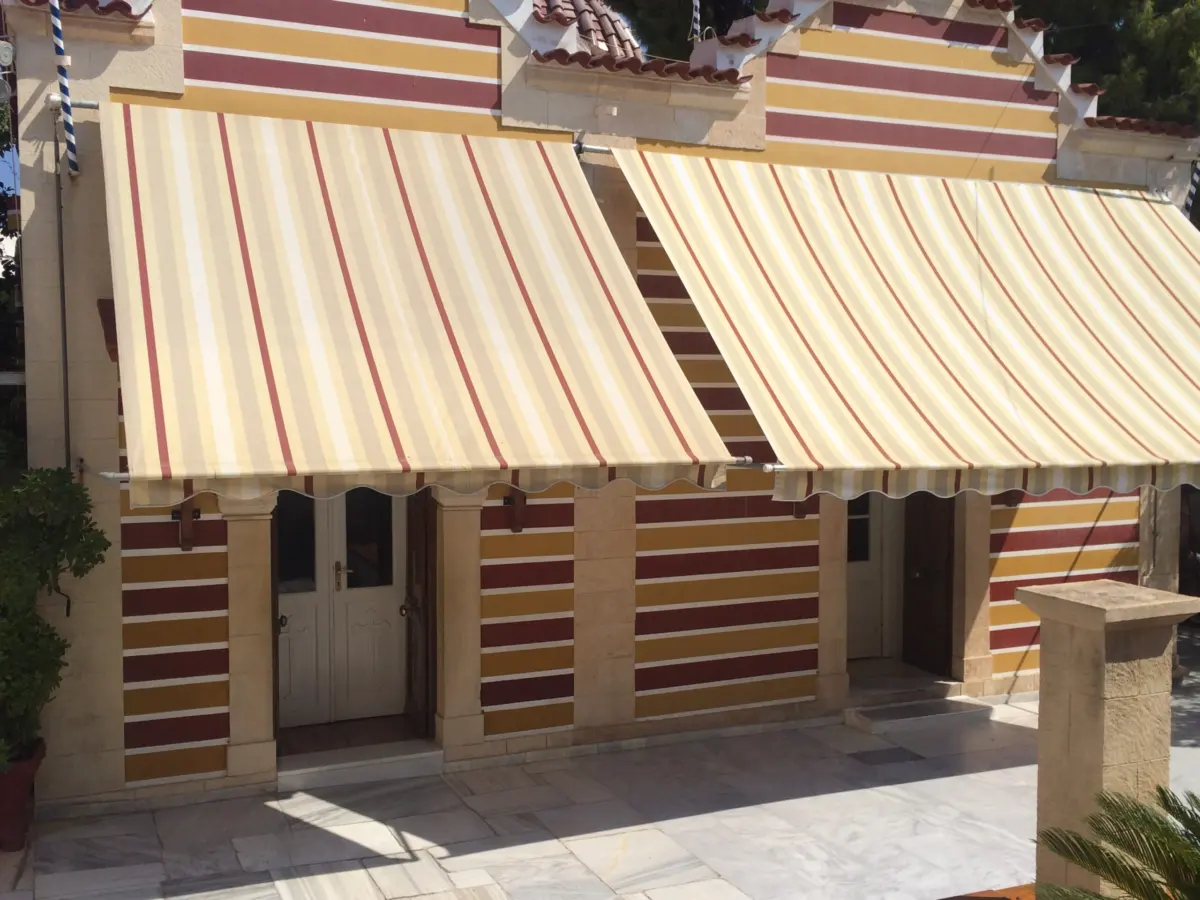
A few devout women who had Nectarios as their spiritual father asked him to help them lead a monastic life. In 1904 he founded for them the monastery of the Holy Trinity on the island of Aegina, on the site of an old abandoned church. He built it with his own money and worked on the building himself, carrying stones and tending the garden in plain clothes, like an ordinary man. The community grew to thirty nuns. He made Mother Xenia, who was blind, the abbess, and he remained their spiritual father. He used to tell them: “I am building you a lighthouse, and God will place in it a light that will shine out to the world.”
In February 1908 he resigned as director of the school, and in April, at sixty-one, he settled on Aegina. There he spent the last twelve years of his life, in prayer, in the services and in caring for the nuns entrusted to him.
Even here he was not left in peace. The slanders began again, this time about the monastery, and once more they came from certain hierarchs. Metropolitan Theokletos of Athens had promised him that he would recognise the monastery. When it began to grow, he withdrew his promise and even threatened to dissolve it. In June 1914 Nectarios wrote to him again. The reply came only three months later and demanded a detailed account of the nuns, the money and the gifts, as though it were an enterprise suspected of dishonesty.
His Lives also preserve an incident from these years. A sixteen-year-old girl had sought refuge in the monastery, fleeing from her mother, who had come to endanger her life. The mother began to slander Nectarios, and the prosecutor came to Aegina with two gendarmes, forced the monastery gate and entered the cell of the old man, who was then about seventy. He insulted him with foul words, seized him by his cassock and threatened to pull out his beard hair by hair. Nectarios did not defend himself. He only pointed to heaven and said: “God sees. God knows!” The same Lives say that a few days later the prosecutor fell gravely ill and then came with his wife to ask forgiveness, and the saint prayed for him and forgave him.
Nectarios answered all of this with patience. His biographers preserve the prayer with which he then entrusted the monastery to the Mother of God. He asked for her protection at least for the sake of the simple souls of the nuns, whom he considered worthier than the souls of the learned, among whom he counted himself. The monastery was officially recognised only on 15 May 1924, by Archbishop Chrysostomos of Athens, four years after the death of its founder.
Death in the ward of the poor
In 1920 Nectarios fell gravely ill. The nuns insisted on taking him to hospital in Athens, although he did not want to leave the monastery. On 20 September, Mother Euphemia took him to the Aretaieion hospital. Because he had no money, he was placed in a third-class ward, where a few beds were kept for poor patients and for those whom the doctors could no longer cure. A metropolitan of the Church lived his last days among the poorest people of Athens, as he had lived all his life.
He died on 8 November 1920, at seventy-four, after nearly two months in hospital. The Church commemorates him on 9 November, because 8 November is the feast of the Synaxis of the Holy Archangels Michael and Gabriel.
Immediately after his death, a nurse and Mother Euphemia, who had accompanied him, began to prepare his body. They took off the woollen garment he was wearing and laid it for a moment on the next bed, where a man had lain paralysed for a long time. The sick man rose at once from his bed, began to walk and glorified God. The ward was filled with a fragrance such as those present had never known. It was the first of his miracles after death.
His body was taken to Aegina. The faithful carried it on their shoulders from the harbour to the monastery, and Saint Savvas the New of Kalymnos, his friend, buried him there.
The justice that came after death
Simple people honoured him as a saint before the hierarchs did, and among the very first was Saint Savvas the New himself. The nuns of the monastery preserved the memory that, some time after the burial, Savvas asked the abbess that no one disturb him for forty days, and he stayed shut in his cell. When he came out, he was holding an icon of Saint Nectarios, the first ever painted, and asked that it be placed in the church for veneration. The abbess was afraid, because Nectarios had not been numbered among the saints and the monastery might suffer for it. Savvas insisted and told her not to search out the will of God. The icon was set out for veneration nearly forty years before the canonisation.
More and more people came to venerate at his tomb. When they opened it, according to Greek custom, they found the body whole. Archbishop Chrysostomos of Athens came to see it and told the nuns to leave it in the sun for a few days and then bury it again, so that it would decompose. After a month or two they exhumed it once more and found it unchanged, so they placed it in a marble sarcophagus. The body remained incorrupt for many years; later it dissolved, and the bones remained. On 2 September 1953, thirty-two years after his death, Metropolitan Prokopios took out his relics and set them out for veneration.
On 20 April 1961, the Ecumenical Patriarchate numbered him among the saints, forty-one years after his death. The decision came from Constantinople, while the Patriarchate of Alexandria, which had cast him out, remained silent for nearly forty more years.
On 15 September 1998, the Synod of the Patriarchate of Alexandria, under Patriarch Petros VII, issued a decision restoring his ecclesiastical standing, with all the honour due to him. In the letter accompanying the decision, the Synod confessed the injustice done to the saint and wrote: “we ask Saint Nectarios to forgive us, the unworthy, and our predecessors.” The year 1999 was dedicated to his memory. One hundred and eight years had passed since his banishment from Egypt and seventy-eight since his death.
Saint Nectarios never fought to have people acknowledge his innocence, but God did him justice so fully that the successors of those who had banished him came to ask his forgiveness and his prayers.
In 2021 his life was brought to the screen in the film Man of God, directed by Yelena Popovic, with the Greek actor Aris Servetalis in the role of the saint. The film follows precisely the years of injustice: the banishment from Egypt, the years at the Rizarios School, the monastery on Aegina and his death in hospital, where the healed paralytic is played by Mickey Rourke. It premiered in April 2021 at the Moscow International Film Festival, where it won the audience award, and in Greece it was the third Greek film of the year by number of viewers. For many people who knew nothing about him, the film was their first meeting with Saint Nectarios.
What links his life to the history of heresies
In the study on the great heresies in Church history we followed hierarchs wronged by those who stood above them. Saint Flavian of Constantinople was deposed by a council led by the Patriarch of Alexandria, died from the beating he received, and only after his death was justice done to him, at the Council of Chalcedon. Saint Gregory Palamas was imprisoned and cast out of the Church by the patriarch of his own city, but he was vindicated in his lifetime, in 1347, and in the same year became Archbishop of Thessalonica.
The injustice done to Saint Nectarios did not arise from a heresy. No one accused him of teaching wrongly about God. He was struck by envy and slander. Yet the pattern is the same. In Alexandria, those who bore responsibility in the Church removed him without trial. In Athens they received him with suspicion: they gave him the preaching post in Euboea and then the school, but never a diocese, and his monastery was not recognised while he lived. The simple faithful knew him before they did: the people of Cairo who loved him, his students at Rizarios, the nuns of Aegina, the sick in the ward of the poor, the people who carried his body from the harbour. The hierarchy followed them, after forty-one years, and the Patriarchate that had banished him, after seventy-eight.
His veneration also began from below, from the people, before any decision of the hierarchs, as happens today too with many figures around whom crowds gather. What set him apart was not the number of those who honoured him. It was the way he bore injustice. He did not make his suffering into a banner. He accepted the lowliest post they gave him, remained in the Church, kept silent, forgave and prayed for those who slandered him, without gathering disciples against them. It is the path that, in the article on the two paths of one unjustly deposed, we called the path of the saints.
His example, however, has its measure. Saint Nectarios was struck by slanders concerning his own person. No one asked him to accept a foreign teaching, and he was not made to choose between the Orthodox faith and obedience to the patriarch. Where the faith itself was in danger, the saints spoke openly and refused communion with those who denied it: Saint Athanasius the Great before the Arians, Saint Maximus the Confessor before the Monothelites, Saint Mark of Ephesus at Florence. Nectarios’s silence concerns the injustice done to himself. It cannot be made into a duty of silence for one who sees the faith denied. The one who is wronged may ask for his due, just as Nectarios himself asked to be received by the patriarch.
The patience of the wronged
Saint Nectarios lived for nearly thirty years with his name stained, without ever finding justice on earth. He died without the Patriarchate having withdrawn its accusations and without the Metropolitan of Athens having recognised his monastery. Yet nothing he lived through made him shut himself up in bitterness. Those who knew him in his last years say that he was a gentle and peaceful old man who rejoiced in every soul that came to him.
For anyone wronged in the Church, his life brings consolation, because God sees what people do not want to see, and His justice comes, even if it comes late. It also shows how a personal injustice is to be borne: within the Church, with patience, without revenge and without making one’s pain a cause of separation. “God sees. God knows,” he said to the prosecutor who insulted him, and with these words he lived through all the years of injustice.
Today the faithful pray to Saint Nectarios above all for grave illnesses and for those suffering from cancer, and the Church receives his prayer with confidence, because God has worked countless healings through him. He who died among the poor sick of Athens, without money and without human honour, has remained close to those who suffer to this day. Besides healing of the body, one may also ask of him the gift he himself possessed above all: the strength to forgive and to remain gentle when one is wronged.
Holy Hierarch Nectarios, pray to God for us.
Sources
- Metropolitan Cleopas of Sweden, his study on Saint Nectarios published in 2021 (Orthodox Times and ProtoThema), for the notices of 3 May and 11 July 1890, the reason given in the letter of discharge, the letter of Ioannis Gryparis of 28 January 1894, the request to be received by the patriarch, the farewell letter of 29 July 1890 and the departure in October 1890. The study refers to Titos Matthaiakis, O Agios Nektarios, and to Constantine Cavarnos, St. Nectarios of Aegina.
- Historical archive of the Rizarios School (heritage.rizarios.gr), for the monastic tonsure, the ordination to the diaconate, the years at Rizarios, the retirement in 1908 and the date of his repose.
- Life of Saint Nectarios published by the Orthodox Church in America (oca.org), for the childhood letter to Christ, the words “for reasons known to the Patriarchate”, the petitions at the Ministry of Religious Affairs, the friend from Egypt who spoke to the minister, the mockery in Euboea, the support for the appointment at Rizarios, Mother Xenia and the saying about the lighthouse, the admission to hospital on 20 September 1920, and the opening of the tomb in the time of Archbishop Chrysostomos.
- Fr Theodoros Zisis, “Saint Nektarios as Seen Through his Letters”, in English translation on saintandrewgoc.org, for the letter to Patriarch Sophronios and the letter about the Muslim coachman.
- Life of Saint Savvas the New of Kalymnos (OrthodoxWiki), for the first icon of Saint Nectarios.
- Decision of the Synod of the Patriarchate of Alexandria of 15 September 1998 and the pastoral letter of 10 September 1998, in English translation on orthodoxphotos.com.
- Life of Saint Nectarios published by Pemptousia (in Greek), for the dates of his ordinations, the letter of 11 July 1890, the years at Rizarios, his repose at the Aretaieion and the uncovering of the relics.
- Vima Orthodoxias (in Greek), for the incident with the prosecutor on Aegina.
- Lives published by Holy Trinity Orthodox Church, OrthodoxWiki and Saint Andrew Greek Orthodox Church (for the conflict with Metropolitan Theokletos, 1914).
- Pemptousia, “Saint Nektarios, unappreciated by people, blessed by God” (2021), for the dates in Greece and the recognition of the monastery.
- The account of the room in the Aretaieion hospital where the saint reposed, published by John Sanidopoulos (2014).
- On the Theotokarion (1905) and the hymn Agní Parthéne: the Wikipedia article “O Virgin Pure”.
- Man of God, directed by Yelena Popovic, Greece, 2021.
