
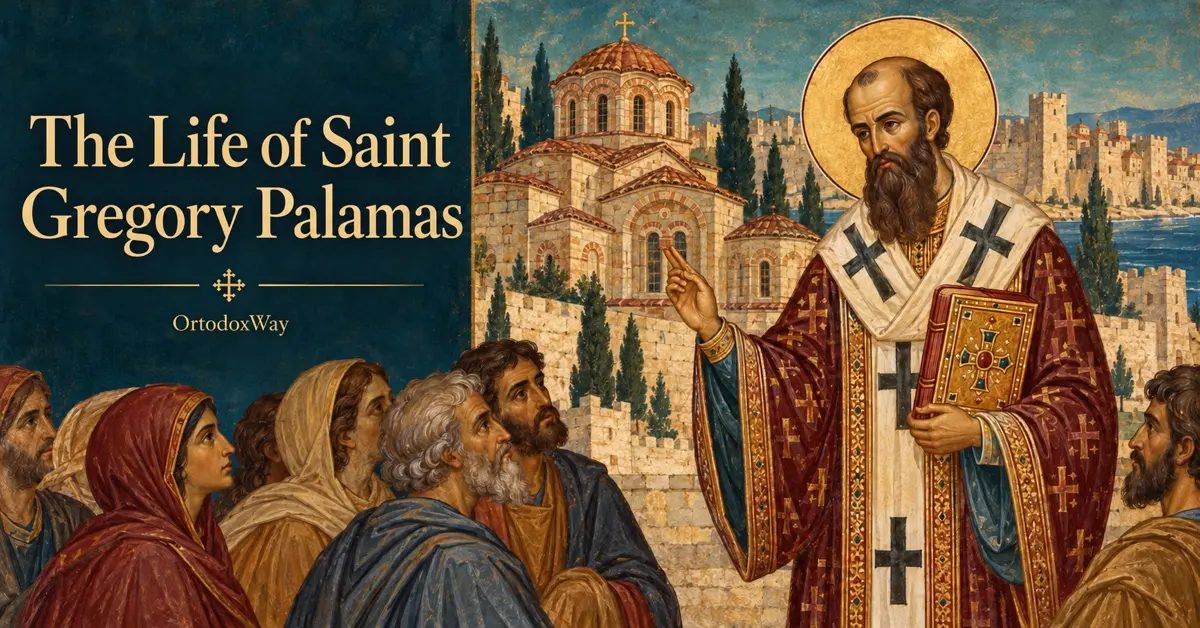
Saint Gregory Palamas lived in the fourteenth century, in the Byzantine Empire. He was a monk on the Holy Mountain of Athos and then Archbishop of Thessalonica, the second city of the empire. The Church celebrates him twice a year: on 14 November, the day of his repose, and on the Second Sunday of Great Lent, immediately after the Sunday of Orthodoxy. She honours him as a teacher of prayer and as a confessor of the divine light.
His Life was written by Patriarch Philotheos Kokkinos of Constantinople, who knew him personally and who, in 1368, numbered him among the saints. Most of the events told here are taken from that Life.
In this article
Childhood at the Emperor’s Court
Gregory was born around the year 1296 in Constantinople. His parents were of noble lineage and had come to the capital from Asia Minor. His father, Constantine, was a counsellor of Emperor Andronikos II, who had also entrusted him with the upbringing of his grandson, the future Emperor Andronikos III. Philotheos relates that this official prayed so deeply, even during the meetings of the imperial council, that at times he did not hear what the emperor was asking him.
Gregory was the eldest of the children. When he was seven years old, his father died, having received the monastic tonsure on his deathbed with the name Constantius. Before he died, he entrusted his children to the Mother of God. The emperor then took the boy under his protection.
Gregory studied grammar, rhetoric, natural science and logic, according to the curriculum of the schools of Constantinople. Philotheos relates that before each lesson the boy made three prostrations with prayer before the icon of the Mother of God, and then learned with ease. At about seventeen he spoke on the logic of Aristotle before the emperor and the court. The Grand Logothete, one of the highest officials of the empire, said that Aristotle himself, had he heard this young man, would have praised him greatly. The emperor wished to keep him at court in an office of state. Gregory refused, because his heart was turning towards the monastic life. Already while he lived in the world, Theoleptos, Metropolitan of Philadelphia, taught him the mysteries of watchfulness, that is, attentiveness to one’s thoughts, and of the prayer of the mind.
The Whole Family Gives Itself to God
At about twenty, around the year 1316, Gregory resolved to go to the Holy Mountain of Athos, and he urged his family to follow the same path. His mother, Kale, entered a monastery in Constantinople, where she received the monastic name Kallone. His two sisters, Epicharis and Theodote, also entered monasteries in the capital, together with some of the household servants. His brothers, Macarius and Theodosius, set out with him for the Holy Mountain.
They began their journey in the autumn and spent the winter on a mountain called Papikion. According to Philotheos, Gregory confronted a group of heretics there and brought back to the right faith their leader and some of his followers.
Disciple of the Elder Nicodemus
In the spring they reached the Holy Mountain. Gregory settled near the monastery of Vatopedi, under obedience to an elder named Nicodemus. Nicodemus was a hesychast. This was the name given to the monks who sought stillness of heart, called hesychia in Greek, and who prayed without ceasing with the prayer of the mind, calling upon the name of the Lord Jesus Christ. Under the guidance of Nicodemus, Gregory lived in fasting, vigil and prayer, and the elder tonsured him a monk.
In those years Gregory prayed without ceasing with the same words: “Enlighten my darkness!” Philotheos relates that after nearly two years spent in this prayer, the Holy Apostle and Evangelist John appeared to him. The Apostle told him that he had come to him as a messenger from the Mother of God, the Lady of all the saints, and he promised him her help and his own. Gregory asked whether this help would be given in this life or in the life to come. The Apostle answered: “Both in this one and in the one to come.”
After the death of Nicodemus, around 1319, Gregory entered the brotherhood of the Great Lavra, the monastery founded by Saint Athanasios the Athonite. There he served for three years as a chanter. He then withdrew for two years to Glossia, a skete, that is, a small settlement of monks living in neighbouring cells. There he lived under the guidance of another hesychast elder, also named Gregory, who had come from Constantinople.
Thessalonica and the Wilderness near Veroia
Around 1325, Turkish raids forced many monks to leave the Holy Mountain. Gregory departed with eleven brethren, intending to reach Jerusalem, and they passed through Thessalonica. His Life relates that there a man in the guise of a great official appeared to him, embraced him and told him that he was keeping him at his side. The brethren understood that this was the Holy Great Martyr Demetrius, the protector of the city. They gave up the journey to Jerusalem and remained in Thessalonica.
At the urging of the brethren, Gregory was ordained a priest around 1326. Beforehand he prayed to God to guide him, then opened the book of the apostolic Epistles and came upon the beginning of the Epistle to the Galatians, where Saint Paul writes that he was called to be an apostle by Christ, not by men. He received this word as an assurance that he should accept the ministry.
He then withdrew with ten disciples to a mountain near Veroia, a city in Macedonia, and lived there for five years. Five days a week he remained in his cell, in silence and prayer, receiving no one. On Saturday and Sunday he came out for the Divine Liturgy and spoke with the brethren about spiritual things.
During these years his mother died in Constantinople. Gregory went to the capital with his brothers and brought their sisters to a convent in Veroia. Philotheos writes that the elder sister, Epicharis, knew the day of her death nine days beforehand. She also foretold the approaching death of their brother Theodosius, and the return of Gregory and Macarius to the Holy Mountain, where heavy trials awaited them.
Near Veroia there also lived an elder named Job, who doubted Gregory’s teaching. Gregory taught that the Apostle Paul’s exhortation to pray without ceasing concerns all Christians, not only monks. While Job was praying, an angel appeared to him and confirmed Gregory’s word.
Again on the Holy Mountain
In 1331 the raids that were devastating the region of Veroia brought Gregory back to the Holy Mountain. He settled in the cell of Saint Sabbas, in the wilderness near the Great Lavra, and kept the same rule of prayer. In these years he wrote the Life of Saint Peter the Athonite, one of the first hermits of the Holy Mountain.
Around 1335 Gregory was for a short time hegumen, that is, abbot, of the monastery of Esphigmenou. He tried to strengthen the common life of the brotherhood, and then returned to the cell of Saint Sabbas.
Defender of the Hesychasts
In those years there lived in Constantinople a learned monk from Calabria named Barlaam. Around 1337 he began to mock the hesychasts and their prayer. Barlaam taught that the light seen by the Apostles on Mount Tabor, at the Transfiguration of the Lord, was a created light that appeared and then passed away. Gregory first tried to reconcile him with the monks. When he saw that this was impossible, he answered him in writing.
Between 1338 and 1340 he composed the three Triads in Defence of the Holy Hesychasts. In them he showed, according to the teaching of the Holy Fathers, that the light of Tabor is the eternal glory of God. God remains inaccessible in His essence, yet truly gives Himself to man through His uncreated energies. Through them man partakes of the life of God and is deified by grace, while remaining a creature. Gregory spoke from the experience of prayer that he had lived for years on the Holy Mountain, and he always set it beside the word of the Fathers.
In 1340 the best-known elders of the Holy Mountain signed a confession drawn up by Gregory, called the Hagioritic Tome, by which they declared that his teaching was their faith. On 10 June 1341 a synod gathered in the church of Hagia Sophia in Constantinople condemned the teaching of Barlaam, and he left Constantinople for good.
Prison
A few days after the synod, Emperor Andronikos III died, and his death opened a civil war that lasted until 1347. Patriarch John XIV Kalekas, one of those governing the empire in the name of the young heir, turned against Gregory. In 1342 synods convened by the patriarch condemned his writings, and Gregory was arrested. From the spring of 1343 until February 1347 he was held in the prison of the imperial palace. On 4 November 1344 a synod convened by the patriarch excommunicated him, that is, declared him cut off from the communion of the Church.
In these years Gregory and those of like mind ceased to commemorate the patriarch at the Divine Liturgy. We have written at length about this breaking of communion in the article “Saint Gregory Palamas and the Cessation of Commemoration“. During his years in prison Gregory continued to write and to support his friends and disciples by letters.
Archbishop of Thessalonica
In February 1347 a synod deposed Patriarch John, and John Kantakouzenos entered Constantinople and ended the war. Gregory came out of prison. In the spring of that same year the new patriarch, Isidore, one of his disciples, raised him to be Archbishop of Thessalonica.
Thessalonica was then in the hands of the Zealots, a rebel movement that had held the city since 1342 and did not recognize the new emperor. They refused to receive the archbishop. Gregory waited for several years, first on the Holy Mountain and then on the island of Lemnos. During this time he wrote the One Hundred and Fifty Chapters. Only in 1350 was he able to enter the city.
In May 1351 a great synod held in the palace of Blachernae in Constantinople confessed his teaching as the faith of the Church and condemned Barlaam and Gregory Akindynos, his other great opponent. The decisions of this synod were entered into the Synodikon of Orthodoxy, the text appointed for the Sunday of Orthodoxy, by which the Church confesses the right faith and condemns heresies. From the autumn of that year Gregory remained steadily in Thessalonica, with his flock. Many in the city had taken the side of his opponents, and he shepherded them and taught them by his preaching. Many of his homilies have been preserved to this day.
Captive among the Turks
In March 1354 Gregory was travelling by sea to Constantinople when his ship was seized by the Turks of the Emir Orhan. He was led as a captive through several cities of Asia Minor, among them Lampsakos, Brousa and Nicaea. Even in captivity he remained a shepherd. At Lampsakos he spoke to the Christians of the city. Near Brousa he spoke about Christ with Ismail, a grandson of the emir. He held other discussions about the faith as well, and he wrote a letter to his Church in Thessalonica recounting all that he had passed through.
In the spring of 1355 he was ransomed by the Serbs and returned to Constantinople. There he had yet another disputation, before the emperor, with the scholar Nikephoros Gregoras, his opponent. In the summer of the same year he came back to Thessalonica.
His Repose
He spent his last years shepherding his flock, preaching and praying for the sick. Philotheos, who wrote his Life, gathered many healings worked through his prayers, both during his life and after his repose.
Saint Gregory reposed in the Lord on 14 November 1357, after an illness. The Lives of the saints composed later preserve the account that in the days before his death Saint John Chrysostom appeared to him, and that his last words were: “To the heights! To the heights!”
His body was laid in the church of Hagia Sophia in Thessalonica, the cathedral of the archdiocese. After the Turks turned it into a mosque, his relics were moved, according to the tradition preserved in the city, to the church of Saint Demetrius by the sea, which became the new cathedral. In 1890 a fire consumed this church, and the relics were touched by the flames. The city then built a new cathedral, consecrated in 1914 and dedicated to Saint Gregory Palamas. His relics rest there to this day, in a silver reliquary.
In 1368 a synod presided over by Patriarch Philotheos Kokkinos numbered him among the saints. Philotheos also composed his service, which the Church sings to this day.
Light of Orthodoxy
The second commemoration of Saint Gregory falls on the Sunday after the Sunday of Orthodoxy, on which the Church celebrates the triumph of the holy icons. In his troparion the Church calls him the light of Orthodoxy, the support and teacher of the Church, the adornment of monastics, the invincible champion of theologians, a wonderworker, the boast of Thessalonica and the herald of grace, and she asks him to intercede unceasingly for the salvation of our souls.
The young monk of Vatopedi prayed with the words “Enlighten my darkness!”, and his prayer was heard. The light he asked for in his youth he later confessed in his writings, before the synods, and in his years of prison and captivity. Those who pray with a pure heart seek the same light today, and Saint Gregory remains for them a guide and an intercessor. Through his prayers may Christ enlighten our darkness too.
Sources and Studies
- Philotheos Kokkinos, Encomium of Saint Gregory Palamas: PG 151, 551–656; critical edition by D. G. Tsames, Thessaloniki 1985, pp. 427–591. Consulted in the Russian translation: «Житие и подвиги святителя Григория Паламы, архиепископа Фессалоникийского», Odessa, 1889.
- Romanian translation: Saint Philotheos Kokkinos, “Cuvânt la cel întru sfinți Părintele nostru Grigorie, Arhiepiscopul Tesalonicului”, in Saint Gregory Palamas, Tomosuri dogmatice – Viața – Slujba. Scrieri I, trans. Deacon Ioan I. Ică Jr., Deisis, Sibiu, 2009.
- J. Meyendorff, Introduction à l’étude de Grégoire Palamas, Paris, 1959 (English translation: A Study of Gregory Palamas, London, 1964). Consulted in the Russian translation, Saint Petersburg, 1997.
- Православная энциклопедия, article “Григорий Палама”.
- A. Rigo, “La canonizzazione di Gregorio Palama (1368) ed alcune altre questioni”, Rivista di Studi Bizantini e Neoellenici 30 (1993), pp. 155–202.
- A. Rigo, “La prima redazione del I Antirretico contro Niceforo Gregoras di Gregorio Palamas e la Risposta sul Contro Eunomio di Basilio di Cesarea”, La Parola del Passato 73, no. 2 (2018, published 2021), pp. 343–358.
- A. Philippidis-Braat, “La captivité de Palamas chez les Turcs: dossier et commentaire”, Travaux et Mémoires 7 (1979), pp. 109–222.
- M. Mitrea, “Monasticism and Kinship in Byzantine Hesychastic Hagiography”, Greek, Roman, and Byzantine Studies 61, no. 3 (2021), pp. 396–422.
- Th. Mantopoulou, “Ο παραθαλάσσιος Ναός του Αγίου Δημητρίου στη Θεσσαλονίκη”, Μακεδονικά 20 (1980), pp. 175–192 (the transfer of the relics and the fire of 1890).
- For the vision in his last illness and his last words: Афонский патерик, 7th ed., Moscow, 1897, under 14 November; Saint Dimitri of Rostov, Lives of the Saints, under 14 November.
Notes
- Year of his repose: 1357, according to A. Rigo, on the basis of the Life written by Philotheos. Many Lives and synaxaria give the year 1359, and some give 1360.
- The troparion is rendered here by its sense, not as a liturgical text.
