
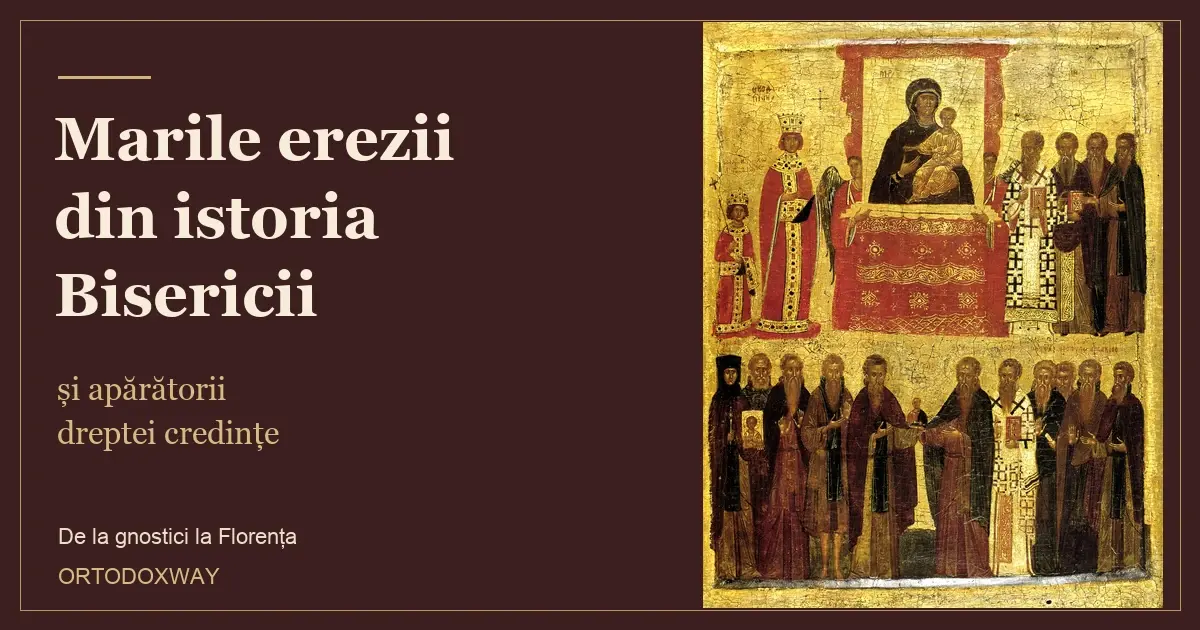
This study follows twelve heresies in Church history, from the Gnostics of the second century to the Union of Florence in the fifteenth. For each one we ask three questions: how long it lasted, how far it spread, and who opposed it.
By heresy we mean a teaching that departs from the faith received from the Apostles and kept by the Church. Such a teaching is false from the moment it appears, not from the day it is condemned. The councils examined it, condemned it, and confessed the Orthodox faith in its place. The word comes from the Greek hairesis, which meant "choice" and later "school of thought". In the language of the Fathers, the word came to name the teachings by which people depart from the apostolic faith, putting an interpretation of their own in place of the teaching kept by the Church.
The Holy Fathers also compiled lists of this kind. St Irenaeus of Lyons wrote five books against the Gnostics around the year 180. St Epiphanius of Salamis described eighty heresies in his Panarion, and St John of Damascus gathered a hundred in his book On Heresies. The Fathers showed above all what the heretics taught. Here we dwell on their history: how many years they lasted, how many followers they drew, and who remained standing.
The question "how many adhered" cannot be answered with numbers of believers. For those centuries we have no censuses, and the chroniclers say only that "many" or "almost all" followed a teaching. For some councils, however, we know the approximate number of bishops who took part or signed. These figures show how much support a teaching had among the bishops. They do not tell us how many believers shared it, nor whether all the signatories truly believed it, for some signed under pressure and others withdrew their signatures. For each heresy, the figures we have are gathered under the heading "How many on each side". Where it applies, we distinguish two things in the duration: how long the crisis lasted until the conciliar condemnation, and how long the communities that kept the teaching lived on afterwards.
We chose the heresies so that they cover every way in which the Church has been tried: false teachings about God and about Christ, "new prophets", false spiritualities of prayer, popular movements with an appearance of holiness, and councils that erred. For each one we first give the facts in brief, then the history.
In this article
1. Gnosticism (c. 130 – fourth century)
Duration: almost two hundred years of flourishing, with traces into the fifth century.
Spread: schools and communities in Alexandria, Rome, Gaul, Asia Minor, Syria and Egypt.
How many on each side: we have no figures. No great council was held that would count those on either side, and of the followers the sources say only that they were "many".
Who opposed it: St Polycarp of Smyrna, St Irenaeus of Lyons, St Hippolytus of Rome.
How it ended: it died out gradually, without any particular council, as the Church settled the list of the books of Scripture, the Creed and the order of bishops.
The Gnostics took their name from the Greek word gnosis, "knowledge". Their schools were many and differed among themselves, but most of them taught that this world was made by a lesser power hostile to the true God. Salvation was supposed to come through the knowledge of secrets that Christ had revealed only to a few chosen ones. This knowledge passed secretly from teacher to disciple, along a chain of initiates that ran alongside the Church but was not hers. Valentinus in Rome and Basilides in Alexandria were the best known teachers, and their schools spread throughout the Roman world.
Some Gnostics did not leave the Church, while others formed separate groups. They came to the services and considered themselves Christians of a higher degree, "spiritual" people. The other believers they called "psychic", that is, simple people who had stayed with a surface faith. For this reason they were hard to tell apart. A believer could stand in the same church beside a Gnostic without knowing what he believed.
St Irenaeus, bishop of Lyons, answered them in a work of five books, Against Heresies. He was not content to refute their ideas. He showed where the true faith comes from: from the unbroken chain of bishops, from the Apostles down to his own day. He wrote out one by one the names of the bishops of Rome, from the Holy Apostles Peter and Paul down to Eleutherius, who was shepherding the Church at the time, and said that anyone who wishes to know the truth can find it in the Churches founded by the Apostles. The Tradition of the Church is handed down openly and is the same in every city. The tradition of the Gnostics hides itself and changes from one teacher to the next.
In his youth Irenaeus had been a disciple of St Polycarp of Smyrna, who had known the holy Apostle John. He relates that Polycarp, having come to Rome, brought back to the Church many of those who had followed Valentinus and Marcion, another heretic of the time, whose teaching was related to that of the Gnostics. When Marcion met him and asked whether he recognised him, the old bishop answered that he recognised him as the firstborn of Satan. Polycarp was then almost ninety years old, and he died a martyr shortly afterwards.
Gnosticism drew learned and wealthy people, who felt attracted to a faith reserved for the chosen. It was dangerous precisely because it promised more than the Church: a hidden knowledge, a special spiritual rank, a race of initiates. The Church answered it with what she held in the open: the Scriptures, the baptismal Creed and the succession of bishops.
There was no great council that condemned it once and for all. As far as the sources show, Gnosticism died out slowly as these three foundations grew stronger. Gnostic groups were still living in Egypt in the fourth century, and St Epiphanius relates that as a young man he came across such groups and was very nearly drawn in, and then reported them to the bishops. This heresy thus had almost two hundred years of strength and another century of hidden life.
2. Montanism (second half of the second century – eighth century)
Duration: over five hundred years; one of the last known testimonies about them dates from 722.
Spread: Phrygia in Asia Minor, then Rome, Gaul and North Africa.
How many on each side: we have no figures for bishops. Eusebius says only that the faithful in Asia gathered "often and in many places" against the new prophecy. The Montanists had their own bishop and clergy at Pepuza until the sixth century.
Who opposed it: the bishops of Asia Minor, among them Apollinarius of Hierapolis; the writers Miltiades and Apollonius; an anonymous author whose testimony Eusebius of Caesarea preserves.
How it ended: condemned in local synods as early as the second century, it survived in Phrygia until the emperors destroyed its centre of worship.
Around the middle of the second century, in Phrygia, a recently baptised man named Montanus began to speak in ecstasy, as if someone else were speaking through his mouth. St Epiphanius places the beginning of the movement in 156 or 157, Eusebius around 172. He said that the Comforter whom Christ had promised to His disciples was working through him. Two women joined him, Priscilla and Maximilla, who prophesied in the same way. They called the village of Pepuza in Phrygia "the New Jerusalem", the place where the heavenly city was to come down.
At first the Montanists did not deny the dogmas. They confessed the same faith about the Holy Trinity and about Christ, although later some groups went astray here too. Their novelty lay elsewhere: they held that the revelations of their prophets stood above what the Apostles had handed down. Their fasting was harsher, their discipline stricter, and a second marriage was forbidden to them. To many believers this severity looked like holiness. The Montanists looked down on other Christians as people who had remained in the life of the flesh.
The bishops of Asia Minor were the first to discern the spirit of these prophets. Eusebius of Caesarea preserves the testimony of a writer of that time, who says that the faithful in Asia gathered often and in many places, examined the new prophecies and found them alien to the faith. These are the first synods we know of in the history of the Church, and they met because of "new prophets". Some bishops came to examine the spirit that spoke through Maximilla, but her followers did not allow them to rebuke it.
The heresy reached as far as Rome. Tertullian, the most important Christian writer in Latin of his time, went over to the Montanists around 207. He relates that a bishop of Rome had been ready to recognise their prophecies and changed his mind only after others had set him right. A movement that the bishops of Asia had condemned was thus almost received in Rome, and one of the most learned men of the Church joined it.
Montanism lived long after its condemnation. In Phrygia the Montanists had their own bishop and clergy, and at Pepuza they kept the tombs of Montanus and the prophetesses, to which they came as to relics. Around the year 550, by order of the Emperor Justinian, Bishop John of Ephesus went to Pepuza, opened the tombs and burned the bones. The chronicle that preserves the event says that the Montanists wept and cried out that the world would perish. Their place of assembly was cleansed and turned into a church.
Even then the movement did not die out. In 722 the Emperor Leo III ordered the remaining Montanists to receive the Baptism of the Church. Many of them shut themselves in their houses of prayer and set them on fire.
A heresy that at first did not touch the dogmas, but claimed only a new working of the Spirit through new prophets, thus lived for more than five hundred years. It lasted longer than many of the great Christological heresies, which were judged and closed by councils within a few decades.
3. Arianism (318–381; among the Germanic peoples until the seventh century)
Duration: almost sixty years of crisis in the Empire, then almost three more centuries among the Goths and the Lombards.
Spread: almost the whole Empire under the Emperors Constantius and Valens; the Visigoths, Ostrogoths, Vandals and Lombards.
How many on each side: at Nicaea (325), out of about three hundred bishops, almost all signed the Creed and the condemnation of Arius. Only two remained on Arius's side, Secundus of Ptolemais and Theonas of Marmarica. Thirty years later, at Milan (355), the balance had been reversed: almost all the bishops assembled signed the condemnation of St Athanasius, the defender of the Nicene Creed. Only three remained on his side, Eusebius of Vercelli, Lucifer of Cagliari and Dionysius of Milan, and all three were exiled. At Rimini (359), out of more than four hundred bishops, only some eighty were on Arius's side, according to Sulpicius Severus, and these even met separately. The rest held the faith of Nicaea. Under pressure, they too signed in stages the formula that left out the word "of one essence", down to the last twenty. At the Second Ecumenical Council (381), one hundred and fifty bishops confessed the faith of Nicaea and the divinity of the Holy Spirit, while on the other side thirty-six Macedonians, also called Pneumatomachi, who denied the divinity of the Holy Spirit, left the council.
Who opposed it: St Alexander of Alexandria, St Spyridon of Trimythous, St Nicholas of Myra, St Athanasius the Great, St Hilary of Poitiers, St Basil the Great, St Gregory the Theologian, St Gregory of Nyssa.
How it ended: through the Second Ecumenical Council (Constantinople, 381); the Visigoths abandoned Arianism at the Council of Toledo in 589.
Around the year 318, a priest of Alexandria named Arius began to teach that the Son of God is the first and highest of creatures, but is not true God as the Father is. "There was when He was not," he said. His bishop, St Alexander, condemned him, and in 325 the First Ecumenical Council at Nicaea confessed that the Son is "of one essence with the Father". The Greek word chosen by the Fathers, homoousios, showed that the Son has the same divine essence that the Father has.
At Nicaea, alongside St Alexander, stood hierarchs whom the Church honours as wonderworkers. Socrates Scholasticus names St Spyridon, bishop of Trimythous in Cyprus, and St Paphnutius of Upper Thebes as the most eminent bishops of the council. Spyridon had been a shepherd before becoming a bishop and had remained a simple man. His Life relates that, facing a philosopher who was defending the teaching of Arius, he took a brick in his hand and squeezed it. Fire went up from it, water ran down, and clay remained in the saint's palm. In this way he showed everyone how three can be one, just as the Father, the Son and the Holy Spirit are one God.
The Tradition of the Church also counts St Nicholas, archbishop of Myra in Lycia, among the Fathers of Nicaea. His name appears in some of the medieval lists of participants, and his Lives, written from the ninth century onwards, speak of the zeal with which he defended the divinity of the Son. Tradition also preserves the story that St Nicholas struck Arius on the cheek before the assembled Fathers. It goes on to say that the Fathers stripped him of his episcopal vestments and imprisoned him. That night Christ and the Mother of God appeared to him in prison. Christ gave him the Gospel, and the Mother of God laid the omophorion on his shoulders. The next day he was brought out of prison and restored to his rank as a hierarch. The early Lives of the saint say nothing about these events. The blow first appears in writing only at the end of the fourteenth century, and the imprisonment in the sixteenth, in the Life written by the monk Damascene.
The victory of Nicaea lasted only a short time. Arius was recalled from exile, and his friends won the trust of the imperial court. In the following decades the Emperors Constantius and Valens supported the Arian bishops and exiled those who held the faith of Nicaea. St Athanasius, Alexander's successor in Alexandria, was driven from his see five times and spent almost seventeen years in exile altogether.
The darkest hour came in 359. The Emperor Constantius gathered two councils at once, one at Rimini for the West and the other at Seleucia for the East. At Rimini more than four hundred bishops assembled, and of these only some eighty were Arians. The majority held the faith of Nicaea. Nevertheless, after months of waiting far from home, after threats and deceptions, almost all of them signed a formula that left out the word homoousios and said that the Son is "like the Father, according to the Scriptures", without any longer confessing the same essence. Blessed Jerome later wrote that the whole world groaned at that time and was astonished to find itself Arian.
At Rimini, then, the Arians did not prevail by numbers. A majority of Orthodox bishops, worn out, pressed and deceived, signed what was demanded of them. Many withdrew their signatures after they returned to their Churches.
Under the Emperor Valens, who reigned in the East from 364 to 378, the persecution covered almost the whole East. St Basil the Great wrote in 372 to the bishops of the West that the heresy had spread almost from the borders of Illyricum to the Thebaid, and that the best of the faithful avoided the churches as schools of impiety. When Valens came to Caesarea in Cappadocia, having passed through all the other provinces, he came, in the words of St Gregory the Theologian, to subdue "the only spark of truth still unquenched".
When St Gregory the Theologian came to Constantinople in 379, the Orthodox of the capital no longer had a single church. They gathered in a house that Gregory named Anastasia, that is, "Resurrection". There he delivered the five Theological Orations on the Holy Trinity, which have remained for all ages the Church's confession concerning God.
The turning came through the Emperor Theodosius, who in 380 ordered all his subjects to hold the faith of Nicaea, and through the Second Ecumenical Council, gathered in Constantinople in 381 with one hundred and fifty bishops. The theological work prepared by Saints Basil the Great and Gregory of Nyssa gave the council the words it needed. St Athanasius did not live to see this day. He had died in 373, after almost fifty years of struggle, and St Basil too had died two years before the council.
Arianism did not end in 381. Bishop Ulfilas, ordained by Eusebius of Nicomedia, the leader of the Arian party, had converted the Goths to this faith, and from the Goths it passed to other Germanic peoples. Socrates Scholasticus says that Ulfilas had at first held the faith of Nicaea, but in 360 accepted the Arian creed of Constantinople. The Visigoths, Ostrogoths, Vandals and Lombards remained Arian long after the Empire had returned to Nicaea. The Visigoths of Spain abandoned the heresy only in 589, at the Council of Toledo, and the Lombards of Italy in the course of the seventh century. As a heresy of the Empire, Arianism lasted about sixty years. As the faith of whole peoples, it lasted almost three hundred.
Today the image of Ulfilas, with a halo, stands among the hierarchs painted in the sanctuary of the church at Drăgănescu, in Romania. We have written about this painting in the article Arsenie Boca (V). The Painting at Drăgănescu.
4. Messalianism (c. 360 – seventh century)
Duration: almost three hundred years.
Spread: Mesopotamia, Syria, Asia Minor (especially Pamphylia and Lycaonia), Armenia; above all among monks.
How many on each side: we have no figures for the followers. At Side (c. 390) twenty-six bishops condemned them, and at Ephesus (431) the council of almost two hundred bishops anathematised their book.
Who opposed it: St Epiphanius of Salamis, St Amphilochius of Iconium, St Flavian of Antioch, the patriarchs of Constantinople Atticus and Sisinnius, and through his writings St Diadochus of Photice.
How it ended: condemned at Side (c. 390), at Antioch, at Constantinople (426) and at the Third Ecumenical Council of Ephesus (431); after the seventh century the trail of the original groups is lost, and the name passes to other groups, among them the Bogomils.
The name Messalians comes from a Syriac word meaning "those who pray". The Greeks called them Euchites, with the same meaning. They were monks and laymen who lived by begging, refused to work and spent the day in prayer and in sleep. They appeared in Mesopotamia around the year 360 and spread through Syria and Asia Minor.
Their teaching started from a simple and deceptive idea. They said that a demon dwells in every man, from Adam onwards, and that Baptism does not drive it out. Only unceasing prayer would expel it. Once the demon had left, a man would reach complete dispassion and would no longer need fasting, the Mysteries or obedience. He could even see the Holy Trinity with the eyes of the body. The Mysteries of the Church thus became superfluous, and prayer was turned into a work by which a man wins his own purification and visions.
The danger of this heresy lay in its likeness to true spiritual life. The Church too asks for unceasing prayer. The Holy Fathers too speak of the struggle against demons and of the divine light. The Messalians used the same words, but gave them another meaning. Moreover, when bishops examined them, they readily renounced their teaching, and afterwards went on handing it down in secret.
St Amphilochius, bishop of Iconium and friend of St Basil the Great, presided around 390 over a synod at Side in Pamphylia, where twenty-six bishops condemned the Messalians. At about the same time, St Flavian of Antioch summoned the elder Adelphius, one of their leaders. He let him speak freely, as between friends, until he had laid bare his whole teaching, and only then condemned him. The patriarchs of Constantinople wrote to the bishops of Pamphylia to drive them out of every city, and in 431 the Third Ecumenical Council at Ephesus anathematised their chief book, called the Asceticon.
The deepest answer, however, was given by the Fathers who wrote about the spiritual life. In the fifth century St Diadochus of Photice showed that Baptism truly cleanses the soul and that grace dwells in the depth of the intellect, while the devil, driven out of the soul, now acts upon it from outside, through the body and the senses. He also taught that not every light or sweetness felt in prayer comes from God. The Orthodox teaching on the prayer of the mind was clarified in part through the struggle against this false prayer.
Messalianism lived for almost three hundred years, mostly in monasteries. Around the year 600 it was still named in the lists of heresies that those returning to the Church had to anathematise. Its name survived even longer. In the following centuries it was given also to groups with no proven link to the original movement, among them the Bogomils, and in the fourteenth century Barlaam even hurled it at the hesychasts of the Holy Mountain.
5. Nestorianism (428–431)
Duration: three years of crisis in the Empire; outside it, the Church of Persia, which did not receive the Council of Ephesus, lives on to this day.
Spread: Constantinople and part of Syria; after 431, the Church in the Persian Empire, and through its missionaries Central Asia, India and China.
How many on each side: Nestorius came to Ephesus with sixteen bishops, St Cyril with fifty. On St Cyril's side, one hundred and ninety-eight bishops signed the deposition of Nestorius, and others joined afterwards. On Nestorius's side stood the bishops gathered around John of Antioch, about forty according to the lists that have survived, which do not all give the same figure. In an assembly held separately a few days later, they in turn deposed Cyril.
Who opposed it: Eusebius, then a layman, later bishop of Dorylaeum; St Proclus, future patriarch of Constantinople; St Cyril of Alexandria; St Celestine of Rome.
How it ended: through the Third Ecumenical Council (Ephesus, 431) and the reconciliation of 433.
In April 428 Nestorius, a monk of Antioch famous for his preaching, was installed as patriarch of Constantinople. Shortly afterwards his priest Anastasius preached in the cathedral that the Virgin Mary must not be called Theotokos, Mother of God. The patriarch supported him and taught that she should be called Christotokos, Mother of Christ. In his sermons he separated the divinity and the humanity of the Lord so far that the Word of God seemed to dwell in the man Jesus as in a temple. Nestorius would not accept that he taught two Sons. The Council of Ephesus, however, examined his words and judged that this teaching divides Christ and no longer confesses one Hypostasis of the incarnate Word.
The first to rise against him was not a bishop. Eusebius, a lawyer in Constantinople and still a layman, stood up in church during one of the patriarch's sermons, around Christmas 428, and cried out that the eternal Word Himself had consented to be born a second time, according to the flesh. Many of those present applauded him. A little later a letter appeared, posted in a public place, usually attributed to the same Eusebius. It showed that Nestorius taught exactly like the old heretic Paul of Samosata. At the same time St Proclus delivered, in the very presence of Nestorius, a homily on the Mother of God that has remained one of the most beautiful sermons ever dedicated to her.
St Cyril of Alexandria wrote to the patriarch several times, patiently, asking him to correct himself. Then he brought the matter before Rome. The Emperor Theodosius II gathered the council at Ephesus in June 431. Under Cyril's leadership, almost two hundred bishops deposed Nestorius and confessed that the Virgin Mary is Theotokos. The faithful of Ephesus waited all day for the decision and then escorted the Fathers with torches to their lodgings. The bishops who arrived late with John of Antioch, about forty, held a separate council. Only in 433 were Cyril and John reconciled through a common confession.
Nestorius was exiled and died in the Egyptian desert, after 451. The teaching linked with his name nevertheless found shelter beyond the borders of the Empire. The Church in the Persian Empire, which did not receive the Council of Ephesus, followed the tradition of Theodore of Mopsuestia, on which Nestorius too had relied, and its missionaries reached Central Asia, India and even China, where a stone set up in 781 records their coming. This Church, which honours Nestorius and did not receive the Council of Ephesus, lives on to this day.
In the Empire the crisis lasted only three years. Resistance had begun before the council, through clergy and laymen who defended the name Theotokos, and St Cyril gave their confession its theological foundation and the force of a conciliar decision. Outside the Empire, where the Church could not act in the same way, the separation was never healed.
6. Monophysitism (448–451; the schism after Chalcedon continues)
Duration: three years until the Council of Chalcedon; the rupture that followed was never healed.
Spread: supported for a time by the Emperor Theodosius II and by the patriarch of Alexandria; after 451, Egypt, most of Syria and Armenia rejected Chalcedon.
How many on each side: on Eutyches's side, at Ephesus (449), about one hundred and thirty-five bishops signed the decisions by which he was declared Orthodox and St Flavian deposed. On St Flavian's side only he himself, Eusebius of Dorylaeum and the deacon Hilary, the envoy of Rome, stood up openly. At Chalcedon (451), on the side of the Orthodox faith, about five hundred and twenty bishops confessed the two natures. Twenty-four years later, in 475, on the side of those who rejected Chalcedon, between five and seven hundred bishops signed the encyclical of the Emperor Basiliscus condemning the council. Zacharias Rhetor, a historian from their own camp, speaks of about seven hundred, while Evagrius speaks of about five hundred; the figures do not show how many of the signatories signed out of conviction.
Who opposed it: Eusebius of Dorylaeum, St Flavian of Constantinople, St Leo the Great of Rome, the holy Empress Pulcheria and the Emperor Marcian.
How it ended: the teaching of Eutyches was condemned at the Fourth Ecumenical Council (Chalcedon, 451); the rupture with those who rejected the council was never healed.
Eutyches, archimandrite of a large monastery in Constantinople, had fought against Nestorius. Out of a desire to defend the unity of Christ, he fell into the opposite extreme. At his trial in 448 he confessed that Christ was of two natures before the union, but after the union one nature, and he would not agree to say that the Lord's body is of one essence with ours. The Fathers saw in this a denial of Christ's true humanity. The name Monophysitism comes from the Greek words monos, "single", and physis, "nature". St Cyril had used, in an Orthodox sense, the formula "one incarnate nature of God the Word", without denying the fullness of Christ's divinity and humanity. The words were almost the same, but Eutyches gave them another meaning.
The one who denounced him was again Eusebius, by then bishop of Dorylaeum and once a friend of Eutyches. He had visited him several times and tried to turn him back, and only after he had failed did he bring him before the synod. St Flavian, patriarch of Constantinople, tried Eutyches in a local synod in November 448 and deposed him. Eutyches, however, had friends at court, and the patriarch of Alexandria, Dioscorus, was on his side.
In August 449 the emperor gathered a new council at Ephesus and gave its presidency to Dioscorus. The letter of St Leo of Rome, which confessed the two natures of Christ, was not read. Eutyches was declared Orthodox, and Flavian and Eusebius were deposed. About one hundred and thirty-five bishops signed these decisions. When some bishops tried to resist, soldiers and a band of monks brought by a Syrian archimandrite entered the church. St Flavian was beaten and trampled, and died a few days later on the road to exile, in August 449. The deacon sent by Rome cried out a single Latin word, Contradicitur, that is, "I object", and barely escaped with his life. Pope Leo later called this assembly "the robbery at Ephesus".
Two years later, after the death of Theodosius, his sister, St Pulcheria, and her husband, the Emperor Marcian, gathered the council of Chalcedon. More than five hundred bishops condemned Eutyches, deposed Dioscorus and confessed that Christ is one Hypostasis, that is, one Person, in two natures, united "without confusion, without change, without division, without separation". Many of the bishops who had signed at Ephesus in 449 now signed the opposite confession and said that they had been forced. Eusebius of Dorylaeum was restored to his see, and the name of St Flavian was cleared of all blame.
St Flavian received justice two years after his death. The victory of Chalcedon, however, was not accepted everywhere. In Egypt and Syria a large part of the clergy and people rejected the council, although communities faithful to Chalcedon remained there too, and the following emperors tried for two centuries to bring them back, without success. Those who rejected Chalcedon also condemned Eutyches, but did not accept the confession of Christ in two natures. The rupture has remained to this day.
Many of the same bishops could affirm one thing at Ephesus and, two years later at Chalcedon, the opposite, as the will of the one on the throne changed.
7. Monastic Origenism (sixth century)
Duration: about forty years in the desert of Palestine.
Spread: the New Lavra and other monasteries in the Judean desert, a few bishops and people at the court of Justinian; in 544 the Origenists managed to bring one of their own to the patriarchal throne of Jerusalem.
How many on each side: on the Origenist side, about forty monks were discovered in the Great Lavra, and the Origenists of the New Lavra were driven out in 554–555. In place of the latter one hundred and twenty Orthodox monks were settled. On the side of the Orthodox faith, one hundred and sixty bishops signed the decisions of the Fifth Ecumenical Council (553), whose eleventh anathema names Origen among the heretics.
Who opposed it: St Sabbas the Sanctified and his successors in the Great Lavra, St Cyriacus the Anchorite, Abbot Sophronius of the monastery of St Theodosius, the monk Cyril of Scythopolis.
How it ended: condemned by Justinian's edict of 543 and by the Fifth Ecumenical Council (Constantinople, 553); the Origenists were driven out of the New Lavra in 554–555.
Origen was a great scholar of the Church in the third century, who wrote much on the Scriptures. Alongside good things, he also left some bold opinions. One held that souls lived before bodies and fell into bodies because of a sin committed in heaven. Another held that at the end all creatures, the demons included, would return to God and be restored. In the fourth century the monk Evagrius made these ideas into a system for the spiritual life, and in the desert some learned monks followed him.
In the Judean desert St Sabbas the Sanctified had founded several lavras, that is, settlements of hermits who each lived in his own cell and gathered in church at the end of the week. In 507 he founded the New Lavra for a group of monks who had separated from him. Around 514 some monks with Origenist opinions entered it, led by one named Nonnus. Cyril of Scythopolis, who wrote the Life of St Sabbas, says that they hid their teaching as long as Sabbas lived.
After Sabbas's death in 532, the Origenists came into the open. The abbot of the Great Lavra, Gelasius, discovered about forty monks with such opinions in his monastery and removed them. They gathered at the New Lavra and tried to win other monasteries to their side. At the monastery of St Theodosius, Abbot Sophronius and his brethren rejected them. Among the Origenists were men with connections at court. One of them, Theodore Askidas, had become archbishop of Caesarea in Cappadocia and had great influence with the Emperor Justinian. In 544 the Origenist monks managed to bring Macarius, one of their own, to the patriarchal throne of Jerusalem.
St Cyriacus the Anchorite had lived in the desert for decades. He was past a hundred years old when Cyril of Scythopolis came to ask his counsel about the Origenists. The elder went through their teachings one by one and told him that they rest not on the Scriptures and the Fathers, but on the speculations of pagan philosophers.
Justinian condemned the teachings of Origen by an edict in 543. The Fifth Ecumenical Council in 553 placed Origen, in its eleventh anathema, among the condemned heretics. Historians debate whether the fifteen anathemas against the Origenists, preserved alongside, were issued by the council itself or by an assembly held before it. The Origenist patriarch had already been deposed in 552. The monks of the New Lavra nevertheless refused to submit. In 554 or 555 the new patriarch Eustochius went to the Lavra with an official and soldiers, drove out the Origenists and settled in their place one hundred and twenty Orthodox monks from other monasteries. Among them was the young Cyril of Scythopolis, to whom we owe almost everything we know of this history.
Monastic Origenism thus lived for about forty years. It was a heresy of learned monks, who considered themselves more advanced than their simple brethren. It hid itself while a holy elder was alive, came into the light after his death and, within twelve years, came to dominate one of the patriarchal thrones of the Church.
8. Monothelitism (633–681)
Duration: almost fifty years, with a brief return between 711 and 713.
Spread: the patriarchates of Constantinople, Alexandria and Antioch; supported by the Emperors Heraclius and Constans II; Pope Honorius of Rome approved the formula.
How many on each side: on the side of the Orthodox faith, in 649 in Rome, one hundred and five bishops condemned Monothelitism together with St Martin. This synod condemned three patriarchs of Constantinople, Sergius, Pyrrhus and Paul, and Cyrus of Alexandria. At the Sixth Ecumenical Council, the first session (680) gathered only about forty bishops, while at the last session (681) one hundred and seventy-four signed the definition of faith on the two wills of Christ. On the side of the heresy only Patriarch Macarius of Antioch remained to the end, with a few disciples.
Who opposed it: St Sophronius of Jerusalem, St Maximus the Confessor and his disciples, St Martin, Pope of Rome.
How it ended: through the Sixth Ecumenical Council (Constantinople, 680–681).
In the seventh century the Empire was torn by the rupture with those who had rejected Chalcedon, while the Persians and then the Arabs were taking its eastern provinces. Patriarch Sergius of Constantinople sought a formula that would reconcile everyone. He proposed that in Christ, although He has two natures, one energy and then one will should be confessed. The name Monothelitism comes from the Greek thelema, "will". The formula seemed a bridge towards peace. In fact it took from Christ His human will, that is, the very thing that makes His human nature true and free, and by which He accepted His Passion willingly. The Sixth Ecumenical Council would later confess that the human will of Christ does not oppose the divine will, but follows it willingly.
In 633 Patriarch Cyrus of Alexandria concluded on this basis a union with part of those who rejected Chalcedon. The only one who rose up openly was an old monk, Sophronius, who the following year became patriarch of Jerusalem and sent all the patriarchs a confession of faith against the new teaching. Pope Honorius of Rome, however, answered Sergius with a letter that confessed "one will" of Christ. In 638 the Emperor Heraclius made it the law of the Empire, and in 648 Constans II forbade all discussion of one or two wills.
The defence of the faith rested on the shoulders of a monk, St Maximus the Confessor, who in his youth had been the emperor's secretary. Together with St Martin, Pope of Rome, he prepared in 649 a synod in Rome that condemned Monothelitism. The court's reply came swiftly. Martin was arrested in 653, taken to Constantinople, tried as a traitor, publicly humiliated and exiled to the Crimea, where he died of hunger and cold in 655.
Maximus was tried several times. His interrogators asked him what he would do if the envoys of Rome too entered into communion with the patriarch of Constantinople. He answered that the Holy Spirit, through the Apostle Paul, anathematises even angels who would preach anything other than what has been preached. In the same trial he spoke the word that has remained an example for all ages: even if the whole world were to commune with the patriarch, he would not.
In 662, when he was over eighty years old, his tongue and his right hand were cut off, so that he could no longer speak or write against the heresy. He was sent into exile in the land of Lazica, on the eastern shore of the Black Sea, and died there on 13 August 662. His two disciples, both named Anastasius, were mutilated in the same way.
At his death Maximus seemed a defeated and solitary man. The patriarchs of Constantinople and of Antioch were Monothelites, Alexandria and Jerusalem had come under Arab rule, and the pope of that time avoided any conflict with Constantinople. Eighteen years later, in 680–681, the Sixth Ecumenical Council, gathered in Constantinople, confessed in Christ two wills and two energies, according to the two natures. The council condemned Sergius, Cyrus and Honorius, the latter for the letters by which he had confirmed the teaching of Sergius, and received the teaching for which Maximus had given his tongue and his hand. The council's decisions do not mention him by name, but their confession is his.
9. Iconoclasm (726–843)
Duration: one hundred and seventeen years, with a pause between 787 and 815.
Spread: supported by the emperors and by most of the bishops of the Empire; rejected by monks, by part of the people, by Rome and by the patriarchates under Arab rule.
How many on each side: on the iconoclast side, at Hieria (754), three hundred and thirty-eight bishops signed the condemnation of the icons, and the surviving acts mention no opposition. On the side of the icons, at Nicaea (787), about three hundred and fifty bishops confessed their veneration. In 815, when the second persecution began, Patriarch Nicephorus was supported by a group of confessor bishops, among them Saints Euthymius of Sardis, Joseph of Thessalonica, Michael of Synnada, Emilian of Cyzicus and Theophylact of Nicomedia. All of them were exiled. We have no count of all the bishops who remained Orthodox.
Who opposed it: St Germanus of Constantinople, St John of Damascus, St Theodosia, St Stephen the Younger, St Tarasius, St Nicephorus the Confessor, St Theodore the Studite, the holy Empress Theodora, St Methodius.
How it ended: through the Seventh Ecumenical Council (Nicaea, 787) and, after the second persecution, through the restoration of 843, celebrated on the Sunday of Orthodoxy.
Around the year 726 the Emperor Leo III began to fight against the holy icons. He considered their veneration to be idolatry and ordered them removed from the churches. Patriarch Germanus resisted and was forced to leave his see in 730. The Church keeps the memory of St Theodosia and of the women of Constantinople who tried to stop the soldiers taking down the icon of Christ above the palace gate, and who died for it.
From outside the Empire, from Damascus under Arab rule, St John of Damascus wrote three treatises in defence of the icons. He showed that God, who could not be depicted, became man and allowed Himself to be seen, and that the icon portrays the One who became incarnate. The honour given to the icon passes to the one depicted in it. Because he lived outside the emperor's power, John could write freely what many bishops in the Empire no longer dared to say.
Leo's son, Constantine V, carried the struggle further. In 754 he gathered at Hieria, near Constantinople, a council of three hundred and thirty-eight bishops, which condemned the icons and anathematised their defenders, among them Saints Germanus and John of Damascus. This council called itself ecumenical, although no patriarch took part. The see of Constantinople was vacant, and Rome, Alexandria, Antioch and Jerusalem sent no one. A heavy persecution of the monks followed. Monasteries were closed, monks were mocked in the city squares and forced to marry, and St Stephen the Younger was killed in 765.
The veneration of icons was restored in 787, when the Empress Irene and the holy Patriarch Tarasius gathered the Seventh Ecumenical Council at Nicaea. About three hundred and fifty bishops confessed the veneration of the icons. Many of them had once signed the iconoclast decisions or had been ordained by iconoclast bishops.
The peace lasted twenty-eight years. In 815 the Emperor Leo V renewed the persecution, and the holy Patriarch Nicephorus was deposed and exiled. St Theodore the Studite, abbot of the Studion monastery, led his monks on Palm Sunday in a procession with the icons held high. He was beaten, imprisoned and exiled several times. He died in 826, seventeen years before the victory.
The victory came in 843, through the Empress Theodora, widow of the last iconoclast emperor, and through Patriarch Methodius, who had himself suffered years of imprisonment. The icons were brought back into the churches on the first Sunday of Great Lent, which the Church has celebrated ever since as the Sunday of Orthodoxy.
Iconoclasm thus lasted one hundred and seventeen years. At Hieria all the bishops assembled were on the emperor's side, and many of those who confessed the icons in 787 had condemned them before. The faith was guarded by monks, by women and by simple people who kept the icons hidden in their homes and prayed before them in secret.
10. Bogomilism (tenth century – fifteenth century)
Duration: about five hundred years.
Spread: Bulgaria, then Constantinople, Asia Minor and Serbia; the links with the Bosnian Church and with the Cathars of the West are debated by historians.
How many on each side: we have no figures. We know only of small circles, such as that of Basil, who had chosen twelve "apostles", and of synods in Constantinople and Tarnovo, without a count of the bishops.
Who opposed it: Cosmas the Priest, Euthymius Zigabenus, St Hilarion of Moglena, St Theodosius of Tarnovo, St Symeon of Thessalonica.
How it ended: condemned in synods at Constantinople (eleventh–twelfth centuries) and at Tarnovo (1211, and according to the Life of St Theodosius also in 1350 and 1359/1360); its traces are lost after the Ottoman conquest of the Balkans.
In the days of Tsar Peter of Bulgaria, who reigned from 927 to 969, a priest who called himself Bogomil, that is, "beloved of God", began to teach that the visible world and the human body are the work of the devil. His disciples rejected Baptism with water, Holy Communion, the Cross, the icons and church buildings. They said that the body of Christ was only an appearance. They held marriage to be an impurity, ate no meat and drank no wine. The only prayer they accepted was the "Our Father", which they repeated many times a day.
The danger lay not only in the teaching, but also in the appearance. Cosmas the Priest, who wrote against them shortly after 970, says that these heretics are meek, humble and quiet, their faces pale from fasting, and that simple people take them for saints. He likens them to the wolves in sheep's clothing of whom the Lord speaks. In the second part of his discourse Cosmas sharply rebukes negligent priests and monks who left their monasteries to wander about the world. He understood that the heresy grew where the shepherds had abandoned their flock.
The Bogomils did not show themselves openly. Many of them came to church, even wore the monastic habit, and handed on their teaching only to those who had been tested. That is why they easily made their way into Byzantium as well. Around the beginning of the twelfth century the Emperor Alexius I Comnenus discovered in Constantinople a circle of Bogomils led by a monk and physician named Basil, who had chosen twelve "apostles". The synod condemned him, and the emperor had him burned at the stake in the Hippodrome. The punishment did not extinguish the heresy. At the same time the monk Euthymius Zigabenus wrote, at the emperor's command, the Dogmatic Panoply, in which he described and refuted the teaching of the Bogomils.
In the same century the heresy came close to the patriarchal throne. In 1144 a synod condemned the monk Niphon for Bogomilism, and in 1147 Patriarch Cosmas II, who had protected Niphon, was deposed. In Macedonia St Hilarion of Moglena spent his years as bishop persuading the Bogomils, one by one, to return to the Church.
In Bulgaria the heresy was condemned by a synod at Tarnovo in 1211 and again in 1350 and in 1359 or 1360. St Theodosius of Tarnovo, a disciple of St Gregory of Sinai, took part in these last synods and fought the Bogomils with the power of his word and of his life. The same synods also condemned the followers of Barlaam, the opponent of the hesychasts. In Thessalonica St Symeon was still preaching against the Bogomils at the beginning of the fifteenth century.
The traces of Bogomilism are gradually lost after the Ottoman conquest of the Balkans in the fifteenth century, and historians do not agree on how it disappeared. It lived for almost five hundred years, much longer than the heresies about Christ judged by the Ecumenical Councils lasted within the Empire. Like Montanism and Messalianism, it endured so long because it rested on a life that looked like holiness and lived among simple people, far from the debates of the theologians.
11. Barlaamism (1337–1351)
Duration: about fourteen years of open struggle; the last opponents were condemned in 1368.
Spread: the learned circles of Constantinople, part of the imperial court, and Patriarch John XIV Kalekas.
How many on each side: in 1344 the synod of Patriarch Kalekas, hostile to the hesychasts, cast Palamas out of the Church; we do not know how many bishops took part. In 1347, on Palamas's side, thirty hierarchs signed the tome by which Kalekas was deposed. In 1351 the council deposed four opposing metropolitans, among them Matthew of Ephesus and Joseph of Ganos. Among the opponents there were also theologians without episcopal rank, such as Nicephorus Gregoras.
Who opposed it: St Gregory Palamas, the fathers of the Holy Mountain who signed the Hagioritic Tome, Isidore and St Philotheus Kokkinos, future patriarchs of Constantinople, and in Bulgaria St Theodosius of Tarnovo.
How it ended: through the councils of Constantinople in 1341, 1347 and 1351.
Around 1330 Barlaam, a learned monk from Calabria brought up in the philosophy of the time, arrived in Constantinople. Around 1337 he came to know the life of the hesychasts of the Holy Mountain. The hesychasts, so called from the Greek word hesychia, "stillness", were the monks devoted to the prayer of the mind, "Lord Jesus Christ, Son of God, have mercy on me", gathering the mind into the heart. Some of them testified that they had seen the divine light, the same light that the Apostles had seen on Mount Tabor at the Transfiguration of the Lord.
Barlaam considered this a delusion. He rejected the hesychasts' teaching on the vision of the divine light and maintained that the light seen on Tabor was a created light, which appeared and passed away. St Gregory Palamas judged Barlaam's understanding of the knowledge of God to be foreign to the experience and teaching of the Fathers. Barlaam mocked the hesychasts with the nickname omphalopsychoi, "those who have their soul in their navel", and accused them of being Messalians. Thus the name of a heresy a thousand years old was hurled precisely at those who kept the pure prayer of the Church.
St Gregory Palamas, a monk of the Holy Mountain, answered him with the three series of treatises known as the Triads. He showed that God remains wholly unknowable in His essence, but gives Himself to man through His operations, also called energies, which are uncreated. The light of Tabor is such a divine energy. The one who sees it does not look upon a light of this world, but partakes of God Himself, in the measure in which God gives Himself. The fathers of the Holy Mountain signed together a document, the Hagioritic Tome, in which they confessed that this is their faith and that of the Fathers before them.
The council gathered in Constantinople on 10 June 1341 vindicated Palamas, and Barlaam left the Empire. The struggle, however, was not over. His place was taken by Gregory Akindynos, and in the same year a civil war broke out. Patriarch John XIV Kalekas went over to the side of the hesychasts' opponents. In 1343 he imprisoned Palamas, and in 1344 he cast him out of the Church through a synod. St Gregory spent more than three years in prison, condemned as a heretic by the patriarch of his own city.
The turning came in February 1347, when a council deposed Kalekas. Palamas was released and consecrated archbishop of Thessalonica, but the city received him only three years later. In 1351 a council gathered in the Blachernae palace examined the whole teaching again, on the basis of the Fathers, and confessed it as the faith of the Church. The remaining opponents, led by the philosopher Nicephorus Gregoras, were condemned.
St Gregory went on to endure a year of captivity among the Turks and died in 1359. In 1368 he was numbered among the saints, and the Church celebrates him on the second Sunday of Great Lent, immediately after the Sunday of Orthodoxy. The struggle for hesychasm lasted about fourteen years. During it, the defender of the Church's prayer was held to be a heretic, and the highest hierarch of the East was on the side of his opponents.
12. The Union of Florence (1439–1484)
Duration: from the signing (1439) to the official repudiation (1484); in practice the union was abandoned after the fall of Constantinople (1453).
Spread: the emperor, almost all the Orthodox hierarchs and theologians present at the council, and the representative of Russia signed.
How many on each side: the delegation that left Constantinople numbered more than seven hundred people. On the side of the union, the decree was signed by the emperor, sixteen metropolitans, the representatives of the other three patriarchs, a few deacons and several officials. On the side of Orthodoxy, the only Greek hierarch who openly refused to sign was St Mark. Bishop Isaiah of Stavropolis had fled Florence before the signing, and Metropolitan Gregory of Tbilisi, the envoy of the Church of Georgia, did not sign either.
Who opposed it: St Mark of Ephesus, his disciple George Scholarius (later Patriarch Gennadius II), the monks, the people of Constantinople, the patriarchs of Alexandria, Antioch and Jerusalem, the Church of Moscow.
How it ended: rejected by the people from the moment the delegation returned, it was officially repudiated by the council of Constantinople in 1484.
The Union of Florence did not bring a new heresy. There, almost all the Orthodox hierarchs present accepted teachings that the Church had never received: the addition to the Creed by which the Holy Spirit would proceed also from the Son, the authority of the pope over the whole Church, and a purification of souls after death through temporal punishments. We include it here because it is the clearest example in history in which almost the whole hierarchy signed, while the faith was defended at the council by a single bishop and, afterwards, by the people.
In the fifteenth century the Empire had shrunk to Constantinople and a few territories, surrounded by the Turks. The Emperor John VIII Palaeologus hoped that a church union would bring military help from the West. In 1438 he set out for Italy with Patriarch Joseph II, many metropolitans and a retinue of several hundred people. The discussions lasted more than a year, first at Ferrara, then at Florence. The delegation depended on its hosts for food and for the journey home, and the emperor asked his theologians not to offend the Latins.
St Mark, metropolitan of Ephesus, bore the weight of the debates. As the months passed, the others gave way one by one. Patriarch Joseph died in Florence on 10 June 1439, before the signing. The decree of union, dated 6 July 1439, was signed by the Greeks and solemnly read in the cathedral of Florence. The only Greek hierarch who openly refused to sign was Mark. Bishop Isaiah of Stavropolis had fled Florence, and the envoy of the Church of Georgia did not sign. According to Simeon of Suzdal, who accompanied him, the Russian bishop Abraham of Suzdal was kept locked up for a week by his own metropolitan, Isidore of Kiev, until he too signed.
On returning to Constantinople in 1440, the delegation was met with coldness. The faithful avoided those who had signed and would not take part in their services. Many of the signatories withdrew their signatures and gathered around St Mark. He wrote an epistle to all Orthodox Christians, asking them to keep away from the union. When Isidore returned to Moscow in March 1441 and commemorated the pope at the service, the grand prince had him arrested, and a synod of Russian bishops deposed him. The patriarchs of the East also rejected the union.
St Mark died on 23 June 1444, at the age of fifty-two. On his deathbed he asked his disciple, George Scholarius, to carry the struggle further, and requested that none of those who had accepted the union should come to his funeral. Scholarius obeyed. The union was nevertheless proclaimed in Hagia Sophia in December 1452, a few months before the city fell on 29 May 1453. The military help expected from the West did not come in a measure that could have saved the city.
After the fall, Scholarius became the first patriarch of Constantinople under Turkish rule, with the name Gennadius II. The union, abandoned in practice after 1453, was officially repudiated by the council of Constantinople in 1484. The people had never accepted it.
What recurs in the history of heresies
Heresies with an appearance of holiness could survive for whole centuries. The heresies about God and about Christ, which started with patriarchs, theologians or emperors, were closed by councils, within the Empire, in a few years or a few decades: Nestorianism in three years within the Empire, Monophysitism likewise in three years up to Chalcedon, Barlaamism in fourteen, Monothelitism in fifty, Arianism in sixty, Iconoclasm in one hundred and seventeen. The heresies that relied on prophets, on experiences and on a harsh asceticism, however, lasted for centuries. Montanism lived for more than five hundred years, Bogomilism almost five hundred, Messalianism almost three hundred. They were not debated in councils, but lived in villages and monasteries, where the decisions of the bishops reached with difficulty. Simple believers followed them because they saw fasting, prayer and humility, and had no way of examining the teaching hidden underneath.
Numbers did not prove the truth. At Rimini more than four hundred bishops signed the formula from which "of one essence" was missing. At Ephesus in 449 about one hundred and thirty-five deposed St Flavian. At Hieria three hundred and thirty-eight condemned the icons. At Florence almost all the Greek hierarchs present signed the union, and of them only St Mark openly refused. In 475, only twenty-four years after Chalcedon, between five and seven hundred bishops signed the encyclical of the Emperor Basiliscus against the council. In the time of St Maximus, the patriarchs of Constantinople were on the side of the heresy. Many of the signatories said later that they had signed worn out, frightened or deceived, or for the sake of peace. Some withdrew their signatures when they returned home, and others signed the opposite confession a few years later. Yet the fact that someone stands alone against the majority does not prove that he is right either. Montanus and Barlaam also stood against the many. The measure was always the apostolic faith kept by the Church and confessed by the Holy Fathers.
Heresy often came from above. Nestorius was the patriarch of the capital, and so was Sergius, while John Kalekas imprisoned St Gregory Palamas. The emperors supported the Arians, the Monothelites and the iconoclasts. A bishop of Rome was ready to accept the Montanist prophecies, and a patriarch of Constantinople was deposed for having protected a Bogomil. The fact that a teaching or a person has the support of hierarchs has never, by itself, guaranteed Orthodoxy.
Resistance began with a few. At Milan in 355 only three bishops refused to condemn St Athanasius. In 815 Patriarch Nicephorus was supported by a small group of confessor bishops. A layman, Eusebius, was the first to contradict Nestorius. An old monk, Sophronius, and another monk, Maximus, rose against Monothelitism. The women of Constantinople defended the icon above the palace gate. At Florence Mark was the only Greek hierarch who openly refused to sign. The hierarchy returned only afterwards, sometimes after a generation.
Many confessors did not live to see the victory. St Athanasius died eight years before the Second Ecumenical Council. St Flavian received justice two years after his death, St Maximus eighteen years after, St Theodore the Studite seventeen. St Mark of Ephesus saw the people rejecting the union, but the council that officially repudiated it met forty years after his death. St Sophronius died in 638, forty-three years before the council vindicated him. Some, like St Cyril or St Gregory Palamas, lived to see the truth confessed by a council.
Force did not prove the truth. The emperors burned the bones of Montanus and burned Basil the Bogomil at the stake, exiled and mutilated. Some heretical communities were weakened or destroyed by persecution, but the same power struck in turn the confessors of the Orthodox faith as well, from St Athanasius to St Maximus. The victory over heresy came from the clear confession of the faith in a council received by the whole Church, prepared by years of writing, prayer and suffering on the part of those who remained faithful.
What the defenders of Orthodoxy did
The confessors remained in the Church and did not make a Church of their own. St Athanasius, St Maximus and St Mark refused communion with the heretics. They did not place obedience to a hierarch above the apostolic faith, and they remained obedient in everything that did not touch the faith. Some broke communion with hierarchs who publicly preached heresy, without waiting for them to demand a false confession of them personally. The Church put this measure into words at the First-and-Second Council of Constantinople, in 861. Its fifteenth canon holds worthy of honour those who separate from their bishop when he publicly preaches, in church, a heresy already condemned by councils or by the Holy Fathers, even before a council has judged him. Canons 13 and 14 of the same council, however, punish those who separate from their bishop for other reasons before the judgement of a council. The canon therefore does not permit separation over suspicions, quarrels or disagreements that do not concern a manifest heresy. The confessors did not base their resistance on a faith of their own invention, but on the teaching of the Apostles and the Fathers, which they sought to keep unchanged.
They wrote. Almost every heresy received an answer in writing: the books of St Irenaeus, the orations of St Athanasius and of St Gregory the Theologian, the letters of St Cyril, the treatises of St John of Damascus, the Triads of St Gregory Palamas, the epistle of St Mark. These writings remained after their authors had died in exile, and prepared the decisions of later councils.
They relied on the Fathers, not on their own opinions. St Irenaeus wrote out the list of bishops from the Apostles onwards. St Cyril had texts of the Fathers before him read at Ephesus. The council of 1351 examined the teaching of St Gregory Palamas by setting it beside the writings of the Fathers. The confessors did not put forward a new faith against heresy, but showed what the Church had always believed.
They had a life that gave weight to their word. St Maximus was a poor and aged monk, St Theodore the Studite an abbot who lived himself what he asked of his brethren, St Gregory Palamas a hesychast with years of prayer on the Holy Mountain. Cosmas the Priest understood that the Bogomils had won over the people where priests and monks had abandoned their duty. A heresy hidden under the appearance of holiness cannot be fought fruitfully by arguments alone, if those who defend the truth do not confess it also by their life.
They endured. Many of them struggled for long years, were exiled, imprisoned or deposed, and died without seeing the fruits. They did not measure the truth by its results. St Maximus knew that at his death the great sees of the East were on the side of the heresy, and still he did not yield.
And today
The faithful today sometimes see great crowds gathering around people whose teachings and spiritual experiences have not been sufficiently examined, at times with the support of clergy and hierarchs. They see prophecies and visions attributed to them, prayers and practices spreading that are mixed with ideas foreign to the Fathers, and every doubt received as a lack of piety. Those who have doubts seem few, and their results seem meagre.
In the history of the Church this situation is not new. The Montanists, the Messalians and the Bogomils also had many followers and defenders among the clergy, and the Montanists came to the tombs of their prophets as to relics. They were able to live for a long time partly because their teachings were hidden beneath things that looked like signs of piety: fasting, prayer, asceticism and supposed divine revelations. The councils needed generations to close them. We have written about several cases of this kind in our own days in the articles of the category False Saints of Orthodoxy.
The same history also shows where the measure must be kept. The condemnation of a new teaching and of those who preach it belongs to a council of the Church, not to a single believer or a group of believers. But when a teaching contradicts a dogma already confessed by the Councils, the believer can recognise it without waiting for a new council. Not every false teaching is a heresy, and not every person honoured beyond measure by the faithful is a heretic. The popularity of a person, the number of those who follow him, the support of the clergy and the miracles attributed to him do not, however, take the place of examining a teaching in the light of the Scriptures, the Councils and the Holy Fathers. The Montanists were examined first by the bishops of Asia, the Messalians by the synods of Side and Antioch, the Bogomils by the synods of Constantinople and Tarnovo. Until the Church judges, the duty of the believer is the one fulfilled by Eusebius, the layman of Constantinople, or by the monks in the time of Iconoclasm: to discern, to confess what he has received from the Fathers, to remain in the Church, and not to be carried away by numbers.
Whoever struggles today and sees little fruit can look to St Athanasius, who died before the victory, to St Maximus, whose tongue was cut out, and to St Mark, who stood alone among the Greek hierarchs at Florence. None of them knew when justice would come. The Church honours them today as saints not because they were few and resisted the many, but because they kept the apostolic faith when confessing it demanded suffering.
Summary table
| Heresy | Period | Duration | How many on each side | Who opposed it | How it ended |
|---|---|---|---|---|---|
| Gnosticism | c. 130 – 4th c. | ~200 years, traces into the 5th c. | no figures | St Polycarp, St Irenaeus, St Hippolytus | died out gradually |
| Montanism | 2nd c. – 722 | over 500 years | no figures; Montanist bishops at Pepuza | the bishops of Asia Minor | local synods; persecutions in 550 and 722 |
| Arianism | 318 – 381 (Goths: until the 7th c.) | ~60 years in the Empire, ~300 among the Goths | Nicaea: ~300 for the Creed, 2 for Arius; Rimini: 400+, of whom ~80 Arians | St Athanasius, St Basil, St Gregory the Theologian | Second Ecumenical Council (381); Toledo (589) |
| Messalianism | c. 360 – 7th c. | ~300 years | 26 bishops condemn them at Side; ~200 at Ephesus | St Amphilochius, St Flavian, St Diadochus | Side, Antioch, Ephesus (431) |
| Nestorianism | 428 – 431 | 3 years in the Empire; the Church of Persia, to this day | 198 depose Nestorius; ~40 with John of Antioch, in another assembly | Eusebius (layman), St Proclus, St Cyril | Third Ecumenical Council (431) |
| Monophysitism | 448 – 451 | 3 years; the schism continues | Ephesus 449: ~135 for Eutyches; Chalcedon: ~520 for the Orthodox faith; 475: 500–700 against Chalcedon | St Flavian, Eusebius of Dorylaeum, St Leo | Chalcedon (451); the rupture continues |
| Monastic Origenism | c. 514 – 555 | ~40 years | ~40 Origenist monks removed from the Great Lavra; 120 Orthodox monks brought to the New Lavra; 160 bishops condemn Origen (553) | St Sabbas, St Cyriacus, Cyril of Scythopolis | Fifth Ecumenical Council (553); 554–555 |
| Monothelitism | 633 – 681 | ~50 years | 105 against the heresy in Rome (649); 174 for the two wills (681) | St Sophronius, St Maximus, St Martin | Sixth Ecumenical Council (680–681) |
| Iconoclasm | 726 – 843 | 117 years | Hieria: 338 against the icons; Nicaea (787): ~350 for the icons; 815: the patriarch and a small group of bishops for the icons | St John of Damascus, St Theodore the Studite | Seventh Council (787); Sunday of Orthodoxy (843) |
| Bogomilism | 10th c. – 15th c. | ~500 years | no figures | Cosmas the Priest, St Theodosius of Tarnovo | synods in Constantinople and Tarnovo; traces until after the Ottoman conquest |
| Barlaamism | 1337 – 1351 | ~14 years | 30 hierarchs for Palamas (1347); 4 opposing metropolitans, deposed in 1351 | St Gregory Palamas, the Athonite fathers | the councils of 1341, 1347, 1351 |
| The Union of Florence | 1439 – 1484 | officially 45 years; in practice until 1453 | 16 metropolitans sign the union; 1 Greek hierarch openly refuses | St Mark of Ephesus, the people | the council of 1484 |
Sources
- St Irenaeus of Lyons, Against Heresies, Book III.
- Eusebius of Caesarea, Ecclesiastical History, Book V, ch. 16–19 (on the Montanists).
- St Epiphanius of Salamis, Panarion (the Gnostics, the Montanists, the Messalians).
- Blessed Jerome, Dialogue against the Luciferians, 19 (on the Council of Rimini).
- Socrates Scholasticus, Ecclesiastical History, I.8 (St Spyridon at Nicaea), II.37 (Rimini), II.41 (Ulfilas).
- Sulpicius Severus, Chronicle, II.41–44 (the Council of Rimini).
- St Basil the Great, Letter 92; St Gregory the Theologian, Oration 43, 47.
- Blessed Theodoret of Cyrrhus, Ecclesiastical History, Book IV (on the Messalians).
- St Diadochus of Photice, On Spiritual Knowledge (One Hundred Chapters), ch. 76–82.
- The Acts of the Councils of Ephesus (431), Ephesus (449, preserved in the Acts of Chalcedon) and Chalcedon (451).
- Zacharias Rhetor, Chronicle, Book V (the encyclical of Basiliscus).
- Relatio motionis and the other acts of the trial of St Maximus, in Maximus the Confessor and His Companions: Documents from Exile, ed. Pauline Allen and Bronwen Neil, Oxford University Press, 2002.
- St John of Damascus, Three Treatises against Those Who Attack the Holy Icons.
- Cosmas the Priest, Discourse against the Heresy of the Bogomils.
- Anna Comnena, Alexiad, Book XV; Euthymius Zigabenus, Dogmatic Panoply.
- Life of St Theodosius of Tarnovo, the passages on the synods against the Bogomils, in Janet and Bernard Hamilton, Christian Dualist Heresies in the Byzantine World, c. 650–c. 1450, Manchester University Press, doc. 49 (the same collection contains the texts of Cosmas the Priest and Euthymius Zigabenus).
- St Gregory Palamas, Triads in Defence of the Holy Hesychasts; the Hagioritic Tome; the Synodal Tome of 1351.
- Canons 13, 14 and 15 of the First-and-Second Council of Constantinople (861).
- Sylvester Syropoulos, Memoirs (on the Council of Florence); the encyclical epistle of St Mark of Ephesus.
- Cyril of Scythopolis, Life of St Sabbas, ch. 84 ff., and Life of St Cyriacus.
- Adrian Fortescue, The Orthodox Eastern Church, p. 253 (the signatories at Florence).
- The Chronicle of Zuqnin, after John of Ephesus (on the end of Montanism at Pepuza), trans. Amir Harrak, Toronto, 1999, pp. 123–124.
Modern studies used for verification:
- William Tabbernee, Montanist Inscriptions and Testimonia, Mercer University Press, 1997.
- Daniël Hombergen, The Second Origenist Controversy, Rome, 2001.
- Cyril of Scythopolis, The Lives of the Monks of Palestine, trans. R. M. Price, Cistercian Publications, 1991.
- Joseph Gill, The Council of Florence, Cambridge University Press.
