
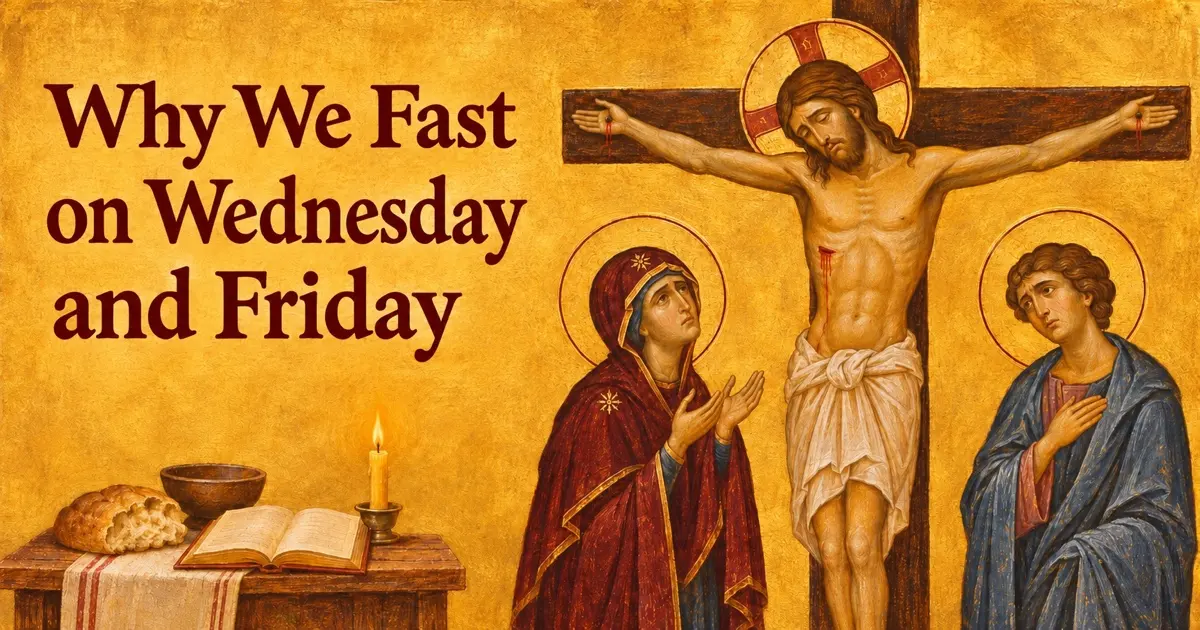
In every week of the year, apart from a few festal periods, the Orthodox Church asks her faithful to fast on two days: Wednesday and Friday. This fast stands beside the four fasts of the year and is older than most of them. Most of us received it in childhood, together with the sign of the Cross and our first prayers, and we keep it as something natural. So it happens that we may fast on Wednesdays and Fridays for years without ever having asked where this fast comes from, why the Church chose these two days in particular, and what she asks of us on them besides a change at table.
In this article
An Ordinance from the Time of the Apostles
The disciples of John and of the Pharisees once asked Christ why His disciples did not fast. The Lord answered them: "Can the children of the bridechamber fast, while the bridegroom is with them? as long as they have the bridegroom with them, they cannot fast. But the days will come, when the bridegroom shall be taken away from them, and then shall they fast in those days" (Mark 2:19-20). The Bridegroom is Christ Himself. The days in which He was to be taken from His disciples were the days of His Passion, when He was betrayed, seized and crucified. That is why His disciples fast on the days that remind them of Him, as those who have known the joy of being with the Bridegroom and the grief of seeing Him taken from them.
The oldest witness to these two days is found in The Teaching of the Twelve Apostles, known as the Didache, one of the oldest Christian writings that have come down to us. Saint Athanasius the Great, in the letter he sent to the Churches for Pascha in the year 367, counts it among the books the Fathers appointed to be read by those newly coming to the faith. In the Didache we read: "But let not your fasts be with the hypocrites; for they fast on the second and fifth day of the week; but fast on the fourth day and the Preparation (Friday)" (Didache 8:1). Hypocrites was the name the Lord had given to those who fast so as to be seen by men (Matthew 6:16). The fourth day of the week is Wednesday. "The Preparation" is Friday, the day on which the Jews made ready what was needed for the Sabbath, and the day on which the Lord was crucified. The Didache appoints these two days, but it does not say why they in particular were chosen.
This ordinance then passed into the canons of the Church. The 69th Canon of the Holy Apostles says: "If any bishop, presbyter, or deacon, or reader, or singer, does not fast the holy Quadragesimal fast of Easter, or the fourth day, or the day of Preparation, let him be deposed, unless he be hindered by some bodily infirmity. If he be a layman, let him be excommunicated." The Quadragesimal fast is the fast of forty days before Pascha, Great Lent. Deposition means removing a cleric from his rank. Excommunication means barring a layman from Holy Communion and separating him from the communion of the Church until he repents. These penalties do not fall on anyone of themselves: the authority of the Church decides them, after examining each person's case.
Saint Nicodemus the Hagiorite, interpreting this canon in his Exomologetarion, the book he wrote for confessors and for those who come to confession, shows that the Apostles set the fast of Wednesday and Friday in the same rank as Great Lent. He urges Christians to stop treating it as a custom without apostolic foundation. The early Church did not see in these two days a piety left to each person's choice, since she placed them beside the forty days before Pascha.
Wednesday: the Day the Lord Was Betrayed
The reason for choosing them is given by the Holy Hieromartyr Peter, Archbishop of Alexandria, who gave his life for Christ in the year 311, during the persecution. His 15th Canon says: "No one shall find fault with us for observing the fourth day of the week, and the preparation, on which it is reasonably enjoined us to fast according to the tradition. On the fourth day, indeed, because on it the Jews took counsel for the betrayal of the Lord; and on the sixth, because on it He himself suffered for us. But the Lord's day we celebrate as a day of joy, because on it He rose again, on which day we have received it for a custom not even to bow the knee." The tradition of which he speaks is Holy Tradition, what the Church received from hand to hand from the Apostles.
The holy Evangelist Matthew tells what took place then. Christ said to His disciples: "Ye know that after two days is the feast of the passover, and the Son of man is betrayed to be crucified." "Then assembled together the chief priests, and the scribes, and the elders of the people, unto the palace of the high priest, who was called Caiaphas, and consulted that they might take Jesus by subtilty, and kill him" (Matthew 26:2-4). At the same time, in Bethany, a woman poured on the Lord's head an ointment of great price, and the disciples were indignant, reasoning that the ointment might have been sold for much and the money given to the poor (Matthew 26:6-9). Then "one of the twelve, called Judas Iscariot, went unto the chief priests, and said unto them, What will ye give me, and I will deliver him unto you? And they covenanted with him for thirty pieces of silver" (Matthew 26:14-15). The Church commemorates these things on Holy and Great Wednesday, and every Wednesday of the year carries in it something of that day.
The Evangelist sets the two events side by side. The woman spent on the Lord an ointment of great price, while Judas, who had walked with Him from the beginning of His preaching, valued Him at thirty pieces of silver. Judas was no stranger. He was one of the twelve, called by the Lord and sent out to preach together with the others, and he sat at the same table with Him. At the Supper the Lord said: "He that dippeth his hand with me in the dish, the same shall betray me" (Matthew 26:23). The betrayal began from within, from beside Him.
Whenever we knowingly choose sin, or set a pleasure or a gain above His commandment, we too make something of Judas's bargain. The Wednesday fast sets us face to face with this bargain. He who fasts on this day resists it with the body, so as to learn to resist it with the soul as well.
Friday: the Day of the Cross
On Friday, says Saint Peter, we fast "because on it He himself suffered for us." On this day the Lord was crucified, and the Church has bound to it a meaning that reaches back to the beginning of the world. Man was fashioned on the sixth day of creation, and Friday is the sixth day of the week. At the Sixth Hour, the short service of prayer at midday, this troparion is sung in the Lenten order: "O Thou Who on the sixth day and hour didst nail to the Cross the sin that Adam dared to commit in Paradise: tear up the record of our trespasses, O Christ our God, and save us." The record of which the troparion speaks is a written bond of debt. The holy Apostle Paul writes that Christ blotted out the handwriting that was against us and nailed it to His Cross (Colossians 2:14). The troparion unites the day on which man was fashioned with the day on which he was healed.
Adam fell through disobedience, tasting of the tree that God had forbidden, and so his wound entered into man through food. Christ healed it on the wood of the Cross, on a Friday, becoming obedient unto death (Philippians 2:8). That is why the Friday fast is deeply fitting: on the day on which Adam's disobedience was healed, the Christian obeys the order of the Church, abstains from food, and draws near to the Crucified.
The holy Evangelist Matthew also records the hours of that day: "Now from the sixth hour there was darkness over all the land unto the ninth hour. And about the ninth hour Jesus cried with a loud voice, saying, Eli, Eli, lama sabachthani? that is to say, My God, my God, why hast thou forsaken me?" Then "Jesus, when he had cried again with a loud voice, yielded up the ghost" (Matthew 27:45-46, 50). The Jews counted the hours of the day from sunrise. The sixth hour thus fell at about midday, and the ninth hour at about three in the afternoon. In the Lenten order of the Ninth Hour, the service of prayer at that hour, the Church sings: "O Thou Who at the ninth hour for our sake didst taste of death in the flesh, mortify our carnal mind, O Christ God, and save us." The carnal mind is the way of thinking of a man ruled by the passions, who sets his own will above the will of God. The appetite of the belly feeds it, and fasting begins the struggle against it at the table.
In the Octoechos, the Church's book of hymns for the days of the week, the services of Wednesday and Friday have a canon, that is, a sequence of hymns, of the Holy Cross and one of the Mother of God. Many of the hymns to the Mother of God on these days show her standing by the Cross and gazing on her crucified Son. He who fasts on Wednesday and Friday stands, with his mind and his heart, where she stood.
Yet the canon of Saint Peter of Alexandria does not stop at Friday. It ends with Sunday, which he calls "a day of joy, because on it He rose again." In a few lines the holy martyr takes in the whole week of the Christian: the Wednesday of the betrayal, the Friday of the Cross, and the Sunday of the Resurrection. Each week thus becomes a little Pascha. The fast of the two days is not a lament without hope: it leads toward the joy of Sunday.
How We Fast
At table, the fast of these days means abstaining from meat, from milk and cheese, and from eggs. Fish is eaten only when the Church gives a dispensation, that is, when for a feast or for a certain season she allows a food that is ordinarily forbidden.
The ancient order asked more. Saint Nicodemus brings the witness of Saint Epiphanius of Cyprus, who wrote that on Wednesday and Friday we fast until the ninth hour. The Typikon, the book that orders the services and the life of monasteries, gives monks on these days a single meal of simple food, after the ninth hour. So Saint Nicholas of Myra fasted from his infancy: his Life tells that on Wednesday and Friday he took the breast only once, in the evening. Those who are able, with the blessing of their spiritual father, do well to draw near to this measure, at least by eating nothing until three in the afternoon, the hour at which the Lord gave up His spirit on the Cross.
As for oil and wine, the calendars of the local Churches do not all have the same measure for the Wednesdays and Fridays outside the fasting seasons. During the fasts of the year, Wednesday and Friday remain as a rule the strictest days of the week, without a dispensation for oil and wine. Saint Nicodemus held that the fast of these two days should be kept like that of Great Lent. Each Christian follows the calendar of his own Church and the measure given him by his spiritual father.
The Didache set Christians apart from the hypocrites, and the danger of hypocrisy remains for everyone who fasts. The Lord said: "Moreover when ye fast, be not, as the hypocrites, of a sad countenance: for they disfigure their faces, that they may appear unto men to fast. Verily I say unto you, They have their reward. But thou, when thou fastest, anoint thine head, and wash thy face; that thou appear not unto men to fast, but unto thy Father which is in secret: and thy Father, which seeth in secret, shall reward thee openly" (Matthew 6:16-18). The Pharisee in the parable boasted before God that he fasted twice in the week, and the Lord says that the publican went down to his house justified rather than he (Luke 18:10-14). A fast kept with pride and with condemnation of those who do not fast earns the Pharisee's reward. In the same way, a rich and choice table without meat can feed the appetite as well as one with meat. The food of the fasting days should be simple and little.
Dispensations and Each One's Measure
There are also days on which the Church lifts the Wednesday and Friday fast for the joy of a feast. In the calendar they are marked as fast-free. Such are the eleven days from the Nativity of the Lord, 25 December, to 4 January inclusive; the eve of the Theophany, on 5 January, remains a fast day. Also fast-free are the week that follows the Sunday of the Publican and the Pharisee, Bright Week after Pascha, and the week after Pentecost. After Bright Week and until Pentecost, lay people have a dispensation for fish on Wednesday and Friday, according to the Typikon of Saint Sabbas. When the Nativity or the Theophany of the Lord falls on a Wednesday or a Friday, there is no fasting at all, and for other great feasts the calendar shows the fitting dispensation.
The Apostolic Canon mentioned above exempts from the fast those hindered by "some bodily infirmity." Saint Nicodemus shows that the dispensations allowed in Great Lent are given in the same way on these days. The sick and those weakened by illness receive oil and wine, and a woman who gives birth during a fast receives a dispensation for wine, according to the canons of Saint Timothy of Alexandria. Saint Nicodemus also counsels the spiritual father to seek, when needed, the opinion of a skilled and God-fearing physician. Saint Cleopa of Sihăstria used to say: "One man can fast for a week, and another fasts a single day with difficulty. So you may not lay the same measure of abstinence on everyone, for not all are made the same way." The dispensations and the strictness of the fast are settled with the counsel of the spiritual father, according to each person's health, strength and circumstances of life.
What We Do on These Days
Saint Cleopa taught that fasting is of two kinds: "Bodily fasting, that is, abstaining from food for a limited time, so that we may pray to God more purely and master our nature. The second is fasting of the soul, that is, keeping the tongue, the eyes and the hearing from evil things." To these he added the guarding of the hands, of the heart and of the will, so that a man may not receive any sin. The fast of the body opens the way, and the fast of the soul gives meaning to abstaining from food.
The tongue. Wednesday was the day of the council held against Christ. By fasting on this day, the Christian guards himself from taking counsel against his neighbour: from gossip, from condemnation, from the word that ruins someone's name. The Prayer of Saint Ephraim the Syrian, which the Church reads during the fasts, asks for exactly this: "grant me to see my own transgressions, and not to judge my brother."
The eyes and the ears. What we look at and listen to enters into us like food. On fasting days it is fitting to abstain also from the screens that fill our minds with images, news and noise, so that prayer may find room in us. For the same reason, Christians do not hold parties and noisy festivities on these days: Wednesday and Friday are days of vigil beside the Passion of the Lord.
Prayer. Saint Cleopa used to say: "Almsgiving and fasting are the wings of prayer. Our prayer never flies faster to God than when it is helped by fasting and almsgiving." The order of the day can be simple and still full. On Wednesday one can read the twenty-sixth chapter of the Gospel according to Matthew, with the council of the chief priests, the anointing at Bethany and the betrayal of Judas. On Friday one can read the twenty-seventh chapter, with the judgement and Crucifixion of the Lord. On Friday at three in the afternoon, whether we are at work or on the road, we can stop for a moment to make the sign of the Cross and say the troparion of the Ninth Hour. At home, with the Horologion in hand, one can read the whole Ninth Hour. It ends with the prayer of Saint Basil the Great to the crucified Lord, Who opened Paradise to the thief who confessed Him on the cross.
Almsgiving. What we spare from our table should not stay in the pantry. The Prophet Isaiah rebuked those who fasted and at the same time quarrelled and oppressed their labourers. He showed them that the fast pleasing to God is the one in which a man shares his bread with the hungry, takes the homeless into his house, clothes the naked and does not turn his face from his neighbour (Isaiah 58:3-7). The money of a meal we have given up can reach someone who has nothing to eat.
Abstinence between spouses. The holy Apostle Paul counsels spouses to abstain from one another for a time, by mutual consent, that they may give themselves to fasting and prayer (1 Corinthians 7:5). Saint Nicodemus shows that this abstinence is fitting on Wednesday and Friday as well, and not only during the fasts of the year.
Toward the Sunday of the Resurrection
Wednesday and Friday can remain for us a mere rule about food. Kept with the heart, they lead us twice a week into the Passion of the Lord. On Wednesday the Christian searches his soul and asks himself what he is selling Christ for. On Friday he stands with the Mother of God by the Cross and gives thanks to Him Who suffered for him. And when Sunday comes, after these two days, the joy of the Resurrection finds him ready.
This fast is a gift of the Church. Twice a week she takes us by the hand and leads us to the Cross, so that we may not pass by the Passion of the Lord with indifference, nor forget it from one Pascha to the next.
Christ said that His disciples would fast in the days when the Bridegroom would be taken from them. By fasting on Wednesday and Friday, the Christian confesses his love for Christ the Bridegroom and his longing for His coming in glory. Yet the Lord is not parted from His Church on any day, for He said: "lo, I am with you alway, even unto the end of the world" (Matthew 28:20). He Who at the ninth hour tasted death for us gives Himself to us in the Holy Liturgy, in His Body and Blood, and at the end He will come in glory for those who have awaited Him.
