
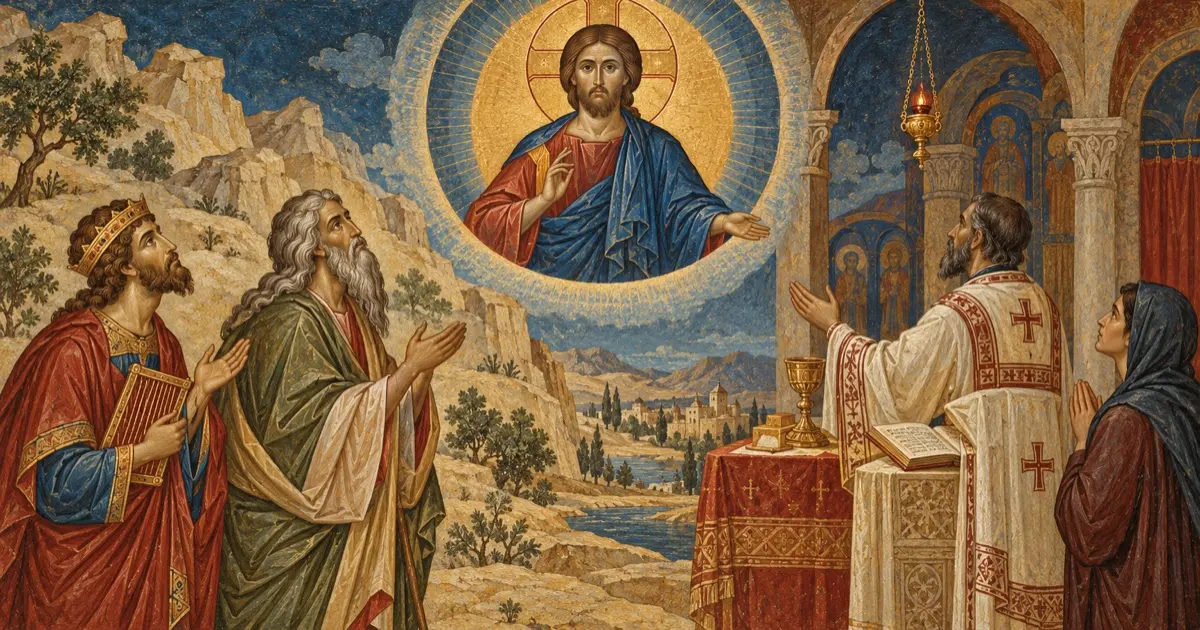
The Orthodox Christian today has a multitude of prayers to the Lord Jesus Christ, to the Mother of God and to the saints, composed by the Church over the centuries. He can stand at the Divine Liturgy, confess his sins in Confession and receive Communion of the Body and Blood of the Lord.
Abraham, Joseph, Job, Moses, David, Elijah and Daniel lived before the coming of Christ and had none of these things. And yet their prayer was so powerful that it has remained an example for all ages, and the Church today honours them among her saints.
More than that, the book from which the Church reads at almost every service was written before Christ. It is the Psalter, the book of the Psalms of David, which the Church has divided into twenty parts, called kathismata, so that, according to the usual order of the services, it may be read through in a week.
In this article
Prayer in Expectation of Christ
The righteous of the Old Testament did not see Christ in the flesh, but they lived by the promise of His coming. The Lord said to the Jews concerning their forefather: "Your father Abraham rejoiced to see my day: and he saw it, and was glad" (John 8:56). And to His disciples He said: "For verily I say unto you, That many prophets and righteous men have desired to see those things which ye see, and have not seen them; and to hear those things which ye hear, and have not heard them" (Matthew 13:17).
The holy Apostle Peter writes that the prophets sought diligently after the salvation that was to come, searching out the time which "the Spirit of Christ which was in them" signified to them (1 Peter 1:11), and that it was revealed to them "that not unto themselves, but unto us they did minister the things" (1 Peter 1:12).
The righteous were not, therefore, deprived of the grace of God. The Son of God was guiding them even before He became man, and the Holy Spirit, as we confess in the Creed, "spoke by the prophets". They lived in a living bond with God and awaited the fulfilment of the promised salvation. From this bond the power of their prayer was born.
The people of Israel had the Law given through Moses, the tabernacle of witness, that is, the place of worship which the Hebrews carried with them through the wilderness, and later the temple in Jerusalem, with priests and with sacrifices. Yet all these things were, according to the word of the Apostle, "a shadow of good things to come, and not the very image of the things" (Hebrews 10:1). Abraham and Joseph lived before the Law was given, and Job lived outside the borders of Israel.
In the Babylonian captivity, far from Jerusalem, three young Hebrews were cast into the fiery furnace because they would not bow down to the golden image set up by King Nebuchadnezzar. In the midst of the flames one of them, Azariah, prayed thus: "Neither is there at this time prince, or prophet, or leader, or burnt offering, or sacrifice, or oblation, or incense, or place to sacrifice before thee, and to find mercy. Nevertheless in a contrite heart and an humble spirit let us be accepted" (Daniel 3:38–39). The burnt offering, the sacrifice consumed whole upon the altar, and the other sacrifices of the Law could no longer be offered.
Having nothing to bring, the young men brought a broken heart. It was the sacrifice of which David had spoken some centuries before: "Sacrifice to God is a broken spirit: a broken and humbled heart God will not despise" (Psalm 50:19).
Abraham Prays for Sodom
The holy Apostle James writes that Abraham "was called the Friend of God" (James 2:23). When the Lord revealed to him what He was about to do with Sodom and Gomorrah, cities fallen into grievous sins, Abraham drew near to Him and began to pray for Sodom, where his nephew Lot was living.
He asked the Lord whether He would destroy the city even if fifty righteous men were found in it. Then he came down to forty-five, to forty, to thirty, to twenty and, in the end, to ten. Each time the Lord answered him that He would not destroy the city for the sake of the righteous in it (Genesis 18:23–32).
In the midst of this prayer Abraham said: "Now I have begun to speak to my Lord, and I am earth and ashes" (Genesis 18:27). Boldness and humility stand in him within the same sentence. Abraham speaks with God as a friend and knows himself, at the same time, to be dust.
Ten righteous men were not found in Sodom, and the city perished. Yet Abraham's prayer bore fruit for Lot: "And it came to pass that when God destroyed all the cities of the region round about, God remembered Abraam, and sent Lot out of the midst of the overthrow, when the Lord overthrew those cities in which Lot dwelt" (Genesis 19:29).
Joseph in Slavery and in Prison
Joseph, the great-grandson of Abraham, was sold by his brothers and became a slave in Egypt, in the house of one of Pharaoh's officers. There, far from his father and from his kin, his master's wife tried to lead him into sin. Joseph answered her: "in this house there is nothing above me, nor has anything been kept back from me, but thou, because thou art his wife—how then shall I do this wicked thing, and sin against God?" (Genesis 39:9). Because he would not sin, he was unjustly cast into prison.
Scripture does not tell us that Joseph knelt or that he lifted up his hands to heaven. But it shows us a man who carried God in his mind in his master's house, in prison and in Pharaoh's palace. When two of Pharaoh's servants, shut up together with him, told him that they had no one to interpret their dreams, Joseph answered them: "Is not the interpretation of them through God?" (Genesis 40:8). And when Pharaoh himself summoned him, Joseph said to him: "Without God an answer of safety shall not be given to Pharao" (Genesis 41:16).
The holy Fathers call this labour of the man who keeps God in his mind in all that he does "the remembrance of God". In the life of Joseph we recognise this remembrance of God.
After the death of Jacob, the brothers who had sold him feared that Joseph would take revenge, and they came and fell down before him. Joseph said to them: "Fear not, for I am God's. Ye took counsel against me for evil, but God took counsel for me for good, that the matter might be as it is to-day, and much people might be fed" (Genesis 50:19–20). His forgiveness sprang from the same remembrance of God: in the evil done by his brothers, Joseph saw the work of God, Who had turned it to good.
The Church commemorates Joseph the All-Comely on Holy and Great Monday, the first day of Holy Week, and the synaxarion of the day, the text that explains the commemoration, presents him "as a type of Christ", that is, an image of Christ given beforehand. Sold by his brothers and brought down into prison, Joseph afterwards saved from famine the very ones who had sold him.
Job Prays for His Friends
The book of Job begins with these words: "There was a certain man in the land of Ausis, whose name was Job; and that man was true, blameless, righteous, and godly, abstaining from everything evil" (Job 1:1). This land lay outside the borders of Israel.
When the days of his children's feasting were completed, Job "sent and purified them, having risen up in the morning", and offered sacrifices for each one of them, for fear that they might have sinned against God in their thoughts. "Thus then Job did continually" (Job 1:5). It was the prayer of a father for his children.
In a single day Job lost his possessions and all his children. Then he rent his garment, shaved his head, fell upon the ground, worshipped and said: "I myself came forth naked from my mother's womb, and naked shall I return thither: the Lord gave, the Lord has taken away: as it seemed good to the Lord, so has it come to pass; blessed be the name of the Lord" (Job 1:20–21).
There follow many chapters in which Job cries out his pain before God and asks Him why he suffers. The friends who had come to comfort him accused him of suffering for his own sins. At the end, God spoke to Job, and Job humbled himself: "I have heard the report of thee by the ear before; but now mine eye has seen thee. Wherefore I have counted myself vile, and have fainted: and I esteem myself dust and ashes" (Job 42:5–6). His words are almost those of Abraham, who knew himself to be "earth and ashes".
Then the Lord said to Eliphaz, one of the friends: "Thou hast sinned, and thy two friends: for ye have not said anything true before me, as my servant Job has" (Job 42:7). He commanded them to offer a sacrifice and added: "And my servant Job shall pray for you, for I will only accept him" (Job 42:8). Scripture concludes: "And the Lord prospered Job: and when he prayed also for his friends, he forgave them their sin: and the Lord gave Job twice as much, even the double of what he had before" (Job 42:10). Those who had wounded him with their words were forgiven through his prayer.
The Raised Hands of Moses
When the Amalekites came to fight against Israel in the wilderness, Moses sent Joshua into battle, while he himself went up to the top of the hill with Aaron and Hur, holding the rod of God in his hand (Exodus 17:9–10). Scripture says: "And it came to pass, when Moses lifted up his hands, Israel prevailed; and when he let down his hands, Amalec prevailed. But the hands of Moses were heavy, and they took a stone and put it under him, and he sat upon it; and Aaron and Or supported his hands one on this side and the other on that, and the hands of Moses were supported till the going down of the sun" (Exodus 17:11–12).
The prayer of Moses demanded the toil of the body, and when the body grew weary, others held up his hands. Saint Justin the Martyr and Philosopher, who wrote in the second century, saw in the outstretched hands of Moses the image of the Cross. The victory came while at the head of the battle stood Joshua, who in Greek bore the same name as Jesus.
Later, while Moses tarried on the mountain, the people made themselves a golden calf and worshipped it. Moses returned to the Lord and prayed: "I pray, O Lord, this people has sinned a great sin, and they have made for themselves golden gods. And now if thou wilt forgive their sin, forgive it; and if not, blot me out of thy book, which thou hast written" (Exodus 32:31–32). Moses was ready to be blotted out of the book of God for the sake of the people that had murmured against him so many times.
The Repentance of David
David was a shepherd, then a warrior, a king and a prophet. He overcame Goliath, was persecuted for years by King Saul, and twice spared his life, though Saul was seeking to kill him. The same man fell into grievous sin: he took Bathsheba, the wife of Uriah the Hittite, and sent Uriah to his death in battle. When the prophet Nathan came to him and showed him his sin, David sought no justification. He said, "I have sinned against the Lord", and Nathan proclaimed to him that the Lord had put away his sin and that he would not die (2 Kings [2 Samuel] 12:13).
In the Greek text of the Psalter, the title of Psalm 50 (51) says that David spoke it "when Nathan the prophet came to him". The Church reads it at many of her services: "Have mercy upon me, O God, according to thy great mercy; and according to the multitude of thy compassions blot out my transgression" (Psalm 50:3).
The Psalter contains the whole life of the soul. In it are the tears of the night: "I am wearied with my groaning; I shall wash my bed every night; I shall water my couch with my tears" (Psalm 6:7). In it is the longing for God: "As the hart earnestly desires the fountains of water, so my soul earnestly longs for thee, O God" (Psalm 41:2). And in it, too, is the trust of one who commits himself to the care of God: "The Lord tends me as a shepherd, and I shall want nothing" (Psalm 22:1).
In David, the strength of a king and the tears of repentance found room in one and the same man.
Elijah on Carmel and at Horeb
Elijah lived at a time when King Ahab and Queen Jezebel had forsaken God and were serving Baal. On Mount Carmel Elijah said to the people: "I am left, the only one prophet of the Lord; and the prophets of Baal are four hundred and fifty men" (3 Kings [1 Kings] 18:22). The prophets of Baal called upon their god for hours on end, and "there was no voice, neither was there hearing" (3 Kings 18:26).
At the time of the evening sacrifice, Elijah drew near and prayed: "Lord God of Abraam, and Isaac, and Israel, answer me, O Lord, answer me this day by fire, and let all this people know that thou art the Lord, the God of Israel, and I am thy servant, and for thy sake I have wrought these works. Hear me, O Lord, hear me, and let this people know that thou art the Lord God, and thou hast turned back the heart of this people" (3 Kings 18:36–37). Then "fire fell from the Lord out of heaven, and devoured the whole-burnt-offerings, and the wood and the water that was in the trench, and the fire licked up the stones and the earth" (3 Kings 18:38).
Straight after this victory, Elijah went up to the top of Carmel, "and stooped to the ground, and put his face between his knees" (3 Kings 18:42). He sent his servant to look toward the sea, and the servant came back saying: "There is nothing". Elijah said to him: "Do thou then go again seven times" (3 Kings 18:43). At the seventh time, "behold, a little cloud like the sole of a man's foot brought water" (3 Kings 18:44), and soon "the heaven grew black with clouds and wind, and there was a great rain" (3 Kings 18:45).
The man who had just overcome the prophets of Baal was now bowed down to the ground, with his face between his knees, asking for rain again and again. The monks who gave themselves to prayer in stillness were called hesychasts, from the Greek word hesychia, which means stillness. When Saint Gregory Palamas defended them against those who mocked them, he brought as an example the image of Elijah with his head bowed upon his knees, together with the publican of the Gospel, who would not lift up his eyes to heaven.
The holy Apostle James writes that "the effectual fervent prayer of a righteous man availeth much", and gives Elijah as an example: "Elias was a man subject to like passions as we are, and he prayed earnestly that it might not rain: and it rained not on the earth by the space of three years and six months. And he prayed again, and the heaven gave rain, and the earth brought forth her fruit" (James 5:16–18).
Later, fleeing from the wrath of Jezebel, Elijah went "forty days and forty nights to mount Choreb" (3 Kings 19:8), where of old "an angel of the Lord appeared" to Moses "in flaming fire out of the bush" (Exodus 3:2). There the Lord told him that He would pass by before him, and that before Him there would be a great and strong wind and an earthquake, but that He would not be in them (3 Kings 19:11). And further: "and after the earthquake a fire; but the Lord was not in the fire: and after the fire the voice of a gentle breeze" (3 Kings 19:12). When Elijah heard it, "he wrapt his face in his mantle, and went forth and stood in the cave" (3 Kings 19:13). Elijah, at whose prayer fire had fallen from heaven, met God in the voice of a gentle breeze.
Daniel Prays Three Times a Day
Daniel was carried away captive to Babylon as a youth. Of the young men chosen to serve at the king's court Scripture says: "Now these were among them of the children of Juda, Daniel, and Ananias, and Azarias, and Misael" (Daniel 1:6). The last three are the young men later cast into the fiery furnace, of whom we spoke above.
Later, under King Darius, Daniel stood above all the governors and satraps: "Daniel was over them, for there was an excellent spirit in him" (Daniel 6:4). The other officials envied him and asked the king for a decree: "that whosoever shall ask a petition of any god or man for thirty days, save of thee, O king, shall be cast into the den of lions" (Daniel 6:8).
Daniel did not change his custom: "And when Daniel knew that the decree was ordered, he went into his house; and his windows were opened in his chambers toward Jerusalem, and three times in the day he knelt upon his knees, and prayed and gave thanks before his God, as he used to do before" (Daniel 6:11). The open window turned his prayer towards the city where the temple had stood. He was cast into the den of lions, and the next day, when the king came to the den, Daniel said to him: "My God has sent his angel, and stopped the lions' mouths, and they have not hurt me" (Daniel 6:23). When they brought him out of the den, "there was found no hurt upon him, because he believed in his God" (Daniel 6:24).
So too had David prayed: "Evening, and morning, and at noon I will declare and make known my wants: and he shall hear my voice" (Psalm 54:18).
At another time Daniel set his face "toward the Lord God, to seek him diligently by prayer and supplications, with fastings and sackcloth" (Daniel 9:3). The prophet Ezekiel names Daniel together with Noah and Job as a righteous man (Ezekiel 14:14). And yet Daniel does not separate himself from his people, but joins his voice to the confession of their sins: "we have sinned, we have done iniquity, we have transgressed, and we have departed and turned aside from thy commandments and from thy judgments" (Daniel 9:4–5). And he rests his prayer on the mercy of God alone: "for we do not bring our pitiful case before thee on the ground of our righteousness, but on the ground of thy manifold compassions, O Lord" (Daniel 9:18).
The angel Gabriel brought him the answer and said to him: "At the beginning of thy supplication the word came forth, and I am come to tell thee; for thou art a man much beloved" (Daniel 9:23).
What Changed After the Coming of the Lord
Moses once besought God: "Manifest thyself to me" (Exodus 33:18). The Lord promised that He would pass by before him in His glory, and then added: "Thou shalt not be able to see my face; for no man shall see my face, and live" (Exodus 33:20).
Many centuries later, on the evening before the Passion, the Apostle Philip said to the Lord: "Lord, shew us the Father, and it sufficeth us". And the Lord answered him: "Have I been so long time with you, and yet hast thou not known me, Philip? he that hath seen me hath seen the Father" (John 14:8–9). The Son of God, Who had revealed Himself to the righteous even before His Incarnation, became man and showed Himself to men in the flesh. In Him we know the Father, although the essence of God remains beyond our sight and our understanding. The holy Evangelist John writes: "No man hath seen God at any time; the only begotten Son, which is in the bosom of the Father, he hath declared him" (John 1:18).
On the same evening the Lord said to His disciples: "Verily, verily, I say unto you, Whatsoever ye shall ask the Father in my name, he will give it you. Hitherto have ye asked nothing in my name: ask, and ye shall receive, that your joy may be full" (John 16:23–24). On Carmel Elijah had called upon the "Lord God of Abraam, and Isaac, and Israel", while the Christian prays to the Father in the name of Jesus Christ, as the Lord taught him.
The name of Father was not unknown to the men of old. The prophet Isaiah said, in the name of the people: "For thou art our Father" (Isaiah 63:16), and David knew His fatherly mercy: "As a father pities his children, the Lord pities them that fear him" (Psalm 102:13). Christ revealed this mercy to us fully and gave us adoption, that is, He made us sons of God by grace. The Son of God came into the world "that we might receive the adoption of sons" (Galatians 4:5), and the holy Apostle Paul adds: "And because ye are sons, God hath sent forth the Spirit of his Son into your hearts, crying, Abba, Father" (Galatians 4:6). Abba is the Aramaic word for father.
At every Liturgy, before the Lord's Prayer, the priest prays that all may be made worthy to call upon God as Father "with boldness and without condemnation". The boldness of the son is asked for together with the fear of receiving it unto condemnation, and the humility of Abraham, who knew himself to be earth and ashes, was not lost after the coming of Christ.
All this springs from the saving work of Christ. Through His Incarnation, Cross and Resurrection He accomplished the salvation which the righteous awaited. Descending into Hades, He overthrew the dominion of death. On the icon of the Resurrection, Christ raises up Adam and Eve, holding them by the hand, and beside them stand Saint John the Baptist, David and the other righteous. In the Church, through Baptism we are united with His death and Resurrection: "Know ye not, that so many of us as were baptized into Jesus Christ were baptized into his death?" (Romans 6:3). Through Chrismation we receive the seal of the gift of the Holy Spirit, and in the Eucharist we partake of the Body and Blood of the Lord. The Christian's prayer is born of this life in Christ and is nourished by it.
The Lord showed the Sadducees, "which deny that there is any resurrection" (Luke 20:27), that the righteous of old are alive: "Now that the dead are raised, even Moses shewed at the bush, when he calleth the Lord the God of Abraham, and the God of Isaac, and the God of Jacob. For he is not a God of the dead, but of the living: for all live unto him" (Luke 20:37–38).
Already in the Old Testament, Scripture shows the righteous who have fallen asleep praying for the living. In a vision of Judas Maccabeus, Onias, "who had been high priest", "holding up his hands prayed for the whole body of the Jews", and then told Judas of a man full of glory: "This is a lover of the brethren, who prayeth much for the people, and for the holy city, to wit, Jeremias the prophet of God" (2 Maccabees 15:12–14).
That is why the Church prays to the saints. They are alive in God and pray for us, and among them are the righteous of the Old Testament as well. The Christian who says today, "Holy Prophet Elijah, pray to God for us", asks the help of the man who prayed on Carmel. The prayers to the Mother of God are likewise a fruit of the coming of Christ, for from her the Son of God took flesh.
The prayers of deep repentance did not begin after Christ. Psalm 50, the prayer of Azariah in the furnace and the confession of Daniel all come from before the coming of the Lord. From that time, too, comes the prayer of King Manasseh. Manasseh had raised altars to idols even in the courts of the temple, and after he had been carried away bound in fetters to Babylon, "when he was afflicted, he sought the face of the Lord his God, and was greatly humbled before the face of the God of his fathers" (2 Chronicles 33:12). His prayer is still read today at Great Compline, the after-supper service which the Church celebrates above all in Great Lent: "And now I bend the knee of my heart, beseeching thy goodness" and "I have sinned, Lord, I have sinned, and I acknowledge my transgressions" (Prayer of Manasseh 11–12).
In the parable of the prodigal son, the Lord showed us with what love the Father receives the one who returns: "when he was yet a great way off, his father saw him, and had compassion, and ran, and fell on his neck, and kissed him" (Luke 15:20). The risen Lord gave the Apostles the power to forgive sins, on which the Mystery of Confession is founded: "Receive ye the Holy Ghost: Whose soever sins ye remit, they are remitted unto them; and whose soever sins ye retain, they are retained" (John 20:22–23).
The Great Canon of Saint Andrew of Crete, a long hymn of repentance which the Church reads in the first week of Great Lent and then in full in the fifth week, passes one by one through the people of the Old Testament, beginning with Adam, Eve and Cain, so that the soul may see itself in the fall of some and in the repentance of others. It begins with the question: "Where shall I begin to lament the deeds of my wretched life?"
Why the Church Still Prays with the Psalms
Christ Himself prayed with the psalms. On the Cross, "about the ninth hour Jesus cried with a loud voice, saying, Eli, Eli, lama sabachthani? that is to say, My God, my God, why hast thou forsaken me?" (Matthew 27:46). These are the first words of Psalm 21 (22): "O God, my God, attend to me: why hast thou forsaken me?" (Psalm 21:2).
In the Gospel according to Luke, the last words of the Lord before His death are these: "Father, into thy hands I commend my spirit" (Luke 23:46). In Psalm 30 (31) David had said: "Into thine hands I will commit my spirit" (Psalm 30:6). The Lord spoke the words of the psalm and set before them the name of Father.
In the same Psalm 21, David describes the Crucifixion almost a thousand years beforehand: "they pierced my hands and my feet" (Psalm 21:17) and "They parted my garments among themselves, and cast lots upon my raiment" (Psalm 21:19). After the Resurrection the Lord told His disciples "that all things must be fulfilled, which were written in the law of Moses, and in the prophets, and in the psalms, concerning me", and "then opened he their understanding, that they might understand the scriptures" (Luke 24:44–45).
The holy Apostle Paul writes that for those who read the Law without Christ "the vail is upon their heart", and "when it shall turn to the Lord, the vail shall be taken away" (2 Corinthians 3:15–16). The Church reads the same Psalter that the righteous of old read, but she reads it with the veil taken away. Where David spoke of the Anointed of God, the Christian recognises Christ, Whose very name means the Anointed One.
Saint Athanasius the Great, in the letter in which he explains the psalms to a Christian named Marcellinus, says that the Psalter has something singular among the books of Scripture. One who reads the other books regards their words as belonging to those who first spoke them. One who reads the psalms takes them upon his lips as his own, as though they had been written expressly for him. The prayer of David thus becomes the prayer of every Christian who speaks it.
In the opening part of Matins the Six Psalms are read, and Vespers begins with Psalm 103 (104), David's song of the creation of the world.
Even the Mysteries which the righteous did not know are celebrated today with the psalms. Psalm 50 stands at the beginning of the Order of Confession in the Book of Needs, and it is also read on the evening before Communion, before the canon of preparation. On the day he receives Communion, the believer reads from the Order of Holy Communion Psalms 22, 23 and 115, and speaks their words: "Thou hast prepared a table before me in presence of them that afflict me" (Psalm 22:5) and "I will take the cup of salvation, and call upon the name of the Lord" (Psalm 115:4). These words were spoken before the coming of the Lord in the flesh, and the Christian speaks them today before drawing near to the Chalice. At the Liturgy, while the clergy receive Communion in the altar, on Sundays the koinonikon is sung, the communion hymn, which is a verse of a psalm: "Praise the Lord from the heavens" (Psalm 148:1).
The canons, the hymns which the Church sings at Matins and in other services, are built upon nine odes from Scripture. Eight of them are from the Old Testament: the two songs of Moses, one after the crossing of the Red Sea and the other before his death, the prayer of Hannah, the prayers of the prophets Habakkuk, Isaiah and Jonah, the prayer of Azariah and the song of the three young men. The ninth is the song of the Mother of God, together with that of Zachariah, the father of Saint John the Baptist. Hannah, the mother of the prophet Samuel, is the woman of whom Scripture says that when she prayed, "she was speaking in her heart, and her lips moved, but her voice was not heard" (1 Kings [1 Samuel] 1:13).
The Paraklesis to the Mother of God, which Christians read in times of affliction, begins with Psalm 142 (143): "O Lord, attend to my prayer: hearken to my supplication in thy truth; hear me in thy righteousness" (Psalm 142:1). Before the canon Psalm 50 is read, and the first ode of the canon sets out from the crossing of the Red Sea: "Having passed through the water as on dry land, and escaped from the evils of Egypt, the Israelite cried aloud: To our Redeemer and our God let us sing." The one who prays to the Mother of God in affliction begins with the joy of Israel after its deliverance from Egypt.
The prayer of the Church after Christ is richer than that which went before, and the prayers of the men of old are woven into it everywhere.
How We Pray After the Example of the Righteous
Whoever wishes to learn to pray can begin with the psalms, spoken slowly, as his own words. One psalm read with the mind on every word is of more profit than a kathisma read in haste. Whoever can read one kathisma each day, with the blessing of his spiritual father, will go through the whole Psalter in twenty days and will find in it every state through which the soul passes.
The rule of Daniel, three times a day, almost anyone can keep: in the morning, at midday and in the evening, a few moments of praise and of supplication before God. Whoever can do more has before him the words of Psalm 118 (119): "Seven times in a day have I praised thee because of the judgments of thy righteousness" (Psalm 118:164) and "At midnight I arose, to give thanks to thee for the judgments of thy righteousness" (Psalm 118:62).
The Mysteries of the Church give us what the righteous of old only awaited, but they do not dispense us from the broken heart which they brought to God when they had no other sacrifice. If we confess without weeping over our sin and approach the Chalice without prayer, we have received much and brought too little.
The Jesus Prayer, which monks and many of the faithful say unceasingly, gathers into a few words what the people of God have spoken before and after the coming of Christ: "Lord Jesus Christ, Son of God, have mercy on me, a sinner." The cry "have mercy on me" belongs to the psalms: "Pity me, O Lord; for I am weak" (Psalm 6:3). Blind Bartimaeus, hearing that Jesus was passing by on the road, cried out with the same words and set the Lord's name before them: "Jesus, thou Son of David, have mercy on me" (Mark 10:47). And the publican in the parable, who "would not lift up so much as his eyes unto heaven", prayed: "God be merciful to me a sinner" (Luke 18:13). In the Jesus Prayer the cry of the psalm and the words of the publican are spoken in the name of Jesus, in which the Lord exhorted us to ask.
Saint John Cassian recorded the words of Abba Isaac, an elder of the Egyptian desert, who said that he had received from the few remaining Fathers of the oldest generation a short prayer for the unceasing remembrance of God. It was a single verse from the psalms: "Draw nigh, O God, to my help; O Lord, make haste to help me" (Psalm 69:2). This verse, he said, must be said without ceasing.
The Righteous at the Divine Liturgy
On Tabor, the mountain on which the Lord was transfigured before Peter, James and John, "his face did shine as the sun, and his raiment was white as the light. And, behold, there appeared unto them Moses and Elias talking with him" (Matthew 17:2–3). The holy Evangelist Luke says that they "appeared in glory, and spake of his decease which he should accomplish at Jerusalem" (Luke 9:31). Moses, to whom God had said that he could not see His face and live, and Elijah, who had met Him on Horeb in the voice of a gentle breeze, now stood in glory beside the Son of God made man, Whose face shone as the sun.
In the rite of the Proskomedia, through which the gifts are prepared for the Divine Liturgy, the priest prepares the bread and the wine for the Sacrifice. From the prosphoras, the loaves brought by the faithful for the Liturgy, he cuts the Lamb, the portion that will become the Body of Christ, and takes out particles for the Mother of God and for the ranks of the saints, which he places on the holy Diskos, the vessel on which the Lamb rests. Among the saints then commemorated by name are most of the righteous of whom we have spoken: "Moses and Aaron, Elias and Elisseus, David and Jesse; of the holy Three Children, of Daniel the Prophet". And at the commemoration of the saints the priest asks: "through whose intercession do Thou visit us, O God". The men who prayed without the Liturgy now have a place at the Divine Liturgy, beside the Lamb of God, and the Church asks for their prayers.
The holy Apostle Paul, after naming the righteous of the Old Testament one by one, concludes: "And these all, having obtained a good report through faith, received not the promise: God having provided some better thing for us, that they without us should not be made perfect" (Hebrews 11:39–40). The righteous who prayed before Christ live in Him and pray for us, awaiting together with us the general resurrection and the perfection of all in the Kingdom of God. When we speak the psalms of David, the song of Moses or the prayer of the three young men, we pray with their words, in the name of the One for Whom they waited.
Sources
- The Holy Bible, King James Version (New Testament), text as published by eBible.org; The Septuagint Version of the Old Testament, English translation by Sir Lancelot C. L. Brenton (Old Testament, including Daniel in its Greek form, 2 Maccabees and the Prayer of Manasses; Psalms in the Septuagint numbering), text as published by eBible.org
- Saint Athanasius the Great, Letter to Marcellinus on the Interpretation of the Psalms (ch. 11)
- Saint Justin the Martyr and Philosopher, Dialogue with Trypho the Jew (ch. 90)
- Saint John Cassian, Conferences, Conference X, the second Conference of Abba Isaac, on prayer (ch. 10)
- Saint Gregory Palamas, Triads in Defence of the Holy Hesychasts (I, 2, 10)
- Liturghierul [The Service Book] (Proskomedia, pp. 120 and 122; Liturgy of Saint John Chrysostom), Editura Institutului Biblic și de Misiune Ortodoxă, Bucharest, 2012
- Ceaslovul [The Horologion] (Matins; Vespers; Great Compline; Paraklesis to the Most Holy Theotokos; Order of Holy Communion), Bucharest, 2001
- Molitfelnicul [The Book of Needs] (Confession), Bucharest, 2013
- Psaltirea [The Psalter] (The Odes of Moses and of the other prophets)
- Triodul [The Triodion] (The Great Canon of Saint Andrew of Crete; the Synaxarion of Holy and Great Monday), 1946 edition
