
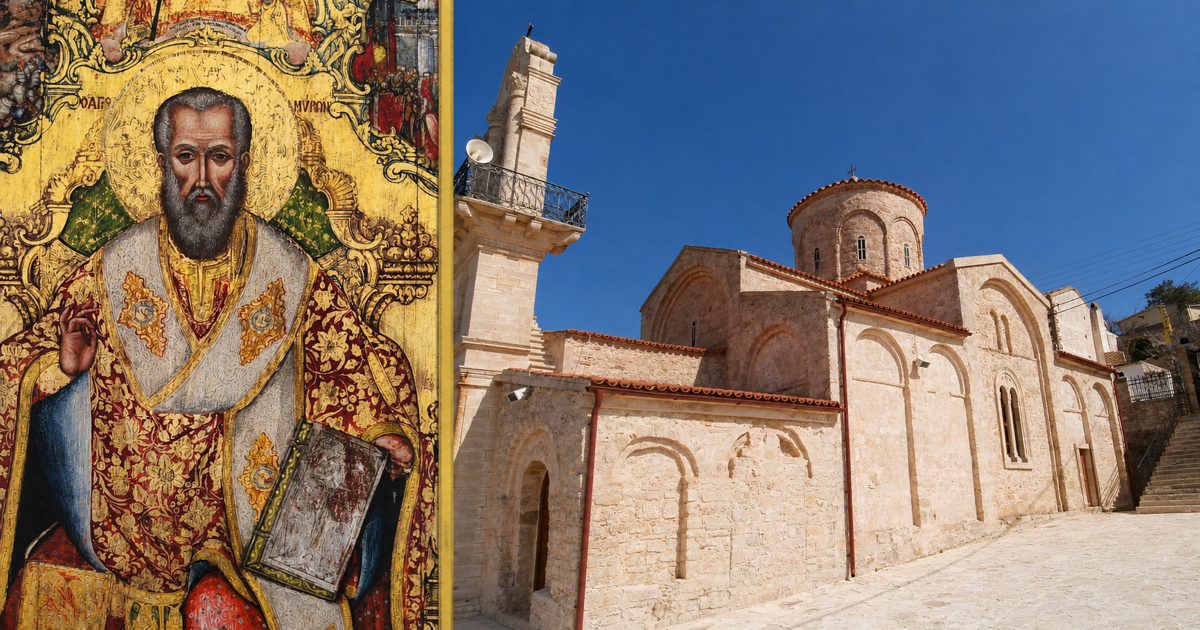
8 August
On the eighth day of August the Church keeps the memory of Saint Myron, Bishop of Crete and wonderworker, who fell asleep around the year 350, at an age close to a hundred years. He was a married man and a tiller of the soil, and his name has remained bound to almsgiving more than to anything else. The village where he was born bears his name to this day.
The Field
He was born in Raukos, an ancient settlement in the heart of the island, west of Knossos. His parents were Christians and raised him in the fear of God. He stayed bound to that land all his life: he did not leave for the city, nor for the great centres of the Christian world, but gathered holiness in the place where he had been born.
He married young and worked the land. From what he drew out of the furrow he gave a portion to those in need, and the Synaxarion preserves a detail worth weighing: the more he gave, the more his fields yielded. This was no calculation. It was the order God works in the merciful man: the wider his hand opened towards the one who lacked, the more richly his field bore.
Two stories are told of him concerning thieves.
The first happened in his garden. Some men had come in to steal his chickpeas, but whatever they managed to gather turned to thorns in their hands, and they could carry nothing away. When the saint learned of it, he came himself, gave them chickpeas with his own hand, and let them go.
The second happened on a night of harvest, on the threshing floor. Myron found thieves there loading his wheat into sacks. He did not shout at them and did not rush upon them. He drew near in silence, saw that the last of them had no one to lift his sack onto his shoulder, and lifted it for him. Then he told them to go with God and to steal no more. It is said that those men set their lives right from that hour.
He did not reckon the loss, but the want which had driven those men to steal. Concerning this he is said to have taught that where thieves appear, greed has gone before them.
The Priesthood and the See
His wife died early. He did not marry a second time, but received the priesthood, asked for it by the faithful of the place, who had seen his life.
He served as a priest in the hard years of the persecution under Decius, when Christian blood was shed in Crete and whoever received the altar received the danger along with it. In that time he strengthened the people for confession and honoured the memory of those who suffered for Christ. When the persecution ceased and the Church drew breath, he was raised to the episcopal see of Crete.
He remained what he had been. He walked through his diocese so as to know the needs of the flock himself and to reach those struck by poverty, and the churches filled when he served, because people wanted to see his face and hear his word.
The River and the Beast
The Lord gave him the gift of working miracles, and Crete knew him as a wonderworker while he was still alive.
Once, going towards Knossos in winter, he found the river Triton flooded across the road. The stream which today is called Giofyros ran high and turbid, and no one could cross. The saint marked the water with his hierarchical staff, and the current stopped and stood in place like a wall until he had passed over with all who accompanied him. When he reached home he sent the staff back with one of his deacons, to touch the water and release it, and only then did the river take up its course.
The scenes painted at his tomb set this miracle beneath an inscription which remembers him together with Moses, who divided the sea, and with Elisha, who struck the Jordan with the mantle of Elijah.
At another time a terrible beast laid the region waste, and the people no longer dared go out to the fields. The beast was seen coming down towards the village at the very hour when the saint was serving the Liturgy. Myron did not leave the altar. He sent his deacon with his crozier, and at the touch of the staff the beast fell dead on the hillside. When the service was finished, the saint went out with all the people, threw the first stone himself over its body, and after his stone so many fell that they covered it entirely. The mound of stones is shown to this day.
He fell asleep in peace, in deep old age, having fulfilled almost a hundred years.
The Tomb and the Village
On the site of ancient Raukos his church was raised. First there stood here a basilica from the centuries of early Christianity, of which there is preserved to this day the great apse of the sanctuary with its synthronon, the stone seat of the bishop. In the eleventh and twelfth centuries the basilica was rebuilt as a Byzantine church, cross-in-square, its dome resting upon four pillars and pierced with eight windows in the drum, through which the light falls over the whole nave.
Within are the saint’s tomb and his wonderworking icon, painted in the sixteenth century. Beneath the church, towards the west, his cell is preserved, turned into a chapel, and from there springs the holy water to which pilgrims have come for centuries.
This place has been sorely tried. On 4 November 1866, during the Cretan revolt, the men of Reshid Pasha laid the village waste, profaned the churches and destroyed the saint’s tomb. In the desecrations and troubles of that time a considerable part of the relics was scattered.
But the saint did not abandon his place. On 12 May 2014, after nearly sixteen centuries, fragments of his relics were found beneath the church. Those who were present bear witness that the church and the courtyard filled with an ineffable fragrance. The relics lie today in a reliquary for veneration, and a portion is kept also at the Monastery of the Great Cave in Kalavryta.
On the evening of 7 August and through the day of the 8th, the village fills with pilgrims come from across the island. The feast of Saint Myron is among the best known in this part of Crete.
A Man in the World Before He Was a Hierarch
The Synaxarion does not begin with the bishop. It begins with the married man and the ploughman, and the hierarch’s staff comes only after the field, after the household and after the years of almsgiving. The order of the telling says something about the order of the life: Myron did not begin to be sanctified when he received ordination.
When ordination came, it did not begin his life with God; it set beneath the grace and the responsibility of the priesthood a man whom the field, the household and mercy had already tried. For the one who lives in the world this image is perhaps the closest of all: holiness does not begin after we leave the place where God has set us, but there, in that very place, if the place is worked with faith.
The Word of the Feast
His memory falls in the days after the Transfiguration, while the Church still celebrates the light of Tabor. The light the apostles saw on the mountain is the uncreated grace of which the saints partake, and the life of Saint Myron shows it at work not in a vision, but on a threshing floor, at night, where a man lifts the stolen sack onto the thief’s shoulder.
Two things are to be taken from his life.
First, that his almsgiving was no calculation. He gave not from his surplus but from what he had, and he did not first examine how much the man before him deserved. He saw the man and his need.
Second, that gentleness reproves without humiliating. The saint did not answer the thieves with anger, but with a kindness so unlooked-for that they were shamed of themselves by what they were doing. Gentleness does not call evil good; it seeks the amendment of the one who did it, and not only his punishment.
Through his prayers, O Lord Jesus Christ, Son of God, have mercy on us.
From the Service of the Saint
The Synaxarion verse
Μύρων ὁ θεῖος ἀρετῆς μύρου πνέων, Εὐωδίας πρόσεισιν ὀσμὴ Κυρίῳ.
Myron the divine, breathing forth the myrrh of virtue, / draws near to the Lord as a fragrance of sweet savour.
The verse plays on the saint’s name, Μύρων and μύρον, Myron and myrrh. And its close, a fragrance of sweet savour, is a biblical formula for the sacrifice well-pleasing to God.
Troparion, Tone 3
Μέγας ἥλιος ἐν Κρήτῃ, Πάτερ, ἀνατέταλκας, θαυμάτων πλήθει καταφωτίζων αὐτήν, ἱερώτατε· ὡς οὖν ὁρμὴν ποταμοῦ διεκώλυσας, καὶ τὸν ὄλεθρον δράκοντα ἐλίθωσας, οὕτως Ἅγιε Χριστῷ, θεῖε Μύρων πρέσβευε, δωρήσασθαι ἡμῖν τὸ μέγα ἔλεος.
As a great sun hast thou risen in Crete, O Father, illumining her with the multitude of thy miracles, most sacred one; and as thou didst hold back the rushing of the river and didst turn the destroying dragon to stone, so, O Saint, pray thou to Christ, O divine Myron, that He grant us great mercy.
Image: icon of Saint Myron (public domain) and the Church of Saint Myron in Agios Myronas, photograph by C messier, CC BY-SA 3.0, via Wikimedia Commons.