
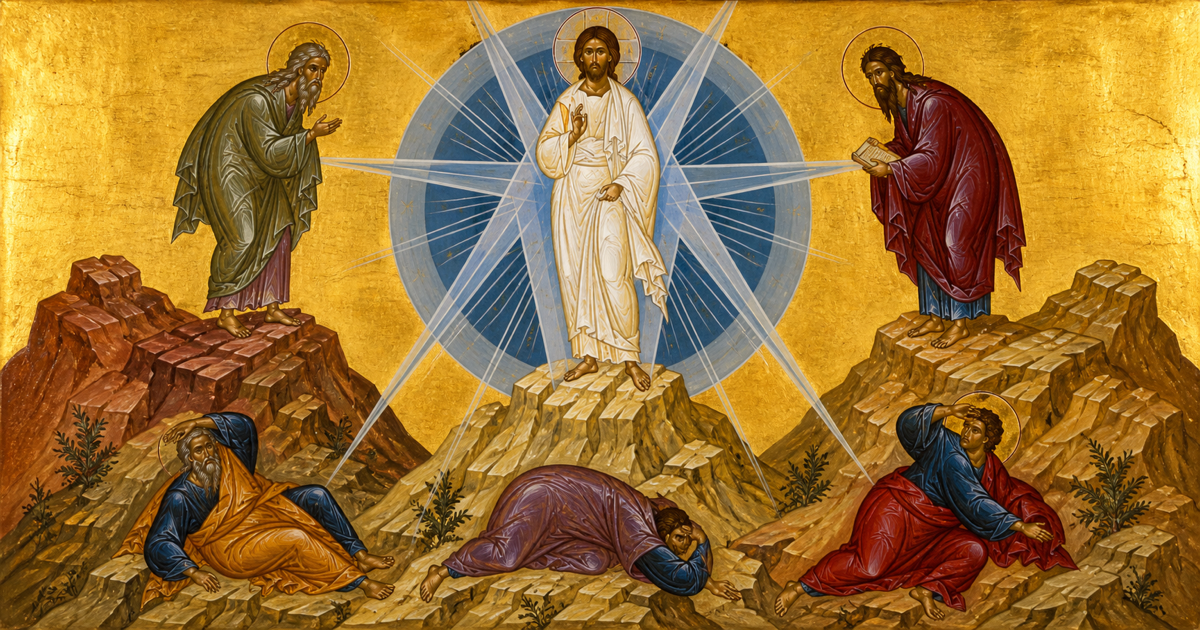
On the sixth of August the Church keeps the memory of what came to pass on Mount Tabor, when the Lord, taking with Him Peter and James and John, was transfigured before them, and His face shone as the sun, and His garments became white as the light. The Gospel says plainly what the disciples saw. The feast, however, sets before us a question that touches every one of us: what happens to a man’s sight when God discloses Himself.
In the troparion of the feast the Church confesses that the Lord showed His glory to His disciples as far as they could bear it. These last words show that He did not disclose His glory without measure, but fitted it to what the three were able to carry.
The Unveiling and the Seeing
He who went up the mountain was the same who had come down before that from Nazareth and was soon to go down toward Jerusalem. The body taken from the Virgin had been from the hour of its conception the body of God the Word, for He took upon Himself our whole nature, with soul and with body, and united it to Himself according to hypostasis. That nature was not mingled with the Godhead, nor consumed by it, but remained whole, as the bush burned in the flame and was not consumed. The glory that shone on Tabor was therefore His from everlasting, and was not added to Him then.
Throughout His earthly life, however, He had kept it covered. He hid Himself not from weakness but out of condescension, that He might be approachable to men and walk among them without consuming them. On the mountain He lifted this covering for a moment. Herein lies the first deed of the feast, wrought by Him in the hour He alone had chosen: the light welled up from within, passed through the body and went out even into the garments, so that it might be seen that it did not come upon Him from anywhere outside.
The second deed was wrought in the disciples, and He wrought that also. Their eyes were strengthened to endure what a nature enfeebled by sin cannot endure, and they were opened to see what had been there from the beginning but had remained beyond the power of their sight. The unveiling and the seeing were given in the same hour, out of the same love for mankind.
Both must be held together. Whoever should say that only the eyes of the disciples were opened moves the light inside man and turns it into a feeling, and the feast becomes an inward episode in the lives of three men. Whoever should say that the Lord merely showed Himself, working nothing in them, has no way of explaining why they were first led up the mountain, and why they were three. The glory discloses itself, and the eye is made ready to receive it, and neither alone suffices.
The fourteenth century was compelled to set down in words what those who struggled knew from experience. When the light of Tabor came to be reckoned a created sign, made and passing, brought before the eyes to convey some notion about God, Saint Gregory Palamas defended the witness of those who prayed, and the Councils of Constantinople laid down the decision of the Church: that light is uncreated, an energy of the divine nature, and not a creature brought forth for our understanding.
The distinction is not one of the schools, and it does not concern only those who occupy themselves with learning. Were the light created, the disciples would have seen on Tabor a sign about God, and something made would still have stood between them and God. Being uncreated, they saw God Himself working and giving Himself, while He remained unapproachable in His essence. Here lies the ground on which the Church dares to say that man can truly partake of God, and not merely think about Him.
The Ascent Before the Vision
The Gospel does not pass over the detail of the road. The Lord took the three and led them up into a high mountain apart. He did not show Himself where they stood, but brought them up first. The vision came after the ascent, and the ascent required labour, silence and separation from things below.
This order is kept whole. Purification goes before illumination, and no one reaches the height except by climbing. Whoever desires to see must first walk the way that all tradition knows: the keeping of the commandments, which cuts off self-will; fasting, which subdues the body; persevering prayer, which gathers the scattered mind; mourning for sins, which washes the inner eye; obedience, which pulls down self-conceit. Without these, the word about the uncreated light remains a report heard from afar, and a dangerous one at that, since it fills the mind with imaginings about a vision the heart has not begun to seek.
Yet it must be said at once that this labour prepares but does not compel. No one climbs the mountain in order to take the light, for the light is not taken. The disciples were led up; they did not go up of themselves, and so it happens still with those who struggle. Ascesis cleanses the eye and makes it able to bear the unveiling, but the hour of it remains with Him who unveils, and for this reason those who have truly come to such sight have never reckoned it wages for their labours.
He did not take all twelve, but three. Neither was this done out of partiality, but again according to measure, since the vision is given in proportion to the strength to carry it, and what to one man is light would be consuming fire to another not yet prepared. And the word apart shows that vision requires separation, and that a mind which lets itself be carried along by the clamour of the world has no way of receiving what is given in stillness.
Peter’s Tabernacles
Peter spoke first, as he often did. He said that it is good for us to be here, and asked that three tabernacles be made. And the evangelist, who might have passed on, adds the word that judges the whole impulse: he knew not what he said.
What the apostle asked seems good, and for that very reason it must be looked at closely. He wished to halt the vision where it stood, to build it a shelter, to remain in it and go down no more. He took the gift for the end of the road and sought to settle it in a dwelling of his own. Herein is hidden a fall that many take for progress: the man who has tasted consolation begins to seek the consolation itself in place of Him who gave it, makes of his experience a possession, settles into it as into a tabernacle, and from there looks down with pity upon those left at the foot of the mountain. What began as a gift ends as an opinion of oneself.
The voice of the Father cut short Peter’s word and gave no answer to his request. It bore witness to the beloved Son and commanded: hear ye Him. The disciples were turned from the light toward Him from whom the light came, and from vision toward obedience. Here lies the touchstone of every spiritual experience. It is not weighed by its brightness, nor by the joy it leaves behind, but by this: whom the man obeys once the experience has passed, and whether he came down from the mountain more submissive than he had gone up. He who has seen light and remained disobedient has not seen what he supposes he saw.
And the disciples, hearing the voice, fell on their faces and were sore afraid. The first sign of true vision was not exaltation, but fear and humbling, and the need to be raised up by His hand.
The Light Given Before the Cross
The evangelists who count the days set the Transfiguration immediately after the hour in which the Lord first foretold to them that He must suffer, and be killed, and on the third day rise. This order is not accidental. The vision was not given them as a reward for what they had accomplished, but as provision for what was coming. They were soon to see Him delivered into the hands of men and crucified, and that sight was to be far harder to bear than the climbing of the mountain. His glory was shown them beforehand, so that when the hour of darkness came they might not reckon Him a defeated man, but might know Him who accepted the passion willingly.
They were not alone on the mountain. Beside the Lord stood Moses and Elijah, and they spoke with Him. He who was now disclosing Himself in glory was the same who had once spoken with Moses in the burning bush and on Sinai, and who had passed by Elijah in the sound of a gentle breeze. Those who had sought Him in signs and in cloud now stood before Him face to face, and by this it was seen that the law and the prophets are not overthrown, but had borne witness to Him all along. The one had come from the dead, the other had been taken up without tasting death, and both were present, so that from their very condition it might be known that He who was to be killed is Lord both of the living and of the dead.
And the evangelist tells us also what they spoke of: of His departure, which He was to accomplish at Jerusalem. In the brightest hour of His earthly life, the word on the mountain was about the passion. The disciples heard the light and the Cross spoken of together, and we are not permitted to part them.
The placing of the feast in the summer months, some weeks before the Exaltation of the Precious Cross, preserves the same bond within the calendar. The Church does not call us to Tabor in order that we should remain there, but that we may afterwards be able to stand beneath the Cross.
For this reason they came down from the mountain. All three Gospels say so, and none of them reckons the descent a loss. The vision was given for the road that followed, and the road led downward, toward the crowd, toward infirmities, and toward Jerusalem.
How We Stand Before the Feast
The feast falls within the fast of the Dormition of the Theotokos, and halfway along that road the Church halts us on Tabor. The placing was not made by chance, and whoever has fasted attentively understands its purpose from his own labour.
The Dormition fast is among the strictest, and it comes in the height of summer, when the body asks for more and the days pass heavily. Precisely at its midpoint the Church opens a Great Feast, permits fish and wine and oil, and sets before us the light from the mountain. This relaxation is not a halt along the road, but a foretaste of the joy for which the whole road is walked. He who abstains without knowing why comes soon either to despondency or to self-satisfaction; whereas he who has glimpsed, if only from afar, the radiance of Tabor knows that ascesis is not asked of him for its own sake, but for the change that grace works in man.
From this it is also seen why this feast stands before the one on the fifteenth of August. On the mountain the disciples received the vision of glory before the hour of the Cross, so that when they should see Him crucified they might not take Him for a defeated man, but might know Him who accepted the passion willingly. And through the Cross death ceased to be an end and became a passage. Without this light, the falling asleep of the Mother of God would have remained a parting that we lament; in its light, the Church keeps it as an entrance.
The two feasts therefore answer one another, and it is fitting to look upon them together. On the mountain there is disclosed to us the glory of Him who is God from everlasting and became man for our sake, and the light that then broke through the body was His from the beginning. At the Dormition we look toward the Theotokos, who bore in her womb Him whom nothing contains, who obeyed from the hour of the Annunciation to the foot of the Cross, and who was received at the last into the glory of her Son. The same light appears in both, yet not in the same manner: on the mountain we learn whose it is, and at the Dormition we see what it works in a creature who has given herself wholly to God.
From this comes also the consolation of the road. The light that shone on Tabor did not remain up there, shut into a single day and a single mountain. It is the inheritance for which all the saints wait, and the Theotokos goes before them, first and above all, showing that our nature can carry it. Whoever walks the fast from one feast to the other learns not only whence the light comes, but also how far it can raise a man.
On this day the fruits of the earth are brought for blessing, grapes where grapes ripen, and elsewhere other fruits, according to each place and season. This is not merely a custom left by our forebears. He who shone upon the mountain is He through whom all things were made, and creation, brought before Him, receives back something of its first calling. What happened to the Lord’s garments, which became white as the light, shows that matter does not stand in the way of glory, but can bear it.
The feast does not end in a single day. The Church appoints for it eight days of afterfeast, up to the leave-taking, so that whoever keeps it may have time to return to the same thing, to hear the same hymns again, and to find in them what he could not grasp at the outset. Feasts open themselves to those who come back to them.
There remains the hardest part, which is not accomplished in one day, nor in eight. The feast does not ask us to marvel at a light that shone long ago upon a mountain in Galilee. It asks us to attend to the eye of the heart. He who prays with a scattered mind, he who remembers evil against his brother, he who feeds upon his own good opinion of himself carries about with him a diseased sight, and would not glimpse the light were he standing on the very summit of Tabor. Purification does not fetch the light from anywhere, nor does it seize it; it only lifts the covering from the eye and makes the soul able to receive what will be granted to it.
This too is confessed by the hymn with which the Church greets the feast. It does not ask for a new light, to be kindled now for us. It asks that the everlasting light may shine forth also upon us sinners. And it is a petition, not a decision of ours, since He who disclosed His glory on Tabor remains master of His own disclosure and grants it in the hour He alone knows. Yet he who asks perseveringly, and cleanses his eye meanwhile, does not ask in vain, for the Lord did not show His glory then for three men and for a single day, but for all who were to come after them, and among these are we.