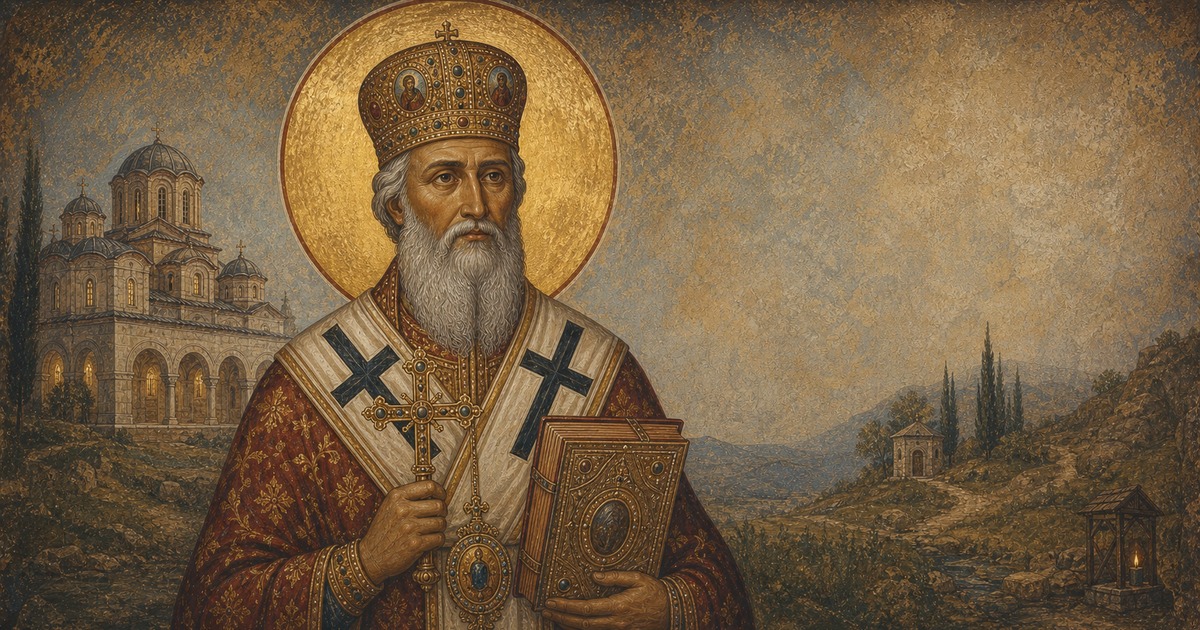
The Hierarch Who Placed the Hesychast Renewal of Poiana Mărului Under Patriarchal Witness
In the year 1749, in Bucharest, a monk who had come down from the mountains of Buzău stood before three Patriarchs of the East and set forth to them, point by point, what the Prayer of Jesus is and why the guarding of the mind is no delusion but the very heart of the monastic life. The monk was Saint Basil of Poiana Mărului, the teacher of the rule of spiritual life to Saint Paisius of Neamț. The Patriarchs — Matthew of Alexandria, Sylvester of Antioch, and Parthenius of Jerusalem — gave written testimony that his teaching was Orthodox. And the one who arranged this meeting, who summoned the elder from his hermitage to be heard by the highest hierarchs of Orthodoxy, was the Metropolitan of Wallachia: Neophytos the Cretan.
This is the fact from which all that follows begins. The hesychast teaching had been defended dogmatically as early as the fourteenth century, through Saint Gregory Palamas and the councils of Constantinople; the Prayer of the Heart no longer awaited, in the eighteenth century, any recognition in principle. But a concrete renewal, carried by a particular elder and his brotherhood, could at any moment be suspected of innovation and smothered in its infancy. It was precisely for this reason that it mattered for the living tradition of Poiana Mărului to be placed under the public witness of the Patriarchs — so that the Prayer of the Heart, as the elder Basil taught it, might be recognized as following the experience of the Fathers, and not as a delusion. The one who arranged this witness was a Greek from Crete, who became the shepherd of a people of another stock and another tongue, and who in the end laid down his life for his flock and died as a confessor.
The Church commemorates him on the sixteenth of June, the day of his passing to the Lord, in the year 1753.
A Cretan in Wallachia
He was born on the island of Crete, around the year 1690. Of his childhood and youth little is preserved, as happens with those who do not seek to be remembered by men. We know only this: that he was raised in the true faith and that, from his youth, he directed his steps toward the monastic life. He did not arrive there driven by need, but out of an inward calling. In the Crete of the seventeenth and eighteenth centuries, under Venetian and then Ottoman rule, Orthodox monasticism was itself a confession of faith — to remain Orthodox meant to refuse both Latinization and Islamization, and to become a monk meant to seal that refusal with one’s whole life.
In the monastery, Neophytos was not content with mastering the rule of prayer. He learned the mysteries of theology and the sciences of his age, becoming, by the testimony of his Life, a learned and virtuous monk — two qualities that do not always go together, and whose union would mark all his later work. He was ordained hierodeacon, then hieromonk. His learning was of a kind that showed itself: he commanded the Greek of the Fathers, knew patristic literature from within rather than from summaries, and possessed that formation which made him capable of weighing a spiritual teaching and judging whether it was Orthodox or not. This last would prove the key to his historical role.
The road to Wallachia was opened to him by Constantine Mavrocordat, one of the Phanariot princes of the age, a man of genuine esteem for books and for the men who made them. Esteeming the Cretan hieromonk, Mavrocordat called him to the court and entrusted him with the education of his sons. Thus Neophytos became tutor to the princely children — a position which, in the Phanariot world, meant proximity to the center of power and access to the means by which a learned man could accomplish something.
His advancement through the ranks of the hierarchy was swift and came with the blessing of the local hierarch. In January 1737, the Metropolitan of Wallachia of that time, Stephen II, ordained him bishop with the honorary title of Myra in Lycia — a title that made him a bishop without giving him a diocese to govern, as was the custom for bishops attached to the court. After the repose of Metropolitan Stephen, in September 1738, the metropolitan see of Wallachia stood vacant. On the seventh of November 1738, “with the counsel of all the honorable boyars and of the whole ecclesiastical clergy,” the former Cretan hieromonk was elected Metropolitan of Ungro-Wallachia. He would shepherd until his death, nearly fifteen years.
He was a stranger in stock and in tongue to the people he was to shepherd. He did not know, upon his arrival, the Romanian in which his faithful would pray. And yet, of him it was later said what is not said of many: that he became a Greek more Romanian than the Romanians. How this transformation came about — from a Greek scholar brought to the court into a shepherd ready to lay down his life for his flock — is, in essence, the subject of this article.
The Phanariot Age and Inner Stillness
To understand what Neophytos did, we must see clearly in what age he labored. The Wallachia of the eighteenth century was ruled by Phanariot princes — Greeks from the Phanar quarter of Constantinople, appointed by the Porte, frequently replaced, often according to the sums they could gather and pour into the Ottoman treasury. It was a system that pressed heavily upon the people through taxation and that made the princely throne an object of auction rather than an institution of justice. Within this framework, the Church remained the only institution with deep roots in the people, the only one that did not change every few years, and the only one capable of holding, over the heads of passing princes, the thread of a spiritual continuity.
In the realm of monastic life, this century witnessed both a great peril and a great recovery. The peril was extinction: Ottoman pressure, poverty, the disorder of the monasteries, the decline of spiritual life in many of them, all threatened to break the chain by which the teaching of the Fathers on prayer and on the guarding of the mind was transmitted from generation to generation. The hesychast tradition — that which, from the Desert Fathers to Saint Gregory Palamas, taught that man may attain, through the unceasing prayer of the heart, to communion with the divine light — risked thinning to the point of disappearance in the very places where it had once been alive.
The recovery would come precisely through a few men who took upon themselves the mending of this chain. The most famous of them is Saint Paisius of Neamț, who would gather hundreds of disciples around himself, organize the translation of the Philokalia into Slavonic, and make of Neamț a hearth of hesychast renewal for the whole of the Orthodox East. But Paisius did not appear out of nothing. Before him — and as his teacher in the things of the rule of the cell — stood Saint Basil of Poiana Mărului, the hermit of the mountains of Buzău. And before, or rather above, Basil, as the hierarch who opened the way for him and gave him cover, stood Metropolitan Neophytos.
Here one sees why a hierarch matters so greatly in the spiritual history of a people. The hermit prays in his cell, and no one can stop him from praying. But for his prayer to become a transmitted teaching, for his practice to be recognized as Orthodox and not suspected of delusion, for disciples to be able to gather around him without fear of ecclesiastical condemnation — for all this a hierarch is needed who understands what hesychasm is and who places his authority in its service. Neophytos was that hierarch. And he could be precisely because he was a scholar: because he could read a Greek spiritual text and weigh whether its teaching stood in the line of the Fathers or departed from it.
The Elder Basil Before the Patriarchs
Saint Basil of Poiana Mărului was not Romanian by birth — he had been born around 1692 in the regions of Russia, near Poltava, in present-day Ukraine. But he had come while still young to Romanian soil, and here he was perfected spiritually. He had entered the brotherhood of Dălhăuți Monastery, near Focșani, where he studied the Scriptures and the Holy Fathers in depth, becoming a tried laborer of the Prayer of the Heart. Later he settled in the mountains of Buzău, at Poiana Mărului, where he founded the skete from which his name derives. Having become an elder before the age of thirty, he gathered around himself a brotherhood of hermits and taught them that prayer which, through the unceasing invocation of the name of Jesus, draws the mind down into the heart and keeps it awake before God.
What made Basil a figure of the first rank was not only his life of prayer but the fact that he was, in the Orthodox East of the modern age, the first great teacher to set down in writing the teaching on the Prayer of the Heart. He wrote “Words on the Guarding of the Mind,” on prayer and on spiritual growth — short introductions placed before the philokalic writings, meant to prepare the one who read them. By this he precedes Paisius of Neamț and even Nicodemus the Hagiorite, the compiler of the Greek Philokalia. His teaching had also a feature that set it apart: he did not insist on the psychosomatic technique of the breath, as part of the Athonite tradition had done, but placed the emphasis on the watchfulness of the mind and the purity of the heart.
Precisely because it was a teaching set down in writing and spread abroad, it also drew suspicion. The first accusation brought against the elder Basil was that he had introduced innovations into monastic life through the Prayer of the Heart — that he was recommending to laymen and untried monks a labor reserved for the perfect. It was exactly the kind of accusation which, left to grow, could smother the entire hesychast renewal in its infancy. If the Prayer of the Heart were declared a delusion or a dangerous novelty, then all that Paisius would build at Neamț set out under a shadow of condemnation.
Here Metropolitan Neophytos enters. In the year 1749 there were in Bucharest, passing through, three Patriarchs of the Orthodox East: Matthew of Alexandria, Sylvester of Antioch, and Parthenius of Jerusalem. The simultaneous presence of three of the four ancient patriarchal thrones was an altogether rare circumstance, and Neophytos understood what could be made of it. He summoned the elder Basil from his hermitage and had him present his teaching before the Patriarchs — to state clearly, before the highest authorities of Orthodoxy, what the Prayer of Jesus is and why it is the true labor of the monk and not a deviation. The Patriarchs heard him and gave testimony to the Orthodoxy of the teaching preached and lived by the elder Basil.
The weight of this fact is easy to overlook today, but at the time it was decisive. The Prayer of the Heart could no longer be accused of innovation once three Patriarchs had recognized it as Orthodox. Their testimony placed it in the continuity of the Fathers, gave it full canonical cover, and lifted it beyond all suspicion. And the one who arranged the meeting, who summoned the hermit and brought him before the Patriarchs, who himself weighed, as a scholar-hierarch, that the teaching deserved defending — was Neophytos. He was not content to tolerate hesychasm; he placed his authority as metropolitan in its service and procured for it the supreme sanction of the Church.
The Link Before Paisius
To measure what this act meant, we must follow the thread further. Saint Basil was the spiritual father of Paisius of Neamț. The young Platon Velichkovsky — the future Paisius — had come to the Romanian Lands during the Great Lent of 1743 and had stayed at the sketes of Dălhăuți, Trăisteni, and Cârnu, which were under the spiritual care of the elder Basil. There, under his guidance, he received his first formation in the Prayer of the Heart. Later, in the year 1750 — one year after the meeting with the Patriarchs in Bucharest — the elder Basil himself tonsured him into monasticism, under the name of Paisius, on Mount Athos. Of his teacher, Paisius would say that, when he beheld him, he glorified God that he had been counted worthy to see a man so holy, unsurpassed among all those of his time in the understanding of Scripture, of the Fathers, and of the canons of the Church.
From here begins the chain we know. From Paisius, through the brotherhood of Neamț and through the Philokalia translated there, the grace of the Prayer of the Heart was transmitted onward, from disciple to disciple, down to our own age. This line — Poiana Mărului, then Neamț, then the hermits and spiritual fathers who preserved the labor throughout the nineteenth and twentieth centuries, down to the great elders of Sihăstria and Neamț of our own time — is the very backbone of Romanian hesychasm. It is the line which, in our days, was carried onward by Father Cleopa Ilie and Father Arsenie Papacioc, among the great confessors of this inheritance in the twentieth century.
And at the beginning of this chain, as the hierarch who made it possible institutionally and canonically, link by link, stands Neophytos the Cretan. Without the testimony of the Patriarchs which he arranged, the hesychast renewal might have set out under suspicion; with it, it set out strengthened. This is, perhaps, the least known and at the same time the most significant of his works. He was not a hermit-elder like Basil, withdrawn into the wilderness as a great laborer of the Prayer of the Heart; he was a hierarch in the city, with a metropolitanate to govern and a people to shepherd. But precisely as a hierarch he understood the hesychast spirit from within, recognized it as the heart of the spiritual life, and opened the way for it with all the authority of his see. In the economy of the Paisian renewal, this was his own particular service: he was the hierarchical hand that held the door open.
The Printer of the Fathers
Neophytos’s scholarly labor was not something set alongside his service as shepherd, but the very form that this service took. A hierarch who understood hesychasm knew that the Prayer of the Heart is not transmitted in a void: it rests upon the reading of Scripture and the Fathers, upon the spiritual nourishment that only the book can give in the absence of a living teacher. Therefore, in his nearly fifteen years of archpastorate, Neophytos made of the printing press one of the most precious weapons of the Church. He printed, in Bucharest, over thirty titles — service books, translations from patristic literature, theological works.
Several of them marked beginnings. He printed “Theological Questions,” translated from Saint Athanasius the Great, in 1741. He brought to light, in 1742, the Homilies of Elias Miniates — the greatest Greek preacher of the age — in the first edition in the Romanian language. He printed, in the Bucharest edition of 1745–1746, the “Orthodox Confession” of Peter Mogila, the foundation of Orthodox catechesis for the entire East, and, in 1746, the “Pearls” of Saint John Chrysostom. Under his sanction appeared fourteen service books, some in several editions, alongside books of instruction — most of them, and this is essential, in the language of the people.
Here one touches a work with roots older than himself, but which he carried to completion: the full introduction of the Romanian language into worship. Before him it had been begun by other great hierarchs — Metropolitan Dosoftei of Moldavia, the first to render the service books into Romanian, and above all Saint Antim Ivireanul, the Georgian who became Metropolitan of Wallachia and who had reissued the Liturgicon and the Euchologion in Romanian. Neophytos completed this transition. The printings issued under his sanction fulfilled the passage from Slavonic to Romanian in the service of the Church, setting the language of the people where, not long before, had stood a language the faithful no longer understood. That a Greek from Crete was the one who definitively established the Romanian language in worship says something about his manner of understanding his pastorate: not as a dominion over a foreign people, but as a service to it in its very own tongue.
His care for the book passed even beyond the borders of Wallachia. Wishing to support the Orthodox Christians under the Ottoman yoke in the Arab East, he helped Patriarch Sylvester of Antioch to print in Bucharest, in 1747, a Psalter in the Arabic language — so that Arabic-speaking Christians too might have the word of God in their own tongue. It was the same logic, carried further: the word of the Church must reach each people in the language it understands.
From this same love of the book sprang also his work upon the Library of the Metropolitanate of Wallachia. Neophytos was not content merely to gather books; he built for them a building of their own, integrated into the metropolitan complex, and endowed the library with an impressive collection. On the second of February 1747 he drew up a partial catalogue of the books he was donating — a list of one hundred ninety-three titles, printed books and manuscripts, in Greek, Latin, and other languages. By his testament, he left to this library his entire personal collection of books and manuscripts, gathered over a lifetime of scholarship. More recent research shows that he was not its absolute founder, but its great reorganizer and benefactor — the one who gave this library its form as a great scholarly institution, with its own place and its own order of preservation.
Among his printings and writings is also a Journal of Travels, composed following two canonical visitations made in the summers of 1746–1747 in his diocese and in part of that of Râmnic. Written in Greek and printed in Bucharest in 1748, the journal contains historical, geographical, and ethnographic notes, copies of inscriptions, and observations on the state of the Church and the country. It is, beyond its documentary value, the testimony of a shepherd who did not govern from afar, but traversed the places of his flock himself, saw them with his own eyes, and recorded them with care.
The Oil from the Lamps of the Martyrs
Neophytos was not only a printer and translator of others; he wrote himself as well. He composed two short treatises in Greek, with titles that show what kind of shepherd he was: one “On Chrismation,” the other “On the Communion with the Holy Mysteries of Those Tempted in a Dream” — concrete questions of spiritual and liturgical life, of the kind a priest or a believer encounters in the daily order of things and for which he needs a clear answer founded on the Fathers. There is also preserved from him a homily delivered in the metropolitan cathedral, as well as the beautiful prefaces he placed before the books he printed — prefaces in which he reveals his mind and his shepherd’s heart.
In one of his writings, Neophytos pauses upon something that places him deeply within the patristic tradition of the veneration of the martyrs: the healing power of the oil from the lamps that burn above the relics of the saints. Bringing testimonies from the Fathers and from history, he shows how this oil, sanctified by contact with the relics of the martyrs, heals diseases and works miracles. This is no marginal curiosity. It is the very teaching of the Church on the holiness of martyric bodies — on the fact that the grace of God does not remain enclosed in the soul, but penetrates and sanctifies the body of the one who has given his life for Christ, so that even the oil touched by his relics becomes a bearer of healing.
It is a teaching which, without knowing it, Neophytos was writing about his own future. For he himself would die as a confessor, his blood shed for his flock, and would be venerated by the Church as a saint. The one who had written of the power of martyric relics would himself enter the company of those whose veneration he had defended.
More Romanian Than the Romanians
Of Neophytos it has been said, in a manner fully deserved, that he was like Saint Antim Ivireanul. The likeness is no accident and merits weighing. Antim had been a Georgian — come from Iberia, enslaved, raised by grace and by his gifts to be Metropolitan of Wallachia, an unsurpassed printer, a confessor who ended his life killed by the order of a Phanariot prince, Nicholas Mavrocordat, father of the same Constantine who brought Neophytos. And Neophytos was a Greek from Crete — come from afar, raised to be metropolitan of the same people, a printer himself, and a confessor himself, killed himself by the order of a Phanariot prince. Two hierarchs foreign by birth, both made Romanian by their love for their flock, both venerated today as saints by the Romanian Orthodox Church.
Here one touches a truth that the Gospel speaks plainly. The Lord says: “I am the good shepherd: the good shepherd giveth his life for the sheep” (John 10:11). And He adds, concerning the one who is not a true shepherd: “But he that is an hireling, and not the shepherd, whose own the sheep are not, seeth the wolf coming, and leaveth the sheep, and fleeth” (John 10:12). The difference between the good shepherd and the hireling lies not in the stock from which he comes, but in this: whether the sheep are truly his own or not. Neophytos had not been born among Romanians; by blood, the sheep were not his own. But he made them his own by love, to the point of laying down his soul for them — and thus he proved that the true bond between shepherd and flock is not that of blood, but that of grace and of sacrifice.
This love showed itself in deeds, not only in words. The most significant of them was the resolute support he gave to the abolition of serfdom. The rumânie — or serfdom — was that condition by which peasants were bound to the land and dependent upon the boyars on whose estate they lived, deprived of the freedom to move and burdened with obligations. Prince Constantine Mavrocordat initiated, in 1746, the abolition of this condition in Wallachia, and Neophytos was the chief ecclesiastical supporter of the reform. More than this: he was the first to free all the peasants on the estates of the Metropolitanate, giving the example himself. A hierarch who freed the peasants on the Church’s own estates was not defending an abstract principle, but doing, with his own property, what he asked others to do.
His care for the lowly was shown also in the founding of schools. He established a Romanian school at the Skete of Buliga in Pitești and a school with instruction in Romanian, Greek, and Slavonic at the Skete of Pătroaia, in the county of Dâmbovița, where the children of peasants learned to read, free of charge. He was appointed, by a charter of Prince Gregory Ghica, “overseer of teachers,” bearing the care of the schools that functioned in his time in Bucharest, Râmnic, Buzău, Târgoviște, Craiova, Câmpulung, and Slatina, supported financially by the Church. For a shepherd who understood that the heaviest bondage is that of ignorance, the free school for the children of the poor was another face of the same love.
And his love did not stop at the borders of Wallachia. He cared also for the Romanian Orthodox of Transylvania, who, under Habsburg rule and the pressure of the Union, were often deprived of the presence of an Orthodox hierarch to ordain priests for them. Neophytos ordained several priests for the Transylvanian faithful — and among them is also Saint Moses Măcinic the Confessor, the priest of Sibiel, one of the Orthodox confessors of Transylvania who would suffer for the faith and who is venerated today as a saint, commemorated on the twenty-first of October. Thus the hand of Neophytos ordained not only servants of the altar, but also future confessors — strengthening Orthodoxy in the very place where it was most oppressed.
The Cross Raised Against the Prince
Toward the end of his life, Neophytos found himself in the midst of a struggle that would cost him his life. In the autumn of 1752, Matei Ghica had ascended the throne of Wallachia — a Phanariot of the Ghica family, related through his grandfather to the Mavrocordats — who pressed the people with ever heavier taxes. Against these abuses rose the party of the native boyars, led by the Cantacuzinos, and Metropolitan Neophytos held, without wavering, the side of the Romanians against the Greek favorites in the prince’s entourage.
A chronicler and eyewitness, the boyar Mihai Cantacuzino, preserved the scene in which is seen most clearly what kind of shepherd Neophytos was. In 1753, on the day of Saint Constantine, while Prince Matei Ghica was at a feast at the Metropolitanate, there had come to Bucharest an envoy of the Sultan — a kapıcıbaşı — to investigate a complaint laid before the Porte against the prince. The Greek boyars in Matei Ghica’s retinue began to blame the boyars of the country for this complaint. Then, writes the chronicler, Metropolitan Neophytos, taking the side of the Romanian boyars, suddenly ordered the bells to be rung; and, the whole populace of Bucharest having gathered, he took the cross in his hand and cried out: “Follow me!” The whole people and the boyars went after him to the Sultan’s envoy and confirmed before him that the complaint against the prince was with the knowledge of the entire country.
This is an icon of the shepherd who does not flee when the wolf comes. Neophytos did not remain behind the walls of the Metropolitanate, did not keep silent to preserve the prince’s goodwill, did not behave as a hired servant. He rang the bells, he took the cross — the sign of Christ, not a worldly weapon — and went out at the head of the people, openly taking upon himself the confrontation with power. In the wake of this action, Matei Ghica was transferred from the throne of Wallachia to that of Moldavia. But a prince so humbled does not forgive.
The End of the Confessor
The confrontation had taken place on the day of Saint Constantine, the twenty-first of May 1753. The same eyewitness chronicler, the boyar Mihai Cantacuzino, recounts what followed: three days later, the metropolitan fell ill; and the Greek boyars in the prince’s circle bribed the physician who was called, who, giving him strong medicines, brought the bishop to the point of losing his mind. A prolonged agony followed. On the sixteenth of June 1753, Metropolitan Neophytos passed to the Lord.
It is fitting to state here, with accuracy, what we know and how we know it, for the veneration of a saint has no need of embellishments but of the truth. The fact of his death — on the sixteenth of June 1753 — is certain and follows from a contemporary note preserved on a book. The circumstance of the poisoning is recorded both by the contemporary chronicler and by the tradition of the Church, which states plainly that Matei Ghica ordered it. Historiography, however, takes it up with the prudence that the sources of that troubled age require, often using the formula “seemingly poisoned”: the chronicler’s account is a precious testimony, but not a document proving every detail, and the illness was a long one, not a sudden death. It was a time of a change of reign, and those who contrived such a thing left no traces. Precisely because the times were so troubled and the change of throne imminent, even the metropolitan’s burial was done in haste and discreetly, so that it did not attract the notice of contemporaries. He was buried beside the metropolitan cathedral in Bucharest, probably outside the church, toward the east, near the funerary pillars of the metropolitans before him.
What remains unshaken, beyond the detail of the manner in which he died, is the core of his confession. Neophytos died because he defended the people against injustice. He laid down his life, as the Lord says of the good shepherd, for his sheep. This is the definition of a confessor: not merely one who dies, but one who dies because he would not keep silent when silence would have spared him. Neophytos could have refrained from ringing the bells. He could have refrained from taking the cross in his hand. He could have remained on the prince’s side and carried on, in peace, his scholarly work. He chose the confrontation — and he paid with his life. It is for this very reason that the Church calls him not merely a hierarch, but a hieromartyr.
The Ground of His Veneration
The veneration of Saint Neophytos as a saint in the Romanian Orthodox Church rests upon a clear patristic ground, and this deserves to be stated emphatically, for not of every proclamation of sanctity can the same be said.
In the tradition of the Church, the recognition of a saint is made not according to feelings or passing fame, but according to norms tested over the centuries. Father Professor Liviu Stan, the great Romanian canonist, showed that the veneration of saints rests upon precise criteria: right faith held unshaken unto death, a holiness of life confirmed by deeds, and, where God grants it, the testimony of miracles. Martyrdom holds, among these grounds, a place apart and the first: he who pours out his blood for Christ or for the flock of Christ is a saint by this very fact, for the baptism of blood covers all. This has always been the conviction of the Church, from the first martyrs onward.
Upon this ground Neophytos stands, and indeed upon the most solid of all. He is not venerated for visions, for extraordinary phenomena, or for an uncontrolled popular cult that imposed itself from below. He is venerated for two things which the historical sources confirm: a virtuous life, that of a hierarch given to prayer and fasting, a scholar and a defender of the faith, and a martyric end, received because he defended the people against injustice. These are precisely the classical grounds of sanctity, recognized without equivocation throughout the patristic tradition. His case resembles, in its very structure, that of Saint Antim Ivireanul — a scholar-hierarch and confessor, killed by the order of the Phanariot power — whom no one has ever called into question.
Honesty requires that we state also the nuance of the source, as we did above: the exact circumstance of the poisoning is recorded by the contemporary chronicler, but not proven by a document in every detail. Yet this does not shake the ground of his veneration. For the martyrdom of Neophytos does not hang upon the precise manner in which he was killed, but upon the fact, historically clear, that his illness and death followed immediately upon the public confrontation with Matei Ghica — falling ill three days afterward, in a context of reprisals, and expiring after a prolonged agony. Whether the poison came through the bribed physician, as the chronicler says, or by some other means, his end bears the character of a sacrifice for his flock. And the Church, in her discernment, does not venerate a detail, but a whole life sealed by such an end.
A distinction must be drawn here, between two things that our age often confuses. One is the holiness of a man — a mystery known fully to God alone, before Whom stand countless saints unknown to men. The other is the official proclamation of his veneration by the Church — an act by which the Church does not make the one proclaimed a saint, but only recognizes and confirms a holiness already wrought by God, founding itself upon verifiable criteria. Where these criteria are clearly fulfilled — a holy life and a martyric end confirmed by the sources — the proclamation stands on firm ground. The case of Neophytos is one of these. His veneration is not a concession made to piety or to national memory, but the just recognition of a hieromartyr whose deeds and whose end speak for themselves.
The Troparion and the Commemoration
The Church commemorates Saint Neophytos the Cretan, Hieromartyr, on the sixteenth of June, the day of his passing to the Lord. The troparion dedicated to him gathers in few words all that we have said here of him — the worthiness of the shepherd, his Cretan origin, the light he brought to the faithful, and above all the sacrifice by which he laid down his life for his flock:
The worthy and wise shepherd of Wallachia, Saint Neophytos the hierarch, the scion of Crete and the enlightener of the faithful, let us honor today with joy; for, laying down his life for his flock, he obtained everlasting glory from Christ, unto Whom he prays for us.
In many years, his commemoration falls within the season of the Fast of the Holy Apostles Peter and Paul — the summer fast that prepares the feast of the two great apostles on the twenty-ninth of June. Unlike the other great fasts, this one has a variable length, for its beginning depends on the date of Pascha and of Pentecost; there are years in which it is long and years in which it is much shortened. In the year 2026, for instance, the fast began on the eighth of June and lasts until the twenty-eighth, so that the sixteenth of June falls in the very middle of it. It is a fitting placement: this fast honors those who proclaimed the Gospel to the world and sealed their preaching through martyrdom at Rome. And Neophytos, the scholar-hierarch who established the word of God in the language of his people and sealed his pastorate with his blood, is in good company with them.
There remains, of his whole life, a single image in which all is gathered. A Greek from Crete, raised to be metropolitan of a foreign people, stands in the midst of Bucharest with the cross raised in his hand and cries “Follow me!” — calling the people not to revolt, but to the defense of justice, under the sign of Christ. A few days later he would die for that act. But that raised cross remained. And through it, as through the testimony of the Patriarchs whom he brought to confirm the Prayer of the Heart, as through the books of the Fathers which he gave to the people in their own language, Neophytos the Cretan did what the good shepherd does: he stood between the flock and the wolf, and he did not flee.
O Holy Hieromartyr Neophytos, pray to God for us.