
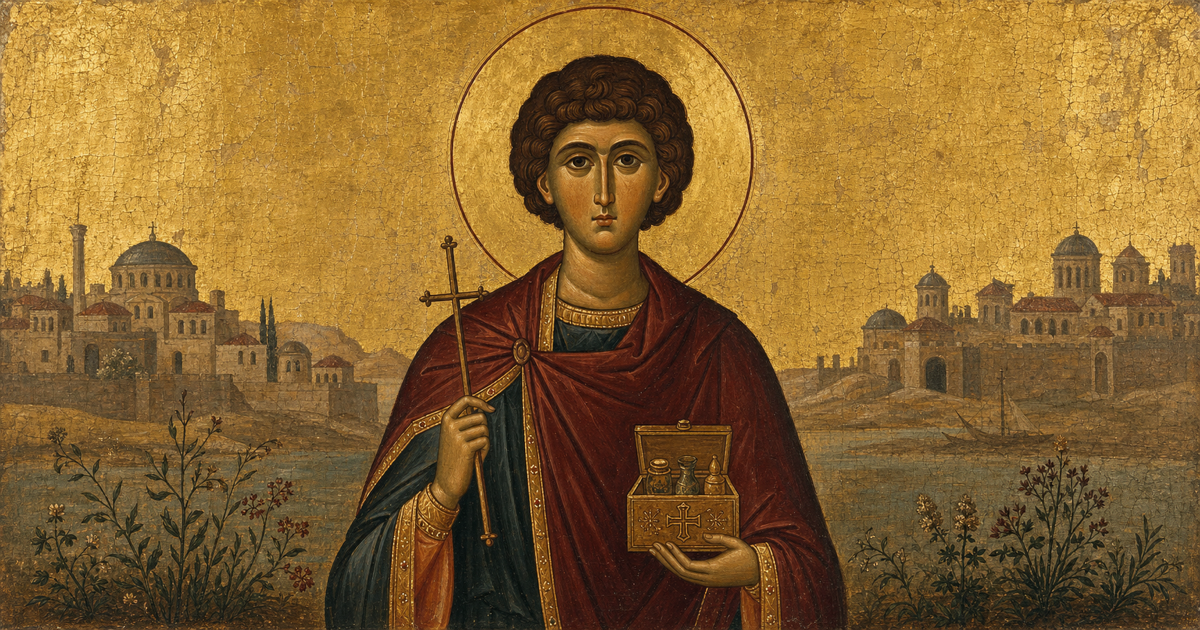
On 27 July, the Church commemorates the Holy Great Martyr and Healer Panteleimon, a physician from Nicomedia in Bithynia who was put to death for Christ during the persecution of Maximian at the beginning of the fourth century. He was young, had learned the healing art from one of the most renowned physicians of Nicomedia, and was expected to serve at the imperial court. He kept his art to the end, but placed it under another Master: he healed by calling upon the name of Christ and accepted no payment from those he cured.
The name by which the Church commemorates him was not the one he received at birth. He was first called Pantoleon, which in Greek means “lion in all things,” a name chosen by a father who expected strength and worldly success from his son. He died bearing the name Panteleimon, “the all-merciful.” The road between these two names is his life.
The City
At the turn of the third and fourth centuries, Nicomedia was one of the imperial capitals of the Roman Empire. Diocletian kept his court there, and for a time the whole East was governed from that city. Nicomedia had many Christians and a church visible to all, built within sight of the imperial palace. This very fact brought upon it the full weight of the fiercest persecution the ancient Church had known.
In the year 303, the imperial decrees were issued: churches were to be demolished, the sacred books burned, Christians removed from public office and forced to sacrifice to idols. The church of Nicomedia was the first to be torn down. The tradition of the Church then records the burning of a multitude of faithful who had been shut inside a place of prayer; the Synaxarion honors them on 28 December. Few priests escaped those days. Those who remained hid in small houses and secluded courtyards, serving in secret.
Pantoleon grew up in this city.
His Father’s House
His father, Eustorgius, was a wealthy and prominent man, honored by the city, and a zealous servant of the idols. His mother, Eubula, was a Christian. The Church commemorates her on 30 March, and the Synaxarion says that she taught her son the faith from infancy, gently and persistently, shielding him as far as she could from his father’s sacrifices.
She died early, however, while the child was still young. The household remained under the rule of Eustorgius, and the boy was sent to the pagan schools of the city. The seed planted by his mother remained covered for many years beneath other teachings and habits, until someone was found to awaken it.
This deserves attention. A mother’s prayer does not always bear fruit before her eyes, nor even during her lifetime. Eubula lived to see none of what she had sown.
The School of Medicine
Eustorgius entrusted his son to Euphrosynus, the most celebrated physician in Nicomedia. The healing art was then learned slowly and carefully, through the reading of ancient writings and practical work beside the sick. The pupil mastered it quickly and soon surpassed those of his own age. His reputation reached the court. Emperor Maximian heard of him and wished to make him his own physician as soon as his training was complete.
The young man therefore had before him everything the world can offer: a name, wealth, a sought-after profession, and a place beside the emperor. None of these things was taken from him by force. He left them behind, one by one, when he discovered something more precious.
The Elderly Priest
On the road between his home and the school stood a small house where the priest Hermolaus lived in hiding, one of those who had escaped the persecution in Nicomedia. The elder watched the young man pass day after day and observed him closely, until one day he called him inside and began to speak with him.
It was not a single conversation. Hermolaus waited for him thereafter, welcomed him each time, and patiently unfolded the faith to him: who Christ is, why He was crucified, what the Resurrection means, and what power the idols worshiped by his father truly possessed. He also spoke to him about the art the young man was learning, showing him that the physician can bind a wound, but only God gives life.
The young man listened and examined what he heard. He did not decide at once, but carried these words within him for a long time and weighed them. The Synaxarion does not hide this delay, and rightly so. What he received then remained firm even before the sword.
The Dead Child and the Viper
One day, returning from the school, he found a child lying dead on the road, bitten by a viper. The creature was still there, coiled near the little body.
Pantoleon stopped. His skill could do nothing more; the child was truly dead. Then he remembered the elder’s words and did the one thing he had never tried: he prayed. He asked Christ, whom he had not yet confessed, that if He were truly God, He would raise the child and kill the serpent; and he promised that he would then be baptized.
The child rose alive. The viper lay dead upon the ground.
The Synaxarion places the turning point of his life here. The young man did not return home, but ran to Hermolaus and asked for Baptism. He remained for seven days in the elder’s house, learning the things of the faith, and only then returned to his father.
The Healing of the Blind Man
The first sign he worked as a Christian took place before his father.
A blind man came to him who had spent all his wealth on physicians and, instead of regaining his sight, had lost the little that remained to him. The physicians had treated him one after another and taken his money one after another, while the illness had only grown worse. The man heard that there was a young physician in the city and came to him without hope, more from the desperate man’s habit of trying once more.
Pantoleon told him that he would heal him, not by his own skill but through the name of Christ, and that he would take nothing from him. Eustorgius listened. The sick man promised that, if he should see, he would believe in the One who healed him. The young physician touched his eyes while invoking the name of the Lord, and the man received his sight.
Both believed that day: the man who had been healed and the father who had witnessed it. Eustorgius smashed the idols in his house and received Baptism from Hermolaus. He died shortly afterward, reconciled to God, and the Synaxarion says that his son buried him with joy, as one who had come to know Christ before his death.
The healed man would later be arrested and killed by order of the emperor, confessing the name of Him who had given him sight.
The Unmercenary Physician
Left alone with the entire family estate in his hands, Panteleimon did something simple with it. He freed the slaves, distributed the wealth to the poor, and began to seek out the sick everywhere, asking nothing in return.
He went through the prisons of the city, where tortured Christians lay, and bound their wounds. He entered the homes of those whom the other physicians had abandoned because they could no longer pay. The sick began to come to him from all over Nicomedia, while the doors of the other physicians stood empty.
Here began the hatred that led him to death. Those who made their living from the profession saw their livelihood being taken from them and went to the emperor with an accusation: this young man is a Christian, honors the Crucified One, visits the prisons, and helps those who have been condemned.
Before the Emperor
At first Maximian did not wish to lose him. He valued him and expected him at court. He summoned him, spoke gently, and asked only this: that he deny Christ before everyone and offer sacrifice to the gods, and then everything could remain as it had been.
Panteleimon asked for a proof before the city. Let a paralytic whom no one could raise be brought in; let the servants of the idols first call upon their gods, and if they were unable to help him, then Panteleimon would call upon the name of Christ.
So it was done. The pagan priests cried out over the man for a long time, without any change. When Panteleimon invoked the name of the Lord and took the sick man by the hand, he rose to his feet and walked.
Many who witnessed it believed. The emperor ordered the healed man to be killed and delivered the physician to torture.
The Torments
The Synaxarion recounts the torments one after another. He was suspended and torn with iron claws, burned with torches, thrown into a cauldron of molten lead, cast into the depths of the sea with a stone tied around his neck, given to wild beasts, and placed upon the wheel. He emerged alive from all of them, and the Synaxarion says that in each trial the Lord appeared to him, sometimes in the likeness of the elder Hermolaus, to strengthen him.
It should be stated clearly how the Church reads such accounts. They are not placed there merely to astonish, but to reveal something that the martyrs confessed with their bodies: the power that upholds the world does not belong to the emperor. The beasts lying down at the feet of the condemned man and the molten lead growing cold are not stories about a powerful man, but about Christ’s dominion over the things that seem unyielding.
Seeing that he could not prevail, the emperor ordered that those who had taught Panteleimon the faith be brought in as well. Hermolaus, together with Hermippus and Hermocrates, confessed Christ and were put to death. The Church commemorates them on 26 July, one day before their disciple.
The New Name
At last came the order of the sword.
They led him outside the city and tied him to an olive tree. The soldier raised his sword and struck, but the iron became soft in his hands like wax and cut nothing. The soldiers fell to the ground, saying that they could not kill this man.
Panteleimon raised them and asked them to carry out what had been commanded, for otherwise they would have no share with him. Then he prayed for those who were killing him and for all who would call upon his name in sickness and distress.
Then, the Synaxarion says, a voice was heard from heaven calling him by name. Not by the old name. It called him Panteleimon, “the all-merciful,” and summoned him to the Kingdom.
The soldier struck a second time, and milk flowed from the wound instead of blood. The olive tree to which he had been tied filled with fruit at that very moment. The emperor ordered the tree to be cut down and the body burned, but the Christians took his remains from the fire and buried them with honor.
According to the chronology of the Synaxarion, this took place around the year 305.
The Holy Relics
His veneration spread rapidly throughout the Christian world, both in the East and among the ancient Churches of the West. Portions of his relics are found today in many places, while his head is preserved on Mount Athos, in the monastery that bears his name.
His name entered the Church’s order of prayer early, among the saints whom Christians invoke in times of illness. He is numbered among the Holy Unmercenary Physicians, together with Cosmas and Damian, Cyrus and John, Sampson and Diomedes, and Hermolaus, who baptized him.
How the Church Teaches Us to Ask for Healing
Here we must proceed carefully, because devotion most often goes astray precisely in relation to the healing saints.
The Healing Art Was Not Rejected
Panteleimon did not burn the books of Euphrosynus after his Baptism. He remained a physician, bound wounds, knew the herbs and remedies of his age, and worked with those trained hands until the day of his death. What changed was not the art itself, but its place: from a master it became a servant.
The Church has never condemned medicine. The Wisdom of Jesus the Son of Sirach states plainly that the physician must be honored, for the Lord created him as well, and that remedies come from the earth by the will of the Creator. In the same passage, the sick person is told first to pray to the Lord and then to call the physician. Saint Basil the Great, in his Longer Rules, addresses this very question and shows that the healing art was given for our benefit, but that the person who places his entire hope in it has crossed the proper boundary.
Whoever rejects physicians in the name of faith has not understood Panteleimon. Neither has the one who relies on them alone.
The Gift Freely Received
“Freely you have received; freely give” (Matthew 10:8). The name “unmercenary” is not a condemnation of payment for labor, nor a rule imposed on every physician in the world. It is the sign of a gift that cannot be sold because it was not purchased.
Panteleimon held two things in his hands: an art learned through labor and a grace received without labor. He could justly have charged for the first. He could not charge for the second. And because both worked together in the same hands, he chose to accept nothing for either.
A Saint Is Not a Craftsman Summoned for a Particular Task
The healing saints are often invoked as though they were specialized craftsmen: one for the eyes, another for pain, another for children. A person comes, asks, promises something in return, and leaves. If he receives what he sought, he returns; if not, he looks for another saint or abandons the practice altogether.
Such a relationship resembles prayer, but inwardly it is not prayer. It is bargaining. The saint does not heal; he intercedes. Christ heals, and He heals when healing serves the salvation of the sick person.
Here too lies the answer to the painful question of an apparently unanswered prayer. The Apostle Paul asked three times that the thorn in his flesh be taken away, and it was not removed. The answer he received was that the power of God is made perfect in weakness (2 Corinthians 12:7–9). His prayer was not fruitless. It was answered differently from the way he had asked.
The person who comes to Saint Panteleimon asking for health asks for something good and permitted. But the one who asks only for this does not yet know how much he may be given.
The Appointed Place of the Petition
Whoever reads the Akathist to Saint Panteleimon at home is still praying the prayer of the Church, with her words rather than his own. The room is not at fault, nor is the late hour. What remains outside the Church’s order is something else: a practice invented according to each person’s own understanding, with promises and calculations, which only sounds like prayer.
For the sick, however, the Church has appointed something more than prayer at home. At the Mystery of Holy Unction, seven Epistle readings and seven Gospel readings are proclaimed, and the prayer over the oil is offered seven times. In the petitions of the service, the Holy Unmercenary Physicians are called by name, Panteleimon among them. There, the petition for the body goes together with repentance and the forgiveness of sins, and the sick person approaches Confession according to the order and guidance of his spiritual father.
There the intercession of Saint Panteleimon is seen in its full breadth: not beside a solitary person bargaining, but in the midst of the Church at prayer.
The Two Names
At the end, there remains what was said at the beginning.
His father gave him the name of a lion, asking victory of him. Heaven gave him the name of the merciful one, after seeing what he did with his strength. Nothing was broken between the two: his boldness remained the same, and it can still be seen in the way he stood before the emperor and in the way he raised his executioners from the ground and urged them to strike. Grace did not extinguish his strong nature, but turned it toward others.
A lion who becomes merciful does not lose his strength. He spends it differently.
This is also the promise carried by today’s feast for every one of us. The name with which we enter life is not necessarily the name with which we leave it.