
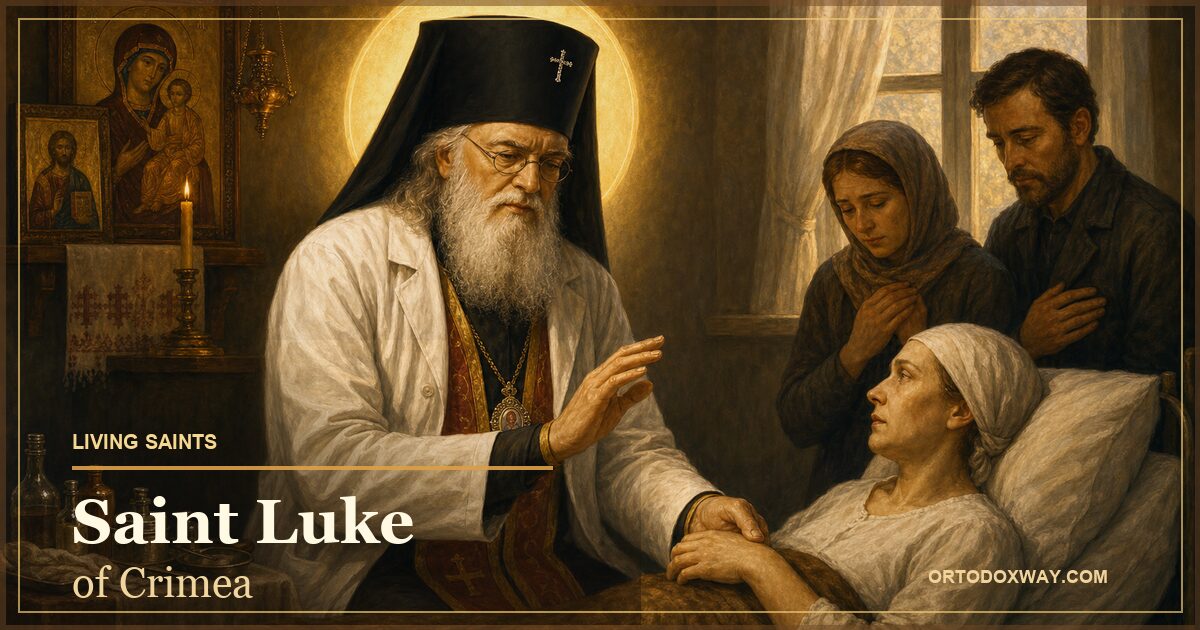
On June 11 the Orthodox Church celebrates the memory of Saint Luke, Archbishop of Simferopol and Crimea (1877–1961). In today’s devotion — from Greece to Romania, from Russia to the diaspora — he is the “unmercenary physician” of the twentieth century: the surgeon who heals even after death, the saint to whom people run before their operations, the gentle face on the little icons in hospital wards. All of this is true. And yet whoever reads the testimonies of his contemporaries and his own writings discovers a man who bears little resemblance to the sweetened image in circulation: a harsh, inconvenient man with a will of iron, who wore down interrogators, state plenipotentiaries for religious affairs and, more than once, his own clergy alike.
The unretouched portrait does not diminish him. On the contrary: only such a portrait shows what it was that God sanctified in this man. Saints are not men who had no passions; they are men who crucified them. And the key to his whole life he gave himself, in a letter to his son: “I came to love suffering, for it so wondrously purifies the soul.”1
The Painter Who Denied Himself His Art
Valentin Felixovich Voino-Yasenetsky was born in Kerch, in Crimea, on April 27, 1877, into a family of impoverished noble descent. In Kyiv he finished secondary school and the school of arts; his gift as a painter was real, and the road to the Academy of Arts seemed open. On the threshold of that road came the first of the ruptures that define his life: the young man judged that he had no right to do what he liked, but only what was of use to people who suffer — and he entered medicine.2
Nor did he choose medicine as a career. To the bewilderment of his professors, the brilliant graduate announced that he meant to remain all his life a country doctor, in the small hospitals of the provinces. The paradox is that precisely this provincial practitioner became a scholar: in 1915 he published “Regional Anaesthesia”, with illustrations drawn by his own painter’s hand, and his doctoral thesis of 1916 on the same subject received the prize of the University of Warsaw. From those same years dates an episode he himself recorded: while drawing up the plan of his future book on the surgery of purulent infections, he was seized by the persistent thought, incomprehensible at the time, that the title page of that book would bear the name of a bishop.3
Tashkent: Priesthood in the Years of Terror
From 1917 we find him in Tashkent, head physician of the city hospital, operating under the bullets of the civil war. In 1919 his wife Anna died of tuberculosis, leaving him four children. The widower read the Psalter at her side, and one verse settled upon his heart as an answer:
“He maketh the barren woman to keep house, and to be a joyful mother of children.” (Psalm 112:9 LXX)
Thus he understood that Sofia Beletskaya, a widowed and childless nurse, would raise his children — and so it came to pass, to the very end.4
In 1921, at the height of the anti-religious terror, when the priesthood promised nothing but the cross, the surgeon-professor was ordained priest. From then on he wore the cassock to his lectures, to his consultations and into the operating theatre, where he began no intervention without prayer and without an icon. When a commission removed the icon from the operating theatre, he refused to return to the hospital until the icon was put back — and back it was put.5
From the same year dates the best-known episode: summoned as an expert at the show trial known as “the doctors’ trial”, he was asked before the whole courtroom, by the head of the Cheka, how he could believe in a God he had never seen. He replied that he had often operated on the brain and had never seen the mind there — and yet the mind exists; nor had he found conscience there.6 The answer has endured; what is told less often is that the man who gave it knew exactly what he was risking, and lowered his tone neither then nor afterwards.
The Bishop Arrested After His First Liturgies
The year 1923 brought to Turkestan, as to all of Russia, the blow of the “Renovationist” schism — the “Living Church”, manufactured by the Soviet power to shatter the Church from within. Father Valentin stood unmoved on the side of Patriarch Tikhon. Bishop Andrei (Ukhtomsky), passing through Tashkent, tonsured him a monk with the name Luke — the name of the Evangelist who was a physician and, according to tradition, an iconographer: his own two gifts gathered into a single name. On May 31, 1923, in the small town of Penjikent, two bishops who were themselves in exile secretly consecrated him to the episcopate. Barely two weeks after his first hierarchical Liturgies, Bishop Luke was arrested.
There followed, with interruptions, three arrests and eleven years of prison and exile: Yeniseysk and Turukhansk, then the hamlet of Plakhino beyond the Arctic Circle, where the hierarch-surgeon went on operating with improvised instruments; then the exile at Arkhangelsk, from 1930 to 1933. The hardest trial came in 1937, the year of the Great Terror: “the conveyor” — thirteen days and nights of uninterrupted interrogation, without sleep, with interrogators relieving one another in shifts. They demanded his signature on fabricated confessions — a “counter-revolutionary church organization”, espionage — and the names of “accomplices”. He answered with a hunger strike, the only protest left to a man who refuses to sign a lie, and he renounced neither his faith nor his cassock.7 The third exile took him to Bolshaya Murta, in the Krasnoyarsk region.
Here there is no ambiguity and no room for legend: his confession is documented in the interrogation archives, not reconstructed from late reminiscences.
The War, the Council of 1943 and the Uncomfortable Zone
When the war began, the exiled bishop sent a telegram asking to be used as a surgeon, without renouncing the episcopate. From the autumn of 1941 he was chief surgeon of a large evacuation hospital in Krasnoyarsk, operating on the gravest of the wounded eight or nine hours a day; in 1942 he was raised to the rank of archbishop. In September 1943 he took part in the Council that elected Sergius (Stragorodsky) patriarch — in the official photograph of the Council he sits first from the left — and was elected a member of the Holy Synod.8
Here begins the zone which the popular lives pass over, and which we shall not pass over. Saint Luke accepted the framework of the 1943 “understanding” between the Moscow Patriarchate and the Soviet state, and in those years published, in the Patriarchate’s journal, articles in the patriotic register of the day.9 At Tambov, where he was transferred in 1944, he led the diocese’s fund-raising for the front.10 At the beginning of 1946 he was awarded the Stalin Prize, first class, for his “Essays on the Surgery of Purulent Infections” and for his work on late resections of infected gunshot wounds of the joints; of the prize’s 200,000 roubles, he directed 130,000 to children orphaned and scarred by the war.11 He then tried to order visiting cards on which the two titles would stand side by side — “Archbishop of Simferopol and Crimea” and “laureate of the Stalin Prize, first class” — and the censors flatly refused him.12 The anecdote says more than it seems to: this man never agreed to separate his two ministries, and hid neither one behind the other.
And to be clear about what we are speaking of: medically, his contribution is not reducible to the aura of a “saintly surgeon”. The Russian medical literature credits him with procedures and landmarks that bear his name to this day — the pelvic resection in suppurations of the sacroiliac joint, procedures for mobilizing the spleen in splenectomy, a technique of his own for closing wounds of the diaphragm, the line and the point that locate the sciatic nerve on the skin — the fruit of a quarter-century’s work on the surgery of suppurations.34 He was not a cleric who “also practised medicine”, but a surgeon of the first rank who refused to leave his faith outside the operating theatre.
His loyalty to the Patriarchate’s line, however, was not servility. In 1945, before the election of the new patriarch, he openly opposed an election with a single candidate and demanded a return to the order of the Council of 1917–1918: several candidates, a vote, and the drawing of lots — exactly what the authorities did not want. Karpov, the state plenipotentiary for religious affairs, kept gathering complaints against him: he kept an icon in the surgical ward of the evacuation hospital, served molebens for the wounded, blessed the sick.13
And yet the question remains, and it is more honest to name it than to hide it: how are we to judge his accommodation with a power that had just been killing his brothers in ministry? The Russian Orthodox Church Outside of Russia carried out the glorification of the New Martyrs and Confessors of Russia in 1981, in an ecclesial context profoundly marked by the rupture with the Moscow Patriarchate; Saint Luke was not then among those glorified, and in circles tied to that Church’s tradition his reception was long encumbered by his association with the post-1943 patriarchal line.14 Today, after the restoration of communion, parishes of that same Church celebrate him on June 11 as a confessor.15
The lesson of this history is not relativism but discernment. The Church did not glorify in Luke a historical infallibility, but the confession of Christ in a life carried through interrogations, exile, ideological pressure and unbroken service. Canonization does not turn a man’s every administrative decision into a model; it shows where grace prevailed. And in his case that victory is seen precisely in this: whenever he was required to choose — between career and faith, between the professor’s chair and the cassock, between comfortable survival and confession — he renounced neither his cross nor his ministry. That is exactly why his case is a touchstone for any discussion of the criteria of canonization: his confession rests on interrogation files and verifiable facts, not on the late piety of a posterity in need of saints.
A Severe Archbishop in Crimea
From May 1946 Saint Luke shepherded the see of Simferopol. The Crimean years were years of an administrative battle almost entirely lost and never abandoned: despite his stubborn resistance, the number of open churches in Crimea had fallen, by 1954, to forty-nine.16 He protested, he wrote, he threatened resignation — and he yielded nothing of what depended on him.
With his clergy he was severe to the point of harshness. He demanded a sermon at every Liturgy, true confession before Communion, services without shortcuts, and he suspended without much ceremony those who treated the altar as just another job. Contemporaries speak of a heavy temperament: cutting judgements, outbursts of anger, an authority that brooked no reply — and he himself recorded his irascibility in writing, sparing himself nothing.17 His most inconvenient biographer, the dissident writer Mark Popovsky — a man from outside the Church, who gathered hundreds of testimonies in the 1960s and 70s — honestly noted both: the veneration and the fear the archbishop stirred around him.18
Yet the same hand that signed suspensions fed the poor daily at his own table, and the money — including the money of the prize that bore his persecutor’s name — went quietly to widows, orphans and former prisoners.18 His cassock was old and patched. The sick would try to touch his vestments during the services; to medical conferences he came, to the very end, in his cassock and with the panagia on his chest, and when the authorities forced him to choose between the professor’s chair and the cassock, he chose the cassock — every time, until he was forbidden to lecture altogether.19
The Blind Man Who Went On Serving
In his last years his sight failed entirely. He continued to serve the Divine Liturgy from memory, without error, to preach, and to govern his diocese.20 To those who marvelled he would answer serenely that a man who has given his life to God does not remain in darkness.
He fell asleep in the Lord on June 11, 1961. The liturgical coincidence is staggering: in the Russian order, the second Sunday after Pentecost is the Sunday of All Saints Who Shone Forth in the Land of Russia — and in 1961, with Pascha on April 9 and Pentecost on May 28, that Sunday fell precisely on June 11.21 A saint of the Soviet prisons departed to the Lord on the very day when the Church of his land was commemorating all its saints, known and unknown. The authorities insistently demanded that there be no procession.22 The city did not listen. An eyewitness recounts that a road that takes twenty minutes took three and a half hours: the streets packed, traffic at a complete standstill, people up in the trees, on the balconies, on the rooftops.21 The plenipotentiary ran from car to car trying to herd the people into buses; no one heeded him.23 All along the way, through the whole city, the crowd sang: “Holy God, Holy Mighty, Holy Immortal, have mercy on us.”24 He was buried beside the cemetery church of All Saints in Simferopol, and his grave at once became a place of pilgrimage and of healings.
From Popovsky to Sagmata: How the Orthodox World Received Him
The first thorough biography did not come from the Church. “Жизнь и житие Войно-Ясенецкого” — “The Life and the ‘Saint’s Life’ of Voino-Yasenetsky” — was written by the dissident Mark Popovsky and published by YMCA-Press in Paris in 1979, at a time when in his own homeland the archbishop’s name was passed over in silence.25 The title itself carries the tension of the true portrait: between documentary biography and hagiography. The pious lives written later have drawn abundantly on Popovsky’s material — as a rule, without the inconvenient parts.
Glorification came first locally: on November 22, 1995, Archbishop Luke was numbered among the locally venerated saints of Crimea; between March 17 and 20, 1996, his relics were translated to the Holy Trinity Cathedral in Simferopol — some forty thousand people took part in the procession — and the festal glorification in the diocese of Crimea was celebrated on May 24–25, 1996.26 The Council of the Russian Church in the year 2000 then inscribed him, for general veneration, among the New Martyrs and Confessors of the twentieth century.
Then came the Greek wave — the phenomenon least known in the Romanian-speaking world. Archimandrite Nektarios Antonopoulos, then abbot of the Sagmata Monastery near Thebes and today Metropolitan of Argolis, wrote his life; the book, printed in thousands of copies and reissued without interruption, made the Russian saint of the Gulag one of the best-loved saints of present-day Greece.27 At Sagmata there is a chapel of the saint, with a portion of his relics — given as early as the translation of 1996 — together with his mitre and personal belongings brought from Crimea;28 across Greece, recent decades have seen the building of numerous churches dedicated to him, some of great size, among them the church at the Dovra Monastery near Veria.29 The weight of this reception lies in the fact that it did not begin with propaganda, but with a book and with the miracles that followed it. And on June 13, 2019, the Holy Synod of the Ecumenical Patriarchate inscribed him in its own calendar of saints as well, with his commemoration on June 11 — an official seal upon a veneration which, in the Greek world, had long been an accomplished fact.32
In the Romanian-speaking world, reception largely followed the Greek and the Russian channels: the autobiography “I Came to Love Suffering” (Sophia, Bucharest, 2005, in the translation of Adrian and Xenia Tănăsescu-Vlas), Antonopoulos’s biography, “The Unmercenary Surgeon” (Bunavestire, Galați, 2003), the volumes of sermons and the treatise “Spirit, Soul and Body”;30 and, since 2013, the Ukrainian-Belarusian film “Излечить страх” — “To Heal Fear”, at first titled simply “Luka” — by the director Aleksandr Parkhomenko.31 But the Romanian reader’s closeness to the saint has long ceased to be merely bookish: the Holy Synod of the Romanian Orthodox Church recognized his canonization in September 2012, his name was entered in the calendar by the synodal decision of 2013, with his commemoration on June 11, and portions of his relics are venerated in Bucharest, in the chapel of the “C.I. Parhon” Institute of Endocrinology and in the chapel of the Floreasca Emergency Clinical Hospital.33 All of it good and profitable. But out of all this, what has settled in current devotion is above all the healer; the severe confessor, the whole man, has remained in shadow.
“I Came to Love Suffering” — the Key to the Portrait
Why does the real portrait matter? Because a retouched saint teaches us wrongly what holiness is. Had Luke of Crimea been the gentle, smiling nature of the printed icon cards, his life would ask nothing of us: we would ask healings of him, the way one asks of a vending machine. The real man asks something else of us. He was not a pleasant man; he was a crucified man. The harshness of his temperament was not a virtue, and he never once called it one; his virtue was that he spared nothing of what he had: not the painter’s gift, which he gave to the sick; not his science, which he signed with a bishop’s name when that signature carried a price; not his body, which he gave to the prisons; not his sight, which he gave to the end of his serving. And God sanctified the whole: nothing of this man remained outside the sacrifice.
Not all saints resemble one another. Some are gentle and radiant like Seraphim of Sarov; others are stern and immovable like Luke of Crimea. The Holy Spirit is one and the same, and their variety is the wealth of the Church — a truth we celebrate every year on the Sunday of All Saints, in whose neighbourhood his commemoration falls, and on which very Sunday, in 1961, according to the order of the saints of his own land, he departed to the Lord.
“Thou therefore endure hardness, as a good soldier of Jesus Christ.” (II Timothy 2:3)
This was the word he lived, letter by letter, the surgeon who became an archbishop. Holy Hierarch Luke, pray to God for us!
In brief. Saint Luke of Crimea (1877–1961) is commemorated on June 11. He was a surgeon of world renown, a university professor, a bishop, and a confessor in the years of the Soviet persecution, passing through three arrests and some eleven years of prison and exile. He is venerated as an unmercenary physician and a protector of the sick, and his life remains a lesson in a holiness that does not cancel the complexity of a man.
1. Saint Luke of Crimea, Am iubit pătimirea. Autobiografie [I Came to Love Suffering: An Autobiography], trans. Adrian and Xenia Tănăsescu-Vlas, Sophia, Bucharest, 2005. The words come from a 1943 letter to his son and stand as the motto of the whole edition; the English rendering of quotations from this book is ours.
2. I Came to Love Suffering, the chapter on his youth.
3. I Came to Love Suffering, in the account of the beginnings of his work on the surgery of purulent infections.
4. I Came to Love Suffering, in the account of his wife’s death (1919). The Scripture quotation: Psalm 112:9 in the Septuagint numbering (113:9 KJV), King James Version.
5. An episode related by his biographers; cf. Archim. Nektarios Antonopoulos, Sfântul Arhiepiscop Luca (1877–1961). Chirurgul fără de arginți [Saint Archbishop Luke: The Unmercenary Surgeon], Bunavestire, Galați, 2003.
6. Recorded in the autobiography and documented by Mark Popovsky, Жизнь и житие Войно-Ясенецкого, архиепископа и хирурга, YMCA-Press, Paris, 1979. Rendered indirectly, with no claim to verbatim quotation.
7. I Came to Love Suffering, the chapter on the third arrest.
8. The official photograph of the Bishops’ Council of September 8, 1943; see also “Stalin’s Revival of the Moscow Patriarchate”, orthodoxhistory.org, April 8, 2025.
9. His writings in the Journal of the Moscow Patriarchate (ЖМП) in the years 1943–1948 are recorded by the historiography; cf. Popovsky, op. cit. The statement is kept here at a general level, without direct quotation from those texts.
10. Cf. the Russian documentary materials on the diocese of Tambov in 1944 and the fund-raising for the “Dmitry Donskoy” tank column.
11. The award: early 1946, for Очерки гнойной хирургии [Essays on Purulent Surgery] and Поздние резекции при инфицированных огнестрельных ранениях суставов [Late Resections for Infected Gunshot Wounds of the Joints]; the destination of the sum (130,000 of the 200,000 roubles, to children scarred by the war) is recorded in the Russian sources, including with reference to the telegram addressed to Stalin.
12. Related by Mark Popovsky, op. cit., and retold in the Russian press (Moskovsky Komsomolets, March 26, 2003).
13. Archival material synthesized by recent Russian church historiography on his position at the patriarchal election of 1945 and on the reports of the plenipotentiary G. Karpov.
14. Saint Luke does not figure among the New Martyrs and Confessors glorified by ROCOR on November 1, 1981 — a fact verifiable in the acts of the glorification. His difficult reception in circles of that tradition, attributed to his association with the post-1943 patriarchal line, is attested by numerous testimonies; no official synodal motivation of the non-inclusion has, however, been published.
15. For instance, the calendar of the ROCOR Cathedral of St John the Baptist in Washington, which commemorates him on June 11 as a hierarch-confessor (stjohndc.org).
16. Mark Popovsky, op. cit., pp. 414–421.
17. The self-descriptions in I Came to Love Suffering; the testimonies of contemporaries synthesized by Popovsky, op. cit.
18. Mark Popovsky, op. cit.
19. Cf. Antonopoulos, op. cit.; Crimean testimonies about the archbishop’s serving and lecturing.
20. On the year of his complete blindness the sources differ (between 1955 and 1958): the synaxarion at pravoslavie.ru gives 1956, while the life published by the Orthodox Church in America notes the worsening of his eye disease after his arrival in Crimea and his total blindness, with continued serving; for this reason the text keeps the general wording.
21. Eyewitness testimony reproduced by the Diocese of Tver (tvereparhia.ru, June 11, 2024). In 1961 Pascha fell on April 9 and Pentecost on May 28; the second Sunday after Pentecost — the Sunday of All Saints Who Shone Forth in the Land of Russia — was therefore June 11.
22. Crimean accounts of the ban on the procession (aif.ru — Crimea, March 2026).
23. Anatoly Komaristov, “Smert’ i pokhorony svyatitelya Luki”, proza.ru — a memoir testimony.
24. Cf. the account of the uncovering of the relics, monastyr.org.
25. Mark Popovsky, Жизнь и житие Войно-Ясенецкого, архиепископа и хирурга, YMCA-Press, Paris, 1979.
26. The chronology of the glorification, after the life published by the Orthodox Church in America (oca.org, s.v. “Saint Luke, Archbishop of Simferopol”): November 22, 1995 — numbering among the locally venerated saints of Crimea; March 17–20, 1996 — translation of the relics to the Holy Trinity Cathedral, with some 40,000 participants in the procession; May 24–25, 1996 — the glorification in the diocese of Crimea.
27. On the spread of Antonopoulos’s biography and the churches built in Greece: orthodoxword.wordpress.com, June 11, 2009, et al.
28. The presentations of the Sagmata Monastery (impantokratoros.gr); the gift of a portion of the relics to Sagmata at the translation of 1996 is also recorded in the life at oca.org.
29. On the church of Saint Luke at the Dovra Monastery (Veria): Greek pilgrimage accounts.
30. The Romanian editions: Sophia, Bucharest, 2005 (the autobiography); Bunavestire, Galați, 2003 (Antonopoulos); the volumes of sermons and Duhul, sufletul și trupul [Spirit, Soul and Body] with the same Sophia publishing house.
31. On the film: premiered in 2013 under the title «Лука», renamed «Излечить страх» for the 2015 release; directed by Aleksandr Parkhomenko (cf. ru.wikipedia, s.v.).
32. The decision of the Holy Synod of the Ecumenical Patriarchate of June 13, 2019, officially announced by patriarchal letter (cf. the communiqué of the Greek Orthodox Archdiocese of America, goarch.org); the request for inscription came from Metropolitan Epiphanius of Kyiv.
33. Basilica.ro, “Pomenirea Sfântului Ierarh Luca al Crimeii” (the synodal recognition of September 2012; the portions of the relics at the chapel of the “C.I. Parhon” Institute and at the chapel of the Floreasca Hospital); for the 2013 decision on entry into the calendar and the commemoration on June 11: the synaxaria of Doxologia and Ziarul Lumina.
34. The synthesis of the surgical contributions bearing his name: the Russian anniversary medical literature, e.g. the article dedicated to him at 140 years from his birth in Vestnik eksperimental’noi i klinicheskoi khirurgii (2017).