
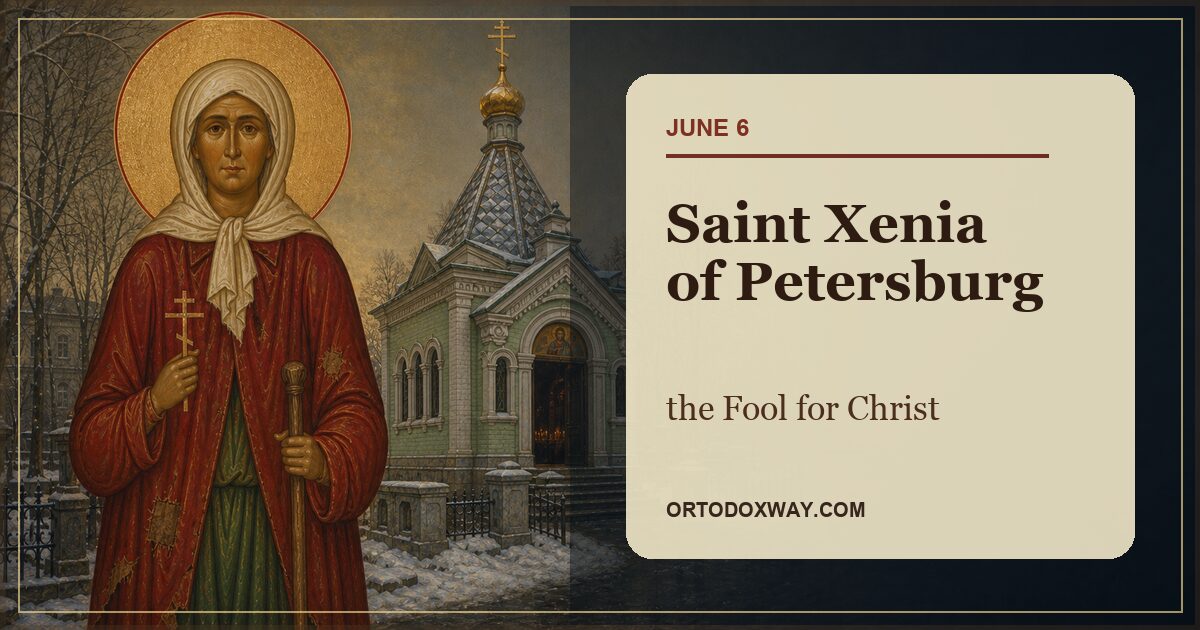
There are saints whom the history of the world does not record. They commanded no armies, moved no borders, left behind no treaties or monuments. And yet, more than two centuries after their repose, people still come to their graves with tears and petitions, while the tombs of the mighty of the earth stand empty. Saint Xenia of Petersburg is one of these.
A widowhood that opened another life
Almost nothing has been preserved about her origins. The life of the saint honestly confesses this silence: the memory of the people did not retain who her parents were, where she was educated, or how she spent her early years. We know only that she was called Xenia Grigorievna, and that she was married to Andrei Feodorovich Petrov, an officer and court chorister.
Her whole earlier life remains hidden, because it was not through it that she entered history. What the memory of the Church retained is the cause that severed her entirely from the world: the unexpected death of her beloved husband. Andrei Feodorovich died suddenly, leaving Xenia a widow at only twenty-six, childless. The blow was so deep that to those around her the young widow seemed to have lost her mind.
But within her soul something altogether different was taking place from what those around her believed. This death showed her plainly how unstable and empty every earthly hope is. She understood all at once that true happiness cannot be found on earth. And she chose the hard path of foolishness for Christ.
The tradition of her life adds a detail that illumines this choice still more deeply: Andrei Feodorovich died suddenly, without the Christian preparation of Confession and Holy Communion. For this reason, Xenia’s grief was not only the grief of a wife left alone, but also the anguish of a love that prays for the soul of the one who has departed. Her foolishness for Christ was not a flight from reality, but a prayer carried through to the end.
She gave away all her wealth to the poor. Her house she gave to a good acquaintance, Paraskeva Antonova. Her relatives even appealed to the authorities to stop her, considering her mad for squandering her property in this way; but her late husband’s superiors, after speaking with her, were assured that she was entirely sound of mind and had every right to do as she wished with what was hers.
Andrei Feodorovich is not dead
Here the depth of her ascetic struggle appears in an astonishing way. Xenia put on her husband’s clothing — his shirt, his caftan, his waistcoat — and began to tell everyone that Andrei Feodorovich had not died, but that his wife, Xenia Grigorievna, had died. She no longer answered when called by her own name, and turned with gladness only when she was called “Andrei Feodorovich.”
It was a way of burying her old identity entirely, but it was more than that: a hidden hope for the soul of the departed, which she took upon herself. Her self-denial went as far as the renunciation of her own name.
In the Church, foolishness for Christ does not mean an illness of the mind, nor theatrics. It is a voluntary renunciation of the glory of men, a concealing of virtue under the appearance of contempt, so that one might no longer seek anything for oneself, but God alone. It is the foolishness of which the Apostle Paul speaks, when he says that the wisdom of this world is foolishness before God, and that God chose what the world counts foolish in order to shame the wise. Saint Xenia chose to be reckoned a fool by the world, so as to be free of the world.
She had no home. She spent her days wandering through the Petersburg Side, especially near the church of the Holy Apostle Matthias, where poor people lived in small wooden houses. Her husband’s clothes wore out in time, and then she began to go about, summer and winter, in rags — a red blouse and a green skirt, or a green blouse and a red skirt. These colors have remained her sign in iconography to this day. On her bare feet, swollen and red with frost, she wore torn shoes.
Some traditions of her life say that, after a while, Xenia left Petersburg for eight years, seeking counsel from the elders and ascetics of Russia. If the silence of those years cannot be traced in detail, it nonetheless fits the image of her whole life: nothing for the curiosity of men, everything for the hidden work of God.
People often gave her warm clothes and shoes, but Xenia never agreed to dress better. She accepted no alms. She received only the small copper coins bearing the image of a rider — the “king on horseback” — from good people, and would at once give them to others as poor as herself.
And for a long time, no one knew where she spent her nights. This stirred the bewilderment of the locals and even the suspicion of the police. When they resolved to find out, they discovered that Xenia, in every season and in all weather, went out at night into the fields, and there, kneeling in prayer, remained until sunrise, making prostrations toward the four corners of the world. On another occasion, the workers building the new church in the Smolensk cemetery discovered that, at night, someone was carrying whole stacks of bricks up onto the scaffolding. The tireless laborer was she.
For forty-five years she bore this ascetic struggle, after the death of her husband. Forty-five years of unceasing warfare against the enemy and against the pride of life.
The gift of foresight
As people came to understand that she was not some ordinary beggar but a chosen one of God, the gift with which the Lord had endowed her also became evident: foresight. The life of the saint preserves several such accounts.
Once, visiting a family she loved — the Golubev family, a widowed mother and her seventeen-year-old daughter — Xenia suddenly said to the young woman, who was just then boiling coffee: “You sit here boiling coffee, while your husband is burying his wife at Okhta. Run there.” The girl, bewildered, answered that she did not even have a suitor. But Xenia, who allowed no contradiction, insisted. The family obeyed and went to the Okhta cemetery. There a young woman was being buried, the wife of a doctor, who had died in childbirth. At the end of the burial the widower, overcome with grief, collapsed unconscious into the arms of the Golubev family. They comforted him, came to know him, and a year later the young Golubev woman became his wife. They lived happily into deep old age.
On another occasion she foretold the death of the Empress Elizabeth Petrovna. On the eve of the Nativity of the Lord, on December 24, 1761, she ran through the streets crying out: “Bake pancakes, bake pancakes; soon all Russia will be baking pancakes!” No one understood, until the next day, when it became known that the Empress had died — and pancakes are, in Russian custom, the food of remembrance for the dead.
In the same way she wept for three weeks on end, saying only this: “There blood is flowing, blood, blood! There the rivers are filled with blood, there the canals are blood!” — foretelling thus the killing of the former Emperor Ioann VI Antonovich in the fortress of Schlüsselburg.
The saint was regarded by the people of Petersburg as the guardian angel of the city. The Synaxarion of Simonopetra gathers this conviction of the people beautifully: the blessing of God seemed to accompany her wherever she went — if she entered a shop, that day’s sales increased; if a cab driver took her in his carriage, he prospered that day; if she took a sick child into her arms, the child soon grew well.
She who works as a living presence, to this day
Saint Xenia departed to the Lord in peace, at an advanced age, forty-five years after the death of her husband. The date and circumstances of her repose have not been preserved with certainty — somewhere toward the end of the eighteenth century or the beginning of the nineteenth, around the year 1800. She was buried in the Smolensk cemetery in Petersburg.
And here, in fact, the other half of her life begins — the half that does not end. Her grave at once became a place of pilgrimage. So many of the faithful took earth from the grave as a blessing that new earth had to be brought continually. A stone slab was laid over it, but the faithful broke it to pieces, bit by bit, and carried it off to their homes; another was laid, and the same thing happened. In the end, a chapel was raised over the grave — the shrine of today, one of the great holy places of Petersburg.
The chapel too bore, in its own way, the cross of the century. First, out of the people’s devotion, a small wooden chapel was raised; and in 1902, over the grave, the stone chapel that pilgrims know today was built in the Neo-Russian style, consecrated that October. In the years of the Soviet persecution the place was closed and profaned — used, by turns, as a warehouse and a workshop — and during the blockade of Leningrad it lost nearly all its treasures, down to the marble slab over the grave. And yet the devotion of the faithful could not be extinguished: even in those years, people came secretly from all over Russia to her grave. After it was returned to the faithful and restored, the chapel was consecrated anew in 1987, a year before the official glorification of Saint Xenia by the Patriarchate of Moscow.
To this day, people come there with their sorrows: illnesses, want, discord in the family, the search for an Orthodox spouse. They write their petitions on small white slips of paper, which they leave at the chapel. And the testimonies of help received through her prayers gather beyond number.
This is the veneration that the Russian Orthodox Church Outside Russia also made evident when it proceeded to her canonization. Bishop Paul of Stuttgart stated it plainly at the Synod of Bishops in 1976: the Blessed Xenia labored more than two hundred years ago, but her memory remains living, and many miracles are wrought through her prayers. The saint was canonized by the Russian Orthodox Church Outside Russia in 1978, in New York, and afterward by the Patriarchate of Moscow in 1988.
The true role in history
There is a homily by the hieromonk Simeon Tomachinsky, delivered on the feast of Saint Xenia, which draws things together through a comparison worth weighing. He observes that there is no history textbook that mentions the Blessed Xenia, while in any textbook one finds the story of Napoleon. The two lived at roughly the same time, at the turn of the eighteenth and nineteenth centuries. And yet, he asks, is their contribution to history really as immeasurably different as the textbooks would suggest?
Napoleon was buried at Les Invalides, in Paris, in a tomb of red porphyry set upon a pedestal of green granite. Tourists crowd there. But no one comes to his tomb to pray. At Xenia’s grave, on the contrary, people have come for two centuries to ask her intercession — and they receive it.
The answer lies, in fact, in the word of the Lord in the Gospel: “What does it profit a man if he gains the whole world but loses his soul?” In the example of Napoleon and Xenia, these words take on a force greater still.
And Tomachinsky closes with a conviction that overturns the usual way of regarding history: history is not made manifest at the Kremlin or the White House, at Brussels or Strasbourg, but here and now — in our heart, when it opens toward God and toward men.
Saint Xenia was neither a monarch nor a commander of armies. She prayed, she fasted, she humbled herself, she forgave without reserve — and she left a deeper mark upon the history of mankind than Napoleon himself.
Troparion and Kontakion of the Saint
Troparion, Tone 4
Having renounced the vanity of the earthly world, thou didst take up the cross of a homeless life of wandering; thou didst not fear grief, privation, nor the mockery of men, and didst know the love of Christ. Now taking sweet delight of this love in heaven, O Xenia, the blessed and divinely wise, pray for the salvation of our souls.
Kontakion, Tone 3
Having been as a wandering stranger on earth, sighing for the heavenly homeland, thou wast known as a fool by the senseless and unbelieving, but as most wise and holy by the faithful, and wast crowned by God with glory and honor, O Xenia, courageous and divinely wise.
Saint Xenia of Petersburg is commemorated on January 24 (February 6 on the civil calendar, according to the Old Style). Her glorification by the Russian Church at the Local Council of 1988 is also commemorated on June 6.
Sources: The Life of Saint Xenia of Petersburg (Orthodox electronic library, lib.pravmir.ru); the Synaxarion of the Monastery of Simonopetra (Mount Athos); Hieromonk Simeon Tomachinsky, The Role of the Individual in History (homily, Pravoslavie.ru, 2006); the Orthodox Church in America (oca.org) and ROCOR parish service texts — for the life and the English liturgical hymns (Troparion, Tone 4; Kontakion, Tone 3); Azbyka.ru — for the Russian synaxarion, the days of commemoration, and the Slavonic hymnography; Smolenka.spb.ru and the Russian encyclopedia of churches — for the history of the chapel in the Smolensk cemetery; ROCOR Studies — for the context of the veneration and glorification in the Russian Orthodox Church Outside Russia.
For a clarification of the several saints who bore the same name and are often confused in popular devotion, see also Saint Matrona of Chios and the Other Saints Who Bore the Name Matrona.