
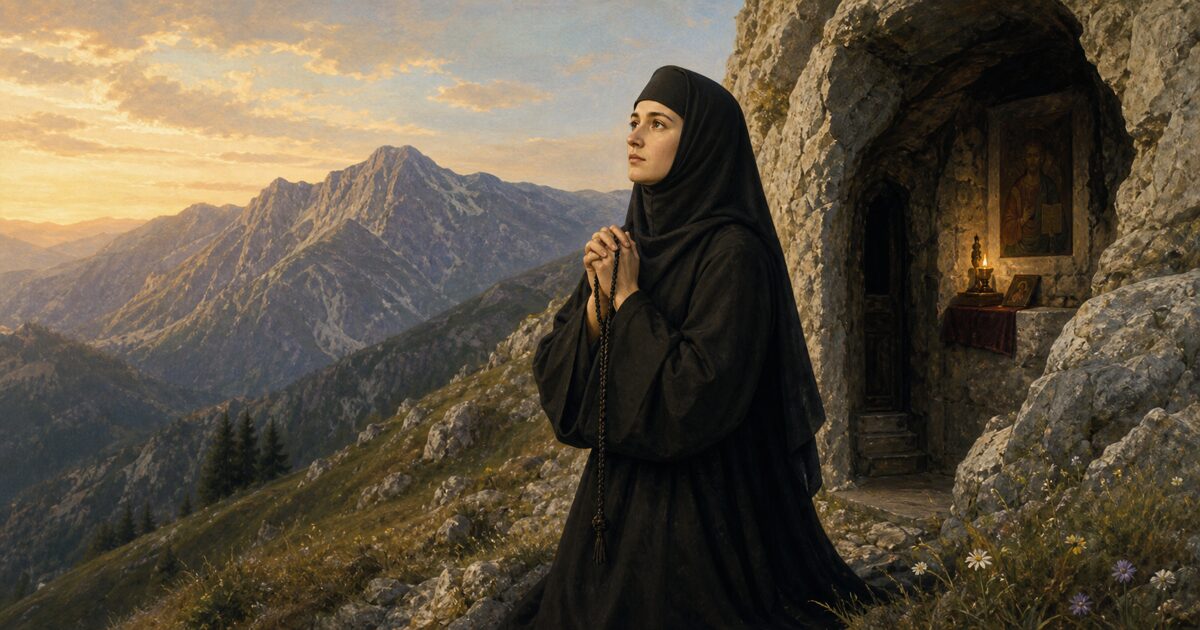
“She was present beside us, yet her heart was already there, where we all long to arrive.” — Mother Nectaria, her sister according to the flesh
She was born in 1970, a contemporary of most of us. And yet the path she took was utterly unlike anything we would expect of someone of our own days: she forsook the world and climbed into the mountains to struggle in fasting, vigil, and unceasing prayer, like Saint Theodora of Sihla of old. Her name in the world had been Rodica Lazăr; the Church would come to honour her as Saint Elizabeth of Pasărea.
There are times when the wilderness seems to have emptied of those who struggle in it. The great hesychasts of the last century departed one by one, and the world, caught up in its own noise, began to believe that unceasing prayer in the mountains had become a tale of the Paterikon — beautiful, but finished. And yet, in these very years, on a mountain peak in Bukovina, in the far north of Romania, beneath blizzard and frost, a young woman carried on the unbroken thread of hesychia, in silence and tears, known to almost no one. In 2025, the Church recognised her holiness, numbering her among the venerable.
Her life has not left us many words. Schemamonastics do not write memoirs. But the little that remains — gathered from the testimony of her sister, of her disciple in the wilderness, of her spiritual fathers, and of the hierarch who exhumed her relics — is enough to show us how deep a soul’s thirst for God can be.
Childhood on the Banks of the Beni Stream
She was born on 16 July 1970, in the village of Benia, in the commune of Moldova-Sulița, Suceava County, into a large and poor family, to her parents Vasile and Maria Lazăr. There were eleven children, two of whom departed to the Lord in infancy; nine grew up together. At baptism she received the name Rodica.
Her earliest upbringing was in the hands of her grandmother Evdochia, a woman strict in matters of holiness, yet at the same time the joy of the children, for she always took them with her to church. Her parents would often take them to monasteries, especially for the great feasts, and sometimes they walked on foot from one monastery to another — a journey that was itself a pilgrimage, in which the toil became a blessing. Thus she learned, from a tender age, the road to the great fathers of the land of Neamț — the historic heartland of Romanian monasticism — a custom she would never afterwards abandon.
From about the age of ten she found a Horologion somewhere in the house. She began to read from it and never parted from it again: she would take the family’s two cows out to pasture and read on the bank of the stream. The first pilgrimage that set her heart aflame she made while in the seventh grade, to Agapia Monastery; from there she returned with her longing for God still stronger. Her sister recalls that, as the years passed, she sensed Elizabeth beginning to live in another world — she was beside them, but her heart was already elsewhere.
Entering Pasărea Monastery
In September 1986, at the age of sixteen, she set out on a pilgrimage with two cousins, seeking counsel and direction from several spiritual fathers. She received guidance from Elder Cleopa Ilie of Sihăstria and venerated the relics at Cernica, and Elder Arsenie Papacioc directed them toward Pasărea Monastery, near Bucharest. (Elders Cleopa Ilie, †1998, and Arsenie Papacioc, †2011, are among the most revered spiritual fathers of twentieth-century Romania, heirs of the living hesychast tradition of the Carpathians.) There the longing for God overwhelmed her entirely, and she remained, received first as a sister, in the time of obedience and the novitiate. It is worth noting that, from her very first steps toward the monastic life, she stood under the guidance of those same great spiritual fathers who would later bless her for the wilderness.
On 12 December 1990, on the feast of Saint Spyridon, she was tonsured a rassophore by Archimandrite Macarie Ioniță, the monastery’s spiritual father, receiving the name Elizabeth. Her chief obedience was work at the metal-engraving workshop of the Romanian Patriarchate, situated within the monastery grounds, where liturgical objects were made. In those same years she also learned church chant, attending the school of psaltic music in Bucharest.
Jerusalem and the Trial of Death
In 1996, at the call of Mother Timoteia, she was sent to serve far from her homeland, at the Romanian Patriarchate’s Representation at the Holy Places, in the Romanian Church in Jerusalem. There she served as sacristan and chanter at the kliros. She was then twenty-six years old, with nearly a decade of monastic life behind her.
In the Holy Land she fell gravely ill. And here lies the heart of her life, the trial from which all the rest sprang. Following a severe crisis, she sank into a state resembling clinical death. The nuns who kept watch over her testify that for three days they could not communicate with her at all, and the doctors held out no hope for her life.
The confession she made after she recovered astonished them all. We know it from two distinct testimonies, one older and one later: a letter of a monk who met her years afterward, and the account of her disciple in the wilderness, Mother Pelaghia. The two converge in everything essential.
A nun had come to her bedside and urged her: pray to Saint John Jacob of Neamț, the Hozevite, for he too was afflicted with this same illness and suffered in this very hospital. (Saint John Jacob the Hozevite, †1960, was a Romanian ascetic who lived out his last years in the wilderness of the Holy Land, near the Monastery of Saint George of Choziba, and was glorified by the Church in 1992.) The mother began to pray with all her strength, almost in despair. Then her soul went out of her body. She would later recount, weeping each time she did so, that the demons seized her and bore her down to hell, where she felt the torments and where she saw, among those being tormented, bishops, priests, and monks — those who had known the will of the Master and had grown slothful. She never wished to name those she saw there, but only to pray for them.
She cried out to the Mother of God and to Saint John Jacob to deliver her. They came and rebuked the demons — why have you seized a soul that has not been judged? — and then the Mother of God departed, and Saint John led her through the beauties of Paradise. She passed, she said, through a field of green and of flowers, in which each blade of grass, when touched, gave forth a sound of heavenly harmony, sounds that cannot be told in words. When she recounted this, her face would grow radiant. But at the gates of the Kingdom a voice like thunder was heard: she is not worthy to enter here; take her back to the earth, to do penance. And Saint John, returning her to her body, said to her: God has granted you more years of life, that you may repent; take heed how you spend them.
Here it is fitting to pause a moment, with the same watchfulness she herself kept. For — a thing worthy of note — the mother never lingered on the beauty of what she had seen. Whenever the joy of remembering Paradise began to light up her face, she would at once rein in her mind, accusing herself: this wretch, instead of pondering the torments that await her, dreams of Paradise! — and she would burst into tears. It was exactly according to the word of Abba Bessarion, which Elder Cleopa would often repeat: if you are in peace and stillness, then humble yourself the more, lest a joy that is foreign enter into your soul. The patristic tradition, from Saint Ignatius Brianchaninov down to the great strugglers of our own day, regards visions of the world beyond with great caution, knowing that the enemy often transforms himself into an angel of light. The surest sign that such a trial is from God lies not in the splendour of the vision, but in the way a person spends the days that follow: if he enters into a deep repentance, then it was unto salvation. And the life of Mother Elizabeth is precisely the proof of this sign. When she recovered, the illness had vanished — yet she rose from her bed to make prostrations and to weep, saying that she must repent. Some thought she was raving from her illness. Only one nun understood her.
The Return and the Search for a Blessing
She returned to her homeland in 1997. Her sister recalls an incident from those days, which shows what an inner change the trial of Jerusalem had wrought in her: seized suddenly by a rapture of the heart, she remained with her gaze fixed upon the icon of the Saviour for a whole day and night, without stirring. She fulfilled obediences at Pasărea for a time, but the life of the community was no longer the measure of what she bore within her soul. Marked deeply by the trial she had passed through, she chose the path of the wilderness — not by her own will, but along the straight path of obedience.
She did what she had learned in childhood: she went and sought out the great spiritual fathers, asking for a blessing. Already in the years of her youth she had had as her guide, for a time, Elder Paisie Olaru of Sihăstria (†1990), the renowned father-confessor of Sihăstria and Sihla. Now she sought a blessing from Elder Cleopa Ilie of Sihăstria, from Elder Arsenie Papacioc of Techirghiol, and from other tried and tested fathers. To Cleopa and to Arsenie she recounted the very experience of her clinical death, and they gave her their blessing, assuring her that all of it was from God. Elder Arsenie’s parting word became renowned: Go, brave one, into the wilderness!
It was no accident that she sought out Arsenie Papacioc in particular. He, like other great monastics, had himself lived “the life of the mountains” in the harsh years of the communist persecution — when, under the 1959 decree, thousands of monastics were expelled from the monasteries and many fled to the forests — when the monasteries were closed and those who struggled were hunted down. One who had known the hardship of hiding could bless such a road with full understanding.
She also brought back from Jerusalem a treasure of great price: the belt of Saint John Jacob the Hozevite, received — according to her disciple’s testimony — from Mother Magdalena, the sister of Father Ioanichie, a disciple of the saint. The mother sewed the belt onto another, that it might not deteriorate, and wore it all her life. With it she would once defend herself from a bear; and through it, according to testimony, healings were worked, especially for women who could not bear children.
The Wilderness of Giumalău
She chose the Rarău-Giumalău massif in the Eastern Carpathians, which she had known since childhood, with its stillness and its wildness. On Mount Giumalău she dug herself a dwelling in the rock, helped by a brother, Ioan, and by Father Varlaam of the Monastery of “Saint John Jacob the Hozevite” at Corlățeni-Pojorâta — the one who would be her spiritual father in the years on the mountain. In these first seasons of struggle, on 6 August 1998, the feast of the Transfiguration of the Lord, she received the tonsure of the Lesser Schema, taking the name Theodora — “the gift of God.”
Before long she realised she was not the only one on that mountain: there were a few other monks and nuns, struggling in hiding. She then conceived the thought of a small skete carved into the rock, where the desert-dwellers might gather for the services. With the help of Father Varlaam, of a few brothers, and of some warm-hearted Christians, they carried the materials up the mountain and hewed into the stone a small dwelling — more than half buried in the rock — with a little church, a vestibule, and two cells. The skete was finished in 2004; the first service was celebrated by Bishop Gherasim, on the feast of the Holy Prophet Elijah. Present at the consecration was also Archbishop Pimen of Suceava, who said to the desert-dweller words she must surely have received with trembling: Mother Theodora, pray also for me, the sinner!
On that mountain she was not left without guidance. The care of her soul was taken up first by Father Visarion Breabăn — Hieroschemamonk Barsanuphius — of Pojorâta, one of the fathers who knew the secrets of Giumalău; and after his repose, the care was taken up by Father Varlaam, the abbot of the Monastery at Corlățeni-Pojorâta. Thus it is plain that her life, however hidden, stood under the order of obedience and under a clear spiritual lineage, and not under her own will. When the time came for the Great Schema, Father Varlaam, knowing the mother’s desire, asked Stavrophore Marina Andreică, the abbess of Teodoreni Monastery, to embroider the two schemas; and the mother, in token of her thanks, sent her a riassa and a vest she had worn, which those who received them held to be blessings.
On 19 April 2006 she received the Great Schema, the highest degree of monasticism, regaining the name from her rassophore tonsure: Elizabeth. The change of name — from Theodora back to Elizabeth — was also a way of losing her trace, for she had begun to be sought out by people, and hiddenness is the very heart of this calling. The Great Schema demands an even harsher asceticism, within the cell, having as its chief gift almost unceasing prayer and silence. According to the word of the bishop who would later exhume her, in the order of the Great Schema schemamonastics are permitted to speak only seven words a day. Thus one understands why so few of her words have come down to us: most of her years she spent in silence.
She lived on the mountain, in silence, prayer, and total self-offering, for seventeen years. For a time, because of logging operations that disturbed the stillness of Giumalău, she was obliged to move into the Mountains of Neamț, to the place called Coroi’s Ravine, returning afterward to her dwelling in the rock. With what she nourished herself in that frost, how she overcame the blizzard with the warmth of prayer — questions only she could answer, and she kept silent. She was attacked by wild beasts and harried by the unseen enemies, but she was guarded, she said, by the grace of Saint John Jacob, poured out upon the belt she wore. She also had disciples; one of them, Mother Pelaghia, lived beside her on Giumalău in her last years, testifying that the mother would bless her for every task she undertook.
From this disciple’s testimony we also know the order of their days, which gives us a clear image of the harshness and the beauty of that life. The day began around three in the afternoon, with Vespers and Compline, each nun at her own cell; then came the evening rule, between eight and ten o’clock, and afterward the night vigil, which over time grew from two hours to four. They ate only once a day, and sleep, broken up among the prayers, scarcely amounted to some five hours. The mother urged her to pray even more than in the community, “for here, in the stillness, we have neither the cares of the world, nor even those of the monastery.”
The disciple also recounts how gentle she was with the wild creatures of the mountain. The saint used to say that she feared people more than beasts. A stag would come to eat from her palm; and when a snake would sometimes enter the cell, she would put it out gently, without fear. Her sister adds that, when wild beasts of the mountain came upon her — a bear, wolves, or sheepdogs — she would drive them off by prayer and by the sign of the Holy Cross. The one who had made peace with God had made peace, it seemed, with all creation as well — just as we read of the ancient venerable ones, before whom the beasts lost their wildness.
She had received from God also the gift of seeing hidden things. Her sister testifies, from an incident she lived through herself, how the saint knew by grace that Nectaria ought not to accept a difficult surgery that had been proposed to her — and her word proved to be her deliverance. Such gifts she neither sought nor displayed; they made themselves manifest of their own accord, in the service of love toward those around her.
She was humble to the point of refusing to instruct. When the monk who met her at Sihla tried to draw her into speaking about prayer, she was not quick to give counsel, nor to set herself up as a guide — a sign of those fallen into self-conceit — but sent him to read in the Sbornik (the classic Slavic anthology of patristic texts on the Jesus Prayer). And when he persisted, asking her opinion over against the word of his own spiritual father, she answered: if your spiritual father has counselled you, God Himself inspired him; who am I, a sinner, to set my word above that of a spiritual father?
The Descent from the Mountains and the Repose in the Lord
In 2014, the cancer from which she suffered weakened her strength, and her spiritual father gave his blessing for the mother and her disciples to come down from the mountain and go to a monastery. Though her soul burned with longing for the wilderness in which she had spent so many years, Elizabeth nevertheless accepted with humility to return to the monastery of her repentance, where she kept the same rule of prayer and asceticism she had acquired in the wilderness.
She departed to the Lord on 5 June 2014, shortly before completing her forty-fourth year — with a body worn down by illness and by the toils of asceticism, but, as it was said, with a soul young and lit by the longing for God. She was buried the following day at Pasărea Monastery, the monastery of her repentance, where her sister according to the flesh, Mother Nectaria, also struggles.
Numbering Among the Saints
In its working session of 1 July 2025, in the “Patriarch Teoctist” Aula Magna of the Patriarchal Palace, under the presidency of His Beatitude Patriarch Daniel, the Holy Synod of the Romanian Orthodox Church approved the canonisation of Schemanun Elizabeth Lazăr, with the title Saint Elizabeth of Pasărea and a day of commemoration on 5 June. The general proclamation of the canonisation took place at the Patriarchal Cathedral in Bucharest on 6 February 2026, within the assembly of the sixteen Romanian women of holy life, while the local proclamation at Pasărea Monastery was appointed for the day of her commemoration, 5 June 2026, together with Saint Philothea of Pasărea.
Before this, on 16 January 2026, His Grace Bishop Timotei of Prahova, auxiliary bishop of the Archdiocese of Bucharest, celebrated the service of the exhumation of her relics, that they might be placed for veneration in the monastery church. The hierarch testified that, if it had been hard for him to stand a single hour in the frost of the Pasărea cemetery on a winter’s day, all the more was the harshness revealed to him of the life of one who had struggled year after year beneath the blizzard of the mountain. At that service he gave thanks to the saint’s family, noting that her father and her brothers are still living — a sign of how near to us this venerable one lived.
Today, in the former cell of Saint Elizabeth of Pasărea lives her sister, Mother Nectaria, together with a niece who has likewise chosen the monastic path. The sister recalls that the saint used to teach her never to remain without the care for prayer, saying that the greatest delusion of our present times is the postponing of prayer. She also taught her, for our troubled times, not to answer the provocations of the day with clamour and opposition, but to pray for one another and to seek peace before justice, for then we are with God and have joy and peace in prayer and in the heart. And when she speaks of her, she does so with trembling: today, when the Church calls her a Saint, I call her my little sister the saint — but I do so with awe, for I understand that God worked in her more than we could say, or see, or comprehend.
Saint Elizabeth left us no written teaching, nor many words. She left us a life. In a world of comfort, in which we so often forget what is truly needful, she shines like the desert-dwellers of old and calls us to treasure our time and to dedicate as much of it as we can to God. She shows us that the wilderness has not been left without those who struggle in it, that the thread of unceasing prayer has not been broken, and that, so long as there are still souls who “have not bowed their knees before Baal,” the world is not lost.
Holy Mother Elizabeth, pray to God for us!
A Note on the Sources
This life has been composed from the testimonies of those who knew her directly, striving to distinguish what is well-founded from uncertain details.
For the chronological and canonical data, the synaxarion published by the Archdiocese of Bucharest on the occasion of the exhumation of 16 January 2026 has been followed. Among the principal sources are also the word of His Grace Bishop Timotei of Prahova, auxiliary bishop of the Archdiocese of Bucharest, the one who exhumed the saint’s relics (Ziarul Lumina, 20 January 2026); the testimonies of Mother Nectaria Lazăr, her sister according to the flesh, of Pasărea Monastery, delivered, among other occasions, at the conference “The Call to Holiness — The Legacy of Saint Elizabeth of Pasărea” (Suceava Eparchial Centre, 28 April 2026); and the account of Mother Pelaghia, her disciple in the wilderness, in an interview published by the Basilica News Agency. To these are added the letter of a monk who met her at Sihla Skete in 1999 (published in the journal Familia Ortodoxă), the biographical account of Ștefan Popa, who knew her personally, and the recollections of Stavrophore Marina Andreică, abbess of Teodoreni Monastery.
The details concerning visions, miracles, the encounters with the beasts of the mountain, the belt of Saint John Jacob, and the gift of clairvoyance are rendered here as the testimonies of those who knew her directly, not as documentary data of the same rank as those of the synaxarion. From the recollections of Stavrophore Marina, chiefly those concerning the spiritual fathers of the mountain and the preparation of the schema have been retained.
Where the older testimonies were contradictory — the day of her birth, the year of her entry into the monastery, the dates of the tonsures — the eparchy’s official synaxarion has been followed, as the most trustworthy. The sequence of her names, often confused in hasty accounts, is as follows: Rodica (at baptism) — Elizabeth (rassophore, 12 December 1990) — Theodora (Lesser Schema, 6 August 1998) — Elizabeth (Great Schema, 19 April 2006). A few additions, unconfirmed by any ecclesial source, have been set aside.
In the same line of holy women whose suffering and hidden prayer became a place of grace, see also Saint Matrona of Chios and the other saints named Matrona.