
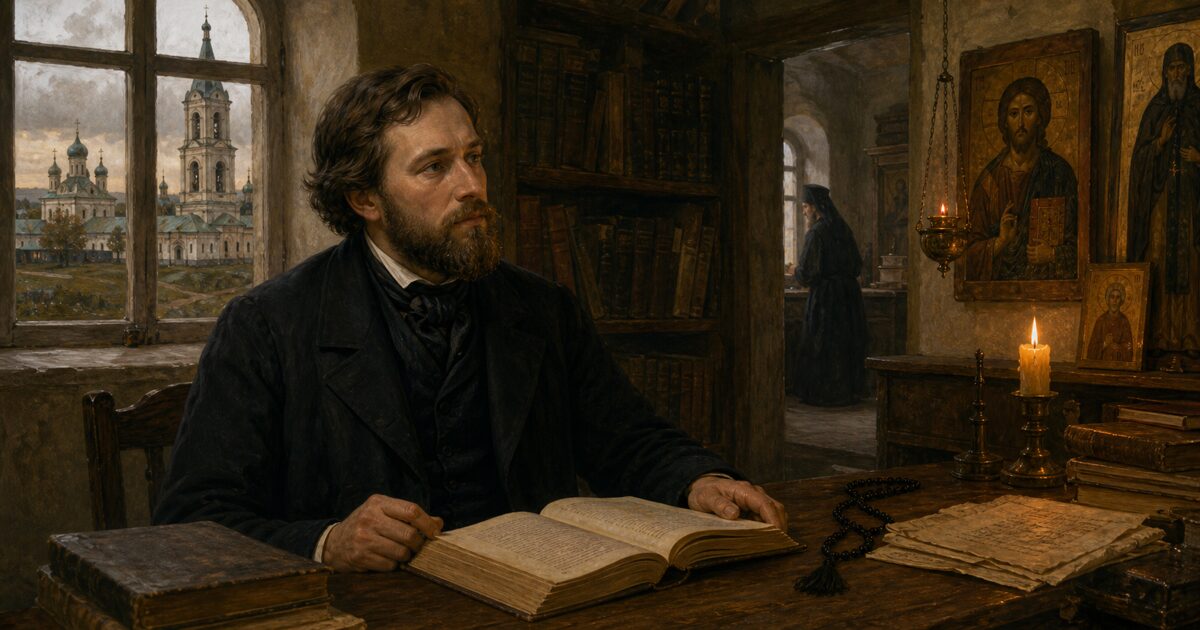
The philosopher who found at Optina what he had not found in Hegel
1. A Man Between Two Worlds
In June 1856, in the midst of a cholera epidemic, one of the most gifted Russian thinkers of the century died at the age of fifty — a philosopher trained in the highest schools of the West, who had nonetheless found his rest in a monastery. He was laid in the earth of Optina Monastery — the first layman buried in the cemetery of that hesychast community; a few months later, his brother Pyotr would be laid beside him. The fact is no small thing: a layman buried in the ground of a hesychast monastery, alongside elders and monks. It was the silent recognition of something his contemporaries had already understood — that Ivan Vasilievich Kireevsky (1806–1856) had not been merely a scholar, but a man who had drawn the educated world close to the living wellspring of Tradition, as few have done.
His road to that place is, in essence, the road traveled by anyone who has tasted all the wisdom of the age and remained thirsty. Kireevsky had everything the Western culture of his time could offer. He was formed in a cultivated noble family — his father, though himself raised in the culture of the Enlightenment, rejected it out of faith: he would deliberately buy Voltaire’s books in order to burn them in the stove, removing from the world, one by one, the pages he considered poison for souls. Together with his brother Pyotr he received a fine education at home, in history, literature, and foreign languages. By sixteen he was already attending lectures at Moscow University, and by twenty he was at the heart of his generation’s intellectual life: he joined the circle called the Lyubomudry — the “Lovers of Wisdom Society” — one of the hubs of the young Moscow philosophical generation, enamored of German idealist philosophy and the new literature. The circle was dissolved by its own members after the suppression of the Decembrist revolt of 1825, with which they sympathized — an early sign that Kireevsky’s generation was seeking, still confusedly, a way to renew Russia.
He then studied in Germany, at the highest chairs of European philosophy: he heard Hegel in Berlin, Schelling in Munich, Schleiermacher. Hegel received him in his home. By formation, he was a complete Westernizer. Yet even then one could see where he was headed: among the great Germans, Kireevsky was drawn above all to Schelling, whose vision of the world as a living organism matched his growing unease with Western rationalism and fragmentation; and he distanced himself above all from Hegel, the embodiment of absolute reason. From within the very heart of German philosophy, then, Kireevsky already sensed what he would later articulate: that the mind which reduces everything to reason loses precisely what is alive.
And yet, out of all this brilliance there emerged a man who, in maturity, would write that Western reason, however sharp, cuts into a void — that it is “a knife that turns on itself,” severed from all the other powers of human knowing1. How this turning came about, and what Kireevsky found at Optina that he had not found in Hegel — this is the story before us.
2. The Soil: The Philokalic Revival
To understand what Kireevsky encountered, one must speak of the soil from which that place had grown — for his return was not a vague religious emotion, but the encounter with a precise, living tradition, handed down from hand to hand.
A generation before him, St. Paisius Velichkovsky (1722–1794) had brought about a true spiritual revival in the Slavic-Romanian world. Setting out in his youth in search of the Fathers, a disciple on Athos, then abbot of the great Romanian monasteries of Dragomirna, Secu, and Neamț, St. Paisius translated and transmitted into Church Slavonic the Philokalia — known as the Dobrotolyubie — together with a whole treasury of patristic ascetic writings, and revived, through hundreds of disciples, the institution of eldership: spiritual guidance from heart to heart, the fruit of a life purified through asceticism.
How great the need for this work was can be seen from a shattering admission by St. Paisius himself. Searching on Athos for the books of the Fathers, he asked everywhere, from the most learned and aged spiritual fathers, and received from all the same answer: not only did they not have those books, but they had never even heard the names of those saints2. The living and widespread transmission of many Philokalic texts had so weakened that Paisius himself testified how hard they were to find even in the milieus of Athos — though in the same era, in the Greek world, the Philokalic movement of St. Nicodemus the Hagiorite and St. Macarius of Corinth was also at work. The labor of St. Paisius’s life was to gather the Slavonic texts, correct them, translate them, and give them back to the Church. The Slavonic translation of the Philokalia would be revised and printed in Moscow in 1793.
The fruits reached Russia along precise paths. Metropolitan Gabriel of St. Petersburg received the translation of the Philokalia from St. Paisius and entrusted it for review to a group of scholars at the St. Alexander Nevsky seminary. But the Metropolitan set a condition of deep wisdom: the translators, however well they knew Greek, were bound to consult at every step with elders who had themselves lived the life described in the Philokalia. “Although they do not know Greek as well as you,” the Metropolitan told them, “they know better than you, from experience, the spiritual truths that cannot be understood from books alone”3. Here, in seed, is the very thesis that Kireevsky would later raise to the level of philosophy: true knowledge is not achieved by the mind alone, severed from the purified heart.
And the thread runs straight to Kireevsky. One of those elders connected with the review of the translation was the hieromonk Philaret, brought from Sarov — the one who would later become the renowned elder of the Novospassky Monastery in Moscow, Natalia’s spiritual father after St. Seraphim of Sarov, and Ivan Kireevsky’s first great spiritual guide4. The chain is unbroken: St. Paisius → the Philokalic revival → the elder Philaret → Kireevsky. The philosopher who had heard Hegel would receive Orthodoxy from the hands of a man bound to the Paisian inheritance.
3. The Return
The Critic and the Drama of The European
Before being the philosopher we know, Kireevsky was a literary critic of the first rank — and this is worth saying, because it changes the image of a mere religious theorist. His 1828 article on Pushkin’s poetry and “A Survey of Russian Literature in 1829” made him known at once: he was among the first to analyze seriously the phases of modern Russian literature and to see in Pushkin its summit. Pushkin himself esteemed him. The man who would withdraw to a country estate was, in his mid-twenties, one of the sharpest critical minds in Russia.
In 1832 he founded a journal, Evropeets — The European — gathering around it the most distinguished men of letters of the day. It was his youthful project: a Russia that would feed on the best Europe had to offer. But the journal was banned by the tsarist censorship after only two issues — his programmatic article, The Nineteenth Century, had been read as dangerous. The blow was deep. The young man full of plans found himself reduced to silence by a state that feared its own ideas. This disappointment — the Europe he had dreamed of and the state that shut his mouth — would become one of the wounds that drove him, years later, toward an entirely different search.
Natalia
As in so many lives, the door was opened by a woman. In 1834, Kireevsky married Natalia Petrovna Arbeneva, a woman of deep and steadfast faith. The meeting between the rationalist trained in Germany and his believing wife had, at first, the natural friction of two worlds. It is told that in the early months, when Ivan spoke words of unbelief in the house out of his Westernizing habit, Natalia kept silent, but suffered. And when he read aloud from the philosophers he admired, she would tell him that many of those thoughts she had already found, clearer and deeper, in the Holy Fathers she read.
It was not a conversion of a single moment. It was a long drawing near, over years. Natalia had already, since 1833, been a visitor to Optina and knew the elders Leonid and Macarius; she would become a spiritual daughter of the elder Macarius. Through her, the Philokalia entered the Kireevsky home not as an object of study, but as a lived life. And she was not merely the door through which Ivan entered the world of Optina: she was herself one of the quiet laborers of this bridge between the elders and educated Russian society — preserving ascetic manuscripts received from her spiritual fathers, supporting the project of printing the Paisian writings, and keeping contact with the hierarchy for the publication of the books.
Twelve Years of Quiet Deepening
After the banning of The European and his marriage to Natalia, Kireevsky withdrew for nearly twelve years to the estate at Dolbino. The withdrawal was not only a choice: the path of public life had been cut off by the censorship, and the gates of the press and the academic chair remained closed to a man considered unreliable by the authorities. What might have been a bitter defeat turned, slowly, into something else. An ill-disposed biographer called these years “a kind of sleep,” a wasted time. The truth is exactly the opposite. They were the years in which Kireevsky “became himself” — the years of inner deepening5. Father Georges Florovsky, who is not uncritical of him, says it plainly: Kireevsky found himself again “not through disillusionment, but through an ascetic effort.”
The decisive step came through his first spiritual father. When Kireevsky came under the guidance of the elder Philaret of Novospassky, receiving from him the gift of a pectoral cross, his attitude toward the Church changed — from indifference to living interest. Under Philaret’s direction, Kireevsky began to read St. Isaac the Syrian and St. Maximus the Confessor, taught by someone who had himself lived those writings, not merely read them6. This is the distinction that Kireevsky would place at the center of his thought: the difference between the one who knows about spiritual truths and the one who has lived them.
The Elder Macarius and the Editing of the Holy Fathers
After the death of the elder Philaret, in 1842, Kireevsky and Natalia drew ever closer to Optina and to the elder Macarius. At their request, the elder often came to the Dolbino estate; they even built him a cell in their orchard. In March 1846, at Dolbino, Kireevsky made his first confession to the elder Macarius.
From this spiritual friendship was born a work of historical importance: the editing and publication of the Holy Fathers in Russian. Under the protection of Metropolitan Philaret of Moscow, the elder Macarius worked together with Kireevsky and other scholars on the printing, in Russian, of the writings of St. Isaac the Syrian, Sts. Barsanuphius and John, St. Mark the Ascetic, St. Maximus the Confessor, St. Symeon the New Theologian, St. Gregory of Sinai, and others7. Kireevsky was not a mere patron: through his consummate philosophical training and his familiarity with the whole of Western culture, he brought to this work exactly what was needed — a sharp mind placed in the service of a tradition he now received with humility. In him, writes the historian Ivan Kontzevich, “the Western philosophical tradition met the tradition of the Eastern Church.”
There is an episode that says everything about what this encounter meant for Kireevsky. Writing for the first time to the elder Macarius from Moscow, at the end of October 1846, with many questions that troubled him, Kireevsky awaited the reply anxiously, knowing how hard it would be for the elder to answer. Not an hour had passed since he sent the letter, when two letters arrived from the post, in the elder’s hand — one for Natalia, one for him. Astonished, Kireevsky asked his wife: “What does this mean? The Father has never written to me!” Opening it, he was stunned: in the elder’s letter were answers to the very questions he had just sent. “Astonishing! How can this be?”8 For a man trained to believe only in the chain of rational causes, the encounter with the gift of clairvoyance of a hesychast elder was a shaking of his entire view of the world.
4. The Mind That Prays
Here we come to the heart of Kireevsky’s thought — and to the reason he is worth reading even today, by any Orthodox Christian, wherever he may be.
The Disease: Reason Severed from All the Rest
Everything Kireevsky saw in the West — in its philosophy, its society, its history — proceeds from a single wound, which he calls the loss of integrality (in Russian, tselostnost’, the wholeness of the spirit). Western man, says Kireevsky, allowed a single power of the soul — logical reason, the syllogism — to reign over all the others and to replace them. “This cold analysis of many centuries destroyed the foundations on which European culture had rested from the beginning”9. Reason severed from faith, from love, from the feeling of the heart, from the will, becomes what Kireevsky names with an unforgettable phrase: a knife that turns on itself, cutting everything, recognizing nothing outside itself.
His diagnosis goes all the way to the historical root, and here Kireevsky makes an analysis worth following step by step, for it is one of the most penetrating Orthodox views of the West. The West too, he says, lived at first from the same undivided faith. In Kireevsky’s reading, the rupture is seen above all in the way the Latin West came to introduce the Filioque into the Creed without the consent of the whole Church. For him, this gesture was not merely a theological error, but the sign of a mentality: the part that considers itself entitled to decide alone for the whole. Rome placed the external authority of the hierarchy above the inner authority of truth preserved in the conciliar consciousness of the Church — that is, the logic of a mind that believes itself self-sufficient slowly took the place of communion.
From this first rupture, all followed in a chain: scholastic philosophy, which sought to prove faith through the syllogism and thus subjected it to reason; then the Reformation, which contested authority, but still with the weapons of individual reason; and at the end, modern rationalism, “the triumph of autonomous reason,” which no longer needs faith at all10. Rationalism, atheism, individualism, social fragmentation — all are, for Kireevsky, the distant fruit of that first displacement: the part severed from the whole, the mind severed from the heart.
Precisely for this reason Kireevsky believed that failure was predetermined even for the deepest Western thinkers who had tried to escape rationalism. He greatly valued Schelling — he had heard him in Munich, he knew his attempt to see the world as a living organism rather than a mechanism. And yet he was convinced that even Schelling could not succeed, because a philosophy grows from the soil of the faith in which it is born, and the Western soil — whether Catholic or Protestant — was itself already rationalist in its very foundation11. You cannot heal rationalism with tools grown out of rationalism. The healing had to come from another soil: from the Eastern faith, preserved whole.
The attentive reader will recognize something familiar here. It is, transferred to the philosophical and historical plane, exactly the disease the Philokalic Fathers describe on the spiritual plane: the mind (nous) that no longer descends into the heart, but wanders alone, severed from its source.
The Cure: The Integrality of the Mind
And the cure Kireevsky proposes is not another philosophy, but another state of the one who knows. He calls it the integrality of the spirit: the gathering of all the powers of the soul — reason, will, feeling, faith — into a single center, under the governance of faith. Only the mind thus gathered, made whole, can receive truth in its fullness; the fragmented mind receives only fragments.
Kireevsky left a page in which he explains clearly why abstract thought, however sharp, cannot reach the highest truths. Purely logical thought, he writes, deals only with the boundaries and relationships between things — with the laws and relations it can measure. But these laws “have nothing essential in themselves; they are only the sum of relationships.” What is truly essential is only the living, thinking, free person. And here lies the problem: when abstract thought touches the things of faith, it can appear, from the outside, very similar to the teaching of faith — it uses the same words, follows the same contours — but in its essence it says something entirely different, precisely because it lacks the sense of the essential, which is born only from within an integral personality. In other words: you can utter the truths of faith with a severed mind, and they become something else — an empty scheme that resembles faith but is no longer faith. The form remains; the life departs.
This is why Kireevsky must not be read as an enemy of reason. He does not ask for a weaker mind, but for a healed one. Reason is not cast out of man, but brought down from the throne on which it had seated itself alone and set back into communion with the heart, the conscience, the will, and faith. The problem is not that man thinks, but that he thinks severed from God and severed from his own depth. Kireevsky did not flee from thought, but from thought severed from prayer.
Kireevsky was inventing nothing. He was translating into philosophical language what he had found at Optina, alive: the elder who, through a heart purified by asceticism and prayer, “saw” truth with a clarity that not even Hegel, for all his sharpness, attained. The calling of Russian philosophy, Kireevsky wrote, is to take up the great philosophies of the West and to rework them “in the spirit of the patristic teaching of the East” — starting from “the deep, living, and pure love of wisdom of the Holy Fathers, which is the seed of the highest philosophical principle”12. And here is a nuance to keep in mind, so as not to read him wrongly: Kireevsky was not calling for the rejection of Western thought, nor for Russia to turn its back on Europe. His dream was a synthesis — that “Russian principles,” without nullifying European culture, would bestow upon it “a higher meaning and a fuller completion.” Not a closed Russia, but one that heals, out of the fullness of its Tradition, what the West had lost. For this same reason he could write, in a letter to his friend Koshelev, words that sum up his whole thought in a single confession: “More than any books, it is to find a holy Orthodox elder to whom you can tell your every thought, and hear from him not his own opinion, more or less intelligent, but the judgment of the Holy Fathers”13.
From Kireevsky and his friend Khomiakov we have also inherited a second word that made a career in Orthodox theology: sobornost’ — a term hard to translate, which names the free and organic unity of the faithful in the Church, a communion founded not on external constraint (as with Rome, in their reading), nor on individualism (as with the Protestants), but on the love that gathers people around what is common to them. The term would be linked above all with Khomiakov, who developed it in his system; but its kinship with the Kireevskian theme of integrality is evident. If integrality concerns the mind of each man, sobornost’ concerns the whole body of the Church: the same inner gathering, transposed from the heart of man into the heart of the community. Both man and the Church live by gathering, not by fragmentation.
Knowledge Made in Communion
Here we come to a less-known facet of Kireevsky’s thought, but one that crowns all the rest. For him, integrality is not only a matter of each individual mind — how a man gathers his inner powers — but also a communal and moral one. Man, Kireevsky wrote, in laboring at his spiritual building, “does not act alone and not for himself only — he does the common work of the whole Church.” And he added a beautiful and deep thought: “all that is essential in the soul of man grows in him conciliarly” — that is, in communion, not in isolation. Man’s true self is not discovered by withdrawal into oneself, but in the living bond with others in the Church. The highest knowledge is not a solitary conquest of the mind, but a fruit of communion.
And there is one more connection Kireevsky makes that is utterly absent from rationalism: the connection between knowledge and the moral life. For him, the health of the mind and the health of the soul are not two separate things. “Moral health,” he said, “is lost where there is a struggle against the ‘natural’ separation of the spiritual forces” — that is, where man allows himself to sever his mind from his heart, knowledge from life, thought from deed. This is why he held that the West had remained spiritually stuck: because an “enlightenment” founded on the development of the severed powers of the mind no longer has any real connection with the moral building of man. You can know enormously and rot inwardly. The knowledge that makes you not better but only more skillful is precisely the sign of a diseased mind. This is why, for Kireevsky, true philosophy could not be separated from ascetic struggle, from the purification of the heart, from life in the Church — exactly what he had seen at Optina, at the feet of the elder Macarius.
This is the most precious legacy of Kireevsky, and it passes beyond any national boundary: the idea that true theology is not a work of the mind alone, but of the whole man, gathered in the heart before God. The highest knowledge is not information, but a state of being.
The reader who wishes to know him directly has at hand, above all, the two mature writings in which his thought reached full clarity: On the Character of European Civilization and Its Relation to Russian Civilization (1852) — where the critique of Western rationalism and the image of the “knife that turns on itself” appear — and On the Necessity and Possibility of New Principles for Philosophy (1856), his philosophical testament, in which he proposes the integrality of the mind as the foundation of a Christian philosophy. To these are added his earlier writings of literary criticism and the articles from the short life of The European (1832). In Romanian there does not yet seem to be a complete and easily accessible edition of Kireevsky’s writings, though fragments and pages about him are found in studies on Optina and on Russian philosophy; the English-language reader will find him chiefly in the anthology On Spiritual Unity: A Slavophile Reader (translated by Boris Jakim and Robert Bird, Lindisfarne Books, 1998) — the most accessible printed source, though it gathers mostly texts by Khomiakov, and the selection from Kireevsky remains partial. A complete edition of his work, whether in English or in Romanian, is still awaited.
5. What Must Be Discerned: The Philosopher and the Slavophile
Up to this point, Kireevsky is a gift for any Orthodox reader. But honesty requires a nuance, for Kireevsky is not a Father of the Church, but a Christian philosopher — and his thought has, alongside its luminous side, a side that requires discernment.
Kireevsky was, together with Khomiakov, the founder of Slavophilism — a movement of ideas that contrasted an “Eastern type” and a “Western type” of culture, seeing in Russia and its Orthodoxy the keeper of a spiritual wholeness the West had lost. Insofar as this critique concerns reason severed from faith, it is penetrating and true. But the schema, carried further, has weaknesses that even Orthodox theologians have pointed out.
The East–West typology is often too simple, too clean: historical reality is more mixed than the schema allows. The idealization of medieval Russia — “a uniform and harmonious light of faith and learning,” as Kireevsky wrote — is, in part, a romantic construction. And, something noted by researchers from within Orthodox circles themselves, Kireevsky’s philosophical thought, however Christian in intention, speaks little of the central realities of the faith — original sin, redemption, the Cross — often remaining at the level of a philosophy of culture14.
One more thing must be said, for the Orthodox reader, not only the Russian one: the theme of the “God-bearing people” and Russian national messianism, which later Slavophilism developed, are dangerous themes. Orthodoxy is not the property of one nation. Honoring what each Orthodox people has given — and the Russians have given enormously — we remain bound to remember that the Church is catholic (sobornaya), belonging to all the world, and that any narrowing of it to the borders of a nation is a betrayal of its universality. Kireevsky himself, by the testimony of those who studied him closely, rose above a narrow nationalism — but the seed was there, and it would bear, in others, less pure fruit.
It is, moreover, a sign of Kireevsky’s honesty that he did not remain a slave to his own schema. In the 1852 article On the Character of European Civilization, he portrayed Byzantium as the perfect type of Christian culture, in contrast to the West. But in his last writing, On the Necessity and Possibility of New Principles for Philosophy (1856), his view of Byzantium had become more critical: he now saw in it pagan remnants and a certain moral decline15. An ideologue would have reinforced the schema; Kireevsky nuanced it, even against his own former position. It is the sign of a man who sought the truth, not the confirmation of his camp — and precisely for this reason he is worth reading with confidence where he is right, and with discernment where he errs.
This is why we receive Kireevsky as is fitting: not as a dogmatic authority, but as a Christian philosopher whose central insight — the mind that prays, the integrality of the one who knows — is true and precious, while his historical and cultural construction requires discernment.
6. Death at Optina
Kireevsky died on June 11/23, 185616, in St. Petersburg, struck down by cholera, at the age of fifty. He was brought and buried at Optina Monastery, beside the church wall, in the ground of the monastery he had loved and from which he had drunk the living water. His brother Pyotr followed him a few months later and was laid beside him. He was the first layman honored with burial in the cemetery of Optina — a sign that the monks themselves reckoned him, though a layman, one of the house.
The work of editing the Holy Fathers, begun together with the elder Macarius, continued after his death and bore fruit for decades. The following generations of Russian scholars who turned toward Orthodoxy — and, later, Dostoevsky himself, who would make the road to Optina in 1878 — walked, not always knowing it, on the path opened by this quiet philosopher who had found at the feet of an elder what he had not found in the lecture halls of Berlin.
This is, perhaps, the lesson of Kireevsky’s life, and it remains valid for anyone who searches today. One can have all the culture of the age and remain thirsty. The mind, however sharp, does not rest alone. Rest comes when the mind descends into the heart and becomes prayer — and there, in the stillness where a hesychast elder answers questions before he has even heard them, a knowledge is discovered that no syllogism can give. Kireevsky sought it all his life and found it at Optina. And he wished, at the last, to rest in its ground. And the ground of Optina received him not as a visitor, but as one of the house.
Notes
1. The phrase “the knife that turns on itself” (or “the self-propelled knife of reason”) appears in the article On the Character of European Civilization and Its Relation to Russian Civilization (1852), Kireevsky’s mature work. The image describes logical reason severed from all the other powers of knowing — “this syllogism that recognizes nothing outside itself and individual experience, this despotic rationality, this logical activity cut off from all the other cognitive powers of man.”
2. St. Paisius’s admission concerning the absence of patristic books even on Mount Athos is found in the Life of St. Paisius (the Optina version, written by the schemamonk Mitrofan). The saint testifies that, asking everywhere for the books of the Fathers, he received from all the same answer: “not only have I not known such books until now, but I have not even heard the names of such saints.” The testimony shows how deeply, in the eighteenth century, the transmission of the Philokalic tradition had died out — and how great was the work of its revival accomplished by St. Paisius.
3. The words of Metropolitan Gabriel of St. Petersburg to the scholars charged with reviewing the translation of the Philokalia are preserved in the Life of St. Paisius (the Optina version). The principle it expresses — that spiritual truths are understood from experience, not from books alone, and that the translators were therefore bound to consult with elders who had lived the life described in the Philokalia — is, in seed, the very epistemological thesis Kireevsky would develop philosophically: true knowledge requires the integrality of the one who knows, not only the sharpness of his mind.
4. The hieromonk Philaret of Sarov, later the elder of the Novospassky Monastery in Moscow, was one of the elders connected with the review of the translation of the Philokalia. Natalia, Kireevsky’s wife, had first been a spiritual daughter of St. Seraphim of Sarov; after his repose, her spiritual father became the elder Philaret, and she then brought Ivan under the guidance of that same Philaret — an encounter decisive for his return. This direct link — from the inheritance of St. Paisius to Kireevsky — is recorded in Elder Macarius of Optina (St. Herman of Alaska Brotherhood, Platina).
5. The assessment belongs to the historian Ivan M. Kontzevich, in his study of Kireevsky included in Elder Macarius of Optina (Platina, 1995). Kontzevich, author of the fundamental work The Acquisition of the Holy Spirit in Ancient Russia, is one of the most serious authorities on the phenomenon of Optina and on the Russian hesychast revival.
6. The detail — that the elder Philaret taught Kireevsky to read St. Isaac the Syrian and St. Maximus the Confessor “as one who had himself experienced these writings” — is recorded by Kontzevich. The distinction between knowledge from books and knowledge from living experience is the very core of what Kireevsky would later call the integrality of the mind.
7. The list of the Holy Fathers edited and published in Russian through the joint work of the elder Macarius and Kireevsky, under the protection of Metropolitan Philaret of Moscow, is recorded in the history of the Orthodox Church (see also the Orthodox Church in America’s synthesis of the nineteenth-century Russian spiritual renewal). It includes, among others, St. Isaac the Syrian, Sts. Barsanuphius and John, St. Mark the Ascetic, St. Maximus the Confessor, St. Symeon the New Theologian, and St. Gregory of Sinai — that is, the heart of the Philokalic corpus.
8. The episode of the letters — the elder Macarius’s reply arriving before he could have read Kireevsky’s questions — is related by Natalia herself and preserved in Elder Macarius of Optina. The gift of clairvoyance (prozorlivost’), by which an elder knows, through the grace of the Holy Spirit, the thoughts and needs of the one who comes to him, is one of the signs of the living hesychast tradition. For a man formed in Western rationalism, such an event was the very shaking of his view of the world.
9. The quotation comes from On the Character of European Civilization (1852). The whole passage describes how “the very triumph of the European mind revealed the one-sidedness of its fundamental aspirations” and how “life itself was deprived of its essential meaning” through the reign of abstract reason.
10. The schema of Western development — from the placing of the syllogism above the consciousness of the whole Church (in Kireevsky’s polemical reading, the Roman moment), to scholasticism, then to the Reformation, then to philosophy severed from faith — is set out in Kireevsky’s mature writings. It must be read as the philosophical interpretation of a nineteenth-century Orthodox thinker, not as rigorous church history: it is penetrating as a diagnosis of rationalism, but schematic in its historical detail.
11. The idea that philosophy depends on “the character of the dominant faith” of a culture — and that therefore the Western attempts to overcome rationalism (Schelling above all) were doomed to fail, because they sprang from a Christian soil that was itself rationalist — is one of the central theses of Kireevsky’s mature writings. Kireevsky regarded Hegel as the summit and conclusion of Western rationalism, an heir of Aristotle; and Schelling as the most serious, but still unsuccessful, attempt to escape from it.
12. The quotations on the calling of Russian philosophy — to rework the Western philosophies “in the spirit of the patristic teaching of the East,” starting from “the deep, living, and pure love of wisdom of the Holy Fathers” — come from Kireevsky’s mature writings, in the English translation from On Spiritual Unity: A Slavophile Reader (trans. Boris Jakim and Robert Bird, Lindisfarne Books, 1998).
13. The words come from a letter of Kireevsky to A. I. Koshelev, preserved in the collection of his writings (Polnoe sobranie sochinenii, vol. I) and quoted, in Romanian translation, by Archimandrite Iov (Cristea), The Spiritual Ties Between the Russian Intelligentsia and Optina Monastery in the Nineteenth Century (Case Study: Ivan Kireevsky). The confession sums up, in practical terms, his whole epistemology: spiritual truth is not received from books, but from living communion with one who has lived the Tradition. Kireevsky added, in the same letter, an assurance full of hope — that such elders are still to be found in Russia, “and if you seek sincerely, you will find.”
14. The critical observation — that Kireevsky’s philosophy, however Christian in intention, does not mention the central realities of the faith (original sin, redemption) and often remains at the level of a philosophy of culture, with a historical typology that is too schematic — has been formulated within Orthodox academic circles themselves (see the studies from the Bulletin of St. Tikhon’s Orthodox University in Moscow on Kireevsky). Acknowledging these limits does not diminish his central insight into the integrality of the mind, but situates his status correctly: a Christian philosopher of great depth, not a Father of the Church.
15. The development can be seen by comparing the 1852 article, On the Character of European Civilization and Its Relation to Russian Civilization, where Byzantium appears as the perfect type of Christian culture, with his last writing, On the Necessity and Possibility of New Principles for Philosophy (1856), where Kireevsky adopts a more critical view of Byzantium, seeing in it pagan remnants and a moral decline. The fact that a Slavophile thinker nuances, toward the end of his life, his own cultural ideal, is a rare sign of intellectual honesty.
16. The Russian bibliographic tradition gives the date of death as June 11 Old Style / June 23 New Style, 1856. Some English sources give May 30 / June 11. I have followed here the established Russian dating.
Select Bibliography
- For the life and the ties with Optina: Elder Macarius of Optina and Elder Ambrose of Optina (Fr. Sergius Chetverikov), St. Herman of Alaska Brotherhood, Platina — they contain I. M. Kontzevich’s study of Kireevsky and Natalia’s account.
- For a Romanian view of the subject: Archimandrite Iov (Cristea), The Spiritual Ties Between the Russian Intelligentsia and Optina Monastery in the Nineteenth Century (Case Study: Ivan Kireevsky) — the source of the quotation from the letter to Koshelev.
- For the context of the Philokalic revival: Blessed Paisius Velichkovsky, by the schemamonk Mitrofan (the Optina version), St. Herman of Alaska Brotherhood, Platina, 1976.
- For Kireevsky’s writings in English: On Spiritual Unity: A Slavophile Reader, trans. and ed. Boris Jakim and Robert Bird, Lindisfarne Books, 1998.
- For Fr. Seraphim Rose’s appreciation of Kireevsky (the conversion from Western rationalism to Orthodoxy): Fr. Damascene Christensen, Father Seraphim Rose: His Life and Works, St. Herman of Alaska Brotherhood, Platina.
- For the historical placement (with due caution toward the secular perspective): Georges Florovsky, Ways of Russian Theology, Part II.