
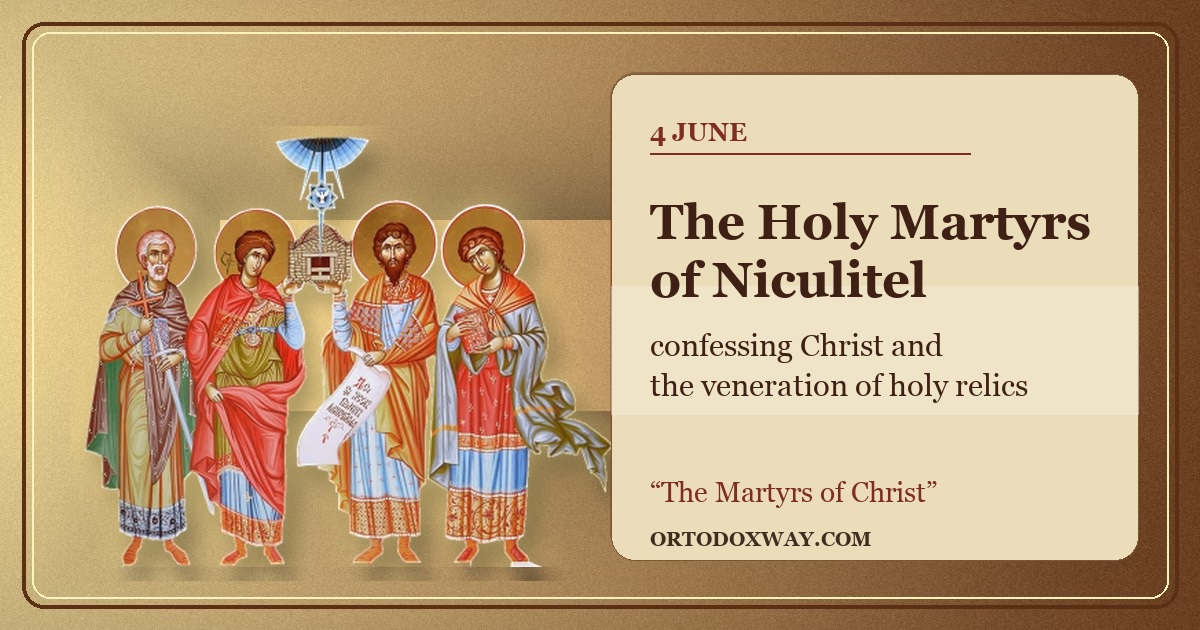
On the 4th of June, the Church commemorates the Holy Martyrs Zotikos, Attalos, Kamasis, and Philippos of Niculitel. Their names, preserved in ancient martyrologies and confirmed by the inscriptions found in the crypt at Niculitel, are spoken once again by the Church today, and the faithful bow before their holy relics, kept for veneration at Cocos Monastery. Yet the question from which we must begin is not what was discovered at Niculitel, but a deeper one: why, after nearly seventeen centuries, does the Church still honour them? What do these martyrs ask of us, the people of today? And what does it mean to bow before the sanctified bodily remains of human beings?
The Holy Martyrs of Niculitel do not call us to admire a discovery, but to learn what it means to confess Christ. The answer to these questions belongs not to archaeology but to the very heart of the faith: the commemoration of a martyr is not a simple act of remembrance, but a summons. And if we look attentively at the four of Niculitel, we shall see that their life and their end teach us things the Christian of today has almost entirely forgotten.
Who were the martyrs of Niculitel
To understand the lesson, it is enough to know the setting, in brief. The four were Christians who confessed Christ in the land of Scythia Minor — today’s Dobruja, an edge of the empire and a place of exile. They were tried by the Roman authority of Noviodunum, the fortress near present-day Isaccea, some 10–12 kilometres from Niculitel. Because they refused to sacrifice to idols, they were put to death by beheading, according to the tradition preserved in the synaxaria. The year of their martyrdom is not known with certainty: scholars place it either in the persecution of Diocletian (the beginning of the fourth century), or in that of Licinius, or even later — an uncertainty it is more honest to confess than to conceal.
In September 1971, after heavy rains had washed away the earth at a crossroads in the village of Niculitel, the vault of a crypt came to light. Within it lay, on the upper level, the relics of the four martyrs, placed in a common wooden coffin; and on the lower level, the sanctified remains of two other martyrs, older than the four, whose names are unknown. On the wall of the crypt was written, in Greek letters, “The Martyrs of Christ,” followed by their names — Zotikos, Attalos, Kamasis, and Philippos — and upon a stone slab a second testimony: “Here and there [is] the blood of the martyrs.” Over the crypt, at the end of the fourth century, a basilica was raised, a sign that their veneration was already alive. After the discovery, the holy relics were taken to Cocos Monastery, where they are venerated to this day.
So much for the things seen. From here onward, we look to the things unseen.
Confession that costs
The first lesson is also the one most often overlooked: the martyr is honoured not because he died, but because he confessed. Death alone sanctifies no one. What makes a martyr — the Greek word martys means precisely witness — is that he stood before the judgement and spoke the truth about Christ when a single word of denial would have spared his life.
The four of Niculitel were set before exactly this choice. They were asked for a small, almost formal gesture: to offer sacrifice to idols. They were not asked, at first, to deny Christ in words, but only to make a sign of submission to the power of the world. Yet they understood what we so easily forget — that there is no neutral gesture when confession is at stake, and that silence out of fear is itself a choice. The words of the Lord leave no room for evasion: “Whosoever therefore shall confess Me before men, him will I confess also before My Father which is in heaven” (Matthew 10:32).
Here lies the question the martyrs put to every Christian today. We are not, as a rule, called to die for the faith. But we are called, daily, to confess where it costs us something: our reputation, a friendship, an advantage, or our own peace. How often do we keep silent when we ought to confess, because the truth of the faith has become unsuitable, outdated, or dangerous to our comfort? The martyrs do not ask our blood; they ask the courage not to be ashamed of Christ when the world politely asks of us a pinch of incense upon its altar.
Why the Church is built upon the martyrs
The second lesson is hidden in the very stones of Niculitel, yet it is a spiritual lesson, not an archaeological one. Over the crypt with the relics of the martyrs the altar of a church was raised. This was no accident, but the order of the Church from the beginning: the sacrifice of the martyr is united to the Sacrifice of Christ, and the Holy Table, upon which the Divine Liturgy is celebrated, is set over their testimony. At Niculitel this order can be seen plainly: the crypt was not somewhere at the edge of the church, but beneath the floor of the sanctuary, in the holiest part of the basilica. It was not merely a tomb kept with respect, but a place of witness set at the very heart of the Liturgy.
The Seer of mysteries beheld this reality in the Apocalypse: “I saw under the altar the souls of them that were slain for the word of God, and for the testimony which they held” (Revelation 6:9). For this reason the order of the Church requires that the altar be consecrated with holy relics, as the Seventh Ecumenical Council clearly confirmed in its seventh canon. The place in which we pray is therefore not merely a building; it is a testimony built in stone, in which the sacrifice of those who died for Christ is woven together with the bloodless Sacrifice.
This overturns the way we usually regard a church. It is not we who make the place holy by our presence, but the blood of the confessors and the presence of Christ. The earliest Latin witness of the faith said it, already in the second century, in words that have endured through the ages: semen est sanguis Christianorum — “the blood of the Christians is seed.” 1 Not as a beautiful metaphor, but as a truth: from the blood of those who confessed, the Church has sprung and grows. The martyrs of Niculitel are, in the most concrete way, such a seed buried in the soil of Dobruja, from which the faith of an entire region took root.
Why we venerate holy relics
Here we come to the question the Christian of today hears most often, and often as an accusation: why do you bow before mere remains? Is this not a worship of matter, a delusion? The answer of the Church is ancient, clear, and well-founded, and the martyrs of Niculitel give us occasion to speak it anew.
First, a distinction must be drawn which many misunderstandings overlook. The Church does not worship holy relics as it worships God. There are, according to the teaching of the Fathers, distinct degrees of reverence: the worship of adoration (in Greek latreia) is given to God alone, who alone is worthy of it by nature; while veneration (proskynesis) is given to the saints and their relics for the sake of God, as to those in whom His grace has dwelt and worked. 2 To venerate the relics of a martyr does not mean to reckon him a god, but to confess that God has made His dwelling within him.
And the ground of this veneration is not custom, but the apostolic teaching concerning the body. The body of a Christian is not a discarded garment, but “a temple of the Holy Spirit” (1 Corinthians 6:19). If the body of the baptised is, already in this life, a dwelling of the Spirit, how much more does the body of the martyr — sealed by blood and sanctified through confession — remain a vessel of grace even after death. For this reason the relics of the saints are called, properly, “the living temples of God, the living tabernacles of God” 3, and the Master Christ “made the remains of the saints to be fountains of salvation to us.” 4
This is no Christian novelty contrived in later times. Already in the Old Covenant, a dead man came to life when he touched the relics of the Prophet Elisha (4 Kingdoms 13:21); and in the Acts of the Apostles, even the handkerchiefs that had touched the body of the holy Apostle Paul healed diseases and drove out evil spirits (Acts 19:11–12). God works through the bodies of His saints because He Himself took on a body and sanctified it. Whoever denies the veneration of relics denies, without realising it, something of the mystery of the Incarnation.
And so, bowing today before the reliquary of Niculitel, we do not honour lifeless remains, but confess our faith in the resurrection: these are not dead. For, as the same Father asks, “How could a dead body work miracles?” 5
A holiness that does not belong to a nation
The fourth lesson is one our times, so easily tempted by pride of nation, have great need to hear. The names of the four martyrs — Zotikos, Attalos, Kamasis, Philippos — are not local names. The first three are Eastern and Greek, the fourth is biblical. These saints were not “ours” in an ethnic sense; they were confessors of the one, catholic Church; upon this soil they struggled and suffered.
This takes nothing from the honour due to them, but sets it in its true place. The martyrs of Niculitel do not teach us to boast that “we too have our saints,” as though holiness were an ornament of the nation. They teach us, on the contrary, that in Christ “there is neither Jew nor Greek” (Galatians 3:28), and that martyrdom has no homeland, but only one Kingdom. Their blood was shed for Christ, not for a people; and their veneration is a lesson in catholicity, not in vainglory.
The Orthodox Christian of today, tempted on every side to mingle his faith with pride of nation, has in these four martyrs a cleansing example. They show us that the true honour rendered to a land lies not in claiming its saints, but in following them. A land is not holy because saints were born in it, but because people from it chose Christ above life itself.
The two martyrs without a name
On the lower level of the crypt at Niculitel were found the sanctified remains, bearing marks of burning, of two other martyrs, older than the four. These appear to come from an older martyr’s grave, taken apart when the monumental crypt was built for the four known martyrs. Their names are unknown. The inscription that guarded their resting place does not say who they are, but only this: “Here and there [is] the blood of the martyrs.” And yet the Church honours them, equally with those it can name.
This is, perhaps, the most consoling lesson of the whole history. The world honours only what it can name, measure, and remember. God, however, “knoweth them that are His” (2 Timothy 2:19), even when history has forgotten them entirely. The two nameless martyrs show us that holiness has no need of human remembrance in order to be real, and that the hidden struggle, unknown to anyone, is not lost before God.
It is no coincidence that the commemoration of these martyrs falls on the very threshold of the Sunday of All Saints, which the Church celebrates on the first Sunday after Pentecost. In 2026, this falls on the 7th of June. The feast is not a mere gathering-together of the saints left without a day of commemoration, but the showing-forth of the fruit of Pentecost. It reveals those in whom the Holy Spirit, descended at Pentecost, brought forth holiness — some through a life of virtue, others, like the martyrs of Niculitel, through blood.
And the two without a name are the clearest icon of what the feast proclaims. The Epistle read on that day (Hebrews 11:33–40) first names confessors one by one, but comes to rest upon a nameless multitude — “others were tortured”; “of whom the world was not worthy” — and concludes by saying that God, “having provided some better thing for us, that they without us should not be made perfect.” The saints without a name are therefore not a forgotten margin of the Church, but its very heart: the proof that holiness is the work of the Spirit, and not the fruit of a name written by men.
For the Christian who labours in secret — in the home, in the service of those around him, in the prayer no one knows of — this is a true consolation. It is not the name written upon a wall that makes a man holy, but blood and faith. And He who received the sacrifice of the two unknown ones will also receive our unseen labour, even if our name remains written upon no stone.
Exile as a place of meeting with God
Finally, the very place in which these martyrs suffered teaches us something. Scythia Minor was an edge of the world, a harsh land, the place to which the empire sent the unwanted — a kind of exile at the mouths of the Danube. And it was precisely there, at the border, far from the brilliant centre of the world, that holiness flourished abundantly.
This overturns a notion we all carry: that life with God requires favourable circumstances, a particular place, a good season, a distance from hardship. The martyrs of Niculitel show us that the margins of the world can be the place nearest to Heaven, and that ascetic struggle does not require the centre, but faithfulness wherever God has placed us. Exile, poverty, estrangement, the place forgotten by all — none of these is an obstacle on the way to holiness; often they are its most fruitful soil.
Many Christians today live, in one way or another, a form of estrangement: far from their homeland, far from their loved ones, far from a church life such as they would wish. The example of these martyrs tells them that God is no farther away at the edge of the world than at its centre. Where you have been placed, there you can be sanctified.
How we truly honour them
It is fitting, at the end, to return to the question with which we began: what does it mean to honour these martyrs? The answer of the Church is that the true veneration of a martyr is not admiration, but imitation. We may light a candle, we may bow before the reliquary, we may speak their names on the 4th of June — and we do well to do so. But if we stop there, we have remained on the surface.
To honour them truly means to confess Christ ourselves where it costs us; to regard the church not as a building, but as a testimony built upon sacrifice; to bow before the holy relics with faith in the resurrection, and not with the doubt of the world; to lay aside pride of nation and to seek one Kingdom alone; to labour in secret, content that God knows us even if men forget us; and to be sanctified in the very place where He has set us, even at the edge of the world.
The Holy Martyrs Zotikos, Attalos, Kamasis, and Philippos left behind neither writings nor discourses. They left a single testimony, written in blood upon the soil of Dobruja and in clumsy letters upon the wall of a crypt: “The Martyrs of Christ.” And this testimony asks each of us whether we are ready to be, according to our strength, witnesses of the same Christ.
Holy Martyrs of Niculitel, pray to God for us.
1. Tertullian, Apologeticum 50.13: “Plures efficimur quotiens metimur a vobis; semen est sanguis Christianorum” — “We become the more numerous every time we are mown down by you; the blood of the Christians is seed.” The widespread form “the blood of the martyrs is the seed of the Church” is a free paraphrase of this sentence.
2. On the distinction between veneration and adoration, see the decree of the Seventh Ecumenical Council: to the holy icons is given “honourable veneration” (timētikē proskynēsis), not the “true worship” (latreia) which belongs to the divine nature alone. See also St. John of Damascus, Three Treatises on the Divine Images, where the same distinction is defended against the iconoclasts.
3. St. John of Damascus, An Exact Exposition of the Orthodox Faith, Book IV, ch. 15: “Surely, then, we must ascribe honour to the living temples of God, the living tabernacles of God.” (trans. S. D. F. Salmond, NPNF, 2nd ser., vol. 9).
4. Ibid.: Christ “made the remains of the saints to be fountains of salvation to us.”
5. Ibid.: “How could a dead body work miracles?”