
The Psalter is the prayer book of the Church. Something from it is read at almost every service. The Church’s order divides it into twenty sections, called kathismata, so that in the ordinary cycle all the psalms are read every week, and twice a week during Great Lent. With this article we begin a series in which we will take the psalms one by one and interpret them, that is, explain them according to the teaching of the Holy Fathers.
The Holy Fathers loved this book in a special way. Saint Basil the Great said that everything useful in the other books of Scripture is gathered in it, because the psalms foretell what is to come, recall what has been, give laws for life and show what must be done. He also taught that the Holy Spirit clothed this teaching in song, just as wise physicians smear honey on the rim of the cup in which they give the sick a bitter medicine, so that a man receives the benefit of the words without noticing. Saint Athanasius the Great likened the psalms to a mirror: whoever reads them sees in them the movements of his own soul and speaks them as words of his own.
The text of the psalm
We give the psalm in the translation of Sir Lancelot Brenton, first published in 1844. It was made from the Septuagint, the Greek translation of the Old Testament made before the coming of Christ. The Holy Fathers quoted here interpreted the psalms from this Greek text, and most Orthodox Churches use it to this day. The psalms are numbered here according to the Septuagint, as in the Orthodox Psalter.
- Blessed is the man who has not walked in the counsel of the ungodly, and has not stood in the way of sinners, and has not sat in the seat of evil men.
- But his pleasure is in the law of the Lord; and in his law will he meditate day and night.
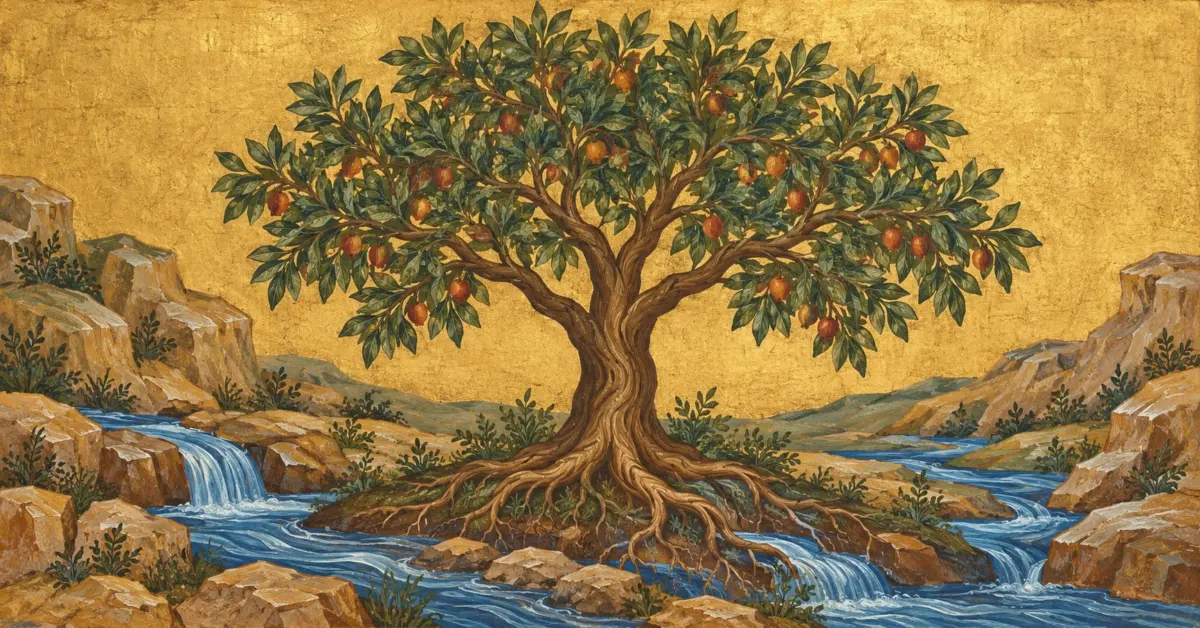
- And he shall be as a tree planted by the brooks of waters, which shall yield its fruit in its season, and its leaf shall not fall off; and whatsoever he shall do shall be prospered.
- Not so the ungodly;—not so: but rather as the chaff which the wind scatters away from the face of the earth.
- Therefore the ungodly shall not rise in judgment, nor sinners in the counsel of the just.
- For the Lord knows the way of the righteous; but the way of the ungodly shall perish.
The gate of the Psalter
Most psalms carry a heading above them, which usually shows to whom the psalm is ascribed or on what occasion it was sung. The Orthodox Psalter marks Psalm 1 only as a psalm of David and adds that among the Hebrews it has no title. Blessed Theodoret of Cyrus explains why. Those who translated the Scriptures from Hebrew into Greek found the headings of the psalms among the Hebrews and carried them over into Greek as well. This psalm and the next they left without a heading, as they had found them, because they did not dare to add anything of their own to the words of the Spirit. The psalm stands at the beginning of the book like a gate through which a man enters who wants to pray with the psalms, and from its first word it shows where the road leads: to blessedness. Saint Basil the Great says that these first words are for the whole Book of Psalms what the foundation is for a house and the heart is for the body of a living creature.
Psalm 1 and Psalm 2 belong together. The first begins with “Blessed is the man”, and the second also ends with a blessing, that of those who put their hope in God, so that the two psalms stand together between these two blessings.
The Church opens the weekly reading of the Psalter with this psalm. It begins the first kathisma, which is read or sung at Vespers on Saturday evening, the service with which the day of Sunday begins. At the Vespers of feasts with a vigil, the Typikon usually appoints only its first part, from which a few chosen verses are sung in parishes. The faithful know it by its first words: “Blessed is the man.”
Saint Gregory of Nyssa, who wrote a whole book on the headings and the order of the psalms, shows that the goal of the virtuous life is blessedness. Medicine aims at the health of the body, agriculture at the food that sustains life, and whoever acquires virtue aims at blessedness. Blessed in the proper sense is God alone, whom the holy Apostle Paul calls “the blessed and only Potentate” (1 Timothy 6:15). Man becomes blessed in the measure in which he partakes of Him and becomes like Him. Already in the first psalm, says Saint Gregory, one sees how the Word of God divides virtue into three steps. First it calls blessed the separation from evil, with which the turning towards the good begins. Then it calls blessed the dwelling of the mind on high and divine things, which awakens in man the longing for what is better. Last of all it calls blessed the likeness to God, which the psalm shows through the ever-green tree.
Blessedness, the goal of the road
Saint Basil the Great explains, starting from everyday life, why the Psalter begins with blessedness. The psalms were going to ask for many labours, so David showed from the start, to those who struggle for the faith, their blessed end, so that the hope of the good things prepared for them might help them bear the burdens of life. The traveller on a hard road is comforted by the thought of the inn that awaits him. The merchant sets out to sea because he wants to bring goods home, and the hope of a good harvest hides his toil from the farmer. In the same way the Spirit of truth, the Teacher of all, has shown us the reward from the beginning, so that, looking towards it, we might pass over our present labours and run in our thoughts towards the eternal good things.
Like Saint Gregory, Saint Basil says that blessed in the proper sense is only the true good, that is, God, the good towards which the desire of all creatures is directed. People call wealth, health and a brilliant life blessed, yet none of these is good by its nature, because none of them makes good the one who has it. Blessed is the man who partakes of the imperishable goods. Blessed Theodoret says that David placed blessedness at the beginning of the book following his Son and Master, the Saviour Christ, who also began His teaching to His disciples with the beatitudes (Matthew 5:3).
Saint Basil also stops at the word “man”. The psalm does not leave women outside blessedness, he says, for man and woman have the same virtue, were created with the same honour and will receive the same reward, as it is written in Genesis that God “made them male and female” (Genesis 1:27). Those who share the same nature are given the same works, and for the same deed the same reward is given. The psalm names only the man because human nature is one, and the psalmist judged it enough to show the whole of it through the one who, as Saint Basil says, leads that nature, that is, through the man.
The first step: separation from evil
Saint Basil likens the life according to God to the ladder Jacob saw in his dream, with one end on the earth and the other above heaven (Genesis 28:12). A ladder is climbed rung by rung, and the first step means leaving the ground. In the same way, he says, the ascent of the virtuous life begins with turning away from evil. That is why the psalmist trains a man first in what is easier. To keep from murder, fornication and theft only requires that one stop, whereas to love one’s neighbour as oneself, or to go two miles with the one who compels you to go one, requires the labour of an athlete.
In the first verse the psalmist sets before us three things to guard against and, says Saint Basil, arranges them in the order in which they take place in a man. First we take counsel within ourselves, then we hold to what we have decided, and finally we remain in the decision we have made. This is why the first thing worthy of blessedness is purity of thought, for the counsel we take in the heart is the root of the deeds we do with the body. The Lord Himself says that what moves a man to act comes from within him (Matthew 15:18).
To each verb there corresponds a kind of people. The first are called in Greek ἀσεβεῖς, a word our translation renders as “the ungodly”; it names the man who does not honour God. The second word, ἁμαρτωλοί, “sinners”, comes from a verb that originally meant “to miss the mark”, and the sinner is the man who misses the goal for which he was created. The third word, λοιμοί, literally means “plagues”. Brenton renders it “evil men” and notes that the Greek means “pestilent”, while Saint Basil speaks of “the plague-stricken”, that is, of people who infect their neighbours with their evil.
Blessed Theodoret gives each name a clear meaning. Scripture calls ungodly those who believe in no god or believe in many gods. Sinners are those who have chosen to live in lawlessness and have embraced a corrupt life. The pestilent are those who not only destroy themselves, but also drag others into destruction, like a disease that passes from one person to another.
Sin directed against God, says Saint Basil, is called ungodliness. A man walks in the counsel of the ungodly when he asks himself in his heart whether there is Someone who governs the world and whether there will be judgment and reward. He also walks in that counsel who is troubled to see the righteous poor and sick and sinners rich and honoured, and who comes to believe that the world runs by itself, by chance. Blessed, says Saint Basil, is the man who has not doubted God, who has not lost heart before what happens to him, and who awaits what is to come.
The Fathers distinguish, however, between the thought of doubt that tempts a man and consent to it. Whoever brings his perplexity before God and asks for his faith to be strengthened does not walk in the counsel of the ungodly. He prays like the father in the Gospel: “Lord, I believe; help thou mine unbelief” (Mark 9:24).
Saint Athanasius the Great understands “the counsel of the ungodly” also as the gatherings of the wicked. Because it is harmful to enter such gatherings, the psalm calls blessed the one who does not walk even a little on their road. So did, says Saint Athanasius, Joseph of Arimathea, who buried the body of the Lord. The Evangelist Luke writes of him that he “had not consented to the counsel and deed of them” (Luke 23:51), that is, to the decision of those in the Sanhedrin who delivered Jesus to death. In Greek the Gospel and the psalm use the same word for “counsel”.
Saint Basil also notes the tense of the verb. The psalm does not say “who walks not”, but “who has not walked”, because a man cannot be called blessed while he is still on the road and his end is not known. Blessed is he who has fulfilled his duty and ended his life without turning aside. Saint Basil then asks why another psalm calls blessed those who are still walking in the law of the Lord (Psalm 118:1). His answer is that the good is praised already in this life: whoever does good has praise in the very deed, but whoever keeps away from evil is worthy of praise only if he keeps away from it to the end.
The way, says Saint Basil, is our life, for each of us hastens towards his end. As those who sleep in a ship are carried by the wind towards the harbour without feeling it, so our time passes without stopping, even when we do not notice. On the road we meet things that gladden us and things that grieve us, but we pass by them all, for the road is not ours, nor are the things we have on it. Blessed is he who “has not stood in the way of sinners”, that is, has not lingered on it, but has set out with a better mind towards the life according to God.
Saint Basil also speaks here of the two opposing ways, the broad and the narrow, each with its own guide. On the smooth and downward way a cunning demon draws a man through pleasures and leads him to destruction. On the hard and uphill way a good angel guides him and leads him, through the labours of virtue, to a blessed end.
The seat, says Saint Basil, means settled and unshaken persistence in sin. When a passion grows old in the soul and a sinful thought is strengthened with time, it becomes hard for a man to heal his passion, and sometimes he can no longer heal it at all, because habit comes to turn into nature. These words show how deeply the habit of sin can enslave a man. They set no limit to the mercy of God. That is why he gives counsel in steps. Blessed is the man who does not have sin even in his mind. If, through the cunning of the enemy, he has nevertheless received thoughts of unbelief into his soul, let him not remain in sin, and if he has fallen into it, let him not settle in it. Saint Athanasius also gives the seat the meaning of teaching, as the Lord speaks of “Moses’ seat” (Matthew 23:2).
As for “the pestilent”, Saint Basil recalls that the plague passes by contact from one to another and sickens all those around. Such are the people who shamelessly tell of their sins as if they were exploits and strive to make as many as possible like themselves, so as to escape reproach in the company of sin. Sin passes from man to man like fire through dry material, above all when the spirits of evil fan it. And when the crowd judges someone’s sin worthy of imitation, says Saint Basil, the plague has entered the life of souls.
What Saint Basil says about purity of thought, the Fathers of the Philokalia described at length. The Philokalia, the collection of writings of the Holy Fathers on prayer and on the guarding of the mind, preserves the teaching of Saint Philotheos of Sinai on the stages by which an evil thought comes to master a man. First comes the provocation, a thought or an image that has barely appeared to the mind. Then comes the coupling, when a man begins to converse with that thought, and then the assent, when the soul receives it with pleasure. After it comes captivity, when the heart is dragged by force towards the thing desired, and finally the passion, the evil that has nested in the soul for a long time. Saint Philotheos says that the first stage is without sin. The passion itself, he adds, remains subject either to repentance or to punishment in the age to come. He also says that whoever resists the thought from the very provocation has cut off at a stroke all the evils that follow, and the Fathers call this unceasing guarding of the mind watchfulness. Saint Philotheos quotes the very first verse of the psalm. The place of the mind, he says, is its firm establishment in virtue and in watchfulness, for a man can be established both in virtue and in sin. That is why Scripture calls blessed the one who “has not walked in the counsel of the ungodly, and has not stood in the way of sinners”. The psalm calls blessed precisely the man who has separated himself from evil from the very first step.
The second step: meditation on divine things
Saint Basil asks a question here: why does the psalm call blessed the one who does not do evil, and not the one who does good? In that way the horse, the ox and the stone could also be called blessed, for none of these creatures stands in the way of sinners. The answer comes in the second verse, “but his pleasure is in the law of the Lord”, and only a rational being can meditate on the law of God. The beginning of good deeds, says Saint Basil, is turning away from evil deeds, according to the word of the psalm: “Turn aside from evil, and do good” (Psalm 36:27).
The Greek word that Brenton renders “pleasure” (θέλημα) literally means “will”, that is, the desire and choice of a man. The law of God is no longer for him a burden laid on him from outside, but the thing he desires.
Saint Athanasius says that the words “day and night” show unceasingness: the law of the Lord is not searched in passing or carelessly. Blessed Theodoret adds that it is not enough to hate evil. A man must attend to the Law of God night and day and set his life straight by it. So God commanded through Moses as well, that the words of the Law should always be in a man’s mouth, when he sits in his house and when he walks by the way, when he lies down and when he rises up (Deuteronomy 6:6–7). Saint Nicodemus the Hagiorite recalls, in his notes to the commentary of Euthymios Zigabenos, the word of Saint Gregory of Nyssa that the law is mentioned twice in this verse in order to show both the Old Law and the New Law, the law of grace, which was yet to be given.
The verb “he will meditate” (μελετήσει) had a very concrete meaning for the Desert Fathers, the monks who struggled in Egypt in the first Christian centuries. With the same word they named the work by which they repeated unceasingly, from memory, the psalms and other words of Scripture, at the work of their hands and in the cell. Saint Athanasius writes of Saint Anthony the Great that he prayed unceasingly in secret and listened so attentively to what was read that nothing of what was written fell from him to the ground. He kept everything, and his memory took the place of books.
In this work one sees how the Desert Fathers fulfilled the Apostle’s command: “Pray without ceasing” (1 Thessalonians 5:17). The Fathers of the Philokalia seek the same unceasingness through the Jesus Prayer, in which the mind remains continually by the name of the Lord. And a mind that meditates day and night on the word of God leaves no room for the counsel of the ungodly.
The third step: likeness to God
The third verse shows the fruit of the first two. The man who has separated himself from evil and meditates unceasingly on the word of God “shall be as a tree planted by the brooks of waters”. The word “planted” shows that the tree did not grow there by chance: someone planted it. This ascent is fulfilled through the grace of God and through the free response of man. Saint Gregory of Nyssa sees in the tree whose leaf does not fall the image of the life made perfect through virtue, that is, likeness to God.
Saint Athanasius says that these waters are the divine Scriptures, in which the proclamation of Christ is found everywhere. The tree, he says, is Christ Himself, as it was written of Wisdom that “she is a tree of life to all that lay hold upon her” (Proverbs 3:18). Those who believe in Him become His body, for the Lord will change the body of our humiliation so that it may be like the body of His glory (Philippians 3:21). The fruit of the tree is faith, and its leaves are the keeping of the commandments.
Blessed Theodoret sees in the waters the gift of the Holy Spirit. As springs make the trees planted beside them grow green, so the grace of the Spirit makes the faithful bring forth divine fruit. That is why the Lord called His teaching water: “If any man thirst, let him come unto me, and drink” (John 7:37). Those who struggle will receive the fruits of their labours in the life to come. Until then, good hope keeps them green like leaves and lightens their labours. Euthymios Zigabenos, a Byzantine monk who gathered in his commentary the words of the Fathers before him, also sees humility in the leaves. It covers and guards good deeds, just as leaves cover and guard the fruit of a tree. As for the words “whatsoever he shall do shall be prospered”, Saint Athanasius interprets them thus: no work done in God remains without profit. Blessed Theodoret brings them close to the Apostle’s saying that all things work together for good to those who love God (Romans 8:28). The one who has cast off evil and wills only what the Law wills no longer does anything against it, and so everything prospers for him.
The Prophet Jeremiah uses the same image. Blessed is the man who trusts in the Lord, he says, for he shall be like a flourishing tree by the waters, which sends out its roots towards moisture, does not fear when the heat comes and does not cease to bear fruit (Jeremiah 17:7–8). The tree by the waters goes through the same summers as all the others, but its roots reach down to the water.
The tree yields its fruit “in its season”, and spiritual fruits ripen in the time appointed by God. The Greek verb translated “shall be prospered” (κατευοδωθήσεται) contains within it the word for “way” and literally means “shall go well on the way”. The prospering of the righteous man does not lie in the successes of this world, but in the fact that his road leads where it must arrive.
The chaff that the wind scatters
The fourth verse speaks of the others: “Not so the ungodly;—not so.” Blessed Theodoret says that by the repetition the psalmist shows more clearly the opposition between the two kinds of people. Those who drink from the divine words remain always green and bring forth ripe fruit. The others are trampled by the opposing spirits and are like the dust that the winds carry easily here and there. The Greek word translated here as “chaff” (χνοῦς) names fine dust or the chaff that the wind takes away. After the tree rooted beside the waters comes something without root and without weight.
The fifth verse says that “the ungodly shall not rise in judgment”. The Greek verb (ἀναστήσονται) means both “to rise from the dead” and “to stand up”. These words do not mean that the ungodly will remain in their graves. The Lord says plainly that all who are in the graves will hear His voice and come forth: those who have done good, to the resurrection of life, and those who have done evil, to the resurrection of judgment (John 5:28–29). The meaning of the psalm is that they will not be able to stand upright in the judgment. Blessed Theodoret observes that the psalm does not say “the ungodly shall not rise”, but that they shall not rise to judgment. They will rise, not to be examined, for their ungodliness is manifest, but to receive their punishment. So a judge does with a murderer caught in the act: he no longer examines him, but gives the sentence at once.
Saint Athanasius also interprets this verse through the image of the dust. The ungodly will not rise in the judgment because they have no root and are like the dust of the earth lifted by the wind. The wind, he says, is the threat of God on the day of judgment: “Depart from me, ye cursed, into everlasting fire” (Matthew 25:41). Those who hear this voice fall, because they do not stand in Christ, who is the support and foundation of the faithful. He adds that there God separates the righteous from the sinners, and so sinners will have no place “in the counsel of the just”. All people will stand before the judgment of Christ. The distinction the Fathers make is between the examination of deeds and the condemnation of those whose ungodliness is manifest.
The Lord knows the way of the righteous
God knows all things, both good and evil. What then does it mean that “the Lord knows the way of the righteous”? Saint Athanasius answers that here “to know” means “to honour”. So God told Moses that he had found grace before Him and that He knew him above all (Exodus 33:17, in the Septuagint). Blessed Theodoret adds that the righteous Judge knows all things even before the judgment and has no need of proofs. He brings the words “the way of the ungodly shall perish” close to the Apostle’s saying: “If any man’s work shall be burned, he shall suffer loss” (1 Corinthians 3:15). The deed of the righteous remains radiant, while wickedness perishes together with those who wrought it.
Euthymios Zigabenos shows that no one can hide from God. The evil ways God treats as though He did not know them, because they are unworthy of His knowledge. “Not to know” means here not to receive and not to acknowledge evil as His own. God knows all things, and His questions do not seek to learn anything. After Adam had broken the commandment, God asked him as if He did not know: “Where art thou?” (Genesis 3:9). In the same way He asked Cain, after he had killed his brother: “Where is Abel thy brother?” (Genesis 4:9).
At the end of Psalm 2, which is closely bound to this one, the kings and judges of the earth are urged to accept instruction, so that they may not perish from the righteous way. Saint Athanasius shows that this is the way of Him who said: “I am the way” (John 14:6). For him the way of the righteous has a name: Christ.
How we pray with Psalm 1
Psalm 1 can be read in the evening as a mirror of the day. Whoever says it then can ask himself where he received a counsel that was not from God, where he lingered beside a sin, and whether he has not already settled into an evil habit. These questions lead naturally to repentance and to confession.
In the morning the same psalm can be read slowly, so that a man may choose from it a single verse to carry in his mind all day, as the Desert Fathers did. The words “in his law will he meditate day and night” begin to be fulfilled in just this way, with little, but without interruption.
Whoever reads this psalm with faith can make it his own prayer: that God may keep him from the first step towards evil, give him love for His word day and night, and plant him beside His waters, so that he may be known by Him and walk on the way that is Christ.
Sources
- The Septuagint Version of the Old Testament, translated by Sir Lancelot Charles Lee Brenton, London, 1844.
- Saint Basil the Great, Homily on Psalm 1 (PG 29); Romanian translation by Fr D. Fecioru, in Scrieri I, PSB 17, Bucharest, 1986.
- Saint Athanasius the Great, Commentaries on the Psalms – including fragments attributed to other ecclesiastical writers, with the Letter to Marcellinus on the Interpretation of the Psalms (ch. 11–12); Romanian translation by Nun Parascheva Enache, edited by Dragoș Mîrșanu, Iași, Doxologia, 2021.
- Saint Athanasius the Great, Life of Saint Anthony, ch. 3.
- Blessed Theodoret of Cyrus, Commentary on the Psalms; Romanian edition by Florin Stuparu, Bucharest, Sophia, 2018 (from the translation printed at Buzău in 1840).
- Euthymios Zigabenos, Commentary on the Psalter, vol. I (Psalms 1–69), Romanian translation by Metropolitan Veniamin Costachi, Iași, 1850, from the edition prepared by Saint Nicodemus the Hagiorite and published after his death, Constantinople, 1819–1821.
- Saint Gregory of Nyssa, On the Inscriptions of the Psalms, part I, ch. 1; Romanian translation in Scrieri II, PSB 30, Bucharest, 1998.
- Saint Philotheos of Sinai, Forty Texts on Watchfulness, 19, 34–36, in the Philokalia.
