
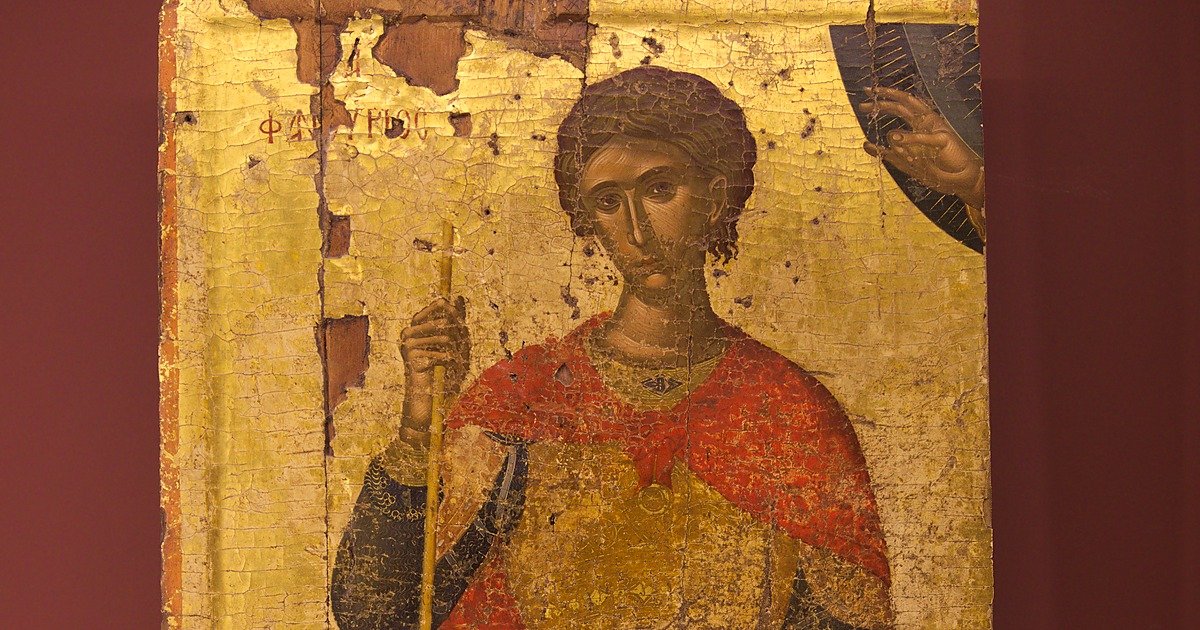
On 27 August the Church keeps the feast of Saint Phanourios the Martyr. In the Greek service books he is called “Phanourios the Newly-Revealed,” and his service is sung to this day.
There are saints of whom we have court records, letters, and the testimony of those who knew them. Of Phanourios we do not have even the century in which he lived. By the time his name enters written history, the man had probably been dead a long while. We do not learn of him from a book, but from an icon.
What we do not have
The name of Phanourios is not found in the ancient martyrologies and synaxaria. We have no dossier of his martyrdom, as we have for George, for Demetrios, or for Panteleimon: no account of the trial, no name of an emperor or a governor, no place.
We are not the first to say this. The more recent synaxaria acknowledge it as well: Phanourios is unknown to the ancient synaxarists, and the time of his life is not known. The Church has not hidden how little she knows of him. She received him as he is.
This is the foundation on which everything that follows rests.
The icon of Rhodes
The tradition that underlies his veneration relates that on Rhodes, during works on the walls of the city, the workmen came upon the ruins of a church. Beneath the rubble lay several icons, most of them effaced by time, their faces and inscriptions past reading. One alone was well preserved.
The icon showed a young man in soldier’s dress, holding in his right hand a cross with a lighted candle. Around it were painted twelve scenes of his martyrdom. The metropolitan of the place, Nilos, read the inscription: the saint’s name was Phanourios. A saint whom no one knew. The metropolitan raised the church again and appointed the commemoration on the day the icon was found.
The twelve torments that piety and preaching would later retell are therefore read off an icon. They do not come from a written testimony.
The dating is uncertain. Some church sources connect it with the episcopate of Metropolitan Nilos, in the years 1355–1369, which would give a marker with known dates. Other sources, among them the printed synaxarion, give the year 1500. A few even say that the icon was found in Cyprus and not on Rhodes.
One detail that circulates in many retellings, Greek and Romanian alike, cannot stand: that the walls of Rhodes were being repaired by the Turks. Rhodes was held by the Knights Hospitaller from 1309 until the Ottoman conquest of 1522. Whichever of the two datings we accept, the works were not Ottoman. The detail attached itself to the story along the way and should be set aside. What remains is what was there from the start: during works on the walls of the city.
The twelve torments
The icon does not say where he was from, nor under which emperor he died. It says what he suffered. The hagiographic tradition describes the twelve scenes as follows.
In the first frame he stands before the magistrate and confesses his faith. In the second, the soldiers strike him with stones on the mouth and on the head, to silence him. In the third they throw him to the ground and beat him with clubs. In the fourth he is in prison, stripped, and his body is torn with instruments of iron. In the fifth he is in prison still, on his knees, praying. In the sixth they bring him out again before the tribunal.
Then they burn him with torches. They bind him on a rack. They cast him among wild beasts. They crush him beneath a great stone. They set him before the idol’s altar with burning coals in his palms, so that the incense might fall on the altar and he might worship. In the last frame he stands in the midst of the fire.
Nowhere does he cry out. In all twelve, tradition describes him with a calm face.
This is the only thing the iconographic tradition has preserved for us about him: not a teaching, not a book, but twelve scenes in which the martyr does not deny.
The saints known to God alone
The silence around Phanourios is not unusual in the history of the ancient martyrs.
In the centuries of persecution a multitude of people died for Christ whose names no one wrote down. The Church commemorates them together, without names, because she knows that they are. God has not forgotten them. The paper has.
The Church venerates Phanourios as one of these martyrs, drawn out of oblivion through the finding of his icon. It was not his dossier that was found, but his face. The Church received the face as testimony and began to call him by name.
This is why the service books call him “the Newly-Revealed.”
The traces of his veneration
The veneration of Phanourios is no modern invention, and here that can be seen plainly.
At the monastery of Valsamonero in Crete, the chapel dedicated to him was built in 1426 and painted in 1431, and the abbot Ionas Palamas laboured to spread his veneration on the island. The great Cretan icon painter Angelos Akotantos, who died around 1450, painted several icons of Saint Phanourios; some have survived and are today at the monastery of Vrontisi. At times he depicts him slaying the dragon, as he does Saint George.
In a musical manuscript of the Great Lavra on Athos, from the same century, at least one sticheron composed for him is preserved — that is, a hymn of the service. This takes us out of the realm of oral tradition.
By about 1430–1450, therefore, Phanourios was already a saint known by his face, with a chapel, with icons, and with a hymn in the service.
The earliest written testimony
A Cretan manuscript of 1542, Cod. Vat. gr. 1190, contains a collection of miracles of Saint Phanourios, printed later in the Acta Sanctorum. A second manuscript, kept at Heraklion, is placed around the years 1600–1640.
Both connect the spread of his veneration from Rhodes to Crete with the deliverance of Cretan clergy fallen into captivity. In the form preserved by the Vatican manuscript, four Cretan priests were returning from Methoni and Koroni, Venetian ports in the Peloponnese, where they had gone to be ordained. They were seized by pirates and taken to Palatia, in Asia Minor. Their spiritual father, Ionas, reached Rhodes in order to work for their ransom. There Metropolitan Nilos urged him to ask the help of Saint Phanourios. After praying, Ionas received word that the negotiations were advancing, and returned to Crete carrying with him an icon of the saint.
A later tradition, which entered the synaxaria, tells it differently: three deacons set out from Crete for Kythera to be ordained priests, and are seized on the return.
The Heraklion manuscript speaks of three priests and takes Ionas to be Ionas Palamas, the abbot of Valsamonero, moving the event into the first decades of the fifteenth century. Yet it keeps Metropolitan Nilos, who was on Rhodes some fifty years earlier. Vassilakes-Mavrakakes sees here a reshaping of the story, in which the metropolitan’s name is retained in order to strengthen its authority.
This detail is worth looking at. It shows how a hagiographic tradition can change over time, without our being forced either to throw it out whole or to read it as a court record.
These same manuscripts also contain miracles for the finding of lost objects and lost animals, and healings. The bond between Phanourios and lost things is therefore centuries old, not a fashion of our day.
The name
In popular piety the name Phanourios was brought close to the Greek verb phaneróno, “to reveal, to bring to light.” Scholarship regards the connection as a folk etymology, that is, an explanation born of piety rather than of the history of the word. It worked powerfully all the same. The saint who himself came to light out of a ruin came to be invoked for everything that has been lost or hidden. The lighted candle, which afterwards became his sign in iconography, came to say the same thing.
The phanouropita
Whoever asks the saint’s help usually promises something in return. In time a single promise became established: the phanouropita, a lenten loaf or cake, brought to church, blessed, and shared out. The custom is firmly settled in Greece and Cyprus, and from there it has spread.
Detailed rules are heard, however: that it must have seven ingredients, or nine, or eleven; that it must be shared among a certain number of women; that the girl who makes it will find her husband. Ethnographic research finds versions with five, seven, nine, and thirteen ingredients, according to the place. These are not rules of the Church but local customs. What the Church blesses is the offering and the prayer, not the number.
It is worth seeing what the person who bakes a phanouropita is actually doing. She asks something for herself, and the payment she gives is a loaf shared with others. For six centuries, people who know of Phanourios neither where he came from nor when he died have asked his help and given alms. And this piety has not died out.
The saint’s mother
Along with the phanouropita there spread also the prayer: “May God forgive the mother of Saint Phanourios.” Behind it stands a story according to which his mother was a great sinner, whom her son could not turn to repentance and for whom he prayed without ceasing.
Here we are in folklore, and it can be shown.
A scholar of Greek folklore, Marianthi Kaplanoglou, gathered seventeen versions of the story about Phanourios and his mother, from Greece and Cyprus. In some the mother is miserly, in others unchaste; in others the sinner is not the mother at all, but his sister, his godmother, or his betrothed. The story follows a pattern known throughout Europe, catalogued under number 804 in the international folktale index: the child who tries to draw his mother out of hell.
A stable piece of biographical information does not behave in this way. The person changes, the sin changes, the ending changes.
A publication of the Church of Cyprus says plainly the same thing: the story of the sinful mother was fashioned by the popular imagination precisely because the saint’s life had remained unknown. The silence was filled.
This does not mean that whoever has said the prayer was wrong in heart. Consider what it actually does: it asks mercy for the soul of a woman whom the one praying never knew, of whom he knows nothing, and for whom no one else prays. Prayer for the departed is a work of the Church, and here it is offered for a stranger. What the prayer does not give us is a piece of news about a particular woman who once lived.
The same measure is due to the story, widespread in Romanian as well, according to which Phanourios was born on Rhodes, was the eldest of thirteen brothers, his father a wealthy merchant who was killed, and his mother driven to a life of sin. It has no support in the ancient Greek tradition. We may relate it as a late popular tradition. We do not confess it as history, because we do not find it in the ancient hagiographic tradition and we have no historical testimony for it.
A question that was raised in the Church
In the last century it was debated in Greece whether Phanourios is a distinct saint or whether the ancient icon was misread. The archaeologist Maria Vassilakes-Mavrakakes proposed that the original image might have been a depiction of Saint George bearing an epithet similar in writing, out of which a new name was born. Other church scholars answered by pointing to the differences in the painting and to the antiquity of the veneration.
Word then spread that the Synod of the Church of Greece had ruled that Phanourios “does not exist.” A study printed in 2019 in the official church journal states that it could find no synodal document containing any such ruling, and holds that the story of a prohibition was inflated.
For as long as this discussion lasted, the Church did not cease to sing his service. She sings it still. The hypothesis remains an academic hypothesis, and no decision of the Church against his veneration has been found.
What we confess and what we do not
We do not have a life of Saint Phanourios written by someone who knew him. We have an icon found on Rhodes, a bishop who read his name and appointed his commemoration, a veneration which from the fifteenth century leaves traces in chapels, in icons, and in hymns of the service, a miracle related in manuscript and printed later, and centuries of prayer.
The Church can keep the memory of a true martyr even after his life has been lost from the papers. For that very reason it is not fitting to fill the silence of the documents with legend and then to call the legend history. The saint has no need of that ornament.
What he has is more. The icon shows him to us thus: he stood before the tribunal and did not deny. He was beaten, torn, burned, cast to the beasts and crushed beneath a stone, and he did not deny. Burning coals were placed in his palms so that he might worship the idol, and he held the coals. He died in the fire.
His name lay for a time beneath the rubble. He did not.
This is why we ask him for the things we have lost. And, if we have any sense, we ask him also for what is lost more easily than a ring or a key: the steadfastness not to deny.
Troparion, tone 4
To the righteous soldier of Christ, victorious in the contest, to you, worthy martyr Phanourios, we the faithful bring praise and cry out: O most glorious one, cease not to show mercy towards Christ the All-Merciful on behalf of us who hope in your grace, Great Martyr, new luminary of the faith.
Notes
On tale type 804. The index referred to is the international catalogue of folktale types, known by the initials of its authors, Aarne–Thompson–Uther.
On the liturgical text. The troparion above is translated from the Romanian service books. Readers may wish to use the English text customary in their own jurisdiction.
Holy Martyr Phanourios, pray to God for us.
Image: Saint Phanourios, Angelos Akotantos, second quarter of the fifteenth century, Agia Aikaterini Collection, Heraklion; public domain, photograph by C messier, via Wikimedia Commons.