
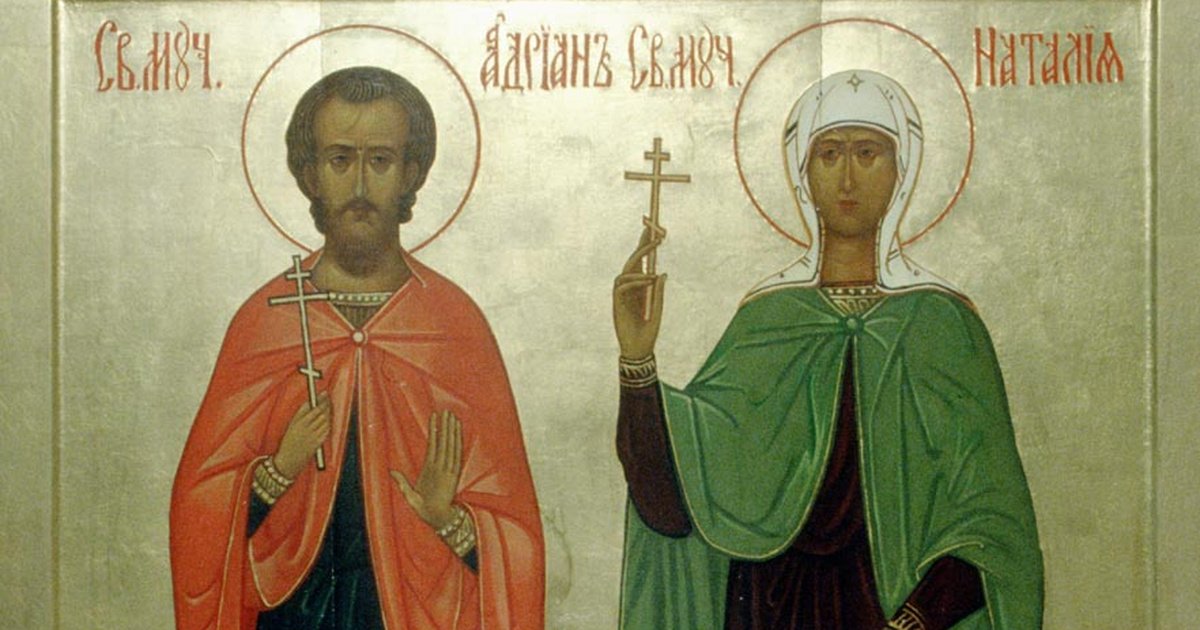
On 26 August the Church commemorates the Holy Martyrs Adrian and Natalia. They were husband and wife, and they suffered in the city of Nicomedia, in Bithynia, in the days of the emperor Maximian, during the persecution of the Christians. Together with them the Church remembers the twenty-three martyrs who had been shut up in the same prison. In the Churches that follow the Julian calendar, this day falls on 8 September of the civil calendar.
The twenty-three from the cave
According to the synaxarion, Maximian came to Nicomedia and commanded that those who believe in Christ be sought out and brought to judgement. Punishment was prepared for anyone who sheltered a Christian, and gifts and honour were promised to anyone who denounced one. So it came about that neighbours gave up neighbours, and parents their own children.
Twenty-three Christians were found hidden in a cave, where they had been heard singing during the night. They were brought before the emperor in chains. When he asked where they were from, they answered that they had been born there, and that in faith they were Christians. They were beaten at length and then taken to the court, so that their names might be entered in the book of the condemned.
Adrian writes down his own name
Adrian was one of the chief men of the imperial court, a young man of twenty-eight, raised in paganism. Watching how the prisoners endured, he came up to them and asked what reward they expected from their God for such torments.
The martyrs answered that the mouth of man cannot tell those good things and that the mind cannot reach them, and they set before him the word of the Apostle: “Eye hath not seen, nor ear heard, neither have entered into the heart of man, the things which God hath prepared for them that love him” (1 Corinthians 2:9).
Adrian then turned to those who were writing out the list and told them to enter his name as well, saying that he too was a Christian. Called before the emperor and asked whether he had lost his mind, he answered that on the contrary, he had only now come back from madness to a sound mind. He was bound in irons and thrown into the prison with the rest.
The Life shows Adrian as a pagan up to that hour and does not mention that he had received baptism in water. The Church honours him as a martyr all the same, because confession carried through to death takes the place of baptism in water. The Fathers call this the baptism of blood, and the teaching is ancient. St Cyril of Jerusalem writes that martyrs receive the kingdom even without the water, since in a time of persecution a man is baptized in his own blood (Catechetical Lecture III, 10).
Natalia
Natalia had been born of Christian parents and kept her faith hidden, because she saw how harsh the persecution was. When a servant told her that her husband had been taken to prison in chains, she tore her garment and wept. She then asked what the cause was, and when she learned that Adrian had numbered himself among those condemned for Christ, she left off weeping, put on her good clothes and ran to the prison.
She fell at his feet, kissed his chains and told him that he had found the treasure his parents had not left him. She begged him not to spare his youth and not to look back at his wealth, his kinsmen and his friends, since all of these grow old and perish. She told him to look at the martyrs beside him and to follow their patience.
The closed door
After some days Adrian learned that the emperor was about to bring the prisoners out to be tortured. He asked leave of the other martyrs to go home and call Natalia to the hour of his suffering, and they stood surety for him.
On the way a man of the city saw him, ran ahead and told Natalia that her husband had been set free from his chains. She judged that he had denied Christ. She shut the doors against him and cried out from behind them, calling him a second Judas and forbidding him to speak with her any more. Adrian stayed outside, and hearing her, he rejoiced in spirit.
He told her then that he had not fled from the torture, but had come for her as he had promised, and that the martyrs had stood surety for him. Only then did she open the door.
Here the measure of her love can be seen. She wept when she thought her husband had been imprisoned for some other cause, and she rejoiced when she learned that he was imprisoned for Christ. She was ready to lose him from her house and from her life, so long as she did not lose him from the number of those who confess.
Service in the prison
The wounds of the prisoners had festered, and the chains tore their flesh. Natalia sent for clean linen and bound their wounds with her own hands, serving them for seven days, until the day of the trial. Other faithful women did the same.
When the emperor gave orders that no woman be allowed into the prison any longer, Natalia cut off the hair of her head and put on men’s clothing, so as to reach them still. The other women did likewise.
The anvil
Seeing that the prisoners were near death from their wounds, the emperor commanded that an anvil and an iron hammer be brought into the prison, to break the shins of their legs and their hands.
Natalia met the men who had been sent and begged them to begin with Adrian, lest her husband take fright at seeing the end of the others. She herself lifted his feet and laid them on the anvil. After they had been broken, she begged him to stretch out his hand as well while he was still alive, so that he might be equal with the other martyrs, who had suffered more than he. Adrian stretched out his hand, and she set it on the anvil. From that pain he gave up his soul.
The other martyrs stretched out their own hands and feet, saying: “Lord Jesus Christ, receive our souls.”
Natalia’s request seems cruel if we read it as conduct between husband and wife. In the synaxarion it carries another sense. Natalia feared for his crown and not for his body. She knew that the body perishes in any case, and she held more to the part he was gaining in that hour.
The hand, the fire and the departure
The emperor commanded that the bodies be burned, so that the Christians could not take them. Natalia secretly hid her husband’s hand. When the bodies were thrown into the furnace, a great rain came down with thunder, the furnace was quenched, and the servants fled. The Christians drew the bodies out of the furnace untouched by the fire.
A faithful man asked them to let him carry the relics to Byzantium, until the death of the persecutor. They took them by ship and laid them at Argyropolis, near the city.
Natalia stayed at home, keeping Adrian’s hand anointed with myrrh and wrapped in purple at the head of her bed. A tribune of the city asked the emperor’s leave to take her to wife, and the emperor granted it. She asked for three days’ delay and prayed to God that the bed of His martyr not be defiled. As she slept, one of the martyrs appeared to her and told her to go quickly to the place where the relics had been taken.
She set out on a ship that carried Christians fleeing from Nicomedia. Arriving at Argyropolis, she joined the hand to her husband’s body and prayed at length. Then she rested a little, and the brethren who came to wake her found her departed.
Why she is called a martyr
Natalia did not shed her blood, and yet the tradition of the Church numbers her among the martyrs, because she took part in the suffering of the martyrs. She served them in prison, stood beside Adrian in his torments and left her house in order to remain faithful to Christ. For this reason the Life says that she completed her martyric course, though without the shedding of blood.
She left the city for what the Church books call sophrosyne, which means chastity and self-restraint. The Church permits a widow to marry again, so Natalia’s flight passes no judgement on a second marriage. What her Life speaks of is her own resolve to remain in chastity, and above all her refusal of a marriage forced upon her with a pagan.
What is honoured today
In many places 26 August has become chiefly a name day, and the two saints are called upon for peace and good understanding between husband and wife. The request is a good one, but the synaxarion gives their union another measure. Natalia shut the door of her house against her husband at the moment she believed he had denied Christ, and she held his hand to the anvil at the moment she feared he would not receive the full crown.
Their marriage is honoured not because the love between them was small, but precisely because it remained beneath the love of Christ.
Troparion and Kontakion
Troparion of the Holy Martyr Adrian, Tone 3
“Thou didst reckon the saving faith a treasure that cannot be taken away, O thrice-blessed one, forsaking the paganism of thy fathers; and following the Master, thou wast enriched with divine gifts. O glorious Adrian, entreat Christ God to save our souls.”
Kontakion of the Holy Martyr Adrian, Tone 4
“Laying up in thy heart the divine words of thy God-minded wife, O Adrian, martyr of Christ, thou didst run to the torments, and together with thy wife thou didst receive the crown.”
Adrian had confessed and had been imprisoned before Natalia reached him, so it was not she who began his confession. What the kontakion shows is how greatly her words strengthened him on the road to the torments: he laid them up in his heart, and he ran. The Church does not commemorate her beside her husband merely because she was his wife, but because she carried him through to the end.
Image: icon of the Holy Martyrs Adrian and Natalia from the church dedicated to them in Moscow, 1916–1917, unknown author; public domain, via Wikimedia Commons.