
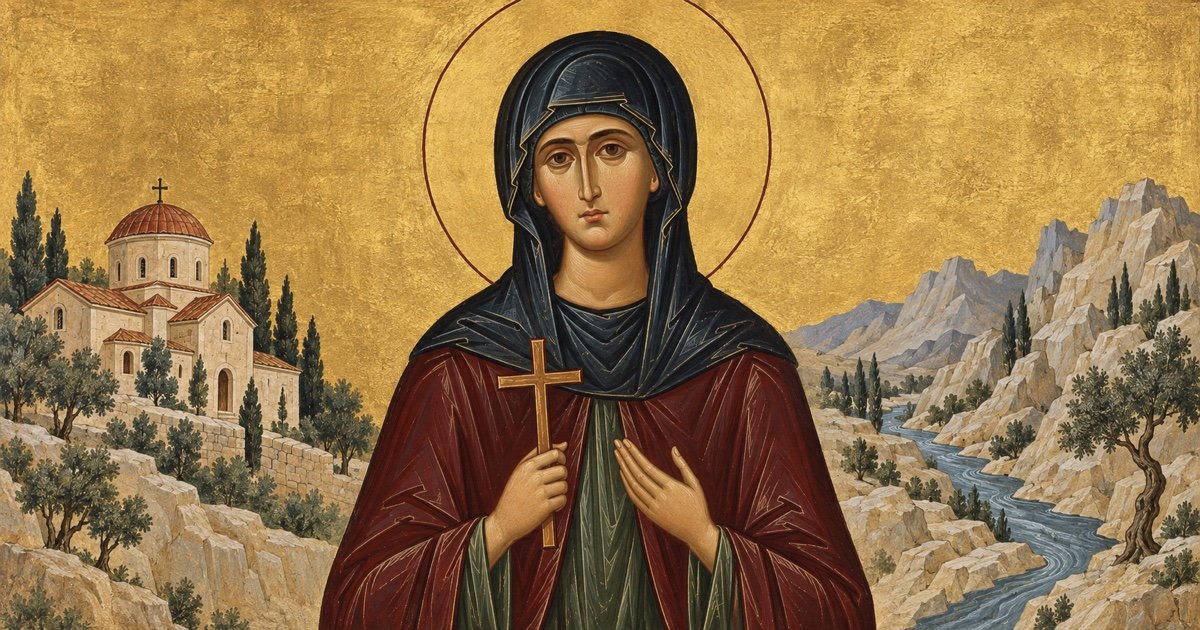
Saint Paraskeva, whom the Church commemorates on 14 October (27 October in churches that keep the Julian calendar), is one of the most beloved saints of Orthodoxy. Her relics have rested in Iași, Romania, since 1641, and her life is read today in many languages. Her oldest Life, that is, the oldest surviving written account of her life, was composed in Greek in the middle of the twelfth century by a deacon named Vasilikos, at the command of the Patriarch of Constantinople. For a long time this work was thought to be lost. Today it can be read again, and in Romanian as well.
The Lives read today mostly follow the Life written in the second half of the fourteenth century by Saint Euthymius, Patriarch of Tarnovo, after the saint’s relics had come to Bulgaria. The Life by Vasilikos is more than two hundred years older, and in many places it tells the story differently. In it, the saint’s parents are alive and oppose her choice. Her return from the desert is her own decision, made in prayer and confirmed by an inner assurance received from God. Her relics are revealed to a monk who lived as a recluse, shut in his cell. This Life also preserves miracles that the later Lives no longer mention.
The Life Written by Patriarchal Command
How this Life came to be written we learn from Theodore Balsamon, who in the twelfth century wrote commentaries on the canons, that is, the rules of the Church. He relates that Patriarch Nicholas IV Mouzalon (1147–1151) found a Life of Saint Paraskeva written by a villager and decided what to do with it:
“That most holy patriarch, the lord Nicholas Mouzalon, having found the Life of Saint Paraskeva, who is honoured in the village of Kallikrateia, written by a villager in an unlearned manner and unworthily of the saint’s angelic way of life, ordered it to be given to the fire, and entrusted the deacon Vasilikos with writing her God-pleasing life.”
Balsamon mentions the episode in his commentary on canon 63 of the Council in Trullo, also called the Fifth-Sixth Ecumenical Council. This canon orders that false accounts of the martyrs should not be read in churches but burned. Balsamon says only that the burned Life was written without skill and unworthily of the saint; he does not specify what it contained. Evelina Mineva, the scholar who identified the Life by Vasilikos, considers that by this command the Church of Constantinople received Paraskeva among its saints.
Vasilikos himself says, at the beginning of his work, that he undertook a task beyond his strength because he “thought it a heavy thing to set aside the words of a father”. Mineva sees in these words the patriarch’s command. In some Romanian writings the deacon’s name appears as Vasilisc.
The Life by Vasilikos has survived, without the author’s name, in fourteenth-century Greek manuscripts, one now in Gothenburg, Sweden, and the other in Florence. The text was printed in 1989, from one of the manuscripts, as an anonymous Life. In 2017 Evelina Mineva, a professor in Athens, showed that it is in fact the Life written by Vasilikos and published it from both manuscripts. Her evidence includes a title the text gives to the emperor, “ausonanax”, that is, “lord of the Ausonians”. According to her research, the Byzantines began to call their emperors by this title only in the twelfth century.
In 1230–1231 the saint’s relics were moved from Kallikrateia to Tarnovo, the capital of Bulgaria at that time. In 1234 a service in her honour, an encomium (a discourse in her praise) and a Life were brought there to be translated into Slavonic. Around the middle of the fourteenth century, however, these translations from the Greek were no longer copied, and from then on the Slavonic Lives were written without them. Only traces of the Life by Vasilikos survived in Slavonic: the oldest Slavonic canon to the saint, that is, a cycle of hymns for her service, was composed on the basis of it in the thirteenth century, and the Life written by Saint Euthymius of Tarnovo preserves a small passage about the saint’s childhood, translated from an abridgement of the Life by Vasilikos.
A shortened Life of the saint also circulated later, under the name of the Greek scholar Meletios Syrigos. It was printed in Greek in Bucharest in 1692 by the hieromonk (priest-monk) and printer Anthim the Iberian, at the expense of Constantin Brâncoveanu, Prince of Wallachia, and then in Iași in 1817. The Iași edition was reprinted in 1841 with a Romanian translation alongside. Mineva showed that it is an abridgement of the Life by Vasilikos.
A Romanian translation of the entire Life, by Nun Parascheva Enache, was published by Doxologia in Iași, in the volumes of hymn canons dedicated to the saint, in 2022 and 2024.
The Child of Epivates
Saint Paraskeva was born in Epivates, a village in Thrace on the shore of the Sea of Marmara, near Constantinople. The place is now called Selimpaşa and belongs to Istanbul. The Life does not give her parents’ names. It says only that they were of noble birth and wealthy, but “far nobler in soul and admirable in their way of life, for they had been brought up in piety”.
When she was ten years old, she went with her mother to the church of the Mother of God and heard in the Gospel the words of the Lord: “Whoever desires to come after Me, let him deny himself, and take up his cross, and follow Me” (Mark 8:34). The Life says that “at once she was wholly given over to the divine and most spiritual love”.
On leaving the church she met a poor man. Escaping the notice of those who accompanied her, she took off her garments of silk woven with gold, gave them to the poor man and put on his clothes.
“Her parents, seeing her dressed in rags, were astonished at what had happened and asked: ‘Where are your clothes?’ But she kept silent, not considering such a question worthy of any answer.”
Her parents dressed her again and threatened her. Yet the child gave her clothes to the poor again, many times over. Vasilikos sees in her deed a rebuke of “the great stinginess and pettiness of her parents”, who had more than they needed and did not take care to do good. At first her parents tried to dissuade her with counsel. Then they scolded and mocked her, and in the end they beat her, “as they ought not to have done”, the Life says. Vasilikos regards all these things, which took place in her parents’ house, as the first signs of the heavenly life she was to lead.
Some present-day Lives say that the saint left home after her parents’ death, as the earliest form of the Life written by Saint Euthymius of Tarnovo also says. Other accounts add that her father died when she was small. In the Life by Vasilikos both parents are alive when she leaves, and her departure is a flight from their house.
Five Years in the Church of Our Lady
Her longing for God grew in her until she could no longer keep it hidden. She escaped the eyes of her parents, her relatives, her maidservants and countless servants, and left home “like Abraham of old”. She came to Constantinople, where she went in haste from one holy church to another, in fear of her parents, and with a humble heart asked God to show her the road she was to take. She longed to see the places where Christ had walked.
First she resolved to go to Heraclea Pontica, a city on the shore of the Black Sea, now called Karadeniz Ereğli. There stood a church of the Mother of God which was said to have been built not by human hands but by the hand of God. She wished to beg the Virgin to guard her virginity and to be her guide as far as Jerusalem. She crossed by ship to Chalcedon and from there went on foot, although she was, as the Life says, “a girl who had only just left her father’s hearth, who had only just turned away from a life of ease, and who had no idea what hardship was, or even that it existed”.
Her parents, wounded in soul, sent their most faithful servants to look for her. They searched the village and its surroundings and went as far as Constantinople, but did not find her. The Life says that the saint’s prayer reached God ahead of them and sent them back empty-handed.
When she came to Heraclea, she entered the church of the Mother of God, threw herself face down on the ground and wept until the floor was wet with tears. Then she rose, looked at the icon of the Mother of God and prayed:
“[…] I thank you, Maiden, Mother of God, and I magnify your invincible power; I thank you, who alone are graced by God, that you have strengthened me, the weak and wretched one, to tread your holy place with impure feet and to look upon your most holy image with unholy eyes. But I implore you, my Lady who love the good, […] gird me still more with your unconquerable strength, so that I may be able to trample the goads of the enemy and be made worthy to behold the all-venerable places […].”
After this prayer “she shut herself up in a corner of the church and made her dwelling there”. Vasilikos asks who could describe in words her struggles there:
“[…] her all-night prayers, her firm and adamantine standing, her constant fasts, her painful beating of the breast, her most bitter lamentations, her unquenchable mourning, her ever-flowing tears, her sleeping on the ground and the squalor of her bed, her lowly and downcast bearing, the modesty of her mind, her restrained manner, her most pure heart inclined towards God alone, in the contemplation of whom she delighted purely and without ceasing, according to the God-spoken words of the Gospel: ‘Blessed are the pure in heart, for they shall see God.'”
She lived in this way for five years.
Some present-day accounts say that at Heraclea, at about fifteen years of age, she entered a convent of virgins, while the Slavonic Lives do not mention Heraclea. The Life by Vasilikos places her alone, for five years, in a corner of the church of the Mother of God.
Jerusalem and the Jordan Desert
After these five years, God sent her some travellers on their way to Jerusalem. Before leaving, the saint prayed again in the church, lifting her mind, her hands and her eyes to her Maker:
“Hear me too, Your most wretched handmaid, at this hour — me, who have wholeheartedly given up earthly and unstable things and chosen You instead of all things as my immortal Bridegroom. Be with me on this journey as helper, guardian and saving guide, and count me worthy to see Your life-giving tomb, to venerate it with much fear and to embrace it with reverence.”
Then, looking at the icon of the Mother of God, she said from the depth of her heart:
“Lady Theotokos, who received in your womb Him who for my sake became like me, have compassion on me, the helpless one, deprived of all help from outside, who have found only your most powerful protection.”
She joined those who were going to the Holy Places and set out rejoicing. Vasilikos compares her to a pure virgin betrothed to a most beautiful bridegroom, who sets out towards him and thinks of nothing but him. The saint “seemed to see the Lord before her and to be illumined by His beauty”.
After a long and wearisome journey she reached Jerusalem. She entered the life-giving Tomb, embraced it with her heart, her hands and her lips, and said with tears:
“I thank You and glorify You and magnify Your ineffable goodness, pre-eternal Word of Your unoriginate Father, that You have counted even me worthy — me, the defiled one, whose lips, eyes and thoughts are impure — to see with my own eyes and to kiss with reverence the venerable tomb in which You, the Maker of all, were laid in the flesh. […] Be pleased, almighty Lord, that Your handmaid may finish what remains of her wretched life according to Your good pleasure.”
She then venerated the other holy places. She went to Bethlehem and reverently embraced the cave that received God. She went down to Jericho and crossed the desert of the Jordan like a desert sparrow. There she found a community of nuns and joined them. Vasilikos says that, like a wise bee in a hive, she made there the honey of virtue.
The Slavonic Lives say only that she withdrew into a desert, without naming it, and mention no community. In the Life by Vasilikos the saint lives for many years in a convent of nuns in the desert of the Jordan.
The Warfare of Thoughts
The saint ate only as much as she needed to stay alive and to spare her body a violent dissolution. She drank spring water, and very little of it. A rush mat served her as a bed, and her clothing was a single garment. The Life goes on:
“Hymnody sounded ceaselessly on her lips, tears flowed from her eyes in streams, and over all these things love blossomed. And the summit of the virtues, humility, the greatest of them, encompassed her entirely, as in a circle.”
Vasilikos then describes her struggle with the devil in the words the Fathers of the desert use for the war with the thoughts. The enemy first tried to shake her through the risings of the flesh and the sweetness of pleasure. Repelled by her unrelenting self-restraint and her persevering prayer, he loosed upon her the arrows of acedia, that listlessness of soul which makes prayer and ascetic effort seem pointless. When these too were shattered against her watchfulness, that is, the attentive guarding of the mind, he tried to bring her down with the swords of despondency. The saint blunted these as well through her burning longing for Christ. Then the devil abandoned his hidden ambush and attacked her openly, taking on the forms of strange apparitions to terrify her. But she kept her gaze steadfastly on Christ, and with the sign of the Cross she made him vanish like smoke and melt like wax before the fire.
Here Vasilikos calls her “young in the flesh but old in mind”, and he tells what she did when the enemy poured out all his venom upon her:
“She gathered together all her thought, cut herself off from everything that falls under the senses, bade farewell to all the earthly din that drags downwards, and fled fervently to Christ alone, as the only One able to give the fitting antidote to so bitter a poison. With her feet planted on the ground, in all lowliness, she gave wings to her mind towards the One she loved.”
And she cried out to the Lord in the words of Psalm 34 (35 in the Hebrew numbering), asking Him to judge those who wronged her, to fight against those who fought against her and to rise up to help her.
The Sisters’ Counsel and Her Return
The saint’s ascesis, that is, her ascetic labour, became so severe that the sisters with whom she lived expected to see her die. They then counselled her, with great care, to relax its severity a little:
“It is not pleasing to God that ascesis should exceed one’s strength, nor that the body should be wasted away until one can no longer practise the more general virtues. Whoever does not measure his labours by his own strength is his own enemy, before God and before men. We have heard that what is possible is dear to God, not what goes beyond one’s strength.”
The saint answered them:
“This is not an excess of ascesis, but too great a love for my parents. Therefore commend me to the God of all and arm me with your prayers as with a breastplate. I will go home, and there above all I will overthrow those who plot against me, and my enemy shall not rejoice over me at all. I hang with all my soul upon hope in God, and I do not doubt that I shall also have His help.”
The saint speaks of a love that is “too great”, not of love for one’s parents as an evil. What was wasting her away was the struggle with her longing for home, which the enemy was using to turn her away from Christ, and she resolved to fight this struggle to the end there, near her parents’ house. Her answer does not make the sisters’ counsel any less true: ascesis is measured by each person’s strength and guarded by discernment.
The sisters saw her off with persistent prayers and with tears. How could they not grieve, Vasilikos says, when they were losing one who had lived with them not three or four years but more? They returned to the convent carrying her unforgettable memory within them.
The saint stood still, facing east, and prayed with a fervent spirit:
“Holy Trinity, undivided, without beginning, consubstantial, unconfused, uncreated, Maker of all creation, who brought me from non-being into being by Your goodness, and when, through my negligence, I fell from being into ill-being, restored me again in Your love for mankind to well-being; You who do not desire the death of the sinner, but will that all be saved and come to the knowledge of the truth: be pleased that I too, the sinner, the pitiable, the weak, the wretched one, who have longed for You from the depth of my heart, may break the strength of the all-profane Beliar [that is, the devil] and shatter with Your high arm his fiery darts, his snares and his traps, and receive from You, my God, who preside over the contest, the unfading crown of victory.”
Receiving in her mind a mystical assurance that she would mightily put her adversary to flight and appear as a bearer of victory, she set out for her homeland. She was in about her twenty-fifth year.
In the Life written by Saint Euthymius of Tarnovo, which many present-day Lives follow, her return is commanded by an angel, who appears to her in a dream in the form of a youth and tells her to go back to her homeland, where she was to die. The Life by Vasilikos mentions no angel. The decision is the saint’s own, made after she had come to know her struggle, strengthened by the sisters’ prayers and sealed by the assurance she received from God after praying to the Holy Trinity.
The Storm and Saint Euthymios of Madytos
At Joppa the saint boarded a ship. For a while they sailed with a fair wind. Then a terrible storm arose and stirred up the sea savagely. All the passengers, together with the sailors and even the helmsman, overcome by seasickness, went down into the hold of the ship and lay there weeping without stopping. But the saint lifted up her holy hands and went down boldly among her fellow travellers. She comforted them with gentle words and gestures, then took the helmsman decorously by the right hand and filled him with hope. She went up with him to the stern, the rear of the ship where the helm is, entrusted the sails to him, drove away his seasickness and promised him that the voyage would end without danger and without trouble.
Her words were soon fulfilled. The day of the storm was coming to an end. It was night when there appeared to the saint her brother, Saint Euthymios, who had adorned the episcopal throne of Madytos with honour and had already departed to the Lord:
“[…] he was clothed in the vestments of a hierarch and reverently escorted by both orders, of priests and of deacons. With the censer he held in his hands he censed the sea in the form of a cross, lulled its waves to sleep and made smooth the sea that had been so stormy before.”
Vasilikos adds that so it is with eyes cleansed of every veil of matter, which gaze unblinkingly at God alone: they foresee what is to come and can foretell it to others. If one who saves a single person from death is worthy of praise, he asks, how should she not be praised who rescued so many?
A few days later the ship entered the harbour of Madytos, on the Gallipoli peninsula. The saint went ashore, made her way to her brother’s tomb and embraced with great love the reliquary containing his relics, as one that held a brother’s limbs. It is the only embrace of a relative in the whole Life.
The miracle at sea and the stop at Madytos are absent from the Slavonic Lives. The Life written by Saint Euthymius of Tarnovo, on the other hand, mentions Euthymios of Madytos from the very beginning, as a brother brought up together with her. In the Life by Vasilikos, Euthymios appears only now, at sea. Vasilikos calls him syngonos, a Greek word meaning brother but also blood relative, and he calls his tomb adelphikon, “a brother’s”. The encomium of Saint Euthymios of Madytos, written in the thirteenth century by Gregory of Cyprus, mentions no sister.
The Last Two Years, at Kallikrateia
The saint boarded the ship again and came to Constantinople, which Vasilikos calls “the New Zion”. She had sailed out of the city a human being, he says, and returned to it an angel. Again she went from one church of the city to another. She fell down at the reliquaries of the saints, called their labours blessed, magnified their perfect end, and prayed earnestly to become a sharer in their struggles and in the good things God has prepared for them.
Then she settled in a small village which the local people called Kallikrateia, not far from Epivates. She made her dwelling beside the church of the Holy Apostles, and every day she journeyed with her mind to God. Vasilikos says that she touched the earth with only a small part of her nature, while the whole of her was raised above the vaults of heaven.
Here, near the places of her childhood, she won the struggle she had confessed to the sisters in the desert. The Life says that she nobly set aside the bond with her parents and wisely laughed at the schemes of the crafty Satan. She did not despise her parents; she no longer let her longing for them turn her away from her calling. The devil, “grown old in evil days”, was defeated by a young girl, through her matchless endurance and her more-than-human ascesis. He who boasted that he would wipe out land and sea became, like a pitiful sparrow, the plaything of a tender maiden.
The Life written by Saint Euthymius of Tarnovo brings her back to Epivates, where she dies a long time afterwards. The Life by Vasilikos does not take her back to her native village: she spends her last years at Kallikrateia. Balsamon, too, as we have seen, speaks of “Saint Paraskeva, who is honoured in the village of Kallikrateia”.
Two years passed in this way. Then, says Vasilikos, the undefiled dove flew up from the flood of passing things and came to rest in the heavenly ark. A pain that struck her lightly in the head separated her purified spirit from the tent of her body. By the Life’s own reckoning she was about twenty-seven: she had left the desert at about twenty-five and lived two years more.
Her soul rose up and took its dwelling in the city of the firstborn, where it dances with the choirs of the apostles, stands in rank with the martyrs and the prophets, dwells with the venerable ascetics and shines with the virgins, illumined directly by the light of the Holy Trinity. Vasilikos adds:
“With those she had striven to emulate she was counted worthy to be, and to Him with whom she had hastened to be united while still in the body she was now united without the bond of dust.”
Her body was buried like that of any other person, without anyone knowing who she was:
“Her earthly body was hidden in the earth like one of the many, in no way different from the rest. For just as it had in secret accomplished struggles beyond understanding for the sake of incorruptible things, and had taken no one as witness of its deeds, so it was handed over to the earth, the mother of all, unrecognised by anyone. But He who clearly sees what is hidden, and has promised to reward openly, did not overlook it.”
“I Am Paraskeva, the Handmaid of Christ”
A long time afterwards, a man who had spent his life in wickedness was buried near the saint’s grave. The saint, who until then had borne her humble grave in peace, did not long endure that this unholy man should lie beside her. She appeared in a dream to a recluse, that is, a monk who lived shut in his cell, and said to him:
“Take that stinking body away from here and cast it far off. I can no longer bear its stench, for the light of the sun is not wont to dwell in the same place as darkness.”
The monk woke and took the vision for a delusion of the imagination, for although he was adorned with virtue, he was not used to such apparitions. On the second night the vision was repeated, and he suspected it to be a deception of the devil. Vasilikos thinks that perhaps God so ordained it, and he likens the repeated apparition to the word of the Gospel about two or three witnesses. On the third night the saint appeared to him with a stern face and rebuked him:
“Did I not tell you to send away from me the rotting body that stinks unbearably? Know then that if you do not quickly do what I tell you, you will be severely punished, and you will repent in vain afterwards, as one who has despised what I have decided.”
The monk then asked her:
“But who are you, my lady?”
And the saint answered, pointing to the place with her hand:
“I am Paraskeva, the handmaid of Christ. And see the place where I lie.”
The monk woke at once, resolved to obey and hurried gladly to carry out the command. He quickly called together all the people of the surrounding area and told them, with great amazement, what he had seen and heard. They ran to the grave and dug with spades and mattocks. As they came near the body, they sensed an ineffable fragrance, as though they had come near precious myrrh. With reverent hands they lifted that most pure body out of the earth, whole in every part and untouched by corruption, and carried it into the church of the Holy Apostles with myrrh and incense and the singing of psalms. Vasilikos says that they brought it there because this body had lived according to the words and teachings of the Apostles.
This account also leaves us the example of the monk, who did not accept the vision until he was certain: dreams and apparitions are not to be accepted without examination. The saint’s stern words served to bring about the finding of her relics and the glorifying of God. They show no contempt for sinners, and the decay of a body is not, in itself, a sign of condemnation.
The Slavonic Lives, and the present-day Lives that follow them, tell it differently. A sick sailor dies near her grave, and the stench of his body forces a stylite living nearby to come down from his pillar and ask the local people to bury the body deeper. While digging, they find the incorrupt body of the saint, but bury it again beside the sailor. At night the saint appears in a dream, as an empress surrounded by a radiant retinue, to a man named George, and a woman named Euphemia has the same vision. In the Life by Vasilikos these details are absent. The saint appears three times to a recluse and tells him her name herself.
Coffin, Prince and Dragon
On the night the relics were brought into the church, the saint appeared to a man in his sleep and said to him: “Rise quickly and go to the village that the people there call Oikonomeia. Someone there has recently made himself a coffin. Persuade the man who made it to bring it quickly to Kallikrateia, for it will be suitable for laying my relics in.” That same night the man who had made the wooden coffin with his own hands had a similar vision. He too was asked to take the coffin to Kallikrateia and was told why: he would not need it for now, because his life would not end then but would be prolonged for a long time yet. The two set out, met halfway, and told each other their visions. They gave glory to God and to the saint and went where they had been told, as witnesses and heralds of her miracles.
Evelina Mineva notes that Oikonomeia was a village neighbouring Epivates and Kallikrateia. She believes the miracle was kept in the Life partly to show that the saint was venerated there too from early on. Later the name of the village was lost from the remembrance of the saint.
The second miracle concerns the son of a ruler:
“To the archon of Rus’ a son had been born who from birth had no strength to walk straight. […] His own leg had been withered from the moment he came into the light, and in its place he leaned on a wooden leg.”
Archon here means ruler, prince. Hearing of the mighty works of Saint Paraskeva, the prince’s son came to her as fast as he could, using the horses’ legs as his own. When he drew near the reliquary, the one with the crippled leg was at once made sound and walked well on both legs, he who a little before had limped. He glorified God and the saint with honey-sweet songs, and when he returned home he proclaimed the miracle loudly.
Evelina Mineva believes that this prince’s son was Yaroslav the Wise, Grand Prince of Kyiv (†1054), the son of Saint Vladimir. Later Russian chronicles say that Yaroslav was lame, and a legend preserved in them relates that as a child he suddenly stood up on his feet. His bones, examined in 1939 in the Cathedral of Saint Sophia in Kyiv, confirmed that he limped; a more recent medical interpretation, which Mineva follows, speaks of a congenital weakness of the right hip. The oldest Slavonic canon to the saint also mentions this healing and says that the withered leg was the right one. The Life does not give the prince’s name, and the identification is Mineva’s conclusion.
The Life also tells of a third miracle, involving a dragon. In a very deep well lived a huge and very strong dragon that no one could approach. For the local people and for the strangers passing by, meeting it meant certain death, for it devoured everything it found. The people of the area tried every means to be rid of it and did not succeed. Then they all ran to the saint’s reliquary, as to the strongest refuge, and begged her to deliver them from that murderous neighbour. They took the reliquary on their shoulders and carried it in haste to the dragon’s lair. They placed the Cross of the Lord in the saint’s hand, fixed it there and fled as fast as their legs could carry them. The dragon crawled out, as was its habit, came up against the life-giving Cross and died on the spot.
Here Vasilikos calls the saint’s relics “the spiritual hind that slays serpents”. She who in the desert had overcome the serpent, the author of evil, now delivered people from a visible serpent as well.
After these miracles countless crowds began to flow to her reliquary like rivers: the lame, the deaf, the maimed and the paralysed. Vasilikos asks: “But who could worthily recount, O Christ the King, the wonders of Your servants, by which You, the all-glorious, have glorified them because they glorified You by their life without human glory and by the light of their deeds?” Then he says that the blind saw more sharply than the eagle, the lame leapt like deer, the deaf heard, the paralysed regained their strength, and every incurable illness was driven away by the mere touch of the reliquary.
The news reached Constantinople. The emperor, with the senate and the whole palace guard, came in haste to the saint’s church and adorned her reliquary in imperial fashion. Mineva considers that this emperor was Manuel I Komnenos (1143–1180), in whose time Patriarch Nicholas Mouzalon led the Church. Vasilikos ends his account of the miracles by saying that the reliquary, which heals pains and pours forth miracles, had recently been laid with honour in the church of the Holy Apostles, splendidly built at Kallikrateia, and that from it streams of healing flowed every day.
None of these miracles is found in the later Lives.
In Brief
| Episode | The Life by Vasilikos (12th century) | The Life by St Euthymius of Tarnovo (14th century) and the Lives that follow it |
|---|---|---|
| Her parents | Alive; they oppose her choice and beat her | She leaves home after her parents’ death (in the earliest form of St Euthymius’s Life); some present-day accounts say her father died when she was small |
| Heraclea Pontica | Five years alone in a corner of the church of the Mother of God | Absent; some present-day accounts speak of a convent of virgins |
| The desert | A community of nuns in the desert of the Jordan, for many years | An unnamed desert |
| The return | Her own decision, after prayer and an assurance from God | An angel, appearing in a dream as a youth, commands her to go home, where she will die |
| St Euthymios of Madytos | Appears at sea, after his death; she embraces his reliquary at Madytos | A brother brought up with her, mentioned from the start |
| Her last years | At Kallikrateia, beside the church of the Holy Apostles | At Epivates |
| Finding of the relics | A recluse; the saint appears to him three times and tells him her name | A sailor, a stylite, George and Euphemia |
| Posthumous miracles | The coffin from Oikonomeia, the son of the archon of Rus’, the dragon, the emperor’s visit | Absent |
Its age makes the Life by Vasilikos precious, but age alone does not settle every detail. The differences between these writings show how the memory of the saint was kept over the centuries, and none of these details is a teaching of the faith.
Saint Friday and the Virgin of Epivates
The name Paraskeva is the Greek word for Friday, the day of preparation before the Sabbath. On this day the Lord suffered on the Cross. For this reason several Orthodox peoples translated the saint’s name into their own language: the Serbs and the Bulgarians call her Saint Petka, and the Romanians Sfânta Vineri, both meaning “Saint Friday”.
In time, folk belief gave rise to an image of “Saint Friday” that does not come from the saint’s Life. The ethnological studies gathered by Evelina Mineva in her book show that this image was formed chiefly through the saint’s confusion with another saint of the same name, the Martyr Paraskeva of Rome, commemorated on 26 July. In folk belief, Saint Friday protects women and household work, and according to these beliefs women were forbidden to work in the house on Fridays and on her feast day. She appears in two forms. One is young and kind: she wards off storms and fire and grants a good death. The other is that of an old woman who takes revenge on women who break the prohibition. Romanian folklore collections portray her as an old, stern widow and say that girls who sew or wash on her day will remain unmarried.
The decisive difference lies not in age or widowhood. The image of folk belief is bound up with prohibitions and punishments for breaking them, while the Life by Vasilikos attributes nothing of the kind to the saint. In it, Paraskeva gives herself to Christ from childhood, receives sanctification from Him and prays to Him for people. The saint departed to the Lord a virgin, at about twenty-seven, and Saint Mark of Ephesus, who in the fifteenth century dedicated to her six stichera, that is, short hymns of the service, calls her “Paraskeva, all-blessed, the glory of virginity”.
The Church has long cared for the purity of her memory. In the twelfth century the Patriarch of Constantinople burned a Life of hers that he considered unworthy of her angelic way of life. Whoever reads the Life written at the patriarch’s command today meets Saint Paraskeva as the Church of Constantinople honoured her: a virgin who gave herself to Christ and prays for those who honour her.
The Life’s Closing Prayer
Vasilikos ends his work by showing how God glorifies His saints: “Thus God knows how to glorify those who glorify Him; thus to exalt the humble; thus to grace with heavenly gifts those who have left all earthly things.” The same thought is found in the sticheron of Saint Mark of Ephesus, who says that God “glorifies all who glorify Him by divine deeds”.
In the language of the ascetics, harsh words about the body concern enslavement to the passions, and corruption, not the body that God made. The saint’s relics, honoured by the Church, bear witness that the body too is called to sanctification and to resurrection.
At the end, Vasilikos entreats the saint to help us towards repentance and salvation, which he seeks from the grace of Christ:
“But you, all-venerable and most beautiful among women, who have had such glory even here, now stand in honour on high beside your Bridegroom, bearing your lamp with the wise virgins, and receive from Him, still more brightly, the rewards of your long labours. Look down from above with heavenly eye upon us, who are bound to this heavy and wretched flesh, which drives us to unseemly deeds wholly unworthy of Him who made us. Guide us onto the path of Christ’s commandments, make us stronger than the schemes of the enemy, stop us from passionate attachment to material things, and present us saved to God, having first cleansed us through repentance from every spot, stain and blemish. Without repentance it is impossible to attain salvation. May we all attain it, by the grace and love for mankind of our Lord Jesus Christ, to whom belong all glory, honour and worship, together with His unoriginate Father and the all-holy, good and life-giving Spirit, now and ever and unto the ages of ages. Amen.”
Sources
- Evelina Mineva, The Byzantine Hagiographic and Hymnographic Texts on St Parasceve of Epibatae. Part One: The Byzantine Vita of St Parasceve of Epibatae or the Vita by “Vasilikos the Deacon”, Institute for Literature, Bulgarian Academy of Sciences, Sofia, 2017. The Greek text of the Life is on pages 197–228.
- Canoane pe cele 8 glasuri la Sfânta Cuvioasă Parascheva de la Iași [Canons in the Eight Tones to St Paraskeva of Iași], Doxologia, Iași, 2022; second, revised and enlarged edition, 2024. The volume contains the introduction by Fr Dragoș Bahrim and the Life in the Romanian translation by Nun Parascheva Enache.
- Canoane de rugăciune la Sfânta Cuvioasă Parascheva de la Iași [Canons of Prayer to St Paraskeva of Iași], Doxologia, Iași, 2024, with the same translation of the Life.
All quotations from the Life, as well as Balsamon’s words, are translated from the Greek text of Evelina Mineva’s edition. Scripture is quoted from the New King James Version. The sticheron of Saint Mark of Ephesus, whose Greek original was edited by Evelina Mineva (Το υμνογραφικό έργο του Μάρκου Ευγενικού, Athens, 2004, pp. 283–286), is translated here from the Romanian translation by Nun Parascheva Enache, reproduced by Fr Dragoș Bahrim in the introduction to the 2022 volume.
Image: AI-assisted illustration created for OrtodoxWay in the Byzantine style.