
There are saints whom the Church knows through the books they wrote, the words they left behind, the disciples who preserved their memory. And there are others, fewer in number, of whom we would know absolutely nothing had God not sent, on one single occasion, one single man to see them. Saint Onuphrius the Great, commemorated on June 12, is among these latter. He left us no writing, no saying in the Paterikon, not one word set down under his name in any collection of teachings. He lived sixty years in a place where, by his own testimony, he saw no human face. Everything that has reached us passed through the mouth of a single witness, sent there by a providence he was not seeking.
This silence is no accident of history. It is the very form of his holiness. And for the reader of today, accustomed to measuring a man's worth by the traces he leaves — texts, images, recognition — the life of Onuphrius sets before us a question both unsettling and purifying: what is a life seen only by God?
The Infant Drawn Out of the Fire
The beginning of his life already bears the mark of that paradox. According to the account preserved in the Lives of the Saints for the month of June, Onuphrius was born the son of a king — a king of the Persians whom the historians call Narsita, who lived in the days of Diocletian, emperor of Rome. Yet before he was the child of a royal house, he was a child upon whom a suspicion fell, sown by a diabolical slander. The enemy, "who hates the human race," taking the form of a stranger, convinced the father that the child conceived was not his own. And he gave him a dreadful sign: to cast the infant into the fire, and if it did not burn, only then to believe it was his.
The father believed the slander, and not his wife. He kindled a great fire and cast in the infant. But — the text says — "Almighty God, who guards infants by His most wondrous power, preserved this infant also unburned by the fire, alive and whole." And not only this: while in the flames, the infant "lifted up toward heaven its small and feeble hands, as though praying to God." Then the father understood that he had been deceived, and the angel of the Lord appeared to him and commanded him to baptize the child, to name him Onuphrius, and to take him into the desert, "for the child shall be a great friend and one well-pleasing to the Lord."
So a king set out, the infant in his arms, toward the mountains of Egypt. On the way a white hind came to meet them, sent to nourish the child with her milk until the monastery where he was to be left. It is a detail easy to read as an ornament of the story; yet it says something precise about the whole life that follows. From the very first day, Onuphrius is fed by a providence that comes from outside every human order. The hind at the beginning is the date palm later on, is the angel with the bread, is the Chalice brought down from heaven. His eremitism will never be a departure from the care of God, but an ever-deeper entry into it.
The Bread from the Hand of the Christ-Child
The child was left at the monastery of Eriti, near the city of Hermopolis, in the region of the Thebaid — a community of a hundred monks, "all of one soul, keeping the common life ordered with much love." There the wonder took place that seals his childhood and that, for the reader attentive to the theology of the Liturgy, already says everything.
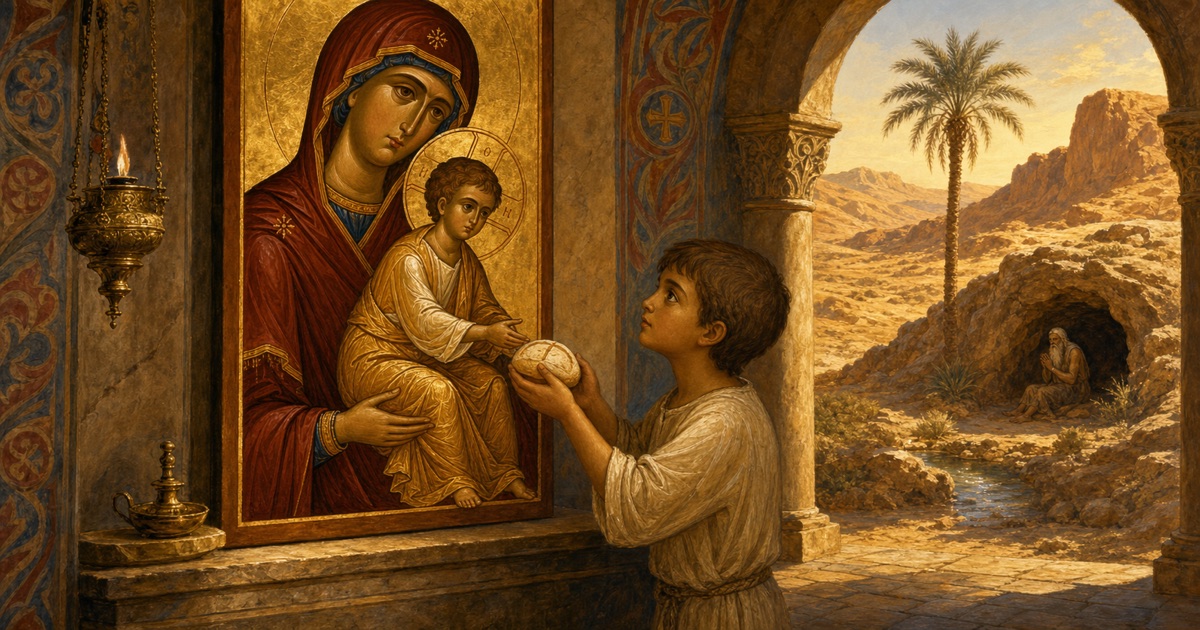
The boy, having reached the age of seven, would ask for a small piece of bread at the refectory and go with it into the narthex of the church, where an icon of the Mother of God was painted, holding upon her arms our Lord Jesus Christ. And he would speak with the Christ-Child of the icon "as with one living," with the innocence of a "holy ignorance": "You too are small, just as I am, but I go to the refectory, ask the cellarer for bread and eat, while You never eat. Why do You suffer so, eating nothing? Here, take my portion and eat." And the Christ-Child depicted on the icon, "as though He were living, stretched out His little hand and took the bread from the hands of Onuphrius."
When the cellarer, having been told, stopped giving the child bread and told him to ask "from Him to whom you have given so often," the boy went weeping to the icon: "The cellarer will not give me bread from himself, and I am hungry; give me from Yourself, for I too have given to You so often!" And at once the Christ-Child gave him "a great loaf, beautiful, pure, white as snow, and warm," so large that a child of seven could scarcely carry it. The monks divided it among themselves "for the blessing and sanctification of all."
It is an icon within an icon. A child gives bread to Christ and receives back from Him a heavenly bread, warm, which is shared with the whole community. Whoever has stood at a Liturgy recognizes the movement at once: we bring the bread, He returns it to us sanctified, and it is broken for all. All of Onuphrius's later life will be an enlargement of this single scene from childhood — a man who gives God his little and receives back the true Bread, brought into the desert by the hand of the angel.
The Greatest of the Ascetics
It was also at the monastery of Eriti that the longing for the desert was kindled in him, and how it was kindled matters. Onuphrius himself says, later, that he listened to the Holy Fathers telling of the Holy Prophet Elijah, who was strengthened by God and spent long fasting in the desert, and of Saint John the Forerunner, "to whom none among men was ever likened." Eremitism did not present itself to him as a novelty, but as an inheritance: the line of Elijah and of John, the way of those who sought God in solitude.
And the question he put to the Fathers is the very question around which his whole life is arranged. He asked them: "Are those who dwell in the desert greater before God than you?" And their answer deserves to be heard in full, for it is no easy glorification of the eremitic life, but a settled spiritual judgment: "Son, those are greater than we, for we see one another every day and celebrate with joy the common church singing; and when we hunger, we find bread ready, likewise when we thirst, we have water in plenty. If one of us falls ill, he is consoled by the other brethren." The one in the desert has none of this. In sorrow, who consoles him? In sickness, who serves him? In unseen warfare, who changes his thought? Therefore, said the Fathers, "beyond comparison greater is the labor" of the one who enters the desert.
But at the end of this labor, the Fathers set the very gift that will nourish the whole life of Onuphrius: "For this reason God sends them holy angels to bring them food, to draw water from the rock," that the word of Isaiah may be fulfilled — those who wait upon the Lord "shall mount up with wings as eagles; they shall run, and not be weary." And where one is not made worthy to behold the angelic vision with his eyes, "he is not deprived of their unseen presence." This Onuphrius heard as a child. This Onuphrius would live as an old man. The desert is not abandonment; it is the place where heaven serves upon earth, seen or unseen.
Hearing these things, "I was made sweet in my soul and in my heart, sweeter than honey, and it seemed to me that I was in another world." He went out from the monastery by night, with bread enough for four days. And on the way a ray of light appeared to him, out of which he heard a voice: "Fear not! I am the angel who has walked with you from your birth, set by God beside you to guard you." The same angel who had drawn him out of the fire was now leading him into the desert. An aged hermit received him, taught him the rules of the eremitic life, led him to the innermost cave, and remained with him thirty days; thereafter he visited him once a year, until his repose. After that, Onuphrius remained alone.
Sixty Years, a Date Palm, and the Bread of the Angel
Alone — and yet never alone. Here lies the heart of his life, and here it is fitting to let him speak, through the words preserved by the one who found him.
At the beginning, the labors were crushing. "So many labors did I suffer in this place that often, despairing of my life, it seemed to me that I was near death. Often I grew faint from hunger and thirst." He ate the wild herbs of the desert; only the heavenly dew slaked his thirst; by day he was scorched by the sun, by night chilled by the cold. But of the deepest struggles he refused to speak, with a reticence that says more than any description: "it is not fitting to disclose those things which a man is bound to do in solitude, for the love of God."
Seeing that he had given himself wholly to ascetic struggle, God commanded His angel to bring him each day a little bread and water. "Thus the angel fed me for thirty years." After those thirty years a consolation was added: near his cave there grew a date palm that had twelve branches, "and each branch in turn brought forth its fruit in one month of the year" — as one month ended, the fruit of one branch ended; as another came, the fruit of another arrived. A calendar-tree, giving food month by month, year by year, measuring time not in days lost but in fruits received. And a spring of living water welled up by divine command. "Now I have a further thirty years in such abundance as this."
Yet neither the bread of the angel nor the fruit of the palm was for him the first food. "Above all I am nourished and given drink with sweetness from the words of God, as it is written: Man shall not live by bread alone, but by every word that proceedeth out of the mouth of God." This is the key to his whole life, and it is no pious phrase: it is the exact description of a life in which Scripture took the place of all that we call food, company, strengthening. A man alone in a wilderness, alive for sixty years, nourished alike by the bread from heaven and by the word from heaven.
The Chalice Brought by the Angel
And yet a question remains, the one the witness himself put to him, and which touches the heart of all we believe about the Church. A man without a priest, without an altar, without a community — from where does he commune? He asked him directly: "Father, from where do you commune on Saturday and Sunday with the Most Pure Mysteries of Christ?"
The answer of Onuphrius is, perhaps, the most precious word of the whole life: "The angel of the Lord comes to me and brings me the Most Pure Mysteries of Christ and communes me." And not to him only, but to all who dwell in the desert for God and "see no human face"; these, communing them, the angel "fills with unspeakable gladness."
Let us weigh what is said here. The perfect hermit is not a man who has gone out of the Church, but a man led so deeply into her that heaven itself descends to commune him. And precisely here the truth is seen: Onuphrius is not deprived of the Eucharist as though it were superfluous to one who has reached such a height — on the contrary, because not even the loftiest hermit can live without it, God sends the angel with the Chalice to where there is no priest. The absence of an altar in the desert does not give rise to some way around the Mysteries, but to a descent of heaven so that the Mysteries shall not be lacking. His solitude does not sever him from the Body of Christ — it sets him in the heart of the unseen Liturgy, the one the angels serve unceasingly before the divine Throne. Onuphrius did not forsake the Liturgy when he forsook the world. He was received into its depth, there where the angelic ministry never ceases.
Readers who have followed on this site the series on the Book of Revelation will recognize the landscape at once: the same heavenly Liturgy, the same Chalice, the same angelic ministry before the Lamb. The desert of Onuphrius and the altar in heaven of the Apocalypse are the same place, seen through two windows — and the ancient bond between fasting and the Liturgy finds here its purest image: a man who, through sixty years of fasting, did not draw away from the Supper of the Lord, but was led to its heavenly table by the hand of an angel.
"Into Thy Hands I Commend My Spirit"
Their meeting was brief, and it was a parting. The next morning, after the singing of Matins, the witness saw the old man's face changed and was afraid. But Onuphrius said to him: "Fear not, brother, for God, who is merciful toward all, has sent you to me to bury my body; for on this very day I end my temporal life." It was the twelfth day of the month of June — the day on which the Church commemorates him to this day.
He left him a single request, the one to which we owe the fact that we know him at all: "Beloved brother, if you return to Egypt, remember me before the brethren and all Christians." Then, bowing his knees to the ground, he uttered his last word: "Into Thy hands, O God, I commend my spirit!" And in that moment "a wondrous light from heaven shone upon him, and in the radiance of that light, rejoicing in his face, he gave up his spirit." An angelic voice was heard in the air, singing and blessing God, for the angels were taking the soul of the saint and "bearing it up with joy to God."
Then comes the sign at which we ought to pause. The witness buried the saint in a grave found already made within a rock, "not by human hands, but by the providence of God." And he wished to remain there, in that blessed place, to carry on the hermit's life. But "at once, before my eyes, the cave collapsed, the date palm that fed the saint fell from its root, and the spring of living water dried up."
The palm did not grow old, nor did the spring run dry of itself. They fell in the very moment the man wished to inherit them. And the lesson is clear as light: the gift is not bound to a place, to a tree, to a spring, to a cave. It is bound to the life of the saint. Holiness is not inherited by moving into another's cell. The palm had borne fruit twelve months a year for Onuphrius, not for the place itself; and when Onuphrius departed, the palm had no one left to feed. God does not leave traces that one may gather cheaply. He leaves lives, and lives are meant to be lived, not picked up off the ground.
Known Only to God
Onuphrius is not, in this desert, the only one of his kind. The one who found him met, on the same journey, other servants of God unknown to the world — hermits whom the angel communed in the same way, in secret, far from every human face. And when the witness begged them to tell their names, that he might remember them before the brethren, some of them refused, with a word that ought to be engraved over our whole discussion of holiness: "God who knows all things knows our names also."
Here it is fitting to pause and to look closely, without forcing anything. We live in an age in which holiness often wishes to be seen, named, swiftly fixed in icons and akathists. The desert of Onuphrius sets before us the exact opposite image: men who fled from being known, whose single desire was that their names remain written only in the book of heaven. We say nothing by this against the appointed veneration of the saints — the very commemoration of Onuphrius has come to us through precisely such veneration. We say only what the life itself says: that the true measure of a man before God is not the recognition he enjoyed among men, but the life he lived when no one saw him.
And here the circle closes. The Fathers of Eriti had told the child Onuphrius that the ascetic in the desert is greater than those in the community precisely because no one sees him, no one consoles him, no one takes account of his labor — and that to him, unseen by man, God sends His angels. Onuphrius took that word as the law of his life and fulfilled it to the end: he became the very one of whom the Fathers spoke, the man whom no one saw and whom the angel fed. That voice of the desert — which treasures obscurity as a treasure and the flight from human glory as the straight path — is not a word of Onuphrius alone, but the speech of the whole eremitic tradition, from the Fathers of the Thebaid to this day. Onuphrius was great not because he was seen, but long before he was seen, in the sixty years in which he was not seen at all.
A Note on the One Who Wrote
And here lies a gift the life itself gives us, concerning the manner in which we ought to handle our sources. All we know of Onuphrius comes to us, as we have said, through a single witness: a hermit named Paphnutius, who went out from his monastery precisely to learn whether there was in the desert any monk "serving the Lord more than I." He wrote down what he saw and heard, and from his writing the memory has been preserved.
The Orthodox desert preserves a single pattern in these discoveries. Just as Saint Mary of Egypt would never have been known had God not sent Saint Zosimas to find her beyond the Jordan, so too Onuphrius has remained to us only through Paphnutius — a witness who went out into the desert believing he had attained the great measure, and finding someone far beyond him. The likeness reaches to the very heart of the Mystery: just as Zosimas returned to the desert precisely to commune Mary, who was without priest and without altar, so too the angel brought Onuphrius the Holy Chalice. The same hunger for the Eucharist of those led into solitude for God, fulfilled by heaven along its hidden ways.
But which Paphnutius? The one who set this life down in the collection of the saints does not pass over the question, but raises it himself, with a care we all ought to have. For, he observes, "in the Church Histories and in the Paterika there are found many by the name of Paphnutius." There is Paphnutius the confessor bishop, the one whose right eye was put out in the days of Maximian and who, at the First Ecumenical Council at Nicaea, rose to defend the marriage of priests — mentioned by the historians Socrates, Sozomen, and Nicephorus. There are several others as well: Paphnutius the martyr, Paphnutius the father of Saint Euphrosyne, the Paphnutius of the repentance of Thais, Paphnutius the disciple of Saint Macarius. And the one who found Onuphrius is not, the author clarifies, any of the renowned ones, but another Paphnutius, "as is proven from an old Greek paterikon written by hand."
It is worth dwelling on this detail, for it is a lesson in itself. A holy writer, having before him a wondrous life, does not hasten to attach it to the most well-known fitting name. He weighs, he distinguishes, he cites his sources, he confesses where he is on firm ground and where he cannot know more. This is the very discipline that faith requires of the one who handles holy things: not to embellish, but to attest.
And here too it is fitting to say how the Church reads such a life. The synaxarion is not a chronicle, but an icon in words. Just as the icon does not photograph the face of the saint, but shows forth his glory, so too the life of Onuphrius does not give us the record of the sixty years in the desert, but their truth: that God nourishes the one who seeks Him, that the desert is a place of the Liturgy, that holiness bears fruit unseen. Whoever asks whether the palm really bore fruit twelve months a year is putting to it the question one puts to a photograph, not to an icon. The truth of the palm is not botanical but spiritual — it says that where a man gives himself wholly to God, the earth itself becomes nourishing at the command of the Creator. Thus the Fathers wrote these lives, and thus the Church receives them: not weighing each detail on the scales of history, but reading in it the ancient testimony of divine providence.
The life of Onuphrius teaches us about holiness; the note on Paphnutius teaches us about truth. And the two hold together, for a saint is honored not with fables, but with attested deeds.
A Window: Saint Peter the Athonite
On the same page of the calendar, on June 12, the Church commemorates yet another great hermit: Saint Peter the Athonite, honored as the first known hermit of the Holy Mountain. The nearness of the two on the same day is no meaningless coincidence. It binds, across centuries and across seas, the desert of Egypt to the Garden of the Mother of God — the same way of solitude for God, carried first in the sands of the Thebaid, then in the crags of Athos.
Peter had been a Greek soldier and commander. Taken captive in a battle in Syria and cast in chains into the fortress of Samara, on the Euphrates, he remembered that he had often resolved to renounce the world and had not done so — and he understood his captivity as a deferred calling. He prayed fervently to Saint Nicholas, and through his intercession and that of Saint Symeon the God-Receiver, he was delivered from prison. From there he set out on the way that would lead him to the desert of Athos, where he spent, like Onuphrius, long years of solitude given wholly to God. Of him — and of the bond between the Egyptian eremitic life and the beginnings of Athonite monasticism — there will be, perhaps, a separate word.
For now it is enough to set the two figures side by side in the light of the same day: two men who believed that the best place for a life is there where God alone sees it.
Conclusion, in the Days of the Apostles' Fast
The commemoration of Saint Onuphrius falls in the very days of the Fast of the Holy Apostles — a fast set precisely in the footsteps of those who left all and followed Christ. It is no meaningless coincidence. Onuphrius carried, in his desert, to the farthest extreme, what the fast asks of each of us in our own measure: to detach ourselves from what feeds the body so as to learn to be fed by what feeds the soul. He received bread from the hand of the angel because he received, first, the word from the mouth of God as food.
Few of us are called into the desert. But all of us are called to the table the angel brought to Onuphrius — to the Chalice brought down from heaven, which in the Church is held out to us not by angelic hands, but by the hands of priests, and yet from the same altar above. And perhaps this is the first teaching of a life lived sixty years under the gaze of God alone: that nothing we do in secret is lost, and that our true life is precisely the one no one sees.
Venerable Father Onuphrius, pray to God for us.
The quotations are rendered from the Lives of the Saints for the month of June, the twelfth day (pp. 106–117). Scripture: King James Version.