
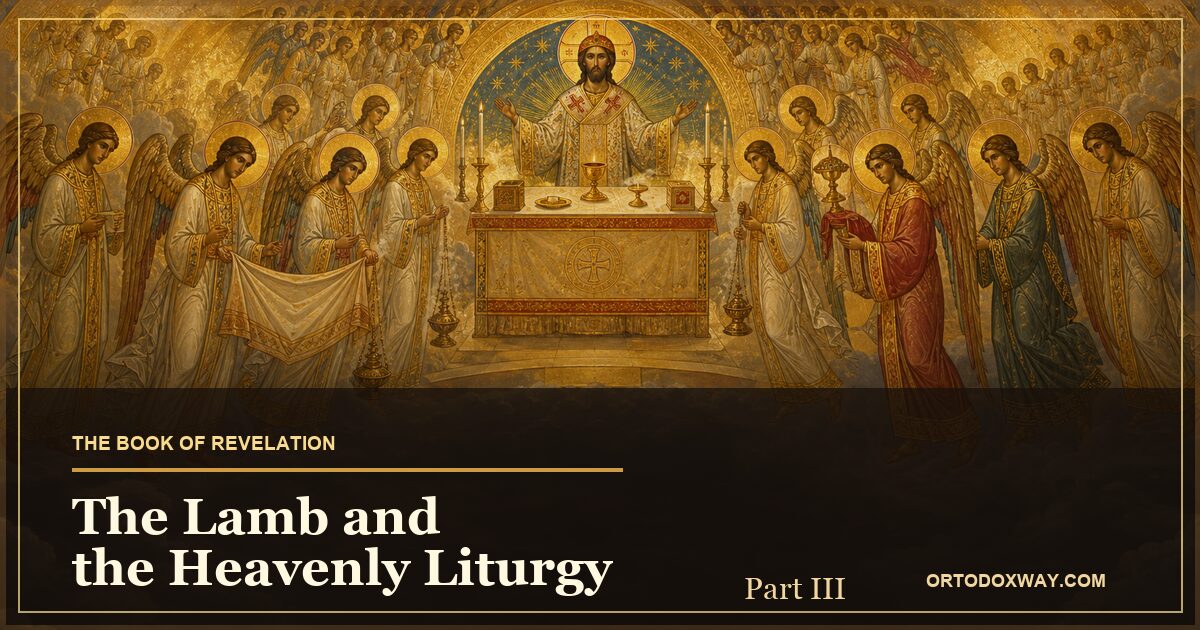
The true face of the book: not a map of catastrophes, but the vision of the Lamb’s victory and of the heavenly worship
From the series “The Book of Revelation” — an Orthodox reading in five parts.
“Worthy is the Lamb that was slain to receive power, and riches, and wisdom, and strength, and honour, and glory, and blessing.”
— Revelation 5:12
In the first two parts we stood, so to speak, in the porch of the book: we came to understand the silence of the first centuries, and we received the key of reading from Saint Andrew of Caesarea. Now it is time to enter. And here the greatest surprise of the whole book awaits us — one that the reader raised on films and internet “prophecies” does not suspect.
For what does the man of today look for in Revelation? The beast, the number, the catastrophes, the end. And what does he actually find, if he opens the book without prejudice? A door opened in heaven — and beyond it, not a field of ruins, but a throne surrounded by worship: “and, behold, a throne was set in heaven, and one sat on the throne” (Revelation 4:2). The first great vision of the book is not a calamity but a service. Before any seal, any trumpet, any plague, John sees heaven at worship.
This is the true face of Revelation, which we wish to show in this part: a book whose centre is not the beast but the Lamb; whose background is not panic but the heavenly Liturgy; and whose judgments are not unleashed from outside this worship, but from within it.
A word about the key we are working with. Of the three senses we received in the second part — the historical, the moral, and the anagogical — it is chiefly the last that will be at work in these chapters. Not because the others have no place here, but because the vision of the throne and of the Lamb is the very anagogical heart of the book: here Revelation does not narrate history; it looks upon it from above. The historical and the moral senses are not absent — the reader will meet them in the multitude of those who come “out of great tribulation” and in the judgments that go forth from the altar. And across the series as a whole, each key has its hour. The first two parts dwelt mostly in history — the fate of the book in the Church — and in learning the method. The present part stands before the throne, with the anagogical sense. The fourth part will come down to the words everyone knows, where the moral sense will claim its due. And the last will gather everything into guidance for our life now.
The Open Door: Heaven at Worship
Let us look first at the scene from which everything begins. In the fourth chapter, John sees the throne, and around it four and twenty elders clothed in white raiment, with crowns of gold upon their heads, and four living creatures full of eyes — one like a lion, another like a calf, the third with the face of a man, the fourth like a flying eagle. (The King James text calls these creatures “beasts” — an older English word for living beings, not to be confused with the beast of chapter thirteen.)
Who are the elders? Saint Andrew first sets down, honourably, the readings he received from those before him — some saw in them twenty-four particular righteous ones, beginning with Abel; others, all the God-fearing, figured in the twenty-four letters of the Greek alphabet — and only then gives his own judgment: “To me it seems more enlightening” that twelve are those who shone in the Old Law, the patriarchs of the twelve tribes, and the other twelve are the Apostles, who “took the helm in the place of the twelve patriarchs of the old Law” (Saint Andrew of Caesarea, Commentary on the Apocalypse, Romanian edition by Gheorghe Băbuț, Pelerinul Român, Oradea, 1991, p. 35; translation ours). Upon the thrones around the throne sits, then, redeemed mankind out of both Covenants. The white garments are “the image of their illumined life and of the unceasing festival,” and the golden crowns figure their victory over the demons (p. 35). And when the elders cast their crowns before the throne (Revelation 4:10), the gesture has its own meaning: they confess that “from God they received the power of victory” (p. 38). Even the crowns of the saints return to the One who gave them.
And the four living creatures? We saw in the second part where these figures come from: from the vision of the cherubim in Ezekiel, over which are laid the wings of the seraphim of Isaiah — the heavenly powers nearest the throne, with the numberless eyes of unsleeping vigilance. Here too Andrew sets out, without hurrying to choose, the meanings he received: the four elements of creation; God’s dominion over things heavenly and earthly, over the sea and the things beneath; the four Gospels. It is a thing worth noting: the great commentator does not close the meaning but opens it — a sign that the vision is roomier than any single key. Above them all, however, he reads the creatures christologically, as a testimony about the One who is served: “Through the lion He is shown as a king; through the calf, as a priest and sacrifice; through the man, as the One who became man for us; and through the eagle, as the Giver of the life-creating Spirit” (Commentary on the Apocalypse, p. 37). King, priest, sacrifice, man, and Giver of the Spirit — even before the Lamb appears, the whole vision speaks of Him.
And the four living creatures do not stand idle: they sing. “And they rest not day and night, saying, Holy, holy, holy, Lord God Almighty, which was, and is, and is to come” (Revelation 4:8). It is the song of the seraphim that Isaiah had heard — and Andrew comments that the holy powers “have no rest” because they unceasingly bring the divine song “to the Godhead in its threefold holiness” (Commentary on the Apocalypse, pp. 37–38): the threefold praise bears witness to the Trinity. Every Orthodox Christian recognises here something familiar: the same thrice-holy song that the Church offers at every Divine Liturgy. The heaven John sees is not a mute heaven of tense expectation, but a heaven that worships without ceasing.
Nor is it a small detail that John receives the vision “on the Lord’s day” (Revelation 1:10) — on the day of the Resurrection, the day the Church gathers for worship. The book that the Byzantine tradition does not read at the Divine Liturgy is, by its very fabric, one of the most liturgical books of the New Testament. We named this paradox in the first part; now we see it resolved.
A Lamb as It Had Been Slain: the Victory That Does Not Look Like Victory
In the midst of this heavenly worship comes the scene that gives the key to the whole book. In the right hand of Him that sits on the throne is a book sealed with seven seals, and no one — in heaven, on earth, or under the earth — is worthy to open it. This book, Andrew comments, is the very “mind of God,” in which lie “the depths of His judgments” (Commentary on the Apocalypse, p. 38) — and these no human interpretation can exhaust. John weeps. Then one of the elders comforts him: “Weep not: behold, the Lion of the tribe of Juda, the Root of David, hath prevailed” (Revelation 5:5).
John turns to see the lion. And what does he see? “And I beheld, and, lo, in the midst of the throne and of the four beasts, and in the midst of the elders, stood a Lamb as it had been slain” (Revelation 5:6).
Here is the reversal on which the whole of Revelation rests — and, in truth, the whole of the Gospel. He is promised a lion; he is shown a Lamb. He is promised a victory; he is shown a sacrifice. The Victor of history is not a power that crushes, but the One who let Himself be slain. And the Lamb stands — He does not lie prostrate: He is “as it had been slain” and yet alive. Saint Andrew dwells on this detail: in saying that He appears as newly slain, the vision “shows His life after the slaying,” in which, after the Resurrection, Christ “showed the marks of His Passion” (Commentary on the Apocalypse, p. 40) — as He showed them to Thomas. The Lamb of Revelation is the Crucified and Risen One, bearing His wounds as tokens of victory.
And there is a further depth: this slaying is not, in the counsel of God, a late occurrence. The Apostle Peter calls Christ “a lamb without blemish and without spot,” “foreordained before the foundation of the world” (1 Peter 1:19–20) — and Revelation itself speaks of “the Lamb slain from the foundation of the world” (Revelation 13:8). The Cross is not God’s reserve plan, but the mystery ordained before all ages.
That is why only He can open the book. The seals of history — its hidden meaning, its final outcome — are not unlocked by power, by science, or by calculation, but by the Cross. And that is why every reading of Revelation that puts the beast at the centre has missed the mark from the outset: the book itself puts the Lamb at its centre. The beast appears late, in the thirteenth chapter, as an episode of the war; the Lamb stands in the midst of the throne from the fifth chapter to the marriage feast at the end. Whoever counts the chapters sees plainly what book he is reading: not the chronicle of the beast, but the song of the Lamb.
And the whole heaven answers this appearing with worship. The four living creatures and the elders fall down before the Lamb, “having every one of them harps, and golden vials full of odours, which are the prayers of saints” (Revelation 5:8) — and they sing “a new song.” Then the voice widens: the angels, “ten thousand times ten thousand,” cry out the words we have set at the head of this article; and at the last, “every creature which is in heaven, and on the earth, and under the earth, and such as are in the sea” (Revelation 5:13) enters the song. From the throne to the edges of creation, everything becomes doxology. Saint Andrew sees here the mystery of the Church itself: through the joint worship of the heavenly beings and the elders it is shown that angels and men “have become one flock and one church” through Jesus Christ, who “united what was scattered and broke down the dividing wall” (Commentary on the Apocalypse, p. 41). Revelation does not divide heaven from earth: it shows man received into the worship of the angels.
The Multitude in White Robes
How far this reception goes is seen in the seventh chapter. Before the opening of the last seal, the vision pauses: between the earthquakes of the sixth seal and the silence of the seventh there opens a sight that no longer belongs to judgment but to consolation. “After this I beheld, and, lo, a great multitude, which no man could number, of all nations, and kindreds, and people, and tongues, stood before the throne, and before the Lamb, clothed with white robes, and palms in their hands” (Revelation 7:9).
Who are they? The question is asked by one of the elders himself, and the answer holds one of the deepest paradoxes of the book: “These are they which came out of great tribulation, and have washed their robes, and made them white in the blood of the Lamb” (Revelation 7:14). Here the historical sense too has its place: Andrew sees in them, first of all, those who “shed their blood for Christ” (Commentary on the Apocalypse, p. 55) — the martyrs of all the persecutions, from those John lived through to those still to come. But the paradox holds for everyone: made white in blood — no washing of this world works like that. Only the blood of the Lamb makes garments white; purity is not gained by going around the Cross, but by passing through it. And from here the moral sense, within everyone’s reach: the garment received at Baptism is washed anew in repentance and in the patient bearing of afflictions — for the way into the Kingdom passes through much tribulation, as the Apostle says (Acts 14:22).
And what do these people do before the throne? They serve: they “serve him day and night in his temple” (Revelation 7:15). Saint Andrew comments that “day and night” signifies unceasingness — for there shall be no night there, but “one continuous day,” lit not by the natural sun but by “the Sun of Righteousness” (Commentary on the Apocalypse, p. 56). And the palm branches in their hands — the branches with which the Church still greets her King on Palm Sunday — “symbolize the most righteous victories” (Commentary on the Apocalypse, p. 55).
And at the last, the most consoling image in the whole book: the Lamb becomes a Shepherd. “For the Lamb which is in the midst of the throne shall feed them, and shall lead them unto living fountains of waters: and God shall wipe away all tears from their eyes” (Revelation 7:17). The One slain for the sheep feeds His sheep; and those whom He feeds, says Andrew, “will no longer fear the onslaught of the wolves” (Commentary on the Apocalypse, p. 57). The book the world believes to be a book of terrors carries, in its very heart, the promise of the wiping away of all tears.
This is the multitude that the vision sets within the heavenly worship — out of every nation and tongue, beyond counting. Not spectators, but servers.
The Heavenly Liturgy and Our Liturgy
Let us now gather the signs, for together they form a likeness that every believer recognises. An altar (Revelation 8:3). A golden censer, and the smoke of the incense ascending before God “with the prayers of the saints” (Revelation 8:4). The thrice-holy song. New songs, with harps. The multitude clothed in white robes. The cry of “Alleluia” (Revelation 19:6). A marriage supper whose guests are called blessed. The unwaning day — the everlasting “Lord’s day.” These are not ornaments scattered among the visions: they are the skeleton of the book. Revelation unfolds as a service, because what was revealed to John is the worship that heaven brings without ceasing to God and to the Lamb.
And the Church has always understood that her earthly Liturgy is not a remembrance of this worship, nor a repetition of it, but a mystical participation in it. When the priest censes, the Church sees the incense in the angel’s hand; when the people sing the thrice-holy song, she joins her voice to the beings beside the throne; when at the Proskomedia the portion of bread set apart for the Holy Sacrifice is named the Lamb and is cut with the liturgical spear, the words and the gesture confess that in the midst of our Liturgy stands the same Lamb “as it had been slain” whom John saw in the midst of the throne. Revelation does not borrow images from our services, nor do the services “stage” Revelation: both behold the same reality — heaven opened, and the Lamb in the midst.
Saint Andrew himself makes this connection in the most concrete way. Commenting on the golden altar before the throne, he writes briefly: “The golden altar is Christ” (Commentary on the Apocalypse, p. 58) — in Him are offered all the sacrifices, of the martyrs and of all the saints. And of the angel who offers the incense together with the prayers of the saints, he adds: “The image of this angel is borne by every hierarch” (Commentary on the Apocalypse, p. 58), as a mediator who lifts up the prayers of men. The visible ministry of the Church — altar, incense, bishop — is for Andrew the living icon of the invisible one. Whoever stands at the Liturgy stands, though he sees it not with bodily eyes, within the very sight of Revelation.
And to this worship not only those within the altar are called. The new song before the Lamb says it outright: “And hast made us unto our God kings and priests” (Revelation 5:10). This does not replace the ordained priesthood of the Church, but reveals the priesthood of all the faithful: the life of every Christian redeemed by the blood of the Lamb is called to become an offering. His prayer is the incense in the golden vials; his righteous deeds are the fine linen with which the bride is arrayed (Revelation 19:8). In this vision no one stands idle: all serve.
From here one also sees how deeply mistaken are the readings that make of Revelation a text of fear. The book culminates not in a catastrophe but in a wedding: “Let us be glad and rejoice, and give honour to him: for the marriage of the Lamb is come” (Revelation 19:7). And the song that announces it is “Alleluia” — a word which, Andrew comments, “signifies the praise of God” (Commentary on the Apocalypse, p. 125), offered alike by the heavenly powers and by men. The end towards which history moves, as John sees it, is not a disaster but a marriage feast; not a scream, but an Alleluia.
But What of the Plagues? Judgment from Within the Worship
Someone might rightly ask: very well, but the seals, the trumpets, the vials of wrath? Are we not avoiding precisely the pages that have frightened so many?
We are not avoiding them — we are setting them in their place. And their place is inside the heavenly Liturgy, not outside it. Let us mark who opens the seals: the Lamb. Not a blind power, not a fate, not an angel of destruction — but the One slain for the world. The judgments of history pass through hands pierced by nails. This does not make them less fearful for the hardened heart, but it changes their meaning entirely: they are not the fury of an unleashed god, but the working of the same Lamb who saves. In God there is no passion, no human outburst: “true and righteous are his judgments,” sings the very heaven of Revelation (Revelation 19:2) — and His justice is not divided from His love for mankind: it does not allow evil to reign without end.
And let us mark where the trumpets begin. Before the first angel sounds, another angel offers upon the golden altar the incense “with the prayers of all saints”; then he fills the censer with the fire of the altar and casts it into the earth — and only then do the thunders and voices break forth (Revelation 8:3–5). The same censer that lifts up the prayers brings down the fire. The vision declares, in liturgical language, a staggering truth: beyond what seems decisive to the world — the chanceries of emperors, the armies, the roar of events — history is carried, in its depths, by the providence of God and by the prayers of the saints, offered upon the heavenly altar. Seen from heaven, what looks like power is the answer to a censer.
Even the silence has its place in this service. When the Lamb opens the seventh seal, “there was silence in heaven about the space of half an hour” (Revelation 8:1) — and Andrew sees in this silence not the void before disaster, but “the good order of the angels” and the fear of God (Commentary on the Apocalypse, p. 57). It is the silence with which the Church too stands at the highest moments of the service: not the muteness of dread, but the trembling of reverence.
This is how the plagues are read with the key received in the second part: not as a horror script to be matched against the day’s news, but as the unveiling of how the judgment of God — righteous and loving of mankind at once — works from within the same worship in which the prayers of the saints ascend. Whoever has understood that the plagues go forth from the altar can no longer fear them as a blind happening — but he can fear, as is fitting, his own impenitence.
The Book of Joy
Here, then, is the true face of the most feared and most misread book of Scripture. A book received on the Lord’s day. A book whose centre is the Lamb, slain and alive. A book woven like a Liturgy, in which even the judgments go forth from the altar and even the silence is reverence. A book that ends with a wedding and whose refrain is Alleluia. A book given to us not to feed our curiosity about the end, but to give us watchfulness, repentance, and hope.
Perhaps this is why the Byzantine tradition never felt the need to set it among the appointed readings: it does not read Revelation at the services, but, in a mystical way, it serves it. Whoever wants to know what this book “is about” need not run to the merchants of fear, but stand, with a sober mind, at a single Divine Liturgy — and he will have seen, as through an icon, what John saw face to face.
There remain, however, the words — those verses everyone knows and few read rightly: “Alpha and Omega,” “behold, I stand at the door, and knock,” the city from heaven, and, above all, the most misread of them all. Of these, in the next part.
In Part 4: The Words That Remain — the famous verses of Revelation, and the right way to read them.
About this series
“The Book of Revelation” is a series in five parts which seeks to recover the Orthodox, patristic reading of the most misunderstood book of Scripture — beyond fears and calculations about the end of the world.
- Why the Fathers Were Silent — The peculiar standing of Revelation in the Byzantine tradition: a book received with reserve, not read at the services, and long left without commentary. What this silence means.
- The Key to Reading It — The method of Saint Andrew of Caesarea and the golden rule of all interpretation: the symbols are unlocked through Scripture and within the Church, not through the events of the day.
- The Lamb and the Heavenly Liturgy (this article) — The true face of the book: not a map of catastrophes, but the vision of the Lamb’s victory and of the heavenly worship.
- The Words That Remain — The famous verses of Revelation, from “Alpha and Omega” to the New Jerusalem, and the right way to read them — including the most misread of them all.
- Revelation Today — Why, now that anyone can read it, what we need is not deciphering but guidance.
The book of this series
Archbishop Averky Taushev, The Apocalypse: In the Teachings of Ancient Christianity (translated, edited, and introduced by Fr. Seraphim Rose, St. Herman of Alaska Brotherhood) — the most accessible modern Orthodox commentary on Revelation, built upon the interpretation of Saint Andrew of Caesarea, the same foundation on which this series stands. Available on Amazon, or in a newly annotated edition from Holy Trinity Publications.