
Between Ascension and Pentecost
Introduction: A Sunday between the Ascension and Pentecost
In the liturgical order of the Church, the Seventh Sunday of Pascha is no ordinary Sunday. It falls within that mysterious interval between the Ascension of the Lord and the Descent of the Holy Spirit — that is, between the moment when Christ ascended to the Father and the moment when the Holy Spirit descended upon the Apostles. These are ten days during which the Church watches, awaits, and prays. These are the days when the Apostles were gathered together in one place, “continuing with one accord in prayer” (Acts 1:14).
At the very heart of this expectation, the Church has placed the commemoration of the Holy Fathers of the First Ecumenical Council, held at Nicaea in the year 325. And the Gospel appointed for this day is the High Priestly Prayer of the Saviour — John 17:1–13. This is not a liturgical coincidence. It is an entire theology.
The Holy Fathers who composed the liturgical synaxaria did not work solely by didactic or chronological criteria. They worked according to a deep spiritual logic. Why should we read the High Priestly Prayer precisely now? Because in this prayer, uttered only hours before the Passion, Christ Himself speaks of His Father, of the glory He had “before the world was” (Jn 17:5), of His consubstantial unity with the Father, of the keeping of His disciples in the “name” of the Father (Jn 17:11–12). These are the very words that form the foundation of Nicene Christology. These are the words that Arius distorted. These are the words that the 318 Fathers defended at Nicaea.
By placing the High Priestly Prayer on this Sunday, the Church makes a theological statement: it shows that the dogma of the First Council is not a human construction, not Greek philosophy baptized into Christianity, not a dogmatic system composed by theologians. The Nicene dogma is the very word of Christ Himself, received from His own lips, transmitted through Saint John the Evangelist, preserved by the Apostles, confessed by the Fathers at the cost of blood and exile.
And we, who live today, are called on this Sunday to stand before this prayer with the same mind in which the Fathers of Nicaea stood: with watchful heart, clear mind, and the resolve to neither add nor remove anything from what has been handed down to us.
The Historical Context of the First Council (325)
To understand what we confess today when we recite “I believe in one God, the Father Almighty… and in one Lord Jesus Christ, the Son of God, the Only-Begotten, begotten of the Father before all ages,” we must return to the beginning of the fourth century.
Around the year 318, in Alexandria, a presbyter named Arius began to preach a new teaching. He claimed that the Son of God is not eternal, but was created by the Father at a certain moment. He used a formula that spread throughout the Empire: “There was when He was not” (in Greek: ἦν ποτε ὅτε οὐκ ἦν). According to Arius, the Son is not of the same essence as the Father, but is a created being — the first and highest of creatures, but a creature nonetheless. Christ, in Arius’s view, was a kind of “second-rank god” — not an ordinary man, but neither true God.
This teaching was not merely academic speculation. It struck at the heart of the faith. For if Christ is not true God, He cannot save us. Salvation requires that He who assumes human nature must Himself be God — otherwise He cannot deify the nature He has assumed. Saint Athanasius the Great formulated this principle with a clarity that has echoed through the ages:
“God became man so that man might become god.”
If Arius is right, this affirmation collapses. Salvation becomes impossible. Christianity becomes a moral philosophy.
The Arian heresy spread with terrifying rapidity. Whole episcopates fell into it. The Empire was shaken. The Emperor Constantine the Great, honoured by the Church as a saint and as Equal-to-the-Apostles, seeing that the dispute threatened the very unity of the Church and of the Empire, convened a general council — the first ecumenical synod in the history of the Church.
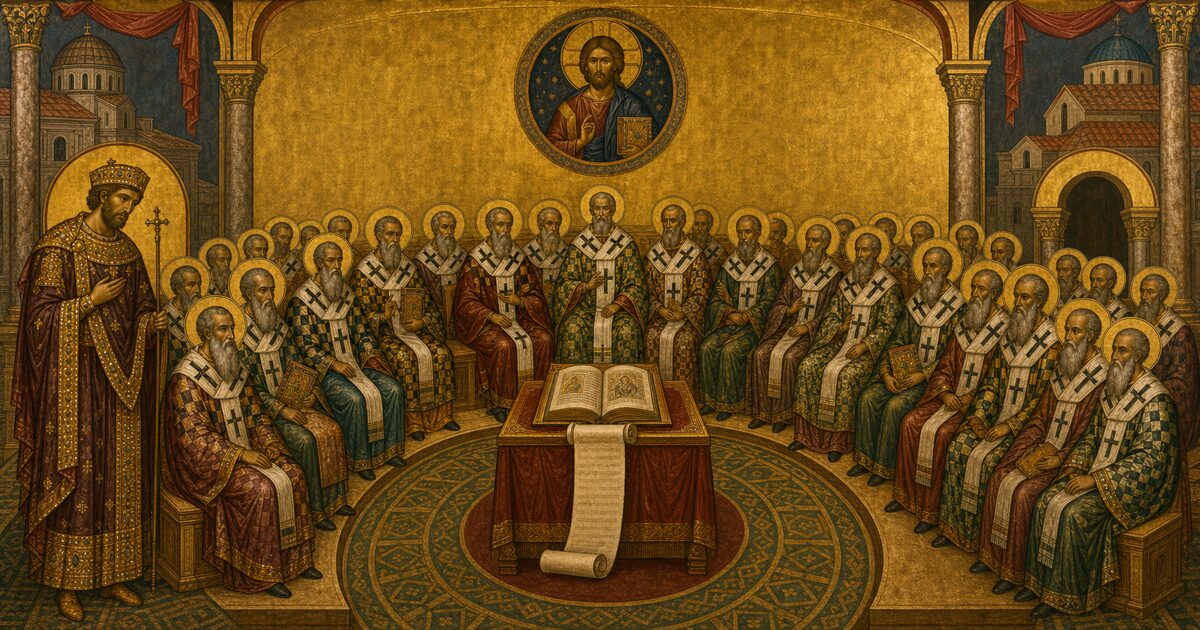
In the month of May 325, at Nicaea — a city on the shore of Lake Iznik in Bithynia (today in Turkey) — the Fathers of the Council assembled. The Tradition of the Church has preserved the number of 318, although modern historians sometimes discuss slightly different figures; the traditional number corresponds to the 318 servants of Abraham in Genesis 14:14, a coincidence which the Holy Fathers did not consider accidental. Among them were men who bore on their bodies the marks of Diocletian’s persecution: eyes gouged out, hands maimed, feet crippled. They were confessors in the strict sense of the word — men who had suffered for Christ.
The Council defined the faith of the Church in that Creed which we recite to this day (the form of 325, completed at Constantinople in 381). The key word introduced at Nicaea, the word that definitively divided Orthodoxy from Arianism, was ὁμοούσιος (homoousios) — “consubstantial,” of one essence. The Son is consubstantial with the Father. Not of another essence, not of similar essence, but of the very same essence. The term does not appear as such in Scripture, but it expresses with technical precision what Scripture confesses throughout — and most of all in the Gospel according to John.
Arius was anathematized. The Creed was signed. The bishops who refused to sign were deposed. The struggle seemed to be over.
In reality, it was only beginning. For after the death of Constantine, his successors (especially Constantius II) were favourable to Arianism. The Empire turned against the Nicene Creed. Orthodox bishops were exiled. Churches were occupied by Arians. And there came a moment when it seemed that the entire Christian world had become Arian. Saint Jerome recorded the moment in a sentence that has become famous:
“The world groaned and found itself Arian.”
In such an hour, one man became the symbol of the unwavering resistance of Orthodoxy — Saint Athanasius the Great, Bishop of Alexandria. Of him we will speak below.
But first, let us understand a fundamental matter: why the Gospel according to John, in particular, became the principal source of the Nicene dogma.
Saint John the Theologian — the Source of the Nicene Dogma
In the Tradition of the Church, only three Saints bear the name “Theologian”: Saint John the Evangelist, Saint Gregory of Nazianzus, and Saint Symeon the New Theologian. And among these three, Saint John is the first — not only chronologically, but as the scriptural source of the Trinitarian theology of the Church. For he is the wellspring. The other two drank from his spring.
Why did Saint John receive this name above all apostolic names? Not because he wrote more than the others — Saint Paul wrote more. Not because he was more learned — other Apostles had equal or better scriptural formation. Not because he suffered more — all the Apostles, except him, died as martyrs. The criterion is neither quantity, nor erudition, nor sacrifice, nor even physical proximity to the Lord (Peter and James were also on Tabor, and also in Gethsemane).
The criterion is something else, and it is unique. Saint John is the Theologian because, in his Gospel, he speaks of the very inner mystery of the Holy Trinity — of the eternal relations between the Father and the Son, between the Son and the Holy Spirit. This depth of the eternal relation between the Father and the Son is expressed in the Gospel of John with a clarity and density that are unique, although the witness to the divinity of Christ is not absent from the other Gospels either. Matthew, Mark, and Luke wrote more about the deeds and words of the Lord in the economy of salvation. Saint John, alongside all this, wrote about Who the Lord is in His mystery from all eternity. The Prologue of the fourth Gospel — “In the beginning was the Word, and the Word was with God, and the Word was God” (Jn 1:1) — is the clearest scriptural confession of the pre-existent divinity of the Son and of His eternal relations with the Father. And the High Priestly Prayer (chapter 17) is the liturgical unfolding of this mystery.
The three saints whom the Church has named “Theologians” with the proper, liturgical title — John, Gregory of Nazianzus, Symeon the New Theologian — have in common this unique gift: they spoke of the inner mystery of the Trinity not out of study, but out of direct vision. These bear, in Greek, the definite article: Ὁ Θεολόγος — The Theologian. This is a liturgical recognition of the Church, not a hierarchy of value. Many other Holy Fathers are θεολόγοι (theologians) in the full patristic sense — those who speak of God out of theoria, out of dispassion, out of pure prayer, according to the word of Saint Evagrius:
“He who truly prays is a theologian; and he who is a theologian truly prays.”
In this patristic sense, Saint Gregory Palamas is fully θεολόγος — he beheld the uncreated light, he was taught by the Mother of God, and the distinction between the essence and the energies of God which he defended is a Trinitarian theology of the greatest depth. So too is Saint Maximus the Confessor, with the depth of his Ambigua, and Saint Basil the Great, with his treatise On the Holy Spirit. All of these are theophoroi and “divine Fathers.” But the Church has reserved the proper liturgical title — Ὁ Θεολόγος — for those three who spoke not only out of theoria, but specifically about the inner mystery of the Trinity: about the eternal relations between the divine Persons, about the eternal glory of the Son with the Father, about the begetting without beginning and about the procession from the Father.
And the gesture of Saint John resting on the bosom of the Lord at the Mystical Supper (Jn 13:23) — which the Holy Fathers have commented upon so many times — is the icon of this mystery, not its cause. Saint John heard “the heartbeat of the Word,” that is, he received access not only to the outward words of the Lord, but to the inmost mystery. And out of this mystery, under the inspiration of the Holy Spirit, he wrote the Gospel that has nourished the whole of Orthodox theology for two thousand years.
Saint Athanasius the Great understood this perfectly. His entire struggle against Arianism rested upon the Gospel of John. In his work Three Discourses Against the Arians, he comments verse by verse on the Johannine passages and shows how, if they are read with the mind of the Church and not with the mind of Arius, they entirely exclude any teaching that would make the Son a creature.
There is, therefore, an organic continuity, a direct spiritual filiation:
Christ utters the High Priestly Prayer → John hears it at His bosom and writes it → Athanasius defends it against Arius → the Fathers of Nicaea formulate it in the Creed → the Church transmits it down to today.
This is the living Tradition. This is the Holy Tradition in which we are baptized. Not a theology of the study, not a system composed of concepts, but a living word, received from the lips of the Saviour, transmitted from heart to heart, defended with the blood of the confessors.
And now, having laid this foundation, we may enter into the High Priestly Prayer itself — verse by verse, with the Holy Fathers as our guides.
Exegesis of the High Priestly Prayer (John 17:1–13)
“Father, the hour is come. Glorify Thy Son, that Thy Son also may glorify Thee” (v. 1)
Christ begins the prayer by lifting His eyes to heaven and with the word “Father.” Saint John Chrysostom, in his 80th Homily on John, observes that this lifting of the eyes is not for His own sake — for He who sees all things has no need to lift His eyes — but for our sake, to teach us how we ought to pray: with mind uplifted, with pure heart, with the body in the proper attitude.
“The hour is come.” This “hour” is the hour of the Passion. The entire Gospel of John flows toward this hour. “His hour had not yet come” — this is repeated many times in the early chapters. And now, the hour has come. Saint Cyril of Alexandria, in his Commentary on John (Book XI), shows that Christ calls the Passion a “glorification” — for through the Cross the Son was glorified, and through the glorification of the Son the Father was glorified, who gave His Only-Begotten for the life of the world.
Here already we see the collapse of the Arian teaching. If the Son were a creature, then His glorification would not glorify the Father. A glorified creature does not glorify the Creator — on the contrary, it dishonours Him by presuming to be on His level. Only if the Son is of the same essence as the Father is His glorification the glorification of the Father. Only if “I and the Father are one” does the honour given to the Son pass to the Father, and the honour given to the Father pass to the Son. The Fathers of Nicaea read this verse through this lens — and they formulated accordingly.
“As Thou hast given Him authority over all flesh, that He should give eternal life to as many as Thou hast given Him” (v. 2)
Saint Cyril insists here on the word “authority” (ἐξουσία). Christ, as man, receives from the Father the authority to give eternal life. But this receiving must not be understood in an Arian sense — as though the Son were receiving something He did not have of Himself. According to Saint Cyril, Christ receives as man what He had as God from all eternity. This is a receiving in the economy of salvation, not an ontological receiving. He who emptied Himself, taking the form of a servant (Phil. 2:7), receives through the Incarnation the authority which He possessed by His divine nature.
This is the fundamental distinction between Arian theology and Orthodox theology: the Arian reads “He gave” as proof that the Son is inferior; the Orthodox reads “He gave” in the light of the Incarnation — the Son receives, as man, what He gives, as God. Saint Athanasius, in his Third Discourse Against the Arians, shows that Scripture deliberately uses two registers — one according to divinity, the other according to humanity — and that whoever confuses the two falls either into Arianism (if he reduces everything to humanity) or into Monophysitism (if he reduces everything to divinity).
“And this is eternal life, that they might know Thee, the only true God, and Jesus Christ, whom Thou hast sent” (v. 3)
This is the key verse of the High Priestly Prayer. Here everything is decided. And it is precisely here that Arius tried to plant his teaching.
The Arian argument was as follows: Christ says that the Father is “the only true God.” Therefore, if only the Father is true God, then the Son is not true God. The word “only” excludes the Son from true divinity.
Saint John Chrysostom (80th Homily on John) and Saint Cyril (Commentary on John, Book XI) dismantle this reading with an exegetical force that leaves no room for doubt. Their argument is twofold.
First, the words “the only true God” are not used to exclude the Son, but to exclude the idols. The entire religious context of the ancient world was full of false “gods.” Christ here, on the threshold of the Cross, affirms that His Father is the only true God — that is, not Zeus, not Jupiter, not Mithras, not any of the pagan idols. The verse excludes idolatry, not the Son.
Secondly — and this is the decisive argument — if the word “only” were to exclude the Son, then it should also exclude the Holy Spirit. Yet if we apply Arian logic consistently, the word “only” would come to exclude not only the Son but also the Holy Spirit — something which the Church clearly rejected, especially in the later struggle against the Pneumatomachi (those who denied the divinity of the Spirit) at the Second Ecumenical Council in 381. Thus the Arian exegetical principle collapses from within: applied consistently, it would lead to a triple denial — of the Son, of the Spirit, and ultimately of the Trinity itself.
Moreover — and this is the height of the argument — in the very same verse, Christ places the knowledge of the Father and the knowledge of Himself on the same plane of saving knowledge. “This is eternal life: that they might know Thee… AND Jesus Christ.” The knowledge of the Son gives eternal life in the same measure as the knowledge of the Father. And eternal life is given only by God — a creature cannot give eternal life. Therefore, if the knowledge of the Son gives eternal life, the Son is true God.
This verse, so brief and apparently so simple, contains within itself the entire Nicene dogma. The 318 Fathers knew it by heart.
For us today, it is also a word that cuts through every form of religious syncretism. For Christ does not say: “Know God, by whatever name you call Him.” He says: “the Father,” and “Me.” Saving knowledge is personal, Christic, Trinitarian knowledge. Whoever seeks God while bypassing Christ, however sincerely, does not find the Father. For, as Christ Himself said: “No one comes to the Father but by Me” (Jn 14:6).
“I have glorified Thee on the earth: I have finished the work which Thou gavest Me to do” (v. 4)
Saint John Chrysostom underlines here that Christ speaks of the Passion as a work already accomplished, even though it had not yet come. For in His will the Passion was already fulfilled. Christ was not led to the Cross against His will — He went of His own accord. And His will was united with the decree of the Father from all eternity.
The “work” that Christ accomplished on earth is, according to the Holy Fathers, the entire economy of salvation: the Incarnation, the preaching, the working of miracles, the teaching of the disciples, the founding of the Church, the voluntary Passion, the Resurrection, the Ascension. All are contained in this brief word. And through their accomplishment, the Father was glorified on earth — that is, the name of the Father was made known, true worship was established, idolatry was uprooted.
“And now, O Father, glorify Thou Me with Thine own self with the glory which I had with Thee before the world was” (v. 5)
This is the second pivotal verse of the High Priestly Prayer for the Nicene dogma. And it is the verse that made any Arian defence impossible.
“The glory which I had with Thee before the world was.” Christ here affirms, without any equivocation, His eternal pre-existence in glory, alongside the Father, before creation. Saint Athanasius the Great, in his Discourses Against the Arians, uses this verse as an arrow that pierces the heart of Arius’s teaching.
For Arius said: “There was when He was not.” If there was when the Son was not, then the Son was created at a certain moment. But Christ Himself confesses here that He was before the world was — that is, before any beginning of creation. And if He was before all creation, He cannot Himself be a creature. He who is before creation is Uncreated. And only God is Uncreated. Therefore the Son is God.
Saint Cyril of Alexandria goes further. He observes that Christ does not merely say that He was before the world was, but that He had glory before the world was. Now, what kind of glory can a being have apart from its relation to other beings? Glory presupposes communion, presupposes relation. But before the world was, there were no other created beings. Therefore the glory which the Son had was glory in the Father, through the Father, together with the Father — uncreated glory, eternal glory, the glory of the Trinity itself.
Here enters — and this is the appropriate moment to bring him into the discussion — Saint Gregory Palamas. In his dispute with Barlaam the Calabrian (fourteenth century), Saint Gregory defended the teaching that the glory of God is uncreated, that the light beheld by the three Apostles on Tabor was this uncreated glory, and that the deified man can, by grace, behold this eternal glory. And the verse Jn 17:5 is one of the verses Saint Gregory uses to show that the glory of Christ is not a created light, but the very same glory which the Son had with the Father before the world was. That is, it is the glory of the Godhead itself — uncreated, eternal, active.
In His prayer, Christ asks that this glory may be manifested again — not because He had lost it (a God cannot lose His glory), but because, after the Incarnation, it had been hidden from human eyes beneath the humble form. At the Resurrection and at the Ascension, this eternal glory shone forth again in the assumed human nature — and it shall shine, in the age to come, in the deified Body of Christ, whom we shall see “as He is” (1 Jn 3:2).
This is the foundation of the Palamite teaching on deification. And the Fathers of Nicaea, although they did not yet formulate the distinction between essence and energies as Saint Gregory Palamas would do a thousand years later, laid the foundation: they confessed that the Son is of the same essence (homoousios) as the Father. The rest followed organically from this.
“I have manifested Thy name unto the men which Thou gavest Me out of the world: Thine they were, and Thou gavest them Me; and they have kept Thy word” (v. 6)
The “name” of the Father, according to Saint John Chrysostom, is not merely a word — it is the very revelation of God. In the Old Testament, God had revealed Himself as Yahweh — “He who is.” In the New Testament, He reveals Himself as Father — the Father of our Lord Jesus Christ, and through Christ, our Father. This is the highest revelation: God is Father. And if He is Father, He has a Son. And if He has a Son, the Son is of one essence with the Father.
Saint Cyril notes that Christ did not make known a new name invented by Himself, but revealed what had been hidden from all eternity: that God is Trinity. The Father, the Son, and the Holy Spirit — not three gods, but one God in three Persons. This mystery was fully revealed only through Christ. The Old Testament had foreshadowed it in many places (the Oak of Mamre, “Let us make man in our image,” the sending of the “Wisdom” of God), but its full revelation came only through the Incarnation.
And the men “whom Thou gavest Me out of the world” are the Apostles. They are the ones who “kept the word” of the Father — that is, received, preserved, and transmitted the teaching. From them we have all that we have. And from the Apostles come the Fathers. From the Fathers, the First Council. From the First Council, the Creed which we recite. And from the Creed, the faith of the Church to this day.
“Now they have known that all things whatsoever Thou hast given Me are of Thee. For I have given unto them the words which Thou gavest Me; and they have received them, and have known surely that I came out from Thee, and they have believed that Thou didst send Me” (vv. 7–8)
Here Christ describes what has been called in patristic theology paradosis — handing down, transmission. The Father gives to the Son. The Son gives to the Apostles. The Apostles give to the Church. And the Church preserves and transmits onward, until the end of the ages.
Saint John Chrysostom underlines the force of the verbs: “I have given,” “they have received,” “they have known,” “they have believed.” Four verbs that describe the four stages of Tradition: gift, reception, knowledge, faith. Tradition is not an inert process, a mechanical transfer of information, but a living work, in which the receiver does not merely retain, but knows and believes.
This is also the difference between the living Tradition of the Church and the “traditions” of men found everywhere. The Tradition of the Church is the gift of God received, known, and believed by the Apostles, transmitted through the Fathers and maintained through life in Christ. It does not change, because God does not change. It is not completed by “dogmatic developments,” because the truth was given once for all to the saints (Jude 1:3). What was done at the Councils was not added to the Tradition — it was only formulated in technical words what the Church had always possessed.
“I pray for them: I pray not for the world, but for them which Thou hast given Me; for they are Thine” (v. 9)
This verse has often been wrongly interpreted. “I pray not for the world” does not mean that Christ despises the world or does not love it. Saint John Chrysostom explains: Christ also prayed for the world in other places (“Father, forgive them, for they know not what they do” — Lk 23:34). But here, in this particular prayer, He prays for the Apostles and for those who will believe through their word (v. 20). For these are the seed from which the Church will be born. Through them the world will be saved.
And “the world” here, according to Saint Cyril, is not creation as such — for that is the good creation of God — but the world in the sense in which the world “hated” Christ (Jn 15:18). That is, “the world” as the spirit of the fall, as the rejection of God, as resistance to grace. For this “world,” as such, Christ does not pray — because it does not want to be saved. But He prays for those who, coming out of this “world,” receive the word.
“And all Mine are Thine, and Thine are Mine; and I am glorified in them” (v. 10)
Here is a verse which, in its apparent simplicity, contains one of the most powerful confessions of the divinity of the Son in all of Scripture. Saint Athanasius the Great uses it with force in his Discourses Against the Arians.
“All Mine are Thine.” This could be said also of the Apostles, of the angels, of any creature. The creature gives to God what is its own — that is, in the final analysis, what it has received from Him. But the reverse? Which creature could say to God: “And Thine are Mine”? Such an affirmation, uttered by any creature, would be blasphemy. Uttered by Christ, it is natural. For between the Father and the Son there is no distinction of essence, but only distinction of Person. All that the Father has is the Son’s — except that of being Father. And all that the Son has is the Father’s — except that of being Son.
Saint Athanasius writes in this vein: no creature can say to God “what is Yours is mine” — except the Son, who is of the same essence. This verse alone is enough to refute the Arian teaching.
“And now I am no more in the world, but these are in the world, and I come to Thee. Holy Father, keep through Thine own name those whom Thou hast given Me, that they may be one, as We are” (v. 11)
This is the third culminating moment of the Prayer. “That they may be one, as We are” — Christ places the unity of the Apostles (and by extension of the Church) on the model of the unity between Himself and the Father.
Saint Cyril of Alexandria develops this verse with great depth. The unity between the Father and the Son is not a moral unity, not merely a cooperation, not an understanding between two. It is unity of essence. The Father and the Son are one in essence, though They are two Persons. And to this unity the Church is called. Not a unity of essence (for the Apostles and the faithful remain distinct persons, with natures distinct from the divine), but a unity of grace, a unity in the Holy Spirit, a unity that makes the many to be one Body of Christ.
This is the unity of the Church. Not an organizational unity, not a unity of canonical code, not a unity of “common declarations.” It is the unity of the Spirit in the bond of peace (Eph. 4:3) — the unity of those who confess the same faith, receive the same Mysteries, follow the same Tradition, are baptized into the same Christ.
It is precisely here that we see why every attempt at unity that bypasses or diplomatically negotiates dogmatic truth becomes a betrayal of the High Priestly Prayer. Christ asks that His disciples be one as the Father is one with the Son — that is, in full truth, in identity of confession. A “unity” that would place Orthodoxy alongside confessions which have altered the Trinitarian dogma (through the Filioque, which alters the very being of the Trinity), or which have lost the Mysteries, the hierarchy, and Tradition, would not be the unity asked for here by Christ. It would be precisely the opposite — an exterior uniformity concealing a rupture at the core.
“Holy Father, keep them in Thy name.” The name of the Father is, as we have seen, the highest revelation of God — God as Trinity. To be “kept in the name of the Father” means to be preserved in the right confession of the Trinity, in the Creed, in dogma. It is not a sentimental keeping, but a dogmatic keeping. Whoever falls from the Creed falls from the keeping.
“While I was with them in the world, I kept them in Thy name: those that Thou gavest Me I have kept, and none of them is lost, but the son of perdition; that the scripture might be fulfilled” (v. 12)
Saint John Chrysostom observes here that Christ speaks of Judas — “the son of perdition.” He too had been chosen. He too had received the same gifts. He too had participated in the same mystery. But he fell. Why? Because, although he received Christ outwardly, inwardly he let in the love of money, and through it, the devil.
This is a lesson for all ages: receiving Christ is not enough. We must also preserve Him. And preservation requires unceasing labour, watchfulness, prayer, repentance. How many bishops, how many priests, how many theologians have begun well and ended badly! How many were at the First Council with the Fathers and then yielded to the Arianizing pressure of the emperor! How many seemed pillars of right faith and fell!
This is why the Church watches. This is why the Councils anathematize — not to condemn persons, but to mark clearly the line between truth and falsehood, lest others be lost.
“And now I come to Thee; and these things I speak in the world, that they might have My joy fulfilled in themselves” (v. 13)
Saint Cyril concludes his commentary on this portion by underlining the tone of the Prayer: it is a wellspring of joy. It is not a sorrowful prayer, even though it is uttered on the threshold of the Passion. Christ wishes that His joy — the joy of victory over death, of the fulfilment of the will of the Father, of the salvation of the world — be fulfilled in His disciples.
This is also the joy of the Church today: the joy of being in the truth, of standing in the Creed, of being part of this living Tradition which has come to us from Christ through John, through Athanasius, through the 318 Fathers, through all the Councils. The joy is not sentimental. It is the joy of one who knows he stands on the rock, not on the sand.
Saint Athanasius the Great and Orthodox Confession
After the First Council, something happened that the Fathers had not foreseen. The Creed had been signed. Arius had been anathematized. It seemed it was over. But the death of Saint Constantine (337) changed everything. His sons were favourable to Arianism, especially Constantius II. And the Empire turned against its own official faith.
At that moment, the Orthodox Church was left with one central pillar of resistance: Saint Athanasius the Great, Bishop of Alexandria. He was not literally alone — alongside him stood other Nicene bishops, monks of the Egyptian desert (with Saint Antony the Great at their head), priests, and the faithful multitude. But he became the figure and the voice of this resistance. He refused to accept any compromise. He refused to enter into communion with the “moderate” Arians (the Semi-Arians, who proposed the formula homoiousios — “of similar essence” — instead of homoousios — “of the same essence”; a single letter, but one which changed everything). He refused to submit to the emperor in matters of faith.
For this refusal, Saint Athanasius was exiled five times. Five.
He was driven from Alexandria, hunted by soldiers, pursued like a fugitive. He lived in hiding in the Egyptian desert among monks, under the protection of Saint Antony the Great. He wrote from hiding books that strengthened the Church. He sent epistles. He coordinated the Orthodox resistance. And he never yielded.
Of him was later said the phrase that has remained in history:
Athanasius contra mundum — “Athanasius against the world.”
The expression must be understood rightly: not that Athanasius was biologically alone, but that, in the most difficult moments, when the majority of the Arianized imperial hierarchy had isolated him, he remained the emblematic figure of Orthodoxy. And in the end, the world returned to Athanasius — not Athanasius to the world.
This figure of Saint Athanasius is extremely important for understanding Orthodoxy. For it shows us a capital truth: number does not determine truth.
In ordinary human thinking, if most bishops believe something, then that something is the truth of the Church. If most theologians sign a declaration, then that declaration expresses the mind of the Church. If the majority of the hierarchy adopts a position, then the position becomes official.
Orthodoxy does not function this way. In Orthodoxy, truth is the criterion of men, not men the criterion of truth. And truth is defined by continuity with Apostolic Tradition, not by the number of supporters. Saint Athanasius, in becoming the emblematic figure of Orthodoxy, expressed the faith of the Church from all ages. The Arian bishops, however numerous, however organized, however imperially supported, expressed nothing but heresy.
This lesson is vital today. For today, as then, the pressure toward conformism is great. Today too there is a temptation to look toward majorities, toward conferences, toward declarations, toward institutions, toward official positions. Today too, the one who stands alone against the current is suspected of “non-canonicity,” of “lack of love,” of “schismatic spirit.”
But Orthodoxy has been preserved in history not by majorities, but by solitary figures. By Athanasius. By Maximus the Confessor. By Theodore the Studite. By Mark of Ephesus. By all those who, in their own times, stood alone or nearly alone for the truth.
And for the Church, the criterion is not the number of supporters of a position, but its continuity with the Holy Fathers. Athanasius continued the Apostles, Saint John the Theologian, Saint Irenaeus, Saint Antony. The Arians continued no one — their teaching was a novelty. This was the decisive critique: heresy is new. Tradition is old. He who changes, ruptures.
Saint Athanasius died in peace in Alexandria in the year 373, after seeing how, little by little, the Church returned to the faith he had defended. A few years later, at the Second Ecumenical Council (Constantinople, 381), the Nicene Creed was confirmed and completed. The Arian heresy was buried. But the lesson of Athanasius remained: when it is necessary, one man can stand for the whole Church.
The Nicene Creed Against Contemporary Relativizations
The Nicene Creed is not a relic of the past. It is the present criterion of Orthodoxy. Whatever does not conform to the Creed is not Orthodoxy, no matter what it may call itself.
And the contemporary world abounds with teachings that contradict the Creed, sometimes openly, sometimes under the appearance of a “mutual understanding” or a “theological development.”
A few examples, without entering into details that would require separate articles:
The Roman Catholic *Filioque alters the very article concerning the Holy Spirit in the Niceno-Constantinopolitan Creed. The Creed says that the Holy Spirit proceeds “from the Father” (Jn 15:26). The addition “and from the Son” (Filioque), introduced first at a local level in Spain, then extended throughout the West and officially consecrated by Rome in the eleventh century, is not a mere difference of formulation. It changes the internal relations within the Trinity. Saint Photius the Great showed in the ninth century, and Saint Gregory Palamas later, that the Filioque* introduces two principles in the Trinity instead of one, destroys the monarchy of the Father, and confuses the persons. This is not a secondary matter. It is a betrayal of the First Council — and of all the Councils which confirmed the Creed.
Contemporary religious syncretism proposes the idea that all religions speak, fundamentally, about the same God, only with different names. This idea collapses precisely before the verse Jn 17:3: “This is eternal life: that they might know Thee, the only true God, and Jesus Christ, whom Thou hast sent.” Saving knowledge is not a generic knowledge of any “god” whatsoever. It is the personal knowledge of the Father and of the Son — which presupposes the confession that Jesus Christ is true God of true God. Whoever does not confess this does not know the Father, however “sincere” he may be in his search.
The reduction of Christology to the moral or social dimension — Christ seen only as a moral teacher, as a social reformer, as an example of love — is, in essence, a return to Arianism by other means. For Arius did not deny that Christ is a high teacher, a great prophet, a superior spiritual being. What he denied was that Christ is God. And modern liberal Protestantism, although with another vocabulary, denies precisely the same thing. The reduction of Christianity to an ethic (even the highest ethic) leads directly to the loss of the essence: that God became man so that man might become god.
The Western idea of the “development of doctrine”, formulated systematically by John Henry Newman in the nineteenth century, especially when it ends up justifying formulations unknown to or rejected by the patristic consciousness of the Church, is foreign to the Nicene spirit. The Fathers of Nicaea did not “develop” doctrine. They formulated it in technical words in order to defend it from distortion. Orthodoxy confesses once and for all, definitively, what it has received from the Apostles. The Councils add nothing to the faith — they only express it in the face of new heresies.
All these deviations collapse before the High Priestly Prayer read with the Holy Fathers. “This is eternal life, that they might know Thee… and Jesus Christ.” “The glory which I had with Thee before the world was.” “That they may be one, as We are.” These words exclude the Filioque, exclude syncretism, exclude reductions, exclude “developments.” They remain like a rock through the ages.
And the criterion of Orthodoxy remains that which Saint Vincent of Lérins established in the fifth century: quod ubique, quod semper, quod ab omnibus creditum est — that which has been believed everywhere, always, by all. That is, the living Tradition of the Church, in unbroken continuity from the Apostles through the Fathers down to today.
Conclusion: To Be “Kept in Thy Name”
We return to the key verse of the High Priestly Prayer for the Church: “Holy Father, keep through Thine own name those whom Thou hast given Me” (v. 11).
This prayer of Christ has been fulfilled. The Church has been kept. It has passed through persecutions, through heresies, through schisms, through betrayals, through secularization, through more trials than we can count. And it has remained. Because Christ prayed for it.
But this prayer also calls for our response. To be “kept” does not mean to be automatically protected, without our participation. It means to receive the keeping through remaining in the truth. Whoever leaves the truth, leaves the keeping. Whoever moves from the Creed, moves from the Church. Whoever changes the confession, changes the belonging.
The commemoration of the Holy Fathers of the First Council on this Sunday is not merely an act of historical honour. It is a call. We are called to stand in their Creed. To utter from the heart what they formulated with their blood. To believe what they believed. To confess what they confessed.
And this confession is not merely verbal. It is a form of life. Saint Athanasius did not defend the dogma only by letters — he defended it through thirty years of exile. Saint Mark of Ephesus refused to sign the union of Florence with Rome at the cost of isolation. The Holy Confessors during the iconoclasm bore witness with their blood. The Holy New Martyrs of the twentieth century bore witness in the communist prisons.
To be “kept in the name of the Father” means to stand in this Tradition. Not to seek to be “on the side of the times,” but on the side of the Holy Fathers. Not to be persuaded by majorities or official declarations, but by continuity with the Apostles. To prefer, if necessary, to stand alone with Athanasius, rather than in the majority chorus of a world that has forgotten Nicaea.
And the joy of Christ, of which verse 13 speaks — “that they might have My joy fulfilled in themselves” — this joy is the joy of one who stands in the truth. Not a sentimental joy, not a superficial joy, but the deep joy of one who knows that the foundation on which he stands is the same on which the Apostles, the Fathers, and the Confessors stood.
On this Sunday, between the Ascension and Pentecost, when the Apostles awaited the Holy Spirit, and we await Him together with them — let us stand upon this rock. Let us utter the Creed with watchful mind. Let us honour the 318 Fathers and all the Fathers of the Ecumenical Councils. Let us love this living Tradition which has come to us through Saint John the Theologian, through Saint Athanasius the Great, through the Fathers of Nicaea.
And let us beseech Christ, who prayed for us in the High Priestly Prayer, to keep us to the end in the name of the Father — in the Nicene Creed, in the Apostolic Tradition, in the truth that does not change, however the ages may change.
Amen.
Holy Fathers of the First Ecumenical Council, pray to God for us!
The same High-Priestly Prayer returns in the commentary for the Sunday of the Holy Fathers of the Fourth Ecumenical Council.