
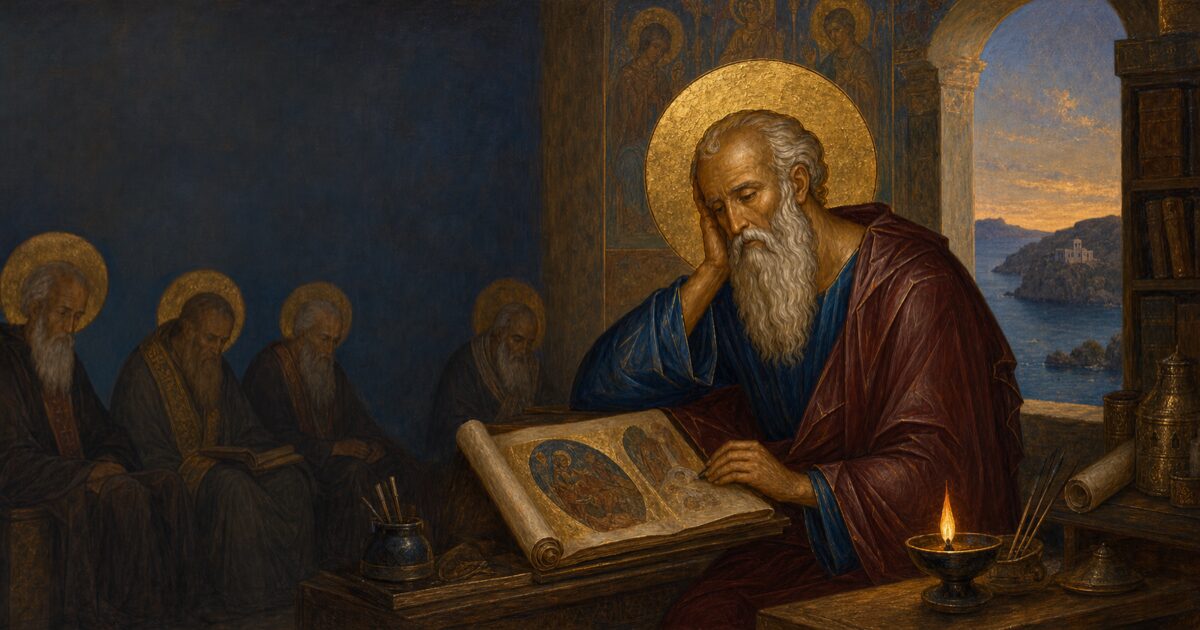
The only book of the New Testament not read at the Divine Liturgy
From the series “The Book of Revelation” — an Orthodox reading in five parts.
“Blessed is he who reads, and those who hear the words of the prophecy and keep the things written in it.” — Revelation 1:3
It is the book most talked about and least understood. More calculations and more fears have been raised around it than around any other part of Scripture: every age has read its own dread into its pages, every crisis has found there its confirmation, every improviser his material for prophecy. And yet, in the centuries when the faith of the Church was being settled, the great Greek interpreters were silent about it.
This silence is no small thing. On the contrary, it is one of the most telling silences in the history of the Church — and to understand it is the first lesson in how the book ought to be read today.
A book that is not heard
Let us begin with a simple fact that few notice: of all the books of the New Testament, Revelation is the only one that never entered the lectionary of the Byzantine tradition — that is, the fixed order of Scripture readings appointed for each service of the church year. The Epistle resounds at every Liturgy, the Gospels are read daily, the catholic epistles have their place as well. Revelation, however, is not read publicly at the Divine Liturgy. Its place in the liturgical life of the East was a different one: not rejection, but a place set apart.
This is not an oversight, but a choice. The Church did, in the end, acknowledge its place in the canon, yet it did not set it among the readings of the services. And so, for centuries, it remained the book least heard by the people — for in those days Scripture was heard in church, not read at home.
To see what this meant, we must set aside an assumption of our own age. For us, the canon is a list printed in a book on a shelf. For the early Church, the canon lived first of all in her voice: a book was received through being read publicly, through entering the prayer of the community. This is why the question “is this a book of the Church?” went together with the question “is it read in the Church?” St Cyril of Jerusalem plainly tells the catechumens to learn from the Church which books belong to Scripture, and to hold to those read in the churches — and in his list, Revelation does not appear. Its absence from the ordinary readings was not a technical detail but a pedagogy: the Church knew that not every holy book is given to everyone in the same way and at every moment.
And yet — here is a paradox to which we shall return — this liturgical silence does not make the book a stranger to the spirit of worship. Quite the opposite: few books are so filled with the image of the heavenly Liturgy. The book that is not read at the services is, in its depths, a vision of worship — history seen from the throne of God. But of this we shall speak in its proper place.
To the liturgical silence there corresponded another, just as striking: the absence of any systematic commentary. The great Greek interpreters, who left whole commentaries on nearly every book of Scripture, left us no settled, verse-by-verse exposition of Revelation. This does not mean the book went unread: some early writers cite it or explain a passage here and there, and traditions of interpretation would later be gathered by St Andrew of Caesarea. But the settled ecclesial commentary was slow in coming. The reasons were, of course, several: an uneven reception from region to region, the order of the lectionary, differing pastoral circumstances, perhaps also texts that have not survived. And yet, seen with the eyes of the Church, they gather into a single meaning: what looks on the surface like mere delay resembles, in its depths, a guarding rather than an incapacity.
First: a book received late
The first reason lies in the history of the canon. Revelation was one of the last writings of the New Testament to find a firm and universally acknowledged place, and in the East this road was harder than in the West. Nor was it the same everywhere even in the East: the Eastern traditions are several, and some — such as the Syriac — for a long time did not include it in their Scripture at all.
The witnesses are clear. The list St Cyril of Jerusalem gives the catechumens does not contain it. St Gregory the Theologian, in his verse catalogue of the inspired books, ends his list of the New Testament with the catholic epistles and does not mention it. The list handed down under the name of the Synod of Laodicea — whose sixtieth canon is, moreover, of disputed authenticity — likewise omits it. The reception was not uniform: while St Athanasius the Great places it among the received books, in his Paschal Epistle of the year 367, other voices in the East pass it over in silence.
So long as the very place of a book among the holy writings remains uncertain in many places, it is not natural for it to be interpreted systematically. The books expounded were those whose authority was already settled. A book still uncertain in the canon calls rather for caution.
Then: the wound left by chiliasm
The second reason is the decisive one, and it explains why the hesitation took on, at a certain point, an edge of suspicion.
In the third century, Revelation had become the banner of those who awaited an earthly kingdom. Reading literally the words about the thousand years (Revelation 20), some hoped for a visible reign of Christ on earth, with bodily pleasures and abundance — a hope that turned the eternal Kingdom into an age of the senses. This error is called chiliasm (from the Greek word for “a thousand”), known in the West as millenarianism. It must be said, in fairness, that not every expectation of a future fulfillment was, in the earliest centuries, an error in the full sense: some old and worthy writers held vaguer forms of this hope, which the Church clarified in time. The real danger lay in the crude, fleshly form — the one that lowered God’s promise to abundance and pleasure. In Egypt, this form found a notable defender in Nepos, bishop of Arsinoe, who devoted an entire work to it, defending the literal reading of the promises. Through his authority as a bishop, the teaching took deep root among the people.
The response came from one of the great hierarchs of the age: St Dionysius of Alexandria, a bishop of deep discernment and a careful student of the Scriptures. What troubled him was not a faulty calculation but something graver: chiliasm lowered the Christian hope itself. In place of the eternal Kingdom it set an earthly dominion; in place of things unseen, food and pleasure. It did not merely distort the meaning of one chapter — it turned hope away from heaven toward the earth.
The way he responded shows how the Church heals an error. Dionysius could have sent a written condemnation from Alexandria; instead, he went himself to the region where the teaching had spread. Eusebius relates that he gathered the priests, the teachers, and the people, and examined the matter together with them over three days. It was not an adversarial debate but a common search for the truth in Scripture. In the end, those who had held to chiliasm abandoned it of their own accord. Revelation was thus healed first within the life of the Church, before it was ever interpreted in writing — for it was not the book that was sick, but the way it was being used.
In studying the text, however, Dionysius also reached a bold conclusion: in language and style, the author of Revelation does not seem to be the same as the author of the Fourth Gospel. (The account, again, we owe to Eusebius.) Here a clarification is needed, for the point is easily misunderstood. Dionysius did not remove the book from Scripture, nor did he deny its inspiration. On the contrary: he said plainly that he did not dare to reject it, since many hold it in honor, and that its meaning might surpass his own understanding. He kept it as a holy writing; only the author did he distinguish from the Evangelist, on grounds of language. The Church did not follow this distinction: Tradition confesses to this day that St John the Theologian is the author of the book. The opinion of a single hierarch, however learned, did not unsettle the witness of the whole Church.
But the mark remained. A book whose authorship had been questioned by so respected a hierarch, and whose name had been tied to a persistent error, could no longer be approached easily. Eusebius himself, taking up Dionysius’s doubt, deepened the shadow cast over it in the Greek world. And so the book once used for error came to be kept at a distance — not rejected, but guarded from unready hands.
Here we see the tension in which it had been caught. Revelation stood between two extremes, both of them dangerous. On one side, the fever: those who used it for the dream of an earthly kingdom. On the other, the denial: some, frightened by these abuses, went so far as to deny its apostolic origin, even to ascribe it to another. The Church received neither the fever nor the denial. It did not turn the book into a calendar of earthly kingdoms, but neither did it cast it out of Scripture. It kept it — but with a guard. And this is perhaps the deepest lesson of the patristic silence: there are times when the Church defends a book not by speaking much about it, but by not letting it be spoken wrongly.
The witness of Chrysostom’s silence
Nothing shows this restraint better than the example of the greatest interpreter of Scripture in the golden age.
St John Chrysostom left the Church homilies on nearly the whole of Scripture: on Genesis, on the Psalms, on the Gospels, on every one of the Apostle Paul’s epistles, verse by verse. Nowhere, however, do we find from him an interpretation of Revelation. He who spoke of everything was silent precisely here.
We cannot put this down to ignorance or lack of time. Chrysostom was the man of Scripture par excellence. We do not know with certainty what kept him from this book: perhaps the canon he had inherited at Antioch, where Revelation did not stand in the first rank of the books read, perhaps the very restraint of which we are speaking. Whatever the reason, his silence stands beside the silence of the lectionary and shows the same measure of the Church before a book she honored as holy but knew to be easily misread.
What the silence tells us
We are used to regarding silence as a weakness, a delay waiting to be remedied. With this book, things may be seen otherwise. The historian will count several reasons here, and will be right: the slow reception, the order of the readings, the threads of tradition preserved here and there. But the believing reader may ask something else as well: might there not have been, beneath this weaving of reasons, also a wisdom? The way the Church carried the book — without rejecting it, yet without handing it hastily to unready hands — does not look like embarrassment, nor like a gap that more enlightened ages ought to fill. It looks rather like discernment.
The Church had seen with her own eyes the harm that a literal reading could do, when it had intoxicated minds with the hope of an earthly kingdom. She had seen how easily a book full of visions becomes material for error. And she chose restraint over haste: she kept it, acknowledging its place in Scripture, but held it apart from the ordinary public reading and from systematic commentary, until the hour when a voice worthy to interpret it rightly should arise.
That voice would come. Toward the end of the sixth century and the beginning of the seventh, St Andrew of Caesarea in Cappadocia — not to be confused with Caesarea in Palestine, the city of Eusebius — set down the interpretation that would become, in the East, the normative one. It was not the first Greek attempt to interpret Revelation, but it was the one that gave the book a sure ecclesial reading, guarding it from the fever of calculations and the temptation of chiliasm. And the very first thing this interpretation does is to overturn the chiliast reading — that is, the error that had caused, centuries before, the whole suspicion.
And St Andrew did not arise out of a desert. Throughout all this time there had been preserved, in the life of the Church, threads of interpretation — in writing, in oral tradition, in the very liturgical way of understanding the victory of Christ. He gathered them and wove them into a coherent reading. This is why his interpretation was not a scholarly curiosity but a settling of the Church: it did not unlock Revelation for everyone’s fancy, but bound it once more to the whole of Scripture, to the dogma of the Church, and to the hope of the Kingdom.
How did St Andrew manage to turn a book everyone feared into one that builds up? What is the key he left us, so that we might read the visions without losing ourselves in them? Of this — of the one way by which Tradition has unfolded the symbols of Revelation — we shall speak in the next part.
In Part Two: the key of St Andrew of Caesarea and the golden rule of all interpretation — how the symbols of Revelation are unfolded through Scripture, without drifting into fancy.
About this series
“The Book of Revelation” is a series in five parts, seeking to recover the Orthodox, patristic reading of the most misunderstood book of Scripture — beyond fears and beyond calculations about the end of the world.
- Why the Fathers Were Silent (the present article) — The distinct status of Revelation in the Byzantine tradition: a book received with reserve, not read at the services, and long left without commentary. What this silence means.
- The Key to Reading It — The method of St Andrew of Caesarea and the golden rule of all interpretation: the symbols are unfolded through Scripture and in the Church, not through the events of the day.
- The Lamb and the Heavenly Liturgy — The true face of the book: not a map of catastrophes, but the vision of the Lamb’s victory and of the heavenly worship.
- The Words That Remained — The famous verses of Revelation, from “the Alpha and the Omega” to the New Jerusalem, and the right way to read them — including the most misread of them all.
- Revelation Today — Why, now that anyone can read it, we need not decipherment but guidance.