
When the feast comes, we rejoice; but in fasting, and through fasting, the great things are done — and the feast is nothing other than the joy of their fruit.
Of the four great fasts of the Church year, the Apostles’ Fast is, without doubt, the least noticed. It has neither the weight of the forty days of Great Lent, nor the fixed and solemn place of the Dormition Fast, nor the charm of expectation of the Nativity Fast. It comes in summer, immediately after the joy of Pentecost, when the soul has scarcely risen from the feast of the Descent of the Holy Spirit; and its length changes from year to year. It is the only one of the great fasts with a movable beginning and a fixed end: its beginning shifts with the date of Pascha and of Pentecost — the Monday after the Sunday of All Saints — while its end remains always the same, on the eve of the feast of the Holy Apostles Peter and Paul, celebrated on the 29th of June. In years when Pascha falls late it shrinks almost to vanishing; in others it lasts a good few weeks. (In 2026 it begins on Monday, the 8th of June, and ends on the 28th of June.)
This “marginal” place in the awareness of the faithful must not, however, deceive us. The Apostles’ Fast is not a second-rate fast, but one that preserves, perhaps more clearly than any other, the very reason for which the Church fasts. It is not, in its depth, a fast of withdrawal, but a fast of sending. And this is precisely what makes it, for our age, unexpectedly timely.
“While They Ministered to the Lord, and Fasted”
To understand what we live in these days — and why we fast — we must return to the scene from which the whole missionary work of the Church was born. The Acts of the Apostles sets it in Antioch, where the disciples were first called Christians:
“Now there were in the church that was at Antioch certain prophets and teachers; as Barnabas, and Simeon that was called Niger, and Lucius of Cyrene, and Manaen, which had been brought up with Herod the tetrarch, and Saul. As they ministered to the Lord, and fasted, the Holy Ghost said, Separate me Barnabas and Saul for the work whereunto I have called them. And when they had fasted and prayed, and laid their hands on them, they sent them away.” (Acts 13:1–3)
Let us weigh it word by word. The Holy Spirit does not speak at any time and in any place, but as they ministered to the Lord, and fasted. The sending of Paul and Barnabas to preach — the act that would open to the nations the door of faith and change the face of the world — is not decided in a council of men, but in the midst of the fasting and prayer of the Church. And even after the voice of the Spirit had been heard, the work does not begin at once: the text insists — when they had fasted and prayed, they laid their hands upon them. Fasting here is not a pious background, but the very medium in which the Church hears the voice of God and receives the power to obey Him.
Here is the kernel of the whole fast we keep. The Apostles did not go out to preach by their own power, but out of a fasting and a prayer that had made them transparent to the working of the Spirit. The Apostles’ Fast calls us, year by year, to enter into the same state in which the apostolic mission was born.
The Fast at the Foundation of Every Church
The scene at Antioch does not remain a single episode. The same interweaving of fasting and prayer returns when the Apostles set in order the further life of the Church. After they had passed through the cities of Asia Minor, strengthening the souls of the disciples, we read:
“And when they had ordained them elders in every church, and had prayed with fasting, they commended them to the Lord, on whom they believed.” (Acts 14:23)
So it is not only the sending of the two to preach, but also the appointing of presbyters in every newly founded community, that is done with prayer and fasting. The priesthood — the ministry through which the Gospel was to be carried further, after the departure of the Apostles — is commended to the Lord through fasting. The whole missionary structure of the Church, from the sending of the great to the setting of ministers in every place, rests on this foundation: fasting and prayer go before and accompany every work of the Spirit.
From this it is plainly seen that the Apostles’ Fast does not set before us merely the personal ascesis of two holy men, but an inner law of the Church herself. All that is apostolic in her — that is, all that is sent, given, carried further — was born, and is born, of fasting.
The Threshold of God’s Works
This bond between fasting and the great work of God does not, however, begin with the Apostles. It runs through the whole economy of salvation, like an unbroken thread. Before receiving the Law on Sinai, Moses spends forty days and forty nights fasting before God (Exodus 34:28). Before meeting the Lord on Horeb, the prophet Elijah walks forty days, strengthened by a single meal (1 Kings 19:8). And above all, our Lord Jesus Christ Himself, before beginning His preaching, withdraws into the wilderness and fasts forty days and forty nights (Matthew 4:1–2; Luke 4:1–2).
Here is the pattern: whenever a great work of God with man is opened — a Law, a revelation, a preaching, a sending — at its threshold stands fasting. Fasting is not, in the logic of Scripture, an ascesis added from without, but the very door through which man enters into the new work of God. The Apostles, fasting at Antioch, do but enter in their turn through this door which their Master had passed through first. And through it we too are called to enter, in the Fast that bears their name.
And there is something more. The Lord Himself shows that certain spiritual struggles are not overcome otherwise than by this joining of fasting with prayer: a certain kind of evil, He says, does not go out except “by prayer and fasting” (cf. Mark 9:29). Fasting is therefore not only a preparation for a work, but also a power in the struggle. He who is sent to preach has need of both: of the threshold that cleanses him, and of the weapon that strengthens him.
Why Fasting and Prayer
It is fitting to dwell on this joining, for it is the key to the whole fast. Almost everywhere in Scripture and in all the Tradition of the Church, fasting does not appear alone, but interwoven with prayer. They ministered to the Lord, and fasted. When they had fasted and prayed. Having prayed with fasting. The two are not set side by side by chance; they require and uphold one another.
The Fathers have taught from of old that fasting without prayer remains a mere bodily regimen, and sometimes even an occasion of vainglory; only when joined with prayer does it become a spiritual work. The purpose of fasting is to empty — to thin the heaviness of the body, to still the clamour of the passions, to make room. And the purpose of prayer is to fill that emptied room with the presence of God. Fasting opens; prayer enters by the opened door. This is why the Church knows no fast that is not, in its depth, an intensifying of prayer.
This also makes clear why the Holy Spirit could speak precisely as they ministered to the Lord, and fasted. Fasting had made the disciples transparent. The bodily heaviness that ordinarily stops the inner hearing had been thinned; prayer had held the soul stretched out toward God. In this sharpening of the spiritual hearing the voice could be heard: Separate me Barnabas and Saul. The Apostles’ Fast is, before all else, a work of clearing the hearing of the heart.
A Fast of Sending, Not of Withdrawal
Here too is hidden what makes it, for us, different from the other fasts. Many of the labours of the Church year turn our gaze inward and backward: toward repentance, toward weeping for our sins, toward awaiting a feast that comes upon us. The Apostles’ Fast keeps all of this, but adds something we easily forget: it looks outward and forward — outward, toward those to whom we are sent, and forward, toward the work that God wishes to begin through us. It is the fast of those who are sent.
For not only the Apostles were sent. The whole Church is, by her very nature, apostolic — that is, sent. Every Christian received, at Baptism and at Chrismation, the seal of the Spirit that made him a sharer in the same work. Not all of us are called to preach in foreign cities; but each is set where he finds himself — in his home, at his place of work, in the midst of those whom God has appointed beside him — as one sent of Christ. The Apostles’ Fast is the time in which we remember this forgotten identity. We do not fast only for ourselves, as for a benefit closed within our own correction, but we prepare ourselves, like the Apostles, for that which God wills to send through us.
This is why this fast cannot be lived as a mere temperance at table. To reduce it to a list of permitted and forbidden foods is to lose its soul. It is a conscious entering into the state of Antioch: to minister to the Lord and to fast, until the hearing of the heart is cleared enough to hear what God asks of us and to be ready to obey Him. The question the Apostles’ Fast sets upon us is not only “from what have I abstained in these days?”, but also “for what work am I preparing? to what am I sent?”.
The Apostolate of Every Day
If this is the fast of those who are sent, then its sharpest question is not only what I have taken off my table, but what I have allowed God to set in my heart for others. For the sending — that gaze “outward and forward” — rarely begins with a long journey or with a word spoken in the sight of all. Most often it begins in the nearest and the hardest place: beside the person with whom we easily lose patience, beside the sick man we do not make time to visit, beside the child we do not trouble ourselves to teach to pray. The mission field of most of us is not a distant city, but our own home.
And here it is seen why fasting cannot be separated from sending. The apostolic man is not, first of all, the one who speaks much about Christ, but the one through whom Christ can be felt by those around him — and to become thus transparent, a man must first thin himself. Fasting is precisely the school of this thinning: we abstain from food that we may no longer be ruled by appetite, we guard our tongue that we may not wound, we cut away haste and anger that we may at last see the other. The more a man empties himself of himself, the more room there is in him for mercy; and where mercy has found room, preaching has already begun, before any word. This is the light of which the Lord speaks: “Let your light so shine before men, that they may see your good works, and glorify your Father which is in heaven” (Matthew 5:16) — a light that does not display itself, but its Giver, and which therefore flees vainglory as much as it flees fearful hiding.
So too is made clear the true measure of a fast well kept. It lies not only in our having come out of it cleaner, but in our having allowed someone beside us to feel, through us, the goodness of God: a quarrel quenched, a debt forgiven, a prayer for the one who wronged us, a good word spoken in season, a faith confessed without noise. These do not carry the clamour of Paul’s great journeys, but they carry the same Spirit who sent him. For the voice that said at Antioch, “Separate me Barnabas and Saul”, is the same that says to us, today, things far smaller and no less apostolic: go to your brother, lift up the one who has fallen, be silent when you would wound, speak when you would hide. He who obeys this voice in the days of the fast makes of them not a summer parenthesis, but the beginning of a work.
Toward the Feast of the Apostles
This whole ascent has a clear goal. The fast does not end in itself, but pours out into the feast of the Holy Apostles Peter and Paul. The two whom we named at the beginning — Paul, set apart by the Spirit at Antioch, and Peter, the coryphaeus of the Apostles — stand at the end of the fast as the fruit and the example of all we have sought in it. Peter, who denied and wept bitterly, and Paul, who persecuted the Church and was struck to the ground on the road to Damascus — both are the witness that the sending of God does not rest upon the worthiness of man, but upon the working of the Spirit in the man who has emptied himself. For this very emptying the fast prepares us.
And yet the two Apostles whom the Church celebrates together were not men of the same make, cut alike. They were one in the same Gospel and acknowledged one another’s calling — to Peter had been entrusted the preaching to the circumcised, to Paul to the nations — and they gave one another the right hand of fellowship (Galatians 2:7–9). But this did not keep them from having, once and openly, a disagreement. At Antioch, seeing that Peter, out of fear of those of the circumcision, “withdrew and separated himself” from the brethren of the nations, Paul himself testifies: “I withstood him to the face” (Galatians 2:11–12). The dispute was not about the Gospel, but about conduct: about the manner in which Jews and Gentiles are set together in one and the same Church.
How this episode is to be read, the tradition has not interpreted with a single voice: Saint John Chrysostom saw in it rather an economy — a feigned withdrawal of Peter, for the benefit of those present (the homily In faciem ei restiti, Patrologia Graeca 51, 371–388) — while Blessed Augustine, against Jerome, maintained that the confrontation was real, yet that Peter had erred in conduct, not in faith. However it be read, no one has seen here a rupture of faith. And this is precisely why the two are so fitting an example for the fast of those who are sent: one in the same sending, yet not uniform. The unity of the Church is not uniformity, but communion in the same Christ — two pillars who, setting out from opposite ends, built the same house.
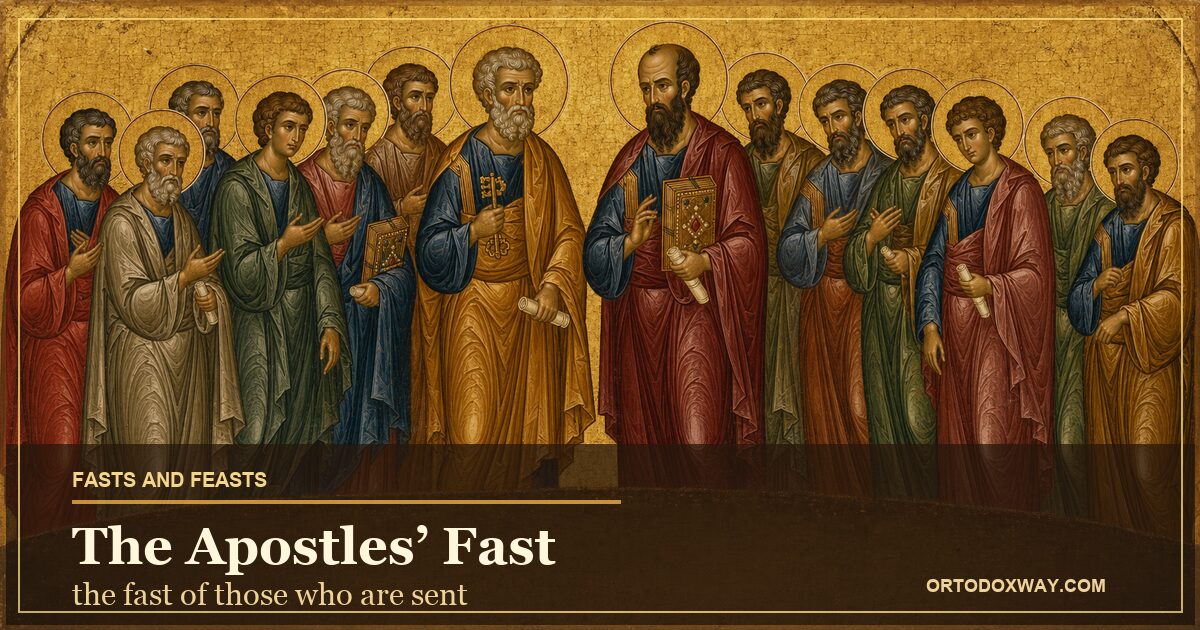
And this fast is not only the two pillars’; it is the whole apostolic company’s. Peter and Paul stand at the head as the clearest images of the same sending — Peter, the first among the Twelve, and Paul, the Apostle of the nations — but behind them stands the whole assembly of those sent. This is why, the next day, on the 30th of June, the Church celebrates the Synaxis of the Holy Twelve Apostles: the honour of the feast of Peter and Paul widens at once from the two toward the whole company of those whom Christ has sent.
As for the manner in which the fast is kept, the Church has her rules, by which the believer is guided, with the blessing and the discernment of his spiritual father, according to the strength, the age, and the health of each. But bodily ascesis, however important, is not the kernel, but only the body of the fast. Its kernel is inward: a more steadfast prayer, a clearer hearing, a heart made ready to hear the voice of the Spirit and to follow it. He who fasts only with the body keeps a fast; he who fasts with body and heart, praying, enters into the state of the Apostles.
Therefore, when we step into these days — be they few or many, according as Pascha falls each year — let us not receive them as a small ascesis, slipped in between feasts. Let us receive them as what they truly are: a call to stand, together with the first Church, ministering to the Lord and fasting, until we too shall hear, each in his place and in his work, the voice that sent the Apostles into all the world.