
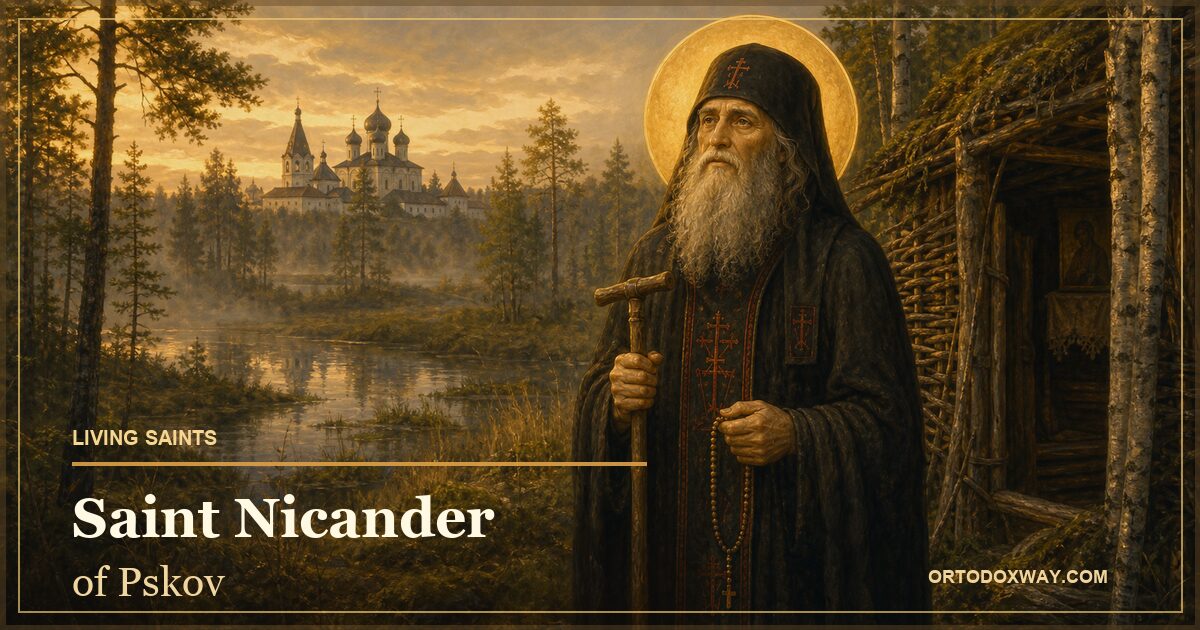
There are saints whom the Church venerates in the full light of her councils, with services composed in good time and with a feast established without hesitation. And there are others whose veneration itself passed through a kind of wilderness: through silence, through forgetfulness, even through a season of suppression, before being established once more, strengthened. Saint Nicander, the hermit of Pskov, is one of these latter. His earthly life was spent almost entirely in the perfect solitude of the forests and marshes of northern Russia; and the history of his veneration after death followed a path no less arduous, one worth examining attentively, for it teaches us something about how the Church discerns true holiness.
The Northern Wilderness, a Continuation of Egypt
For an Orthodox reader, the word “hermit” immediately calls to mind the icon of that first Egypt: Anthony the Great, Macarius, the fathers of the Desert. It is easy to regard that struggle as something bound to a particular land and a particular age, beyond the reach of later Christians. Precisely here lies the significance of the northern hermits of Russia. In the land of Pskov, in the fifteenth and sixteenth centuries, the anchoritic ideal was lived anew, in all its severity, under a different climate and a different sky — not in the burning sand, but in the cold marsh, in the dense forest, in the long winter.
The first of these hermits of Pskov was Saint Euphrosynus, founder of the Eleazar Monastery, followed by his disciple, Saint Sabbas of Krypetsk. In this lineage Nicander takes his place, as their spiritual son across the years: from childhood he longed to follow their struggle and to venerate their relics. The historian Nikolai Serebriansky, the foremost scholar of his life, called him “a remarkable ascetic, exceptional not only in the history of Pskovian monasticism but in that of Russian monasticism as a whole,” showing that he “recalled the covenants of the founders of the eremitic life and proved by his own life that even their highest demand — solitary stillness in seclusion — cannot be considered a struggle beyond the powers of a true monk.”
This is the first lesson of his life: the wilderness did not close with Egypt. Wherever there is a soul that truly seeks it, it opens again.
The Road to Solitude
Saint Nicander — Nikon by his baptismal name — was born on the 24th of July, 1507, in the village of Videlebye in the land of Pskov, some thirty-five versts from the city, into a family of peasants, Philip and Anastasia. His father died early, and the child was left in his mother’s care. His elder brother, Arsenius, had already entered the monastery; and his mother, left a widow, would later take monastic vows under the name Natalia.
From childhood Nikon came to the stone church of the village, dedicated to Saint Nicholas, and — the Life tells us — “marvelled at the church singing and reading.” The longing to read the word of God for himself drove him to a decision unusual for a peasant child: he went to Pskov and entered into service with a merchant named Philip, who placed him under a deacon to learn his letters. Having learned to read, the young man visited many monasteries, seeking a place of wilderness in which to spend his life.
He found the place together with a companion, Theodore, on a small island “in forest and in moss, between the Pskov road and the Porkhov road,” fifteen versts from the town of Porkhov. There he lived for many years, nourishing himself — according to the moving testimony of the Life — on a marsh grass that grew around his hut.
His path as a hermit was not, however, a single unbroken line. After the first long stay in the wilderness, while going once to Pskov, Nikon came to the monastery of Saint Sabbas of Krypetsk. The abbot, seeing his weakened body, was at first afraid to receive him, judging that the severity of cenobitic life would be beyond his strength. Then — the Life recounts — Nikon fell before the reliquary of Saint Sabbas and began to entreat him, as one living, to take him into his community. The abbot relented and tonsured him into monasticism, giving him the name Nicander.
He did not remain long at Krypetsk. He felt once more the call of the wilderness and returned to his solitude. There followed a second period of eremitic life, again of some fifteen years, filled with grievous trials. Then, after another return to the monastery — where he served as sacristan and afterward as cellarer — he departed yet again, living for a time three versts from the community. At last he returned definitively to his wilderness, where he was to spend the longest part of his life.
This alternation — wilderness, community, wilderness — must not be read as inconstancy. On the contrary, it shows the struggle of a soul that knows its calling toward perfect stillness, yet submits also to obedience, and returns each time to the place appointed for it by God. For when, at one point, Nikon was at Pskov, at the divine Liturgy, he heard — the Life says — a voice sending him back to the wilderness shown to him before, promising him that there he would find rest, and that after him that place would be enlarged and many would be saved upon it.
Watchfulness, Weeping, and Toil
Here lies the heart of his life and the kernel of all we can learn from him. For Nicander left behind no extensive writings, but a few words and the example of a life. And from this scantiness shines a pure hesychast teaching.
The saying preserved of him, which entered into his very iconography, is the likening of the monastic life to a field of wheat. The monastic life, he said, is like a field of wheat: it has need of the frequent rain of tears and of much toil. If you wish to bring forth abundant fruit, and not thorns, be watchful in mind and labor. Strive to be good ground, and not stony places, that what was sown from above in your heart may bring forth fruit, and may not wither from the scorching heat of sloth and negligence.
These are a few words, but in them is contained the whole inner order of ascetic struggle: watchfulness of mind (vigilance over the thoughts, that the ground may be worked), weeping (the rain of tears, without which the seed does not sprout), and steadfast toil (the labor that knows no idleness). It is the exact image of the labor that the Holy Fathers call watchfulness and guarding of the heart — the sign that Nicander, though he was an unlettered peasant who had only just learned to read, had drunk from the true source of the Philokalia through his very life.
And he lived what he spoke. The most astonishing testimony of the Life is that, in the last and longest period of his eremitic life, for fifteen years “no man saw his face.” So perfect was his hiddenness that people did not even know of him. His struggle was discovered by chance: a certain Peter Yesyukov, pursuing through the forest an elk that had come near his homestead, plunged ten versts into the woods and saw, in the moss, the prints of a human foot. Following them, he came to a small hut, surrounded by a wattle fence. After he had said the prayer three times, the hermit called him by name from within — for he had the gift of clairvoyance.
Along this path of struggle, the Life recounts many temptations and apparitions of the evil one, which Nicander overcame by the power of prayer. Twice, it is said, Saint Alexander of Svir appeared to him in a vision, strengthening him, after which — the Life says — “the saint was delivered from all the snares of the enemy.” The Life also preserves an episode of robbers who plundered his hut and beat him cruelly, two of whom, losing their way on the return through the forest, came back and gave back what they had taken, while the other two perished, drowned in the river Demyanka.
These accounts must be received as they are: as hagiographical tradition, preserved in the Life of the saint, and not as facts verified historically. We shall presently see why this distinction is, in the case of Nicander, especially significant. They remain, nonetheless, the testimony of how his contemporaries and near successors understood his struggle: as a real warfare with the powers of darkness, overcome through prayer and through grace.
And the bodily severity of this struggle was real. A year before his death, he was visited by Peter, the deacon of a monastery near Porkhov. In conversation with him, the hermit said that for three years his legs had pained him, “but now I have found relief.” When the deacon looked at his legs, he saw — the Life says — that the shins had fallen away, only the bare bone remaining. This silent, consuming struggle, borne without witness and without human consolation, is the measure of what Nicander was.
And yet — and this is of the greatest importance for understanding him rightly — his solitude was never a rupture with the Church. However deeply he hid himself in the forest, Nicander remained joined to the sacramental source of life: during Great Lent he would come from his wilderness to the Monastery of the Nativity on the Demyanka, in order to confess and to commune, and eight years before his repose he received there the Great Schema. His eremitism was not spiritual autonomy, nor the seeking of some self-standing experience outside the order of the Church, but obedience carried to the edge of the world. This is the seal of true Orthodox eremitism and the boundary that separates it from every form of proud isolation: the true anchorite flees from the world, but not from the Church; he deprives himself of all things, but not of the Holy Mysteries.
The Prophecy Fulfilled
The saint knew his end beforehand. He prophesied that he would die when enemies invaded the homeland, foretelling at the same time their approaching defeat. And so it was. In the year 1581, the army of the Polish king Stephen Báthory invaded the land of Pskov, and the city was besieged from August 1581 until February 1582. In that time of war Nicander departed this life, alone in his hut, according to the order of his whole life.
His body was found by a peasant from Borovichi, Ivan Dolgiy, who had come to ask his blessing; he found him lying on his cot, with his hands crossed upon his breast. The inhabitants of Porkhov, learning of his repose, set out to bury him, despite the fighting that raged around Pskov and Porkhov. Passing safely through the troops of Báthory, they reached the wilderness. Nicander was buried on the feast of the Protection of the Mother of God, beside his cell, beneath an oak.
The saint had given instruction, before his death, that the place of his struggle should not be abandoned, promising his protection to those who would settle there. The deacon Peter raised over the grave a church dedicated to the Annunciation of the Most Holy Mother of God. And in the year 1584, on the place sanctified by nearly half a century of prayer, a monastery was founded, which was called the Nicander Hermitage. Its first dweller and founder was the elder Isaiah, of whom the Life says that he had been healed through the prayers of the saint.
His Veneration and Its Trial
Here begins the lesser-known — and more instructive — part of the history. For the path of Nicander’s veneration was not smooth, and to trace it exactly guards us against too simple a notion of how a saint comes to be celebrated in the Church.
His veneration began at once after his repose, in a natural way, at the grave in the wilderness. The first posthumous miracle, recounted in the Life, concerns the very elder Isaiah. In due order, through the mediation of Metropolitan Nikon of Novgorod — the future patriarch of all Russia, who venerated the saint — there took place, according to the reckoning of the historian Golubinsky, a local canonization, sometime between the years 1649 and 1652. In 1652, a nobleman, Yakov Muravyov, who was childless, built in fulfillment of a vow a church in the name of Saint Nicander beside his estate, and shortly afterward a son was born to him. In the wilderness monastery itself, Nicander was venerated as a saint: at his reliquary services were celebrated, lamps were lit, icons were painted.
And yet, when things seemed to be moving toward full confirmation, an unexpected suppression came.
In the year 1687 the uncovering of the saint’s relics took place. On the 29th of June of that year, with the blessing of Patriarch Joachim, a commission composed of Bishop Leontius of Tambov, Archimandrite Euthymius of Khutyn, Abbot Herman, and the key-keeper of the Cathedral of Holy Wisdom in Novgorod examined the relics, washed them, and laid them once more, with honor, in the wall. Metropolitan Cornelius sent to Moscow the Life and the “newly composed service” of the saint, “for true knowledge and trustworthy testimony.”
What followed at the Council of Moscow, on the 7th of October, 1687, is the crux of the whole matter. After the hieromonk Karion Istomin had read the Life before the council, Patriarch Joachim did not confirm the veneration — but suppressed it. He ordered that the newly composed service be set aside, on the grounds that the monk Andronicus had composed it without hierarchical blessing; he stopped the celebration of the saint; and he directed that, in its place, memorial services for the departed be chanted — that is, services of commemoration of the reposed, and not of veneration of a saint. On the day of his repose the Annunciation was to be celebrated, with the service of all saints.
This fact is so significant that it deserves to be said plainly: at the Council of 1687, Saint Nicander was, according to the testimony of the Conciliar redaction of the Life, in fact decanonized. Yet one must distinguish with care what this meant and what it did not mean. It was not a dogmatic denial of his holiness — the Church did not decree that Nicander is not a saint, which would not even have been within her power — but an administrative and liturgical halting of the official celebration, for reasons bearing on good order: the service had been composed without hierarchical blessing, and the local cult had not yet been fully examined and approved by the greater Church. It was, in other words, an act of canonical prudence, and not a judgment upon the saint’s worth before God. The historian Golubinsky mistakenly held that the patriarch had then confirmed the local canonization; he relied, it seems, on the printed edition of the Life from 1801–1805, in which the original text concerning the examination of the relics had been substantially altered, so as to appear an approval. The older source, however, says otherwise.
How, then, did it come about that Saint Nicander is venerated once more today? The answer is as telling as the suppression itself: the patriarch’s order simply was not put into effect. Despite the official halting, the local veneration did not die out, but continued naturally within the space of the monastery, where Nicander was commemorated as a venerable one and where the recording of miracles continued. In 1697, a woman healed through the prayers of the saint, Anna Krekshina, brought to the monastery a covering and laid it upon his reliquary. True veneration, born of the spiritual fruit of the saint, thus waited patiently for the hour in which his name would be set once more, clearly, within the order of the Church.
And the restoration to the full order of the Church came not through a new and resounding act of canonization, but by the most natural path of Orthodoxy: through the inscription of his name in the Synaxes of saints. His veneration was confirmed by his entry into the Synaxis of the Saints of Novgorod — established around the year 1831 and renewed in 1981 — and into the Synaxis of the Saints of Pskov, established in 1987. Thus, more than a century after the suppression of 1687, the Church clearly recognized what had never ceased to be confessed, in living manner, at the grave of the saint.
The Sifting of Piety: The Stone Pillow
The history of Nicander’s veneration contains yet another episode worth telling, for it touches a different kind of discernment than the first. For one thing is the sifting of written sources, and another the sifting of the forms of piety that arise, in time, around a saint. Not everything that springs from the people’s love for a saint is, by the mere fact of its antiquity or its fervor, also healthy.
In the Nicander Hermitage there was preserved a stone held, according to tradition, to have been the pillow upon which the saint rested his head in sleep. In time, a custom formed around it: pilgrims would carry it upon their shoulders, going around the monastery church with it, “in honor and praise of the Venerable Nicander.” And in the Conciliar redaction of the Life itself it is recounted, as a miracle, how a man who had mocked those carrying the stone fell at once into paralysis, and was healed only after the abbot had performed the service of the blessing of waters at the grave of the saint.
In the year 1735, Archbishop Theophan Prokopovich, seeing in this practice “merely a senseless superstition,” sent the stone to the Synod for investigation. And on the 9th of April, 1736, the Synod decreed that the stone be cast into the waters of the Neva. The decree, like that of 1687, was not carried out — the stone was still preserved at the beginning of the twentieth century in the synodal archive, according to the testimony of Serebriansky.
This episode in no way diminishes the veneration of the saint. On the contrary, it illumines precisely the delicacy with which the Church distinguishes between the true veneration of a saint and the customs that, attaching themselves to it, may slide toward superstition. One thing is the holiness of Nicander, attested by relics and by fruit; another is a stone with which one circles a church. The first remains; the second may have need of cleansing. Here precisely is seen that Orthodox discernment is not enmity toward piety, but care that piety remain pure, unmixed with what might darken it.
A Lesson on the Transmission of Sources
The case of Nicander sets before us also a lesson of soberness regarding sources, which a serious Orthodox reader is bound to receive. The Life of the saint has not come down to us in a single form, but in six distinct redactions, known in fourteen manuscripts: the Pskovian redaction (the 1580s), the Monastic (early seventeenth century), the Novgorodian, the Conciliar, the Rhetorical, and the Printed (late eighteenth century). These redactions are not mere copies, but successive reworkings, which add, alter, and at times correct the text.
The scholar Serebriansky showed that all the dates of the Life, apart from the year of repose — 1581 — bear the marks of a later ordering; even the reckoning of the years of his life does not agree from one redaction to another. Moreover, the spiritual censorship of the late eighteenth century removed from the printed edition the episodes that “resembled a miracle too little,” softened the severity of certain accounts, and smoothed away what might appear doubtful. Thus arose also the mistaken notion concerning the Council of 1687, through the alteration of the text in the printed edition.
This in no way lessens the holiness of Nicander. On the contrary: it teaches us that the true foundation of the veneration of a saint lies not in the smoothness of a dossier, nor in the antiquity of a printed page, but in the spiritual fruit that crosses the ages and which the people of God perceive and confess. For the one who seeks the truth, the source most worthy of trust is the oldest and nearest to the fact — here, the Pskovian and Monastic redactions — while the later reworkings are to be weighed with attentiveness.
Conclusion
Saint Nicander of Pskov leaves us, therefore, a twofold lesson. The first, through his life: that the perfect wilderness remains possible even today, wherever there is a soul that seeks it with watchfulness, with weeping, and with steadfast toil; that an unlettered peasant, who had only just learned to read, can attain to the high measures of the Philokalia through the very labor of his heart; and that silent struggle, borne without witness and without consolation, has more worth before God than all visible splendor.
And the second, through the history of his veneration: that the recognition of a saint by the Church may itself pass through a wilderness — through silence, through suppression, even through a season of decanonization — without holiness being thereby touched. For what is truly of God is not extinguished at the command of an hour, but rises again, like the wheat from the good ground of which the hermit himself spoke, and brings forth fruit in its season.
The memory of Saint Nicander, the hermit of Pskov, is kept on the 24th of September / 7th of October (the day of his repose, according to the correspondence of the Russian calendar), and the uncovering of his relics is celebrated on the 29th of June. He is also commemorated in the Synaxis of the Saints of Pskov and in the Synaxis of the Saints of Novgorod, on the Third Sunday after Pentecost. Through his holy prayers, O Lord Jesus Christ, Son of God, have mercy upon us and save us.
A Note on the Sources
The biographical and historical data of this article are founded upon the critical article Никандр in the Orthodox Encyclopedia (Православная энциклопедия, vol. 49, 2022, pp. 376–388, by V. I. Okhotnikova and E. V. Romanenko), which represents the standard academic scholarship on the six redactions of the Life. For the historical analysis and for the episode of the stone pillow, use was made of N. I. Serebriansky, Essays on the History of Monastic Life in the Pskov Land (Moscow, 1908), and of the same author’s study on the struggle against popular superstitions (Pskov Diocesan Gazette, 1905). The critical text of the redactions is found in V. I. Okhotnikova, Pskovian Hagiography of the 14th–17th Centuries, vol. 2 (Saint Petersburg, 2007), and in the Library of Literature of Ancient Rus’, vol. 13 (2005). The data concerning the saint’s sacramental life (confession, communion, and the reception of the Great Schema at the Monastery of the Nativity on the Demyanka) are recorded in the old redactions of the Life, according to the critical edition cited. The episodes and miracles have been rendered as hagiographical tradition, according to the sources, and not as facts verified historically.