
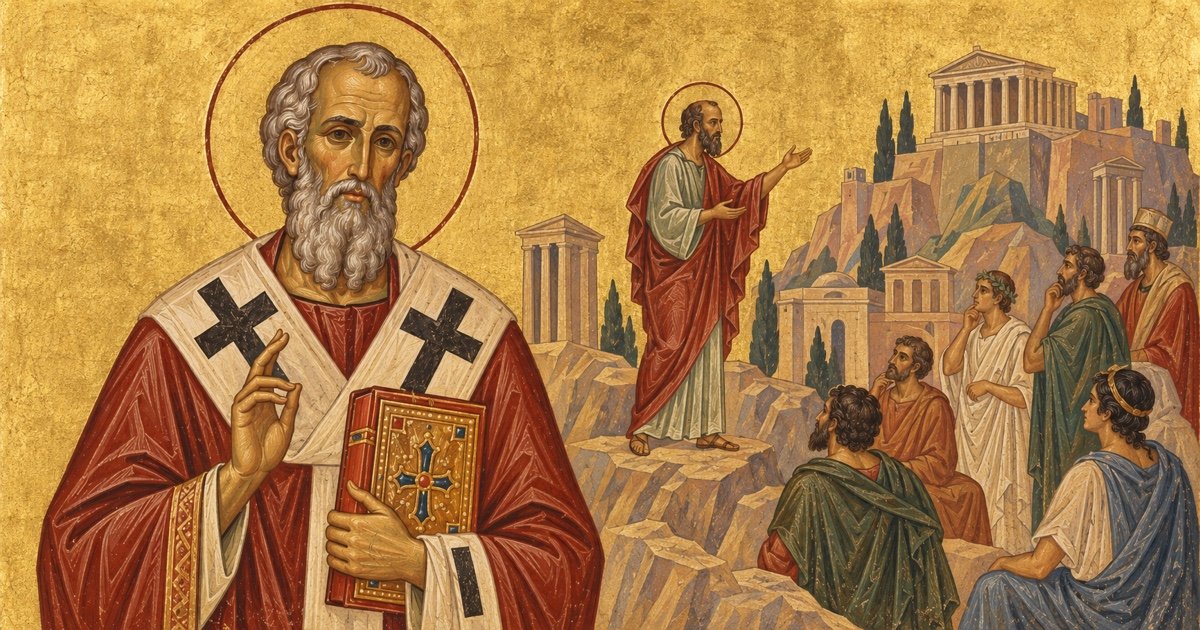
On October 3 (October 16 in the Churches that keep the Old Calendar), the Orthodox Church commemorates the Holy Hieromartyr Dionysius the Areopagite. Dionysius was a nobly born Athenian and one of the councillors of the Areopagus, the ancient court of Athens, which met on the rock named after Ares, near the Acropolis. He came to believe in Christ when he heard the preaching of the Holy Apostle Paul, and the Acts of the Apostles mention him by name. The Apostle later made him bishop of Athens. Under the name of Saint Dionysius there have come down to us writings on God, on the ranks of the angels and on the Mysteries of the Church, received and interpreted by the Holy Fathers. In his old age Dionysius suffered for Christ. The Church calls him a “hieromartyr”, the title she gives to ordained servants of the altar who laid down their lives for the faith.
The Young Man of Athens and the Darkness at the Crucifixion
The Lives of the Saints tell that Dionysius was born in Athens of pagan parents, though of a noble family. As a child he was sent to study Greek wisdom, and he advanced so far that at twenty-five he surpassed all the elder philosophers. To complete his learning he went to Egypt, to Heliopolis, a city that had long been home to renowned teachers. There, together with his friend Apollophanes, he learned from them to observe the courses of the stars.
At that time the Lord Jesus Christ suffered in Jerusalem for our salvation. The sun, say the Lives of the Saints, could not bear to see Him crucified: at noon it hid its light for three hours. Amazed, Dionysius said: “Either God, the Creator of the world, is suffering, or this visible world is coming to an end.” He spoke these words by the Spirit of God, and not according to the wisdom of this age.
The seventh Letter among those attributed to Saint Dionysius, addressed to Bishop Polycarp, tells of the same event in the first person. The author writes that he was then at Heliopolis with Apollophanes, and that both of them saw the moon pass across the sun at a time when, by the order of the heavens, this could not happen. In the service of the day the Church sings to him: “rejoice, for you beheld the Passion of the Lord”.
Returning to Athens, he married and became one of the councillors of the Areopagus, governing the city and its people with great skill and integrity.
The Apostle Paul’s Sermon on the Areopagus
Many years later the Holy Apostle Paul came to Athens. The Acts of the Apostles say that while he waited for Silas and Timothy, “his spirit was provoked within him when he saw that the city was given over to idols” (Acts 17:16). Every day he spoke in the synagogue and in the marketplace, where some philosophers of two schools of the time, the Epicureans and the Stoics, began to dispute with him. Then they brought him to the Areopagus, to learn what new teaching he was bringing.
There, standing in the midst of the Areopagus, Paul said:
“Men of Athens, I perceive that in all things you are very religious; for as I was passing through and considering the objects of your worship, I even found an altar with this inscription: TO THE UNKNOWN GOD. Therefore, the One whom you worship without knowing, Him I proclaim to you.” (Acts 17:22–23)
He then spoke to them of God, who made the world and is not far from each one of us, “for in Him we live and move and have our being” (Acts 17:28). At the end he proclaimed to them the resurrection of Christ from the dead. “And when they heard of the resurrection of the dead, some mocked, while others said, ‘We will hear you again on this matter'” (Acts 17:32). Few believed then. The Holy Evangelist Luke, who wrote the Acts of the Apostles, preserved the names of two of them: “However, some men joined him and believed, among them Dionysius the Areopagite, a woman named Damaris, and others with them” (Acts 17:34).
The Lives of the Saints say that Dionysius listened closely to the Apostle’s words and laid them up in his heart. Many wished to hear Paul a second time, and Dionysius, the wisest among them, began to speak with him. Paul asked him: “Which God do you honour?” Dionysius then showed him in the city the idols of Kronos, of Aphrodite, of Zeus and of the other gods. Walking together, they came to an altar inscribed “To the Unknown God”, and Paul asked him: “But who is the Unknown God?” Dionysius answered: “He has not yet appeared among the gods, but He will come in due time, for He is the God who will reign over heaven and earth, and His kingdom will have no end.”
Then Paul proclaimed to him that this God had come: He had been born of the most pure and ever-virgin Mary, had been nailed to the cross for the salvation of mankind, had risen from the dead and ascended into heaven. At His Passion the sun had been darkened for three hours. Dionysius remembered the darkness he had seen in Egypt and believed at once. He opened “his mind and heart to the knowledge of the unknown God, our Lord Jesus Christ”.
As Paul was leaving the city, a man blind from birth asked him to give him sight. The Apostle made the sign of the cross over his eyes, and the blind man’s eyes were opened. Paul then sent him to Dionysius, to tell him that the Apostle was waiting to baptize him. Dionysius marvelled greatly to see that the blind man had received his sight. Without delay he went to Paul together with Damaris, whom the Lives of the Saints call his wife, with his children and all his household, and they were baptized.
The service of the day sings that Dionysius left the Stoic philosophers behind, became a disciple of “the chosen vessel” and came to know “the ineffable mysteries”. The chosen vessel is Paul, of whom the Lord Himself had said: “he is a chosen vessel of Mine” (Acts 9:15).
Disciple of Paul, Bishop of Athens
After his Baptism, the Lives of the Saints say, Dionysius left his home and family and followed Paul for three years wherever the Apostle went, learning from him the mysteries of God. Then Paul made him bishop and sent him from Thessalonica to Athens, to care for the salvation of the people there.
The Church kept this memory from early times. In the second century, Dionysius, bishop of Corinth, wrote to the Athenians that the Areopagite brought to the faith by the Apostle Paul had been the first bishop of their Church. The testimony of the bishop of Corinth has come down to us through Eusebius of Caesarea, who recorded it in his Church History.
At Matins, the morning service, the Synaxarion is read, that is, a short life of the saint of the day. The Synaxarion of Saint Dionysius says that he learned the ineffable and divine mysteries also from the wise Hierotheus, another councillor of the Areopagus. The Church commemorates Saint Hierotheus on the following day, October 4. The Lives of the Saints say that Dionysius was present, with the Apostles, at the burial of the Mother of God. The Synaxarion of October 4 tells that Hierotheus then led the hymns in the assembly of the Holy Apostles.
Writings Attributed to Saint Dionysius
The tradition of the Church attributes to Saint Dionysius four treatises and ten letters. Most scholars today date their composition to the end of the fifth century or the beginning of the sixth, and call their author Pseudo-Dionysius the Areopagite. Doubts about their antiquity were already raised in the sixth century.
The reception of these writings in the Church concerns the teaching they contain, while the question of their author belongs to historical research. The Church reads them under the name of Saint Dionysius, and in the service of October 3 she still sings of him as their author. Many of the hymns of the service praise him for them.
In On the Divine Names, the names given to God in Holy Scripture, such as the Good, Light, the Beautiful, Love, Life and Wisdom, are interpreted, and it is shown that God remains beyond each of them.
In On the Celestial Hierarchy the order of the angelic ranks is described. The word “hierarchy” here means a sacred order which is at the same time knowledge and activity. Through it each creature is purified, illumined and perfected, so as to become like God and be united with Him, according to its measure. Nearness to God is not measured in space, but in sharing in His light.
In On the Ecclesiastical Hierarchy the Holy Mysteries and services of the Church are interpreted: Baptism, Holy Communion, the consecration of the Holy Chrism, the ordination of bishops, priests and deacons, monastic tonsure and the funeral service.
On Mystical Theology is the shortest of them. “Mystical” here means “hidden”, belonging to the mysteries. It shows how the purified mind draws near to God, beyond every word.
In the service of the day the Church sings to him: “Having made your mind equal in honour with the angels through the practice of virtue, Father Dionysius, you set down in books their good order, which is above the world, O all-wise one; and after it you set in order the assemblies of the Church, following the heavenly orders.”
The Venerable Cleopa of Sihăstria, one of the great Romanian spiritual fathers of the last century, said in a sermon on the feast of the Holy Archangels:
“Of all the Holy Fathers, the one who speaks best about the angels is Saint Dionysius the Areopagite, the disciple of the Holy Apostle Paul. He says that the angels are divided into nine ranks, each with its own name and mission. The angelic ranks are divided into three hierarchies, or groups: the highest hierarchy, closest to the Most Holy Trinity, is made up of the Seraphim, the Cherubim and the Thrones. […] The middle hierarchy is made up of the Dominions, the Powers and the Authorities […]. The lowest hierarchy is made up of the Principalities, the Archangels and the Angels.”
More than a thousand years earlier, Saint John of Damascus had kept the same order in his Exact Exposition of the Orthodox Faith. There he shows that this is how Saint Dionysius the Areopagite divided the angelic ranks, and he calls him most holy and a great theologian.
Saint Maximus the Confessor explained some difficult passages in the writings of Saint Dionysius. He also wrote, following the book On the Ecclesiastical Hierarchy, an interpretation of the Divine Liturgy called the Mystagogy, that is, “guidance into the mysteries”. In the fourteenth century a great controversy arose over the hesychasts, monks who labour in stillness with the Jesus Prayer. At that time the writings of Saint Dionysius were cited as witness by both sides, and Saint Gregory Palamas, the defender of the hesychasts, relied on them.
Knowing the Unknown
On Mystical Theology opens with a prayer in which the Holy Trinity is asked to guide us to the highest summit of the mystical words of Scripture. After this prayer, Saint Dionysius interprets the ascent of Moses on Mount Sinai. Moses first purified himself and separated himself from the impure. Then he heard the trumpets, saw many lights and went up, with the chosen priests, to the summit of the mountain. Even there he did not see God, but the place where He stood. Only after this, writes Saint Dionysius, Moses “is set free both from the things seen and from those who see, and plunges into the darkness of unknowing, the truly mystical darkness […]; and, knowing nothing, he knows beyond mind” (On Mystical Theology I, 3).
The “unknowing” of which Saint Dionysius speaks is not ignorance. By this word he shows that God does not fit into the human mind like a thing it can grasp. The purified man is united with Him beyond mind, after passing beyond everything he can think and say about Him. This union is a gift which man receives by the grace of God; a mere emptying of the mind cannot bring it about. What God has revealed about Himself remains true even then.
In Letter V, addressed to the deacon Dorotheus, Saint Dionysius writes that “the Divine gloom is the unapproachable light in which God is said to dwell”. This light remains invisible, he writes, because of its surpassing brightness. He took the words “unapproachable light” from the Apostle Paul, who writes of God that He is “dwelling in unapproachable light” (1 Timothy 6:16).
In the second chapter of On Mystical Theology, Saint Dionysius uses the image of the sculptor. One who carves a statue removes from the stone everything that covers the form hidden within, and by removal alone brings the hidden beauty to light. In the same way, one who praises God lays aside, step by step, everything that is lower than He, in order to see Him who is above all.
In one of the hymns of Vespers, the evening service, the Church praises the saint for this knowledge: “invisibly you beheld, O blessed one, the invisible God, and by unknowing you came to know the Unknown”.
On the altar in Athens was written “To the Unknown God”. In the service of Saint Dionysius the Church names God with the same word: “the Unknown”. The writings that bear the name of the Athenian brought to faith by Paul speak of how man comes to know the One who remains beyond all knowledge.
In the hymns of the day, not knowing has two meanings. The kontakion, a short hymn of the saint’s service, says that he enlightened “those who sat in the darkness of ignorance”, that is, the pagans who did not know God. The hymn of Vespers praises him because he himself came to know God “by unknowing”, that is, in a way that surpasses the mind. From the first darkness Dionysius came out through faith, when he heard Paul. The second darkness is the one into which Moses entered on Sinai.
The Vision of Saint Carpus
Of the books of Saint Dionysius, which the Synaxarion calls “wonderful and most lofty”, a single episode is read in the service of the day. It is told in Letter VIII, addressed to a monk named Demophilus. The monk had driven away a sinner who had come in repentance and had insulted the priest who received him, and the letter rebukes him for this. The vision of Carpus shows him where zeal can lead once it is separated from the mercy of Christ.
The author of the letter tells that he had been a guest in Crete of Saint Carpus, a man so pure of mind that he would not celebrate the Divine Liturgy until a divine vision had first appeared to him. One day an unbeliever deceived a Christian and separated him from the Church. Carpus was filled with anger and bitterness, as had never happened to him before. At midnight, when he usually rose for prayer, he asked God to strike them both with lightning.
Suddenly he saw the house shaken and split in two, from the roof to the middle. Heaven was open, and above stood Jesus, surrounded by a countless multitude of angels. Below, the earth had cracked and a deep, dark abyss gaped open, and the two men stood on its edge, trembling. Serpents came up out of the depths, coiling around their feet and trying to drag them in. Carpus looked only downward, paying no heed to the things above, and was angry that the two had not yet fallen.
When he raised his eyes again, he saw Jesus, who had taken pity on the two. The Lord rose from His throne above the heavens, came down to them and stretched out His hand, while the angels helped Him hold them. Then He said to Carpus:
“Strike Me, then, for I am ready to suffer many times for the people who are drawing near to salvation, and I rejoice in it, if only others do not sin. So consider whether it would be good for you to exchange life with God and with the good angels, the lovers of mankind, for a dwelling in the abyss with the serpents.”
By the words “ready to suffer many times”, Christ shows how greatly He loves those who are being saved. His sacrifice on the Cross was offered once, as the Apostle writes: “we have been sanctified through the offering of the body of Jesus Christ once for all” (Hebrews 10:10).
In the same writings that speak of the angelic ranks, this image of Christ has also been preserved. The Lord rises from the throne of glory to keep from the abyss those on whom His servant was calling down lightning.
The Martyrdom
The account of the martyrdom in Paris given by the Synaxarion and the Lives of the Saints follows the tradition which holds Dionysius the Areopagite and Saint Dionysius of Paris to be one and the same person. Most historians today distinguish them and place the martyrdom of Saint Dionysius of Paris in the third century.
After many years as shepherd of the Church in Athens, Saint Dionysius desired to preach the Gospel in other lands as well and to suffer for the name of Christ, as his teacher, the Apostle Paul, had suffered. He left another bishop in his place and went to Rome, where the bishop of the city, Saint Clement, received him with joy. Clement sent him to Gaul, where France is today, together with the presbyter Rusticus, the deacon Eleutherius and other brethren. There Dionysius became the apostle of that land and turned to God a great multitude of people who worshipped idols. In Paris he built a church from the alms of the faithful.
When the emperor Domitian began the second persecution of the Christians, Dionysius was very old and worn out by the preaching of the Gospel. Bound with ropes, he was dragged together with Rusticus and Eleutherius before the governor sent by the emperor to Gaul. The governor angrily asked him whether he was the wicked old man who blasphemed the gods and overturned their worship. The saint answered: “Though I have now grown old in body, as you see, my faith blossoms like youth, and my confession will always bring forth new children for Jesus Christ.”
They were beaten without mercy. Dionysius endured the blows and gave thanks to Christ for granting him to bear wounds on his body. The next day he was stretched out on an iron bed with a fire lit beneath it. Then they gave him to the wild beasts, but God shut their mouths. They also threw him into a great fire, from which he came out unharmed.
In prison, where many of the faithful came to him, he celebrated the Divine Liturgy and gave them communion of the Body and Blood of Christ. The Lives of the Saints say that while he served, the faithful saw a great light above him. Those who were worthy beheld the King of glory with the angelic hosts, as far as their bodily eyes could take it in.
Condemned to death, the three were led out of the city to the mountain which this account calls “the mountain of Ares”. The rock of the Areopagus in Athens also bore the name of Ares. On the way, Dionysius prayed: “O God, my God, who created me and taught me Your eternal wisdom, who revealed Your mysteries to me and were with me wherever I went, I thank You for all that You have done through me, to the glory of Your holy name, and because You have visited my weary old age […]”. When he had said “Amen”, he bowed his head beneath a blunt axe, for the most holy name of Jesus Christ. The holy Rusticus and Eleutherius also laid down their heads beneath the sword for Christ.
Then the martyr’s body rose by the power of God, took its head in its hands and walked with it a good part of the way, while those who saw it looked on in amazement. It did not stop until it met a devout woman named Catulla, into whose hands it placed the head “as a treasure”. Many unbelievers, seeing the miracle, believed in Christ.
The Synaxarion of the day in the Romanian Menaion opens with two verses about this miracle: “Your head is cut off, and a great wonder: for, lifting it up, you run, Dionysius.”
The bodies of the martyrs were thrown out to be eaten by wild beasts and birds. Some of the faithful took them and kept them hidden until the murderers had gone. Then the blessed Catulla laid them in a house, on October 3. The Lives of the Saints place his martyrdom in the year 96 after the Birth of Christ, in the ninetieth year of his life. At his tomb many miracles took place, to the glory of God.
“Rejoice, Universal Father”
The kontakion of Saint Dionysius praises him thus:
“As a disciple of the apostle caught up to the third heaven, / you spiritually entered the gate of heaven, Dionysius. / You were enriched with understanding of ineffable mysteries / and enlightened those who sat in the darkness of ignorance. / Therefore we cry to you: Rejoice, universal Father!”
The Apostle named in the kontakion is Paul. He writes of himself, as of “a man in Christ”, that he was caught up to the third heaven, where he “heard inexpressible words” (2 Corinthians 12:2–4).
The same Apostle wrote to the Corinthians that “Greeks seek after wisdom”, and to those of them who were called he preached “Christ the power of God and the wisdom of God” (1 Corinthians 1:22–24). Dionysius sought wisdom in the schools of the philosophers, and found Christ in the preaching of Paul, on the rock of Ares.
The troparion is the short hymn of the saint heard at Vespers, at Matins and at the Divine Liturgy. In the troparion of Saint Dionysius, Paul is called the “chosen Vessel”. The word “continence” in this translation renders the Greek nephon: the watchfulness of a mind that keeps guard and does not let itself be carried off by thoughts. With this troparion we call upon him in prayer:
“Having learned goodness and maintaining continence in all things, / you were arrayed with a good conscience as befits a priest. / From the chosen Vessel you drew ineffable mysteries; / you kept the faith, and finished a course equal to His. / Bishop martyr Dionysius, entreat Christ God that our souls may be saved.”
Note. The quotation from On Mystical Theology I, 3 is our own translation from the Greek, following the critical edition of Günter Heil and Adolf Martin Ritter (Corpus Dionysiacum II, Berlin–New York, 1991). The quotation from Letter V follows John Parker’s English translation (1897). Scripture is quoted from the New King James Version; the troparion and kontakion in the translation of the Orthodox Church in America. The other hymns, the Synaxarion, the Lives of the Saints and the words of Saint Cleopa are translated from Romanian.
Image: AI-assisted Byzantine-style illustration created for OrtodoxWay.