
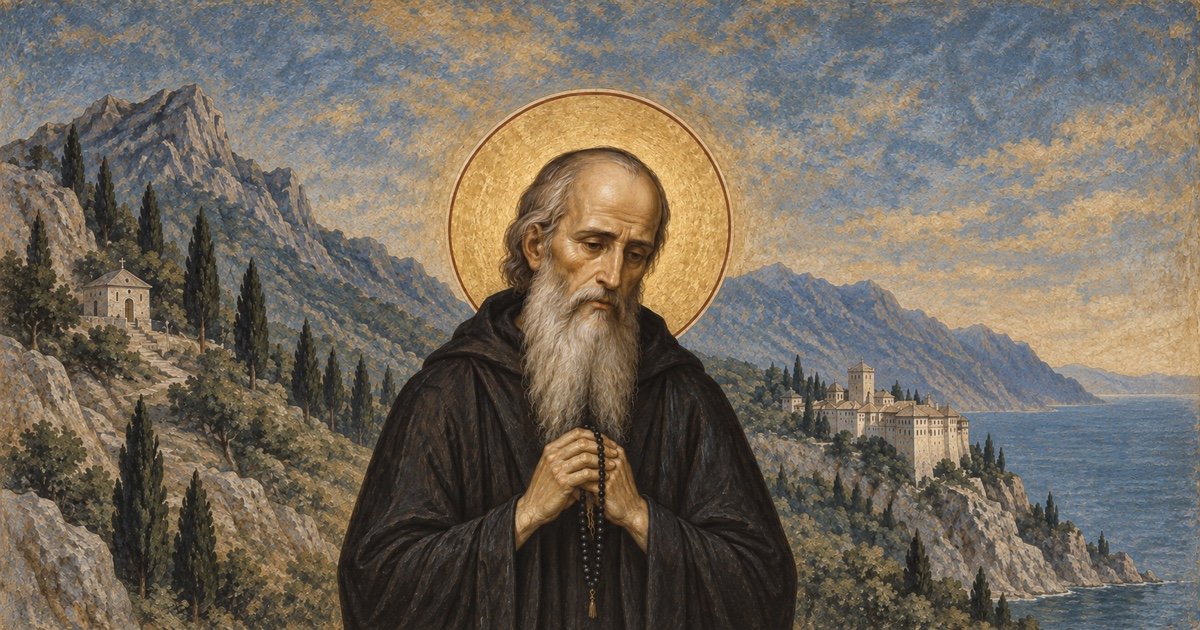
On 24 September, which is 11 September in the Old Calendar, the Orthodox Church commemorates our Venerable Father Silouan the Athonite, a Russian peasant who lived as a monk on Mount Athos for forty-six years and reposed in the Lord in 1938. He had very little schooling. What he lived in prayer he wrote down in his own hand in a few simple notebooks, and his disciple, Saint Sophrony, gathered them after his death and gave them to the world.
In these notes Saint Silouan keeps returning to three things that belong together: the weeping of the man who has lost God, love for enemies, and prayer for all people.
The Peasant from Tambov
His name in the world was Simeon Ivanovich Antonov. He was born in 1866 in the village of Shovskoye, in the province of Tambov, into a family of devout peasants. His father could not read, but he was a gentle and humble man, and Simeon would later say of him, as a monk: “I have not attained to my father’s measure.”
In his youth he lived for a time like the other young men of the village, far from any thought of God. He was awakened by the voice of the Mother of God, which he heard one night in his sleep. From that moment he began to repent, and he thanked the Mother of God for this call until the end of his life.
After his military service, in the autumn of 1892, he went to Mount Athos and entered the Russian Monastery of the Holy Great Martyr Panteleimon, where nearly two thousand monks were living at the time. His first obedience was at the monastery mill. Beside the mill stood a small church of the Holy Prophet Elijah. There, at Vespers, after six months of hard struggle with evil thoughts, he saw the living Christ in the place of His icon. Grace then filled his whole soul and his whole body. Grace is the uncreated energy of God, through which God Himself cleanses and sanctifies man.
Yet the sense of grace did not remain with him as he had first received it. Fifteen years followed in which God visited him and then withdrew from him, and in the times of withdrawal his soul was tormented by thoughts and came close to despair. God had not ceased to love him and uphold him, even when Silouan no longer felt the consolation of His presence. The service of the feast says that he was forsaken “by economy”, that is, by the providential care of God, so that he would seek grace “even more thirstily”. So he came to know from his own life what it means to taste the presence of God and to be left without its consolation.
The Word Received after Fifteen Years
One night, fifteen years after Christ first appeared to him, Saint Silouan was once more struggling with the evil spirits and had come close to despair. He prayed fervently and heard in his heart the voice of the Lord: “The proud always suffer thus from demons.” The saint then asked: “Lord, teach me what I must do that my soul may become humble.” The answer came, again in his heart: “Keep thy mind in hell, and despair not.”
Saint Silouan understood that the root of his suffering was pride. From then on he counted himself worthy of hell, yet he did not fall into despair, because he knew how greatly God loved him. This word was given to him after fifteen years of ascetic struggle, and whoever wishes to practise it needs the guidance of a spiritual father. He himself writes how this word worked in his struggle with thoughts:
“And by this the enemies are overcome; but when my mind comes out of the fire, the thoughts gain strength again.”
From then on grace no longer forsook him as before, and the Holy Spirit gave him once again the power to love. The man who counted himself worthy of hell could no longer wish hell on anyone. From this humility grew his weeping for Adam, his love for enemies and his prayer for the whole world.
Adam’s Lament
Saint Silouan’s best-known writing, Adam’s Lament, was born of the pain of the years in which he was left without the consolation of grace. In it Saint Silouan gives voice to the grief of Adam driven out of paradise:
“Adam, the father of all mankind, knew in paradise the sweetness of the love of God, and therefore, when he was driven out of paradise for his sin and lost the love of God, he suffered bitterly and wept with great groaning over the whole wilderness. His soul was tormented by one thought: ‘I have grieved the God I love.’ He did not grieve so much for paradise and its beauty as for having lost the love of God, which insatiably, every moment, draws the soul to God.”
Adam weeps here for Someone, and the paradise he has lost is for him the love of God, which he no longer feels. Saint Silouan knew this weeping from his own life:
“So every soul that has known God by the Holy Spirit, but afterwards has lost grace, suffers the torment of Adam.”
Then Adam passes through a grief heavier still than the loss of paradise:
“Great was Adam’s grief after his expulsion from paradise, but when he saw his son Abel killed by his brother Cain, his grief became greater still, and he was tormented in soul, and wept, and thought: ‘Peoples will come forth from me and multiply, and all will suffer and live in enmity and kill one another.’ And this grief of his was great as the sea, and only he can understand it whose soul has known the Lord and how greatly He loves us.”
Here Adam’s weeping turns of itself towards his children. Both Abel and Cain are his sons. The peoples who will kill one another will all be born of him. Whoever has known God can no longer look upon anyone as a stranger, because in every person he sees a son of the same Adam.
That is why Saint Silouan, after weeping with Adam for the grace he has lost, asks God for love itself:
“I too have lost grace, and with Adam I cry: ‘Be merciful unto me, O Lord. Grant me a spirit of humility and love.'”
Adam’s weeping is found in the service of the feast as well. At Matins it is sung:
“Taking upon thyself the lament of fallen Adam, O Father, thou didst cast off corruption and put on the image of Christ; with it make us also worthy to be clothed by thy prayers, O Silouan, beholder of God.”
The Sign That Grace Is at Work in Man
For Saint Silouan, love for enemies shows whether a man has truly come to know God:
“But he who will not love his enemies cannot know the Lord and the sweetness of the Holy Spirit. The Holy Spirit teaches us to love our enemies so that the soul pities them as its own children.”
Fasting and prayer are the path of the monk, but without this love they do not bring peace to the soul:
“If a man prays much and fasts, but has no love for his enemies, he cannot have peace of soul.”
Saint Silouan also knew the temptation of believers who wish destruction upon those who do harm to the Church:
“There are people who wish their enemies, or the enemies of the Church, destruction and torment in the fire of hell. They think this way because they have not learned the love of God from the Holy Spirit, for whoever has learned it will shed tears for the whole world.”
Saint Sophrony preserved a conversation Saint Silouan had with a hermit of the Holy Mountain. The hermit told him that God would punish the godless. Saint Silouan asked him what he himself would feel in paradise:
“God will punish all the godless. They will burn in eternal fire.”
“Tell me, please: if they put you in paradise, and from there you saw someone burning in the fire of hell, would you be at peace?”
“What can be done? It is their own fault.”
“Love cannot bear this. We must pray for all.”
Saint Silouan did not deny the judgement of God. He rebuked the calm with which a man can look upon the perdition of his neighbour.
The same thought is found in his notes. Saint Silouan imagines a man who says of another that he is a criminal and should burn in hell. He asks him whether, standing in paradise, he would feel no pity for the one he sees burning. Then he adds:
“Or is your heart made of iron? But in paradise iron is not needed. There humility is needed, and the love of Christ, which pities all.”
Saint Silouan knew that this love is not acquired all at once, and he did not ask of the weak what they could not bear:
“He who has been taught love by the Holy Spirit grieves all his life for the people who are not being saved, and sheds many tears for them, and the grace of God gives him strength to love his enemies. If you do not have love, then at least do not revile or curse them; and that will already be better.”
The power to love one’s enemies comes from God. What remains for man is to restrain his tongue and to ask for this love in prayer, and Saint Silouan promises him peace:
“If we accustom ourselves to pray diligently for our enemies and to love them, peace will always dwell in our souls.”
Prayer for the Whole Adam
From Adam’s weeping and from love for enemies grew Saint Silouan’s prayer for the whole world. People were not for him a crowd of strangers. He saw them as sons of the same Adam, united by the same human nature, and he prayed for them as for himself. That is why his prayer is called prayer for “the whole Adam”, that is, for all mankind, the living and the departed.
In his notes this prayer turns again and again to God with the same request:
“Merciful Lord, by Thy Holy Spirit teach us to love our enemies and to pray for them with tears.”
“Merciful Lord, by the riches of Thy mercy save all peoples.”
The service of the feast says that Saint Silouan laboured at his prayer “unto blood, O Venerable One, as a lament for the whole creation, but above all for the departed”.
Saint Silouan writes that the Lord gives the soul different things at different times:
“The merciful Lord sometimes gives the soul rest in God, and sometimes an aching of the heart for the whole world, that all people may repent and enter paradise.”
Prayer for the whole world did not take him away from the one person beside him. For anyone who prays for someone dear, his word brings great consolation:
“When the Lord wishes to have mercy on someone, He puts into others the desire to pray for him, and helps them in this prayer.”
A mother who has prayed for years for a child who has drifted away from the Church can find here encouragement not to lose hope. God loves her child and can work through her prayer.
The Repose of Saint Silouan
Saint Silouan departed to the Lord after an illness of eight days, clear in mind and immersed in prayer. He reposed in the night of 24 September 1938, between one and two o’clock, while Matins was being sung in the infirmary chapel. The monks lying near him heard nothing.
His prayer for all peoples has entered the service which the Church sings to him on his feast:
“Give to the peoples Thy saving knowledge; give to the peoples Thy love which is beyond words, that, finding it, we may all glorify Thee with one voice for ever, Thee our Creator, O Lover of mankind, who hast made us worthy to be fashioned after Thine image.”
Troparion of Saint Silouan, Tone 3:
“Thou wast given to the whole world, O thrice-blessed one, as a preacher of the love of Christ, the most tender among the theologians, for thou didst behold the Humble and Meek One and didst come to know His heart. Therefore, as we are all enlightened by thy God-inspired words, O Silouan, we glorify the Spirit who glorified thee.”
Through his holy prayers, O Lord Jesus Christ, have mercy on us and save us. Amen.
Image: AI-assisted illustration created for OrtodoxWay, inspired by Byzantine frescoes.