
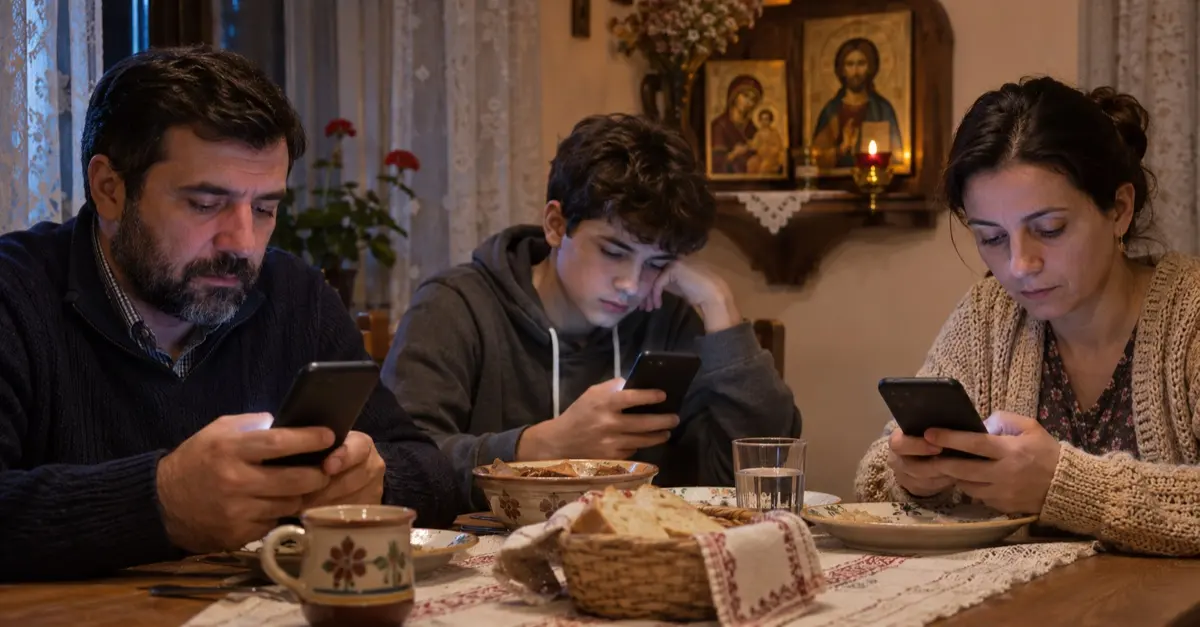
Anyone who has sat at a family table or on a café terrace in recent years has seen the same sight: people seated side by side, each with eyes bowed over the screen of a phone. Children are given a tablet before they have learned to read. In the evening, in many homes, the light of the television takes the place of conversation. Many realise that they have fallen into phone addiction, yet they do not understand why they can no longer let the phone out of their hand.
Those who study this habit often speak of dopamine, a substance by which nerve cells pass signals to one another and which plays a part in motivation and learning. Every new message and every new image urges a person to search again, and he returns to the screen again and again. The explanation has its share of truth, yet it leaves unexplained what exactly man is seeking so persistently. Beneath this unceasing summons works an older thirst, the thirst to know. The screen sets before man, effortlessly and without end, the whole world: places, events, faces, opinions, the lives and feelings of others.
This thirst to know the world without passing through Him who made it has a long history. It begins in Paradise, at the tree of the knowledge of good and evil, and reaches all the way to the phone in our pocket.
In this article
The Gaze at the Forbidden Tree
Scripture describes the moment of the fall through what the woman saw. The fruit of the tree seemed to her good for food, “pleasant to the eyes, and a tree desirable to make one wise” (Genesis 3:6). Three things draw Eve: food, beauty and knowledge. The eye opens the way, and the desire to know carries it to the end.
The fruit was not evil in itself, for God had planted nothing evil in the garden. The fault lay in the way the first human beings took it: against the commandment of God, with the thought of becoming like Him without Him. St Cleopa of Sihăstria, one of the great spiritual fathers of the last century, taught, following St Maximus the Confessor, that Adam fell from several causes at once: from pride, because he wished to be like his Maker; from greed; from disobedience; and from the deceit of the devil.
Adam had not been forbidden to know creation. God brought all the living creatures before him to see what he would call them, and Adam gave them names (Genesis 2:19–20). What was forbidden him was only the knowledge taken by himself, which he desired apart from God. St Theophilus of Antioch says that the tree was good, but Adam was still an infant in mind and could not then receive that knowledge as was fitting. St Gregory the Theologian regarded it as good food for those who had reached maturity, which man would have received at the time God appointed.
The holy Apostle John counts among the things that are in the world and do not come from the Father “the lust of the eyes” (1 John 2:16). The holy Apostle Paul describes the road that begins here, among people who knew the world but no longer gave glory to Him who made it: they “worshiped and served the creature rather than the Creator” (Romans 1:25). This is, at its core, the bite from the fruit. Man stops at the creature and no longer rises to the Creator. The world fills his hands and his mind, and he remembers God less and less often.
The Crafts of Cain’s Line
After the murder of Abel, Scripture says that Cain “went out from the presence of the Lord” (Genesis 4:16) and built a city, which he named after his son, Enoch. In his line, for the first time in Scripture, crafts appear. Jabal is the father of those who dwell in tents and keep livestock. His brother Jubal is the father of all those who play the harp and flute. Tubal-Cain was an instructor of every craftsman in bronze and iron (Genesis 4:17–22).
Scripture does not condemn these crafts. It shows, however, where they were born first: in the line of the one who had departed from the presence of God. In the same chapter, of the descendants of Seth, the other son of Adam, Scripture says that then “men began to call on the name of the Lord” (Genesis 4:26). One line was building cities, forging metals and playing instruments, while the other was calling on the name of God.
St John Chrysostom, in his Twenty-Second Homily on Genesis, takes the “sons of God” of the sixth chapter to be the descendants of Seth and Enosh, and the “daughters of men” to be the women of Cain’s line. Scripture says that the sons of God saw that the daughters of men were beautiful and took wives for themselves from among them (Genesis 6:2). St John shows that the fault was not the eye’s, which was made to look upon creatures and to praise their Maker, but the will’s, which let desire run without a bridle. The line that called on the name of the Lord let itself be drawn by what it saw, and the good name of their fathers no longer protected those who had grown slack in obeying God. After this, Scripture speaks of the corruption of mankind and of the flood.
The saints understood this lesson. From the first Christian centuries the monastics left the cities and went into the desert, to turn their minds from things seen to Him who is unseen. Abba Arsenius the Great (abba, “father”, was the name given to the elders of the desert) had lived at the emperor’s court, among the choicest things of the world. There he received the call to flee from men, and after withdrawing into the desert, the counsel to keep silence and be still. He and those like him set aside the investigation of the world in order to give their whole life to prayer. They kept the work of their hands as an ascesis, for food and for almsgiving, and gave their minds to God.
When a Passion Takes the Place of God
What happened in Cain’s line happens today in the life of every man. When someone is wholly seized by a thing, that thing fills his mind and takes his heart. The composer spends his life composing, and every day is ordered around his music. The scientist measures creation with astonishing patience, knows the structure of the cell or the course of the stars, and may pass through his whole life without seeking Him who ordered them.
Their gift is real, and their labour is honest. But when the passion takes up the whole heart, it occupies the place which God asked for Himself when He commanded us to love Him “with all your heart, with all your soul, and with all your mind” (Matthew 22:37). The heart is not easily divided. What we love most comes to govern our thoughts, and God remains somewhere at the edge.
The Lord also spoke of the eye, through which enters man what he loves. He called it the lamp of the body and said: “If therefore your eye is good, your whole body will be full of light” (Matthew 6:22). St John Chrysostom understands by this eye the mind, which is darkened when it becomes a slave to riches and to the things of this world. The good eye is the mind that looks at the world without becoming its slave.
The Whole World within Everyone’s Reach
Man has been drawn to creation since the beginning of history, and the screen did not give birth to this attraction. But it has made it easier, more frequent and nearer at hand than it has ever been.
Once, to know something of the secrets of the world, one had to be an exceptional man. One needed books, schooling, travel, a teacher and above all the desire to learn, which few had. Most people knew their village, their field, their family and their church. Today the phone opens a door for everyone, according to his measure. The child finds games and cartoons, the simple man finds stories and jokes, the learned man finds courses and research. The deciphering of creation, which was once the work of a few, has come within reach of anyone and at any hour.
The screen brings the world without delay. There is no need to wait for the letter, the newspaper or the meeting. The mind receives something new every moment and grows used to never being without food.
A great part of what people watch on the screen is other people: what they have done, where they have been, what they have eaten, what has made them glad and what has hurt them. This too is a study of creation, for man is the creature who interests man most. The lives of others, with their feelings and all, have become a spectacle without end.
From this the picture at the table and on the terrace becomes clear. The person beside us asks for patience, listening and love, and conversation with him goes slowly and often repeats itself. The screen asks for nothing and always offers something else. The mind, left to itself, chooses what feeds it fastest, and the neighbour becomes less interesting than an image from far away.
The logo of one of the largest makers of phones and computers is a bitten apple. Scripture does not say what kind of fruit it was in Paradise, and the apple is a later notion of popular tradition. The graphic designer who drew the logo in 1977, Rob Janoff, has said that he added the bite only so that the apple would not be mistaken for a cherry, and he considered the other interpretations legends. The company’s first logo, from 1976, drawn by Ron Wayne, one of its founders, showed Isaac Newton under a tree, with an apple about to fall. Whatever the designer’s intention, the sign suits the thing it accompanies: the device that places the knowledge of the world within man’s reach carries a bitten fruit on its back. It is not a proof, but a sign that a Christian can read.
The Comfort of the Mind
The screen is also a form of comfort, and comfort has its share in this bondage. Bodily comfort has spared man much toil: machines wash, cook, carry and count in his place. The screen adds the comfort of the mind. Knowledge comes without being sought, company comes without leaving the house, and boredom is dispelled by the touch of a finger.
St Paisios the Athonite often spoke of the conveniences of our time. Speaking to monks, he said that God has ordained that people should find no rest in these things, and that if worldly progress torments the laity, it torments the monk all the more. He also said that today, with so many conveniences, time is gained, yet people have no time for prayer. His word proves true of the screen more than of any other tool: the phone saves a few minutes on each task and then swallows them all, together with the evening hours.
In the same place St Paisios spoke also of the television. He said that “the world has been greatly harmed because of the television”, and that children above all are corrupted by it. Then he linked the screen with Paradise. The first-formed, Adam and Eve, had the gift of far-seeing, that is, the power of seeing far with the eyes of the soul, and this gift was lost after the fall. The television is the work of man’s hands, but there is also a spiritual television: when the old man dies in us, the eyes of the soul are cleansed, and man sees far without apparatus.
A body pampered by comforts and a mind unceasingly fed together make a man who can no longer stay still. Yet stillness is precisely the place where God speaks to man. The saints chose of their own free will to go without comfort, that the mind might not be scattered and the heart might stay awake.
An Education Turned Towards Creation
Modern man comes unprepared to the knowledge of God, because almost no one raises him towards it. From his earliest years, parents and school direct his mind towards creation: towards language and numbers, nature and history, the trade he will practise. About God he is spoken to rarely and in passing, as of a thing that will not be asked for at any examination.
In the Orthodox countries that passed through communism, this emptiness was dug deliberately. In Romania, the communist state removed religion from schools in 1948 and built in its place an atheist teaching. Priests and monastics were watched, arrested and imprisoned, and the Securitate, the regime’s political police, opened files of surveillance even on St Cleopa and Fr Arsenie Papacioc. Most people learned to keep their faith away from the eyes of others. Two generations grew up hearing at school about God only as a relic of the past, which science was supposed to have left behind.
After 1989 the religion class returned to the Romanian school, mostly through the insistence of the Church. In many schools, however, it has become the least regarded hour. It happens that it is given up to other subjects, to preparation for academic olympiads or to the sports class, and the pupils quickly learn what place the grown-ups give it.
The fruits can be seen on Sunday. Almost a quarter of Romanians say in surveys that they go to church once a week (INSCOP, 2025). In the article “Câți ortodocși mai merg, de fapt, la Biserică?” (“How Many Orthodox Still Go to Church, Really?”) I proposed, however, on the basis of counts made in several cities, a much lower estimate: only about three per cent of the Orthodox there are at the Liturgy on an ordinary Sunday. If this percentage holds for children too, then in a class of thirty pupils a single child would be in church on Sunday, although all the others have had years of religion class at school.
Many of the saints had, in this respect, a great gift: they grew up in believing families. St Basil the Great learned the faith from his grandmother, St Macrina the Elder, and from his mother, St Emmelia, and in the same house three more saints grew up: St Macrina, St Gregory of Nyssa and St Peter of Sebaste. St John Chrysostom was brought up by his mother, Anthusa, left a widow when young. St Cleopa’s mother, Ana, later entered monastic life herself, at Agapia Veche, with the name Agafia. What these children received at home helped them later to stand against the world, with its attractions, inventions and pleasures, and to desire God all their lives.
This desire made them different from those around them. They left the things after which others were running and struggled for what the others did not even notice, so that they were often misunderstood, and sometimes mocked and despised. The fools for Christ accepted this contempt willingly.
God called, however, those who had not had this preparation. The Holy Great Martyr Barbara grew up in the house of a pagan father. Looking at the beauty of the world from the tower in which her father had shut her, she understood that all things must have one Maker, and she sought Him until she found Christ. For her, creation was a ladder to God, not a wall between her and Him.
What Others Have Said About Screens
This change has also been noticed by those who look at it from outside the Church.
Marshall McLuhan, a Canadian scholar of communications media, wrote in 1964 that “the medium is the message”. He meant that a means of communication changes man by the way it works: it changes his rhythm of life, his habits and his ties with others, whatever the things it transmits.
Neil Postman, an American professor, wrote in 1985, long before today’s phones, a book about television entitled Amusing Ourselves to Death. He showed that television turns everything into spectacle: the news, politics, teaching and even religion come to be judged by how well they entertain the viewer.
Jonathan Haidt, an American psychologist, argues in his book The Anxious Generation (2024), with many arguments, that in the years 2010–2015 childhood moved from play in the real world to the phone in the hand, and that from this comes a part of the rise in anxiety and depression among the young. The causal link he proposes has been disputed by other researchers, but his rules have been welcomed by many families and schools: no smartphone for children before high school, no social media before the age of sixteen, phone-free schools, and more freedom and play in the real world for children.
Among Orthodox theologians, Jean-Claude Larchet, known for his studies on the diseases of the soul in the Holy Fathers, wrote in 2016 the book Malades des nouveaux médias (“Sick with the New Media”), published in English as The New Media Epidemic and in Romanian as Captivi în Internet (“Captives in the Internet”; Sophia Publishing House). He examines the effects of the new media on the body, soul, mind and spiritual life. He shows how the bonds between people come apart, how the virtual world covers over the real one and how the life of prayer grows poor, and the book ends with a chapter on protection and healing.
These authors, setting out from different places, reach the same conclusion: the screen changes the man who uses it. The Church shows, besides this, what man is seeking in the screen and where the true food of his seeking is found.
Must Nothing Interest Us Any More?
The question arises naturally. If at the tree of knowledge the desire to know was torn away from God, should the Christian no longer be interested in anything and create nothing?
The Holy Fathers do not count creation a trap. St Cleopa, following St Basil the Great, taught that “all creation is a school of rational souls”. Looking with understanding at creatures, the mind rises to Him who made them as through a mirror, and the love of God grows. For this looking St Cleopa referred to the book of St Nikodemos the Hagiorite on keeping the five senses. The knowledge of creation becomes a bite from the forbidden fruit only when it stops at creation and no longer rises higher.
Nor did the saints think that the work of hands and mind was evil in itself. The same crafts which first appeared in Cain’s line later served the house of God. God says of Bezalel that He filled him “with the Spirit of God, in wisdom, in understanding, in knowledge” (Exodus 31:3). Eve had wanted to take knowledge on her own, from the forbidden fruit. To Bezalel, skill and knowledge are given as a gift from God, to work gold, silver, bronze, precious stones and wood for the tabernacle of meeting (Exodus 31:1–7); that is, he receives them in obedience and puts them at the service of the house of God. The craft was the same, but it had been turned towards God.
The Church has also hymns composed by saints. St Romanos the Melodist wrote kontakia, that is, hymns of praise which the Church has sung for many centuries, and St John of Damascus had a leading part in composing the hymns of the Octoechos, the book of hymns in the eight tones. Iconographers painted, monks copied books, builders raised churches. All these works sprang from prayer and returned to God as praise.
Fr Arsenie Papacioc, one of the most sought-after spiritual fathers of the last century, learned sculpture in his youth at a school of arts and crafts, and after entering monastic life worked for a time as a sculptor at the Biblical Institute. This craft did not prevent him from becoming, through prisons and long years of struggle, the spiritual father of many thousands of people.
St Luke of Crimea loved painting and had a gift for it. He set it aside and chose medicine, that he might serve people. He became a famous surgeon and wrote Essays on Purulent Surgery (1934), a work from which generations of doctors have learned. In 1946 he received the Stalin Prize for his medical contributions and gave the greater part of the money to help children orphaned in the war. In the same period he was an archbishop and suffered long years of prison and exile for the faith.
The saints did not, however, accept everything that men have made. When they approached knowledge or a craft, they took from it only what could be joined to the knowledge of God, and set aside the rest as unsuitable. St Basil the Great advised the young to read the writings of the pagans as the bee works, which takes from the flowers only what it needs for honey and leaves the rest. The same discernment is seen in every field.
In Orthodox worship, singing is by tradition vocal, and psaltic chant keeps the form inherited from Byzantium: the human voice praising God without instruments. Instruments first appeared in Cain’s line too, where Jubal is named the father of all who play the harp and flute. In the Old Testament people also sang with instruments, but the Church has set them aside. St John Chrysostom, expounding Psalm 41 (42 in the Hebrew numbering), said that man no longer needs strings and other instruments of song, since he can himself become an instrument: when he subdues the passions of the body, mind and body sing together to God.
Church painting is the icon. It does not copy the body as the eye sees it, but shows man illumined by grace, as he will be in the Kingdom of God. This is why the icon differs both from painting that renders the world exactly as it is and from that which breaks the human face into abstract forms. The Council in Trullo, held at Constantinople in 691–692, whose canons the Orthodox Church keeps, forbade in canon 100 pictures that attract the eye and corrupt the mind by kindling passions, because the senses of the body readily carry into the soul whatever they receive.
Knowledge of the world, with the saints, begins from God and returns to Him. St Basil the Great, in his first homily on the Six Days of Creation, spoke of the learned men of his time who measured the distances of the stars and knew their courses, but had not found the most important thing: that God is the Maker of the world and the just Judge of the deeds of men. This is why the knowledge of the saints does not accept the explanations which remove God from the making of the world, even when they present themselves as science.
The saints also guarded themselves against the spectacles of their time. In the year 399, St John Chrysostom rebuked the faithful of Constantinople who, on a Friday, had left the service and the fast to run to the hippodrome, and the next day had gone to the theatre. He showed them that the soul keeps what the eyes receive: after the show is over, the faces, words and songs remain in the mind, wound the spectator and go home with him. The hippodrome and the theatre of that day fit today into every phone.
The measure lies not, then, in whether man creates or does not create. It lies in the place he gives to his work and in the nature of the work itself. When the work is born of prayer and serves God and men, it remains in order. When it takes the place of God in the heart, it becomes an idol, however beautiful.
Why, then, does the world seem to create more where God is forgotten? He who gives his whole mind to creation gathers fruits in creation: machines, discoveries, works. The saint gives his mind to God, and his fruits are of another kind. His greatest work is his own purified heart, a man transformed by grace, who cannot be placed in a museum or entered in a statistic. The Lord told His disciples to seek first the kingdom of God and His righteousness, and the things needed for life would be added to them (Matthew 6:33). When the work of the saints can be seen, it bears this fruit: their hymns have been sung for centuries, and their words still direct people towards salvation today.
How to Live with the Screen in the House
Dependence on the phone, the tablet and the computer is today almost impossible to break completely. Work, school, the bank and even contact with loved ones all pass through them. Few people manage not to give their children tablets or phones, to use a phone without a screen and to live without a television. Even these usually turn their thirst for knowledge towards another corner of creation: books, crafts, travel, nature. They have not wholly escaped the bite, but they have escaped its most obsessive form, and this is a real gain.
The Church does not ask the mind to remain empty. She asks it to turn back. The holy Apostle Paul left for this a short rule: “I will not be brought under the power of any” (1 Corinthians 6:12). The eye that bent towards the forbidden fruit can be directed again towards God, and the psalmist has left us words for this petition: “Turn away my eyes from looking at worthless things” (Psalm 118:37; 119:37 in the Hebrew numbering).
The first step concerns the children. The family is the first school of the knowledge of God, and the religion class cannot do alone what has not begun at home. The later a child receives the phone and the tablet, the more time his mind has to learn play, stillness, looking into another’s eyes, and prayer. The rules proposed by Haidt can be a support for parents who feel alone in this decision, especially when they agree with other families to do the same. To mothers who asked him how to keep their children from the television, St Paisios answered that they should make them understand that it spoils their minds, and speak to them of that other television, that of the pure soul, which is kept by those who guard the grace of Baptism.
The second step concerns the home. The place of honour in a Christian house is the icon corner, and the television ought not to take its place. At table, phones can be set aside, that the table may remain a place of prayer and conversation.
The third step concerns the order of the day. Morning prayer can come before the first look at the phone, and evening prayer after the last. On Sundays, on feast days and in the fasts, the screen can be fasted from as food is, with measure and with the counsel of the spiritual father.
The fourth step has to do with the moment when the hand reaches for the phone without knowing why. There the Jesus Prayer can make room for itself, the short prayer which the hesychasts, that is, the monks who seek the stillness of the heart in unceasing prayer, have said for centuries: “Lord Jesus Christ, Son of God, have mercy on me, a sinner.” A few moments of prayer show a man whether he truly needs the screen or is only fleeing from stillness.
When we must use the screen, we can use it as a tool: with a purpose known beforehand, for the time that is needed, and then put it down. The question “what am I looking for now?” shortens many wasted hours.
And when the screen shows us something beautiful from creation, a mountain, a bird or someone’s good deed, we can do what the saints did with every beauty and give glory to God. Then the knowledge of creation becomes thanksgiving, and the gaze rises from the creature to the Creator.
All these rules have their meaning only if they make room for the meeting with Christ. The mind truly turns back through repentance and confession, through prayer, through Holy Communion and the life of the Church, through love shown to the neighbour beside us.
The thirst that keeps man bent over the screen is, in its depths, the thirst for God gone astray on the road. The human mind was made to know without end, and only He who is without end can satisfy it, however many new images are set before it. The eyes that once bent towards the fruit in Paradise can be lifted again to Him who planted the garden, and there they find the rest which the screen promises them without being able to give.
Scripture taken from the New King James Version®. Copyright © 1982 by Thomas Nelson. Used by permission. All rights reserved. The quotations from St Cleopa of Sihăstria and St Paisios the Athonite are translated from the Romanian editions (Lumina și faptele credinței, Doxologia, Iași, 2013; Cuvinte duhovnicești, vol. I, Evanghelismos, Bucharest, 2003); the rest of the patristic material is given in paraphrase.
