
Featured image: The Nativity of the Theotokos, a 1547 fresco at Dionysiou Monastery, Mount Athos. Painter: Tzortzis Phouka. Source: Wikimedia Commons, public domain.
On 8 September the Church keeps the feast of the Nativity of our Most Holy Lady the Theotokos. It is the first great feast of the church year, which begins on 1 September. We commemorate the saints, as a rule, on the day they died, because that is the day they were born into the true life. Three births in the flesh does the Church celebrate: that of the Lord, that of Saint John the Forerunner, and this one.
The Gospels say nothing about the coming into the world of the Virgin. What we know has been kept for us by Tradition. The writing that tells this birth at length is called the Protevangelium of James and was composed about the middle of the second century. The Church did not number it among the books of Scripture. She did receive from it those things which entered the service of the day and the synaxarion, the reading about the life of the saint appointed at matins, and from there the names of the Virgin’s parents have come down to us.
The troparion, the hymn that gathers up the feast and is repeated many times on its day, runs thus:
Your nativity, O Virgin Theotokos, has proclaimed joy to the whole world, for from you has dawned the Sun of Righteousness, Christ our God. He has loosed the curse and given blessing; He has destroyed death and granted us life eternal.
Joachim and Anna
Joachim and Anna grew old without children. In Israel the lack of offspring was taken, in the eyes of men, as a sign that God had turned His face away, and so the two of them bore this reproach for years on end. The synaxarion says that Joachim was rich and a lover of God, and that he brought to the Temple gifts twice those of the others, yet was still despised because he had no child.
The service of the feast keeps the most concrete detail of those years. Joachim went up into the mountain and prayed there, while Anna stayed in the garden and endured the mockery. Both prayed, each from his own place. The Protevangelium tells that Anna was given word that her prayer had been heard, and that the angel brought the same word to Joachim.
Saint Photios dwells on precisely what seemed to stand in the way, their old age. Adam was fashioned from the dust, without natural birth. Eve sprang from Adam’s side, and not by bodily union. Both these beginnings were worked outside the laws of nature. Can grace not renew nature in Anna also, the same grace by which natural things were made? Can the Creator not warm and water what has grown old? Divine grace does not obey nature; it is nature’s master.
Mary was conceived of the union of Joachim with Anna, as all men are. The wonder lies in the loosing of barrenness, and not in the manner of her conceiving. She belongs wholly to our race, and salvation she receives from her Son.
Saint Andrew of Crete sets Anna beside Sarah, who bore Isaac in her old age: He who opened Sarah’s womb then has now given to faithful Anna the fruit of birth from a barren womb. And another hymn of the day marks Anna out from all the other barren women to whom God gave children: by His will other blessed barren women also brought forth, but Mary shone above all who have been born.
Anna’s Joy
The Protevangelium tells that at nine months Anna gave birth, and asked the midwife what she had brought into the world. The midwife told her she had borne a daughter. Then Anna said that her soul had been magnified on that day, and she laid the child in the cradle. When the days of purification were fulfilled, Anna nursed the child and called her name Mary.
The kontakion of the feast, the hymn at matins that gathers the meaning of the day into a few lines, binds this joy to a far older release. Joachim and Anna were set free from the reproach of childlessness, and Adam and Eve from the corruption of death. Its refrain returns four times in the service: the barren woman gives birth to the Theotokos, the nourisher of our life.
This is why the hymns of the day keep turning toward women without children and speak to them directly: grieve no more, you who are barren, and take comfort, you who bear no fruit. Saint Andrew of Crete calls them to the dance: let the barren and the mothers dance, let those who bear no children take heart and leap for joy, because she who was childless and barren has brought forth the Theotokos, who was to heal Eve of her pains and Adam of his curse.
A Name Destined for Glory
The name of Joachim has been understood as “the Lord lifts up,” and Anna means “grace.” To the daughter’s name Christian tradition has given many readings. She has been called the Lady and the Mistress, the Hope, the Enlightened One, the Star of the Seas, She who surpasses all. Some have given it the sense of “bitter sea,” a rendering that runs into difficulties in Hebrew grammar. All of these come from the interpretation of the Fathers, and not from the study of the language.
Saint John of Damascus chooses “Lady.” Grace, for so the name Anna is interpreted, brought into the world the Mistress, for this is what the name Mary means. And she has indeed become Mistress of all creation, since she was counted worthy to be the Mother of the Creator.
The First Steps
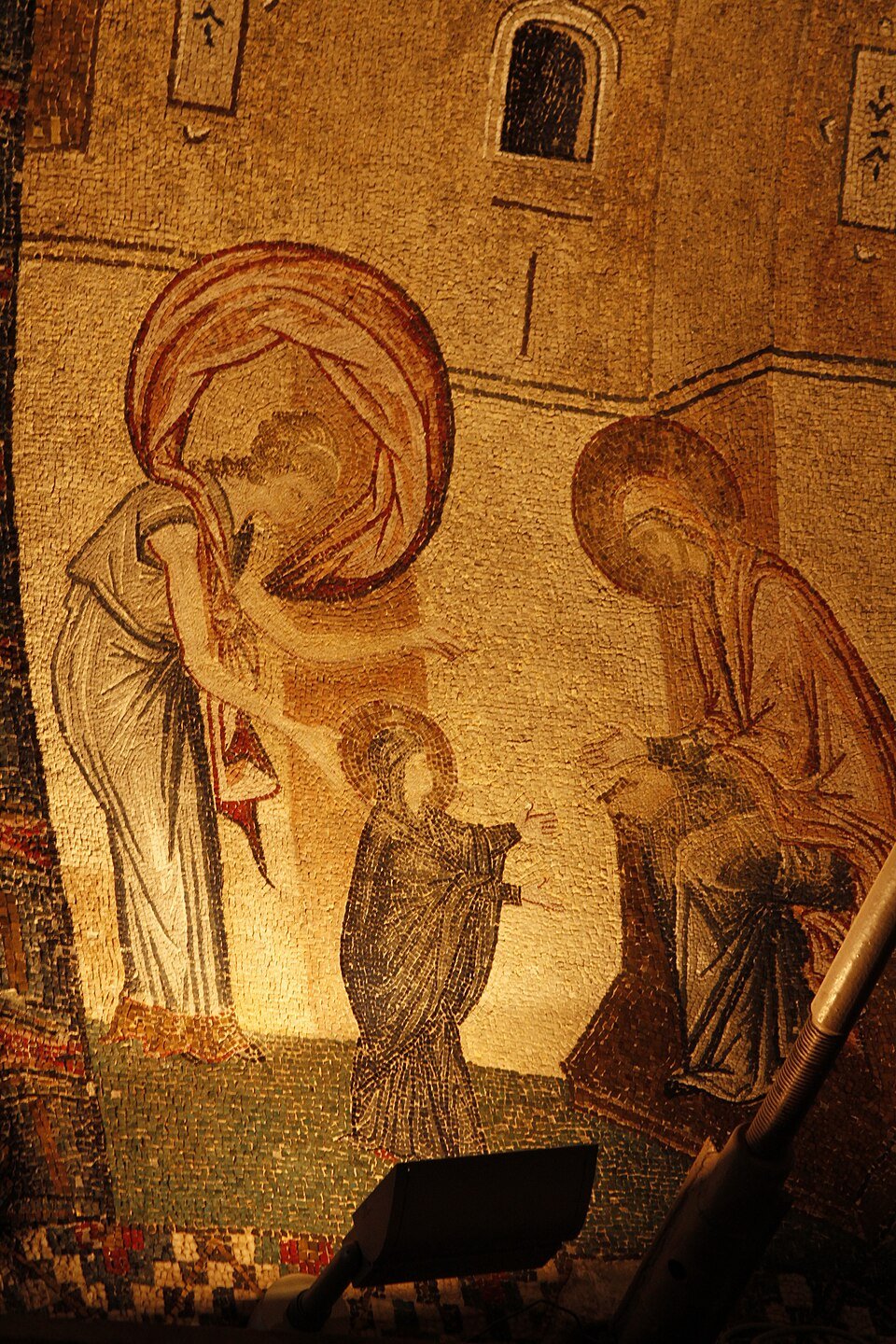
The Protevangelium tells that when Mary was six months old, Anna set her on the ground to see whether she could stand. The child took seven steps and returned to her mother’s arms. Anna lifted her up then and swore that she would not let her walk upon the earth again until she brought her into the Temple of the Lord.
The same writing says that Anna made of the child’s room a place guarded from everything counted unclean, and called undefiled daughters of the Hebrews, who took care of her.
The Feast at One Year
When the Virgin completed a year, Joachim made a feast and called the priests, the scribes, the elders and all the people of Israel. Saint Romanos the Melodist sings that Israel rejoiced on hearing that Anna had given birth, and that when Joachim had gathered the priests and the Levites for prayer, he set Mary in their midst, so that all might glorify her.
The priests blessed her and asked God to give her a name renowned for ever among all the generations of the earth. And all the people answered: “So be it. Amen.” Joachim then brought her before the high priests, and they asked the Most High to look down upon the child and to bless her with a blessing that should remain for ever.
A child of one year receives the blessing of the priests before the whole people. This account brings her later calling to light already in her infancy.
After the feast, says the same writing, Anna took her in her arms, carried her into the bedchamber to nurse her, and began to sing. Her song asks for nothing; it only marvels. God has looked upon her and has taken away from her the reproach of her enemies. He has given her the fruit of His righteousness, which is like no other. And at the last the song becomes a cry: who will tell the sons of Reuben that Anna is nursing a child? Let the twelve tribes of Israel hear that Anna is nursing a child.
She then laid Mary in the little bed in the chamber and went out to see to her guests. When the feasting was over, they all went home glorifying the God of Israel.
A sticheron of the feast, one of the short hymns sung between the verses of the psalms, puts this joy on the lips of the two old people and carries it back as far as Paradise: this is the voice of Joachim and Anna, who keep festival in secret and say: rejoice together with us, Adam and Eve, for to us, who had Paradise locked against us through the breaking of the commandment, a glorious fruit has been given, Mary, who opens the entrance to us all.
Patriarch Germanos of Constantinople puts an end to Joachim’s reproach as well: from now on the offerings of Joachim shall no longer be turned back, for the weeping of Anna has been changed into joy.
The Images That Foretold Her
The Church reads in the Old Testament images through which she was foretold, and the hymns of the feast gather them into one place.
She is the spring of life flowing from the hard rock, life come out of a womb that bore no fruit. She is the bush from which God spoke to Moses, which received within itself the Fire without matter and was not burned. Saint John of Damascus adds the mountain from which the stone was cut without hands, the ladder which Jacob saw, and the gate through which Christ passed. Another hymn calls her the gate facing east, which awaits the entrance of the Great Priest.
Saint Sergios the Hagiopolite, that is, of the Holy City, gathers them all into a single call: come, you faithful, let us run to the Virgin, the chamber of virginity, the rod of Aaron that blossomed from the root of Jesse, the preaching of the prophets, the offspring of the righteous Joachim and Anna.
And to David it had been sworn that of the fruit of his body one would sit upon his throne. The hymn at matins calls him by name and asks him what was sworn to him, so that he himself may say that the oath has been fulfilled on this very day.
Jacob’s Ladder
At great vespers of the feast it is read how Jacob saw in a dream a ladder set upon the earth and reaching to heaven, with the angels going up and coming down upon it, and the Lord standing at its top. The same reading is appointed at the Annunciation and at the Dormition of the Mother of God.
Saint Photios says what it was that Jacob saw: the ladder leading up to heaven, by which earthly nature passes beyond its own limits and comes to dwell in the Kingdom of heaven.
The Word of the Fathers
Saint Andrew of Crete addresses her directly: Bride of the Father, most pure Mother of the Son, holy and shining temple of the Holy Spirit, purest of all creatures and most fitted for that last purpose for which the world was made. Through your nativity, he says, the eternal will of the Creator has been fulfilled.
What was that last purpose? That we should be united to God and sanctified. Saint Ambrose of Milan says it in a single sentence: had He not willed to redeem man, there would have been no reason for Him to be born.
The same Saint Andrew calls this day the beginning of all holy days, and the door of goodness and of truth.
Saint John of Damascus sets the two annunciations side by side. Eve was told that in pain she would bring forth children, while to this one it is said: “Rejoice, you who are full of grace.” Eve was told that she would be drawn toward her husband, while to this one it is said: “The Lord is with you.” Saint Stephen the Hagiopolite puts words into the mouth of Eve herself: salvation has been born to me, through whom I shall be set free from the bonds of hell.
Saint Gregory Palamas looks further back still. The prophecies had foretold her, and the wonders of old had prefigured this wonder. She is, he says, the end, or rather the beginning and the root of so many works of God. She is the fruitful promise given to Joachim and Anna, who had remained childless from their youth so as to bear in old age the one of whom would be born, without seed, He who was born without years from the Father. In another homily he goes further and says that the whole of God-inspired Scripture was written for her. This word is understood in the light of the fulfilment of Scripture in the Word incarnate of her.
Saint Photios sets this feast before all the others, in words of festal praise, because without it none of them would have appeared. He calls it root, spring and foundation, says that it overshadows all the other feasts in beauty, and that it has been known as the day of salvation for all.
Israel was awaiting the Messiah. The prophets had spoken of her, yet many of that people did not know that their waiting hung upon the birth of a virgin of their own race, who was to bear without a father the incarnate Son of God, the Only-begotten of the Father without a mother.
Saint Neophytos the Recluse of Cyprus, sometimes called the Chrysostom of Cyprus, calls her the first fruit of our salvation and the first fruit of the renewal of our nature, which had grown old and dark through the breaking of the commandment.
Saint Joseph the Hymnographer says that the spiritual Bridegroom found her alone, like a lily among thorns and like a flower of the valleys.
Saint Romanos the Melodist binds Anna’s prayer to the prayer of that other Anna, the mother of the prophet Samuel, whom Eli had taken for a drunken woman in the Temple. That one was heard, and gave the Lord a prophet. This one was heard, and gave the world the Theotokos. Saint Andrew of Crete puts the words on her lips: You have heard my prayer, O Lord, giving me this day the fruit of the promise, her who was chosen before all generations. And Anna herself cries out, in another hymn: barren though I was, I have given birth to the Theotokos, through whom the condemnation of Eve is undone.
Joachim’s joy is given a voice as well. The barren woman feeds the infant Mary with milk, and he rejoices at her birth and says: a rod has been born to me, from which has blossomed the flower Christ, out of the root of David.
Why a Mother Was Needed
In his homily for this feast, Saint Photios begins from Paradise. God gave man the joy of Paradise and dominion over everything that was there. He then saw fit that the one who had received such power should be trained and taught by a commandment. Man broke the commandment. Yet the Creator did not overlook His creatures even after that fall. It was needful that one of the Persons of the Holy Trinity should become man, so that it might be seen that the remaking was His own work, as the making had been.
And the Incarnation requires a mother. A mother had therefore to be prepared who would give birth to the Creator, for the remaking from the foundations of the whole of human nature. She had to be a virgin, because, as the first man was taken from earth untouched by the plough, so the remaking was fitly to pass through a virgin womb.
Who was worthy of this? She who was born on that day, in an unaccustomed manner, of Joachim and Anna, from a barren root. It was needful that she who from the cradle kept her body clean, her soul clean and her thoughts clean should be shown to be the Mother of the Creator. It was needful that she who was brought as a little child to the Temple and trod where none had trodden should be shown a living temple for Him who gave her life. It was needful that she who took away the reproach of her parents should set right also the fault of our first parents, because she gave flesh to Him who saved our race.
From that day, says the same Saint Photios, the throne of the Lord has been prepared upon earth. Earthly things have been sanctified. The hosts of heaven join themselves to us. And the deceiver, who had beguiled us long ago and had stood against us, has been crushed, and his designs scattered.
All this the Church sees in the light of what was to follow. The Nativity of the Virgin is kept for the sake of the Incarnation, the Cross and the Resurrection of her Son, and in the beginning the fulfilment is already seen.
Patriarch Germanos says the same thing in a hymn: through the foretelling of the angel there has come forth today a most honoured fruit of the righteous Joachim and Anna, a heaven and a divine throne and a dwelling of purity, who proclaims joy to the whole world and undoes the curse.
Where She Was Born
Tradition has not kept a single answer. Some testimonies point to Nazareth, where her parents had a house. Others point to Jerusalem, to the place beside the Sheep Gate, close to the Temple. This second is upheld by Saint Sophronios, patriarch of Jerusalem, and after him by Saint John of Damascus, who bows before the place itself: the Mother of God was born for us at the holy Sheep Gate. Rejoice, Sheep Gate, most holy dwelling of the Mother of God. Rejoice, Sheep Gate, the sheepfold wall of Joachim.
A reconciling of the two has also been proposed: Joachim, a man of substance, may have had a dwelling both in Judaea and in Galilee. This remains a supposition, which no ancient testimony supports.
From there comes also the oldest trace of the feast. Hymns for 8 September are found in the Jerusalem chantbook compiled about the middle of the sixth century, and Saint Romanos the Melodist bears witness to the feast about the year 550. The earliest liturgical commemoration is bound to the dedication of a church raised on that spot, beside the pool of Bethesda. The building that stands there today, called the Church of Saint Anne, was put up by the crusaders in the twelfth century on the site of the older one. It is very possible that the choice of 8 September and the spread of the feast depend on that first church and on the memory of its dedication.
It is sometimes said that the date was settled between the years 431 and 451, or that the church was built by Saint Helena. Neither of these two statements is sufficiently documented. The testimonies that can be examined today point to sixth-century Palestine and to the house beside the Sheep Gate.
Christians have also seen a spiritual meaning in this day. The number eight has long been the sign of the age to come, of the day that follows the seven of this world. The eighth day of the first month thus carries, in its very number, the news that the world has been taken up again from the beginning.
How the Icons Show Her
The Painter’s Manual of the Byzantine tradition sets the scene in two parts. First the house and the garden with trees of many kinds, and in the middle Anna at prayer, with an angel blessing her from above, and, beyond the garden, upon a mountain, Joachim praying also, blessed by another angel. Then the house, with Anna lying on a bed and leaning on pillows, two maidens holding her from behind and another fanning her, while other maidens go out at the door with dishes of food. Below, some maidens wash the infant in a basin, and another rocks her.
The scene is a household one. It brings us in among Anna’s maidservants, among the dishes and the swaddling clothes, into the room where the child was born. The joy on Anna’s face is the joy of a woman who has waited long.
In the description of the birth itself the Manual does not mention Joachim, yet the painters have often shown him too. So it is in the fresco at Studenica Monastery, in the King’s Church, built about 1314 by King Milutin and dedicated to Saints Joachim and Anna themselves. He stands at the right-hand edge and watches over the cradle from above, as one who has just come in.
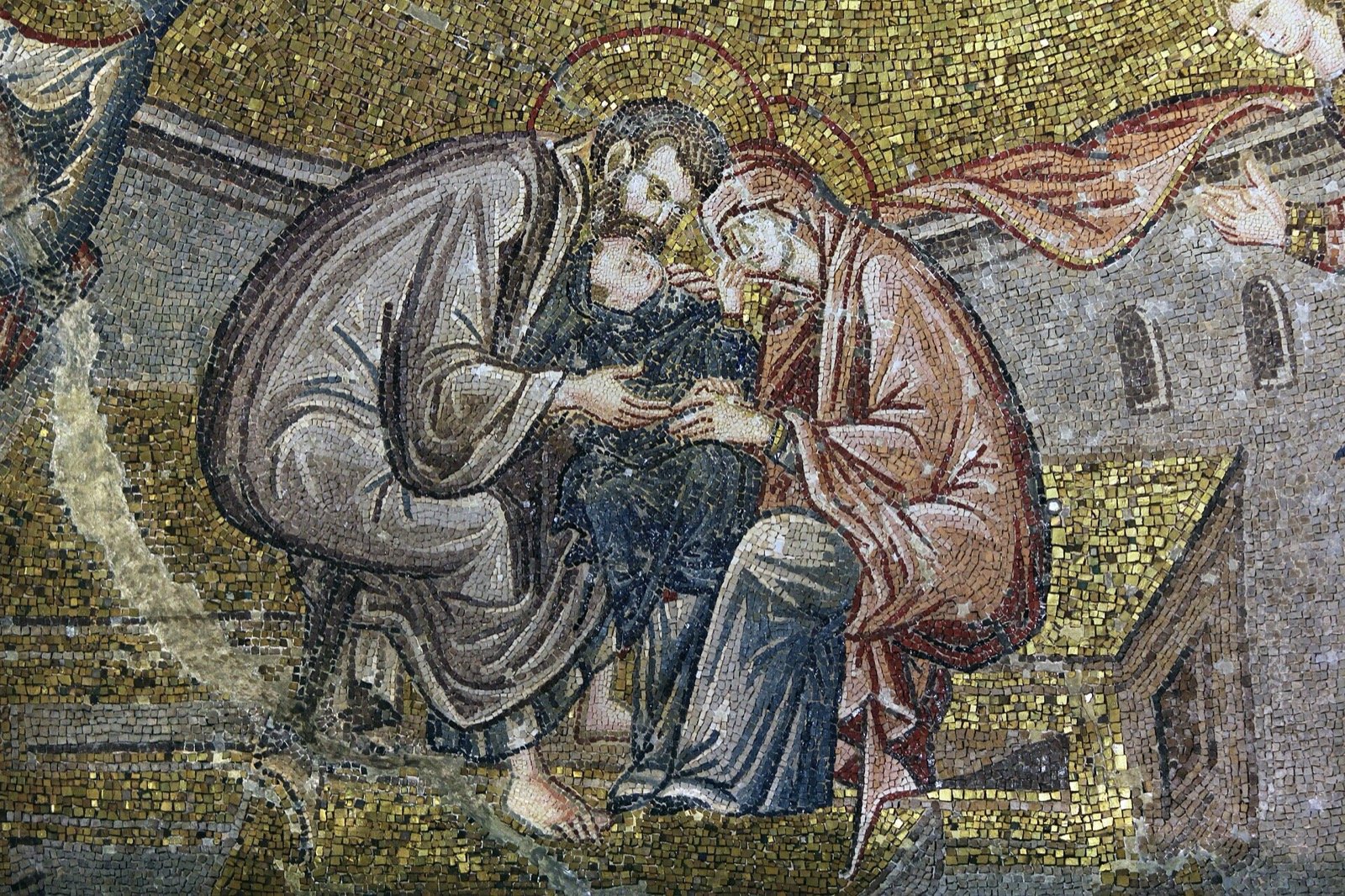
At the monastery of Chora in Constantinople, known today as Kariye Djami, most of the scenes from the Virgin’s childhood are preserved. One of the mosaics shows her kissed by Joachim, while she lays her hand on her mother’s cheek. Another shows Joachim bringing her to the Temple, without Anna beside him, to receive the blessing of three high priests seated on a bench around a table. The child is wrapped in cloths that cover her father’s hands entirely. The usual reading of the scene sees in this covering the sign of her holiness, and likens her to a chosen vessel, born to be given to the altar.
Her Answer
This preparing did not take her freedom from her. She who was born through the prayer of Joachim and Anna will herself answer the angel’s word: “Behold the handmaid of the Lord; let it be to me according to your word.” In that answer the grace of God meets the faith and the obedience of man.
We call her Theotokos because He whom she bore in the flesh is the eternal Son of the Father, true God and true man. Of her He took our human nature, to heal it and to unite it to God. She is not the origin of His divinity; it is from her that He took His humanity. And so all the honour given to the Mother of God turns us toward Christ.
The Gospel of the feast says the same. A woman in the crowd cried out to the Lord that blessed is the womb that bore Him, and He answered that blessed rather are those who hear the word of God and keep it. The first among these is she.
What This Day Gives Us
The church year begins with a prayer heard late. Joachim and Anna asked for years and received nothing but reproach, and when what they had asked for was given them they were both old. The Church has set this day at the head of the year, so that whoever begins it carrying a request that has not yet been answered may begin it with those two beside him.
Their joy takes in also those whose request remains unfulfilled. Childlessness is not proof of God’s rejection, nor the measure of a couple’s faith. The Gospel calls Zacharias and Elizabeth righteous before God, and says at once that they had no child. The feast calls us to remain in prayer and to bear one another’s suffering, certain that no one is forgotten before Him.
What was given to Joachim and Anna has passed to us all. Saint John of Damascus says that the wise parents of the Mother of God received a heavenly gift, worthy of God, a throne higher than the Cherubim themselves: the Mother of the Word and of the Creator.
This is why the hymn of the day does not stop at the joy of two old people, but proclaims it to the whole world: “for from you has dawned the Sun of Righteousness, Christ our God.”
A note on the sources. The troparion, the kontakion, the stichera and the canons are given after the service for 8 September in the Menaion for September. The details of the Virgin’s birth and infancy come from the Protevangelium of James. The arrangement of the icon follows the Painter’s Manual of Dionysius of Fourna.
The words of Saint Andrew of Crete on the last purpose for which the world was made, the sentence of Saint Ambrose of Milan, and the word of Saint Gregory Palamas on Scripture written for her are taken from Viața Preasfintei Născătoare de Dumnezeu și pururea Fecioarei Maria, edited by Archimandrite Constantin Chirilă, Doxologia, Iași, 2013, pp. 30-31, translated from The Life of the Virgin Mary, the Theotokos, Holy Apostles Convent, Buena Vista, Colorado, 1989. They have not been verified against patristic editions.