
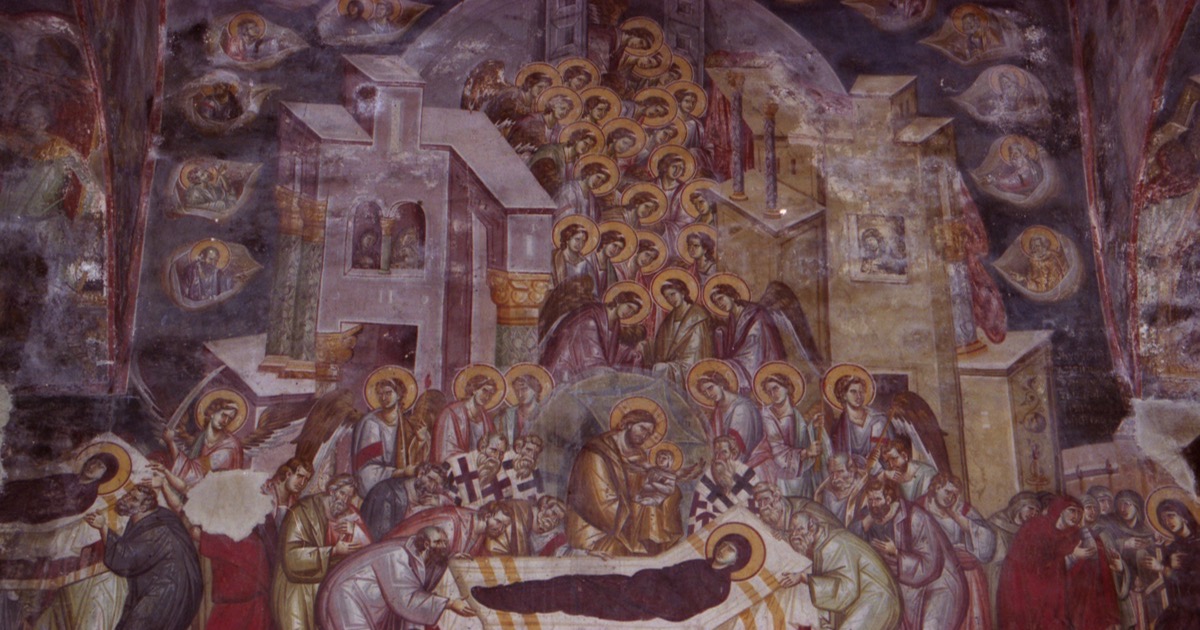
On the fifteenth day of August, the Church celebrates the death of the Theotokos. The name of the feast is the Dormition, and that name does not avoid death; it names it in the light of the resurrection.
The Mother of God truly died. Her body was wrapped, carried on the shoulders of others, and laid in a tomb, exactly as our bodies are.
Falling asleep
The Lord uses this word of the daughter of Jairus — “Weep not; she is not dead, but sleepeth” (Luke 8, 52) — and then of Lazarus: “Our friend Lazarus sleepeth; but I go, that I may awake him out of sleep” (John 11, 11). The disciples understood ordinary sleep and answered that if he slept he would do well, so that He had to tell them plainly: “Lazarus is dead” (John 11, 14). What the word truly meant they learned only four days later, before an opened tomb.
The Church kept this language of Scripture and calls those who die in Christ the departed who sleep, commemorating them so at every Liturgy and at the service of burial. In everyday speech we still say that a person has died; falling asleep has remained the word of the services. It rarely stands at the head of a day in the calendar, since the saints are commemorated by name and by rank, Holy Martyr or Venerable Father. We find it there again on the twenty-fifth of July, at the commemoration of the dormition of Saint Anna, the mother of the Theotokos.
What the Theotokos receives, then, is not a word that sets her apart from us. It is the word with which the Church accompanies all of us to the grave. The honor given her surpasses the honor of all, yet her death is called what ours is called, because she died as we die.
What the Church has kept concerning that day
The New Testament says nothing about the end of her life. What the Church has preserved concerning the day of the Dormition comes to us through Tradition, chiefly through the service of the feast and through the synaxarion of the day, read in churches on the fifteenth of August.
The synaxarion relates that when Christ was pleased to take His Mother to Himself, He made her translation known to her three days beforehand through the Archangel Gabriel, who told her that her Son said the hour had come to take His Mother to Himself, and that she should not fear but receive the word with joy, since she was coming to immortal life.
She rejoiced and went up in haste to the Mount of Olives, where she was accustomed to pray. There a wonder took place: the trees of the mountain bowed of themselves, rendering her due honor like living servants. When she returned home, the house shook. She lit lamps, gave thanks to God, called together her kinsfolk and neighbors, and prepared her bed and what was needed for her burial. She told them what the angel had announced and showed them the gift she had received, a palm branch. The women who had been called wept, and she assured them that in passing to the heavens she would visit not only them but the whole world. Then she appointed that her two garments should go to two poor widows who were her friends and were fed by her.
At that time a sound of thunder was heard and clouds appeared, bringing the disciples of Christ from the ends of the earth, and among them Dionysius the Areopagite, Hierotheus and Timothy. They wept, saying that they could not bear the weight of the parting, and she answered them, calling them the friends and disciples of her Son and God, asking them not to turn her joy into mourning but to care for her body as she herself would arrange it upon the bed. Paul arrived then also, and fell at her feet and praised her, confessing that although he had not seen Christ in the flesh, looking upon her he seemed to see Him.
Having taken leave of all, she lay down upon the bed, prayed for the strengthening of the world and for its peaceful continuance, and so gave her soul into the hands of her Son and God. At once the eyes of the blind were opened, the hearing of the deaf restored, and the lame made straight.
Peter began the funeral hymn. Some of the Apostles lifted the bed, others went before with torches and singing, and the air was filled with the voices of angels. The leaders of the Jews persuaded some of the people to overturn the bed, but they were struck with blindness, and one of them, who had seized the bed, was left without both his hands, which remained hanging from the bed. Believing with his whole soul, that man found healing, and those who had been blinded were healed after they had laid upon themselves a part of the hem of the bed.
Coming to Gethsemane, the Apostles laid the body in the tomb and remained beside it three days, hearing angelic voices without ceasing.
Thomas was absent, by divine dispensation, and arrived three days later, grieved that he had not been counted worthy to see the body also. For his sake the tomb was opened, and seeing, he marvelled: he found the tomb without the holy body, and there was only the burial cloth, left as a consolation to the Apostles and to all the faithful. The synaxarion calls it an unlying witness of the translation of the Theotokos, and adds that to this day the tomb hewn in the rock is seen thus, empty of the body, and is honored with veneration.
Why the Mother of God died
Here lies the heart of the feast, and the Church states it plainly in the canons of the day.
Saint John of Damascus sings that, “having issued forth from a mortal womb”, she received “an end conforming to nature”, and that then, having given birth to Him Who is Life, she was translated to the divine and hypostatic Life. This is the cause of her death: the nature she bore was our nature, with death having entered into it.
Saint Cosmas says the same thing more emphatically. She took the honors of victory over nature by giving birth to God, yet, emulating her Creator and Son, “thou submittest to the laws of nature in supernatural manner”. And from this he draws the conclusion: “Wherefore, having died, thou risest with thy Son unto everlasting life.”
Her purity did not lift her out of this nature. Grace worked within her, and she gave herself to that working without resistance, and from this meeting her glory came to her. This is why we can follow her.
The Church confesses also the raising of her body to heaven: the tomb was found empty, and the burial cloth remained. The manner in which the translation was accomplished remains unknown, however, and we do not pry into it.
The sessional hymn of the feast binds the two ends of her life in a single phrase: her conception in giving birth was without seed, and her mortality in her dormition was incorrupt, a twofold wonder within a wonder.
What this means for us
This feast does not speak only of her. It speaks of us, because she walked the road we have to walk, and found it open.
If her glory came from a nature other than ours, it would have nothing to say to us. Coming instead from grace at work in a nature like ours, it shows us what grace can do with a person who bends his will. Saint John of Damascus asks the question that binds everything together: since Life shone forth from her, how was her all-pure and life-giving body permitted to be tempted by death? And he answers: as the temple of Life, she passed through death on to life.
The ninth ode of the feast says it briefly: in her the laws of nature are overcome, for her birthgiving is virginal and death is betrothed to life; a Virgin giving birth, and alive after death.
And at the Liturgy the Church chants what she herself had foretold: “from henceforth all generations shall call me blessed” (Luke 1, 48).
Whoever draws near to the fifteenth of August draws near to the tomb which the Church confesses to be empty. The tomb at Gethsemane does not, however, stand beside the tomb of the Lord; it comes from it. Christ conquered death by His own Resurrection, and in His Mother there is shown beforehand what that victory works in those who fall asleep in the hope of the resurrection.
In giving birth thou didst preserve thy virginity, and in thy falling asleep thou hast not forsaken the world, O Theotokos. Thou hast been translated to life, as thou art the Mother of Life. And by thy supplications thou dost deliver our souls from death.
Image adapted for editorial use from the thirteenth-century fresco of the Dormition of the Mother of God in the Church of the Theotokos Peribleptos, Ohrid, public domain, via Wikimedia Commons.