
On the first of September the Church begins a new year. It is not the civil year, which begins on the first of January. It is the beginning of the church year, and more precisely of the cycle of fixed feasts contained in the twelve Menaia, the service books that set out, day by day, the offices of each month. Beside this cycle stands the cycle of moveable feasts, ordered around Pascha through the Triodion and the Pentecostarion. The first of the Menaia is the Menaion for September, and it opens with this day.
The older name of the feast is not “the church new year” but the Beginning of the Indiction. That is how the service books title it, and the name is where we must begin, because it shows where the date came from.
What the service book of the day says
The synaxarion, the short account the Church reads at Matins concerning the feast and the saints of the day, gives two reasons why the first of September is kept.
The first is a borrowed custom. The Church keeps the Indiction, the synaxarion says, having taken the practice from the ancients, since in this month the New Year was kept both among the Hebrews and throughout the world of that time. Among the Romans the Indiction was a cycle of fifteen years by which the taxes of the empire were assessed. The Latin word indictio means a command, a public proclamation, that is, the announcement by which the levy was made known. This cycle first began its year on the twenty-third of September, the birthday of the emperor Augustus. In the second half of the fifth century, probably around the year 462, its beginning was moved to the first of September. In the year 537, by Novel 47, the emperor Justinian required official documents to be dated by the year of his reign, by the consul, and by the indiction; through this ruling the indiction became a compulsory element of Byzantine official dating.
The Church therefore took a ready-made framework of the world of that time and filled it with what is her own. She did the same with the day. The division of daylight into twelve hours came from the Egyptians and the Greeks, and reached Rome around the year 293 before Christ with the sundial; the Jews reckoned in the same way in the days of the Lord. The Church received that division and filled it with the works of salvation. Out of it grew the Hours of the Horologion, the service book containing the prayers appointed for the hours of the day: at the third hour the Holy Spirit descended upon the Apostles, at the sixth the Lord was crucified, at the ninth He died upon the Cross, while the First Hour belongs to daybreak and to Christ, the true Light. Tertullian at the end of the second century, and St Cyprian in the third, name these hours expressly.
Those hours were measured by no mechanism. The daylight was divided by twelve, so that an hour lasted some forty-five minutes at midwinter and some seventy-five at midsummer. The prayer of the Church followed the sun.
Her order was not born of a decree written on a given day. It grew quietly, receiving what was useful and leaving aside what was not.
A claim that needs correcting
It is often written, in books and on church websites alike, that the Fathers of the First Ecumenical Council, held at Nicaea in the year 325, appointed the church year to begin on the first of September.
The claim does not come from nowhere. It is found in the longer synaxarion preserved in the Lives of the Saints compiled by St Dimitri of Rostov, where it is said that the feast of the church new year was established by the Holy Fathers at Nicaea, at the time when the emperor Constantine, having defeated Maxentius, changed the meaning of the Indiction. This is a hagiographical account, not a conciliar act, and the distinction between the two must be kept.
The twenty canons of the Council of Nicaea have been preserved and may be read; they contain no such decision. The Council dealt with the heresy of Arius, with the date of Pascha, and with matters concerning the clergy and those who had fallen away during the persecution. Further, the beginning of the Eastern indiction was moved to the first of September in the second half of the fifth century, more than a hundred years after Nicaea, and before that move the opening day was a different one. The synaxarion of the feast itself makes no mention here of any decision of the Council of Nicaea: it speaks of the ancient custom and of the Lord’s entry into the synagogue.
The feast loses nothing by this clarification. The first of September was not given to us by a decree, but by the life of the Church, which prayed each year for the year to come until that prayer became a service and the service entered the Menaion. What was established in this way holds better than what would have been established by a signature.
The acceptable year of the Lord
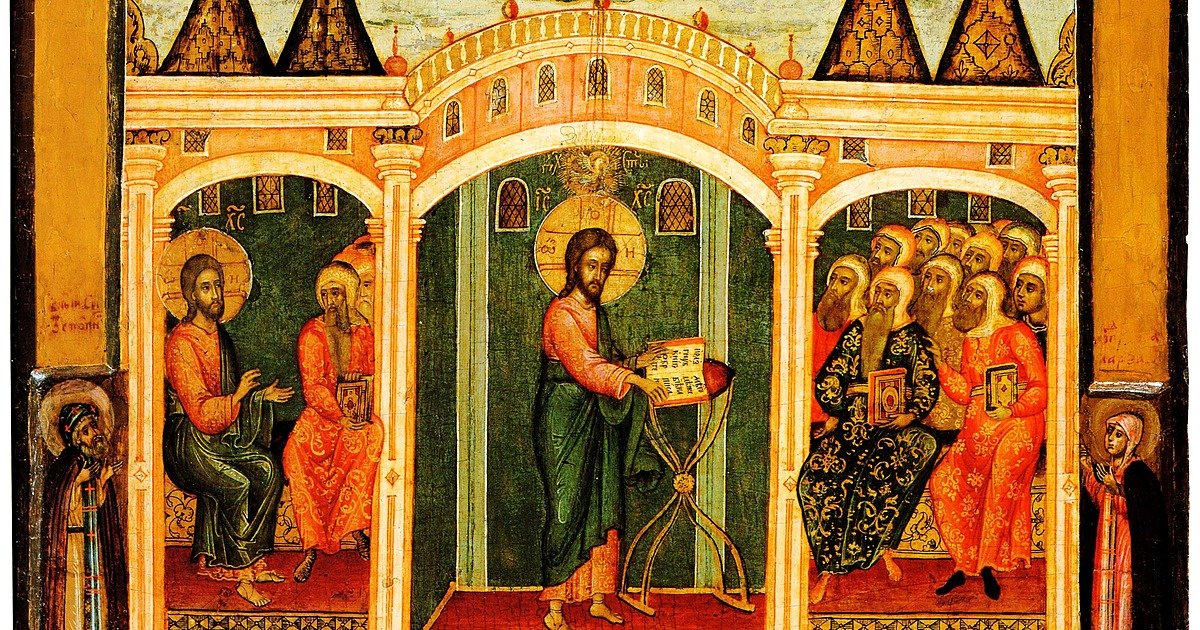
The other reason the synaxarion gives is the Lord’s entry into the synagogue at Nazareth.
The book of the prophet Isaiah was handed to Him. He opened it and found the place where it was written: “The Spirit of the Lord is upon me, because He hath anointed me to preach the gospel to the poor; He hath sent me to heal the broken-hearted, to preach deliverance to the captives, and recovering of sight to the blind, to set at liberty those who are bruised, to preach the acceptable year of the Lord” (Luke 4:18-19; Isaiah 61:1-2). Then He closed the book, gave it back to the attendant, sat down, and said: “This day is this Scripture fulfilled in your ears” (Luke 4:21).
Here is the heart of the day. The year the Church opens is called the acceptable year of the Lord. Its reckoning came from the civil power, but its meaning comes from Christ, who stood in the midst of the assembly and said that this present time had begun with Him. The Christian’s time is no longer a turning without end, but the season in which forgiveness is preached and the eyes of the blind are opened.
One of the stichera at Vespers binds this day to Mount Sinai. He who once inscribed the tablets of the Law on stone has now, in the flesh, received the book of the prophet in the city of Nazareth, to read it and to teach the people that in Him the Scripture is fulfilled. The Law and its fulfilment stand side by side in a single hymn.
The Indiction of Christ
The synaxarion does not stop at the two reasons. It draws a conclusion from them, and that conclusion is the part which bears directly on the life of the one who keeps the feast.
Christians, it says, do not keep the Indiction of the emperor of Rome, but the one appointed by Christ; and the Indiction of Christ is His commandments, which we are bound to keep. The earthly emperor demanded, every five years, iron and bronze for weapons, then silver for the soldiers’ pay, then gold for the adorning of his idols. The heavenly King asks for something else. In place of iron and bronze He asks for faith; in place of silver, for hope in God; in place of gold, for love unfeigned toward God and toward one’s neighbour. And of these three, the greatest is love.
So the historical reason and the evangelical one meet in the concrete prayer for the time that lies ahead, and in the petition that it be passed with a clean conscience and in the keeping of His commandments. The church new year is kept, the synaxarion says with the words of the Apostle, by walking in newness of life.
What the Church asks on this day
The troparion of the feast, in the second tone, is short, and it asks for one thing:
O Fashioner of all creation, who in Thine authority hast appointed the times and the seasons: bless Thou the crown of the year with Thy goodness, O Lord, preserving in peace Orthodox Christians and Thy city, and save us through the prayers of the Theotokos.
“The crown of the year” comes from the Psalter: “Thou shalt bless the crown of the year with Thy goodness” (Psalm 64:12 in the Greek numbering, 65:11 in the Hebrew). The image is of the whole year crowned by the goodness of God. From the outset the Church entrusts to Him the entire course of the time that is coming, with its fruits, its wants and its trials.
The canon of the day shows what kind of year is asked for. Not an easy one:
O Master, God of all things, lead through this year which beginneth those who adorn themselves with divinely beautiful spiritual works, and who hymn Thee with faith.
The beginning of the year do Thy people offer unto Thee, O Saviour, glorifying Thee with angelic hymns.
The year is not merely received; it is offered, as the farmer brought the first sheaf to the altar before the rest of the harvest. And the troparion that follows asks that those who have begun the year may also be counted worthy to complete it in a manner well-pleasing to Christ; that is, not a good beginning only, but a road walked to the end.
The Epistle read at the Liturgy runs in the same direction: “I exhort, therefore, that, first of all, supplications, prayers, intercessions, and giving of thanks, be made for all men” (I Timothy 2:1). The year begins with prayer for all, not for ourselves alone.
Who is commemorated on the first of September
On this day the Church commemorates our venerable father Symeon the Stylite, of whom the synaxarion says that he endured forty-seven years upon his pillar, together with his mother, the venerable Martha. She commemorates also the forty holy martyred women with their teacher, the deacon Ammon; the martyrs Callista, Evodus and Hermogenes, who were brother and sister; the righteous Joshua, son of Nun; the icon of the Mother of God of Miasena, which was cast into a lake for fear of the iconoclasts and came out uncorrupted after a long time; and the great fire which consumed the greater part of the imperial city over seven days.
The year does not open, then, under the sign of good resolutions, but under the sign of endurance. The first figure the Church sets before us is a man who stayed in one place for decades.
And the first of the twelve great feasts of the year is the Nativity of the Mother of God, on the eighth of September, as the last is her Dormition, on the fifteenth of August. The church year opens with the birth of the Theotokos and closes with her passing over into life. Between these two boundaries everything we shall celebrate is set.
A more recent observance
Since 1989, by the patriarchal encyclical of Ecumenical Patriarch Dimitrios I, the first of September has also been appointed a day of prayer for the protection of creation, and the observance was afterwards received in the Orthodox Churches. It is a recent addition to an ancient feast. It should be said that the petition for the fruits of the earth was always in the service of the day: one of the sessional hymns at Matins calls upon God as the one who bestows fruitful seasons and rains from heaven upon those on earth, and among the readings at Vespers stands the promise from Leviticus that the land will yield its increase to those who walk in the commandments of the Lord.
How the Christian prepares
Preparation for the church year is not like the resolutions of the first of January. The Church does not ask for promises, but for a beginning.
Go to the service. The feast opens at Vespers on the evening of the thirty-first of August and is completed at the Divine Liturgy the next day. In the Romanian Orthodox Church, a service of thanksgiving for the church new year is served after the Liturgy, in which thanks are given for the year that has ended and the blessing of God is asked for the one beginning. This day is kept by standing in church, not by reading about it.
Set in order what you have left unconfessed. There is no confession for the church new year prescribed by the Typikon, and no one should make an obligation out of the date. But the beginning of the year is a good occasion for confession, so that you do not carry forward things that call for repentance and amendment. What is left unconfessed weighs on everything that follows.
Take up a rule of prayer you can keep for a whole year. Here most of us go wrong. A large rule is taken up at the start of the year, kept for three weeks and abandoned, and out of the abandoning comes discouragement. Better a little every day than much with interruptions. The measure is set according to your strength and with the blessing of your spiritual father, since he knows you. And one thing more: prayer is not payment. A number of akathists or of prostrations reckoned as the price of a petition is not prayer but bargaining. Prayer is standing before God, and the number serves only to guard constancy.
Take the calendar in hand. The year that begins has a known road. On the fourteenth of September comes the Exaltation of the Cross, a fast day; on the fifteenth of November the Nativity Fast begins; then the Triodion, Great Lent, Pascha. Whoever knows in advance what is coming enters the year with open eyes and is not caught unprepared by each fast.
Read the Gospel of the day and the life of the saint commemorated, every day. It takes a few minutes. Done daily, it changes the way you see the day, because it sets that day beside a man who lived it for Christ.
Begin the year with almsgiving and with prayer for others, as the Epistle of the day asks. It is the surest sign that the year has not been begun for oneself.
And if out of all this only one thing can be done, let it be a small one, kept to the end. One small thing carried through a whole year is worth more than ten begun in September and abandoned in November.
A closing word
The Church does not ask on this day for a year without sorrows. She asks for a year passed in spiritual works and finished as it was begun. The rest remains in the hands of Him who has appointed the times and the seasons in His own authority.
Bless, O Lord, the crown of the year with Thy goodness.
Image: The Beginning of the Indiction, late seventeenth-century Russian icon, Kolomenskoe Museum; image via Russian Icons.