
Humility is one of the highest virtues of the Christian life. Christ was humble, and the saints walked in His footsteps. Yet their humility did not make them weak men, for God asks man to be strong and to do great deeds, worthy of Him. The Lord held the crowds by the power of His word. Many of the saints were soldiers and generals, men who knew how to command and how to win. Others laboured in the desert, that is, they fought there an unceasing battle of fasting, vigil and prayer, with a strength that most of us can scarcely imagine. All of them accepted being beaten, mocked and left alone when they spoke the truth, and their strength was seen in the hour of humiliation as clearly as in the hour of glory.
This is the path of the Christian. First he becomes a personality, that is, a man with a face of his own: a firm will, a faith that has grown through deeds, and the courage to stand upright when others bow down. This strength shows itself in his deeds, and sometimes God also gives him glory before men. A man who has come this far is ready for humiliation as well. It comes to him through persecution, as the consequence of his courage to speak the truth, and then the same strength is seen in the way he carries his cross. His strength and his glory remain wrapped in humility the whole time. For many of the saints, this path ended in a death willingly accepted for Christ.
In this article
The Strength God Asks For
The mind, the will and the strength of the soul are gifts that man has received from God. Christ asks him to deny himself: “If any man will come after me, let him deny himself, and take up his cross, and follow me” (Matthew 16:24). In this way man renounces his passions and his own will, which separate him from God. The gifts he has received remain, and ascetic struggle cleanses them of the passions and turns them back towards the One who gave them. The Fathers call this strength of soul manliness, or courage, and count it among the virtues. The word does not concern men alone, for the Church honours virgins and mothers who faced torments with more courage than their torturers ever had. The Apostle Paul asked this courage of the Corinthians and at the same time showed them its measure: “Watch ye, stand fast in the faith, quit you like men, be strong. Let all your things be done with charity” (1 Corinthians 16:13–14).
Humility does not take from man the strength he has received. It teaches him where that strength comes from. The same Apostle received from the Lord an answer which he wrote down for the Corinthians:
“And he said unto me, My grace is sufficient for thee: for my strength is made perfect in weakness. Most gladly therefore will I rather glory in my infirmities, that the power of Christ may rest upon me. Therefore I take pleasure in infirmities, in reproaches, in necessities, in persecutions, in distresses for Christ’s sake: for when I am weak, then am I strong.” (2 Corinthians 12:9–10)
The man who wrote these lines had carried the Gospel through many cities and had stood without fear before rulers. The weakness in which he glories is that of a man struck, deprived and persecuted for Christ. The strength is Christ’s, who works in him precisely in those hours. Paul placed all his strength in the service of the One who had given it to him, and he never hid it under the name of humility. He did not deny his labours, but he knew whose fruit they were:
“But by the grace of God I am what I am: and his grace which was bestowed upon me was not in vain; but I laboured more abundantly than they all: yet not I, but the grace of God which was with me.” (1 Corinthians 15:10)
The exhortation “fear not” is one of the most frequently repeated in Scripture. God spoke it to Abraham and to Joshua, the angel spoke it to the Virgin Mary and to the shepherds, and Christ spoke it many times to His disciples. When He saw them terrified on the sea, He came to them walking on the water and said: “Be of good cheer; it is I; be not afraid” (Matthew 14:27). Peter asked to come to Him on the water, and he walked, until he looked at the wind:
“But when he saw the wind boisterous, he was afraid; and beginning to sink, he cried, saying, Lord, save me. And immediately Jesus stretched forth his hand, and caught him, and said unto him, O thou of little faith, wherefore didst thou doubt?” (Matthew 14:30–31)
The Lord did not rebuke Peter for his daring, but for his doubt. The Apostle Paul himself confesses that he came to Corinth “in weakness, and in fear, and in much trembling” (1 Corinthians 2:3), and yet he preached the Gospel there. God wants man not to let himself be ruled by fear, and to ask with boldness. In the parable of the man who knocks at midnight at his friend’s door and asks him for bread, the Lord says that the friend will rise and give, even if he does not do it for friendship’s sake: “yet because of his importunity he will rise and give him as many as he needeth” (Luke 11:8). Then He adds: “Ask, and it shall be given you; seek, and ye shall find; knock, and it shall be opened unto you” (Luke 11:9). The Canaanite woman would not be turned away even when the Lord put her to the test, and He said to her: “O woman, great is thy faith: be it unto thee even as thou wilt” (Matthew 15:28). The Epistle to the Hebrews calls us to “come boldly unto the throne of grace” (Hebrews 4:16). At every Divine Liturgy, before the Lord’s Prayer, the priest asks God to make us worthy to dare, with boldness, to call upon Him as Father.
Strong faith is not born in a man who shrinks from every struggle. Faith and inner strength grow together, through the great deeds that a man does with God’s help. The holy Apostle James recalls that Abraham laid his son upon the altar, and he adds: “Seest thou how faith wrought with his works, and by works was faith made perfect?” (James 2:22). The Epistle to the Hebrews remembers the righteous of the Old Testament,
“who through faith subdued kingdoms, wrought righteousness, obtained promises, stopped the mouths of lions, quenched the violence of fire, escaped the edge of the sword, out of weakness were made strong, waxed valiant in fight, turned to flight the armies of the aliens.” (Hebrews 11:33–34)
The Ascetics
The ascetics showed the same strength. They stood willingly in the cold, fasted beyond the measure of ordinary men, kept vigil through whole nights and made hundreds and thousands of prostrations, that is, bows to the ground accompanied by prayer. They were able to sustain such struggles because they had received grace from God, but also because they had set their will never to turn back. God gives grace, and man gives Him his will.
Saint Symeon the Stylite lived for decades in Syria on a pillar, under the open sky. Blessed Theodoret of Cyrrhus, who knew him in his lifetime, writes that year after year he spent the forty days of Great Lent without food. The saint bowed in prayer so deeply that his forehead touched his toes. One of Theodoret’s companions once counted one thousand two hundred and forty-four such bows, then grew tired and gave up counting.
Saint Seraphim of Sarov prayed for a thousand nights on a rock in the forest and for a thousand days on a stone in his cell, standing or kneeling, with the prayer of the publican from the Gospel. He lived in the forest among wild beasts and fed them from his hand, and a bear obeyed him as its master. One day robbers attacked him. Seraphim was a very strong man and was holding an axe, so he could have defended himself. He put the axe down, crossed his arms on his chest and said to them: “Do what you intend.” They beat him until they left him nearly dead, with his head broken and his ribs crushed. The saint forgave them and asked that they should not be punished.
Many hermits lived in the desert among wild beasts, and the beasts grew tame before them. Saint Gerasimus of the Jordan drew a thorn from the paw of a lion. The lion stayed by him and served him, and when the elder died, it lay down on his grave and died there.
The fools for Christ went still further along the way of humiliation. They hid their holiness under the guise of a man bereft of reason and willingly accepted the contempt of all. Saint Andrew the Fool for Christ endured for years the mockery, the insults and the blows of the people of Constantinople. One winter the frost held the city for two weeks. The saint lay down in the street beside a dog to warm himself, but the dog got up and ran away from him. Andrew thought he was dying, and then he was caught up in a vision into paradise.
These men had the strength to bear what few can bear, and they chose to place it in the service of God without exalting themselves through it. The Sayings of the Desert Fathers relate that the devil once came out against Saint Macarius the Great with a sickle and wanted to strike him, but could not. Then he said to him:
“What is your power, Macarius, that makes me powerless against you? All that you do, I do, too; you fast, so do I; you keep vigil, and I do not sleep at all; in one thing only do you beat me.”
When Macarius asked what that was, the devil answered: “Your humility. Because of that I can do nothing against you.” The enemy can imitate fasting and vigil. Humility he cannot imitate, and without it all the strength of the ascetic would have remained a merely human power.
Christ, Who Gave Himself Up Willingly
Our Lord Jesus Christ held sway over the crowds. People stayed with Him even for three days without having anything to eat, and after the Sermon on the Mount the Evangelist Matthew writes:
“And it came to pass, when Jesus had ended these sayings, the people were astonished at his doctrine: for he taught them as one having authority, and not as the scribes.” (Matthew 7:28–29)
The scribes were the teachers of the Law in that time, and Christ spoke as the One who had given the Law. When the chief priests sent officers to seize Him, the officers came back without Him. Asked why they had not brought Him, they answered: “Never man spake like this man” (John 7:46).
A few days before His Passion, the Lord entered Jerusalem as King. The crowds went out to meet Him and spread their garments and branches cut from the trees in the way:
“And the multitudes that went before, and that followed, cried, saying, Hosanna to the Son of David: Blessed is he that cometh in the name of the Lord; Hosanna in the highest.” (Matthew 21:9)
“And when he was come into Jerusalem, all the city was moved, saying, Who is this?” (Matthew 21:10). The kings of the earth entered cities on horseback or in war chariots, with their armies behind them. This King, met with so much glory, came seated on an ass, as the prophet had foretold: “Behold, thy King cometh unto thee, meek, and sitting upon an ass” (Matthew 21:5). His glory was that of a King, and the garment in which He came was humility.
At the Mystical Supper, the Evangelist John first shows the power that Christ knew was in His hands, and then what He did with it:
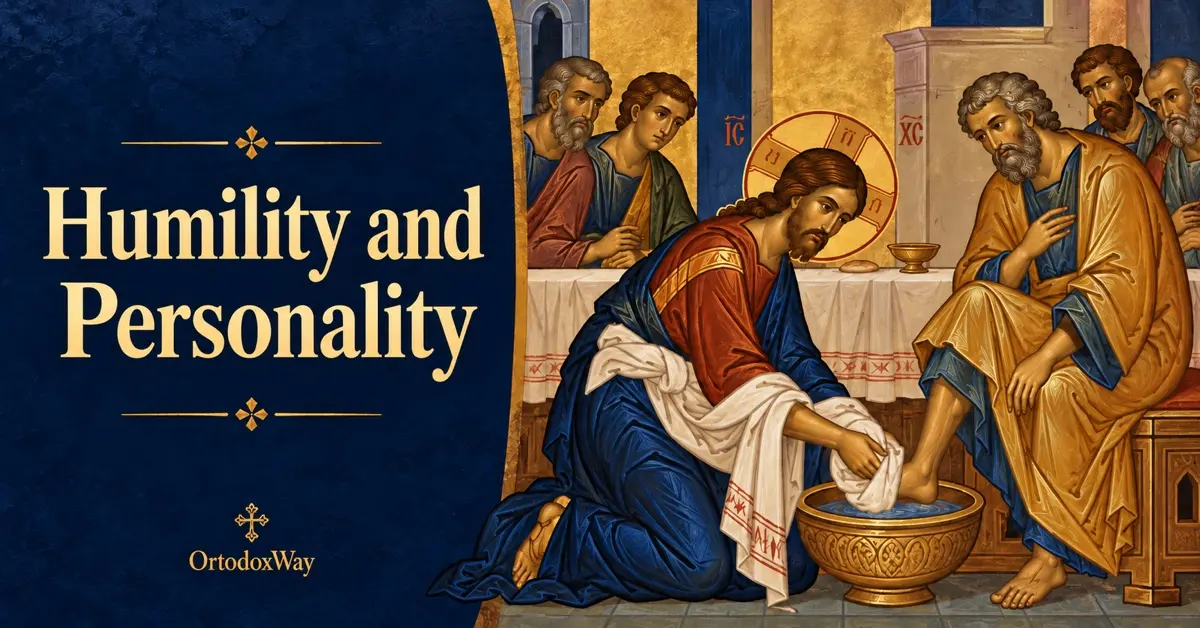
“Jesus knowing that the Father had given all things into his hands, and that he was come from God, and went to God; he riseth from supper, and laid aside his garments; and took a towel, and girded himself. After that he poureth water into a bason, and began to wash the disciples’ feet, and to wipe them with the towel wherewith he was girded.” (John 13:3–5)
The hands into which the Father had given all things washed the disciples’ feet.
On that same night, the Lord Himself went out to meet those who had come with torches and weapons to take Him:
“Jesus therefore, knowing all things that should come upon him, went forth, and said unto them, Whom seek ye? They answered him, Jesus of Nazareth. Jesus saith unto them, I am he. And Judas also, which betrayed him, stood with them. As soon then as he had said unto them, I am he, they went backward, and fell to the ground.” (John 18:4–6)
A single word of His threw to the ground those who had come to seize Him. After that He let Himself be bound by them. To the disciple who had drawn his sword to defend Him He said: “Thinkest thou that I cannot now pray to my Father, and he shall presently give me more than twelve legions of angels?” (Matthew 26:53). Earlier He had said of His life: “No man taketh it from me, but I lay it down of myself. I have power to lay it down, and I have power to take it again” (John 10:18).
Brought before the high priest, the Lord was struck in the face:
“And when he had thus spoken, one of the officers which stood by struck Jesus with the palm of his hand, saying, Answerest thou the high priest so? Jesus answered him, If I have spoken evil, bear witness of the evil: but if well, why smitest thou me?” (John 18:22–23)
The Lord did not strike back, nor did He cower before the servant like a frightened man. He spoke the truth calmly and received the blow. This is the humility of the strong: he stands upright in the truth and lets injustice fall upon him. That night too, “all the disciples forsook him, and fled” (Matthew 26:56).
The Apostle Paul says of Him that “he humbled himself, and became obedient unto death, even the death of the cross” (Philippians 2:8). No one humbled Christ against His will. Humility was His own work, accomplished by the One who had all power. The same Lord who rebuked the winds and the sea said of Himself: “learn of me; for I am meek and lowly in heart” (Matthew 11:29).
Saint Isaac the Syrian, hermit and teacher of prayer, writes about humility, which he calls humble-mindedness:
“For humility is the raiment of the Godhead. The Word Who became man clothed Himself in it, and therewith He spoke to us in our body. Every man who has been clothed with it has truly been made like unto Him Who came down from His own exaltedness, and hid the splendour of His majesty, and concealed His glory with humility, lest creation should be utterly consumed by the contemplation of Him.” (Ascetical Homilies, Homily 77)
Christ’s humility hid His power without diminishing it. Whoever clothes himself in humility carries his strength as the Lord carried His: hidden and whole.
The Soldier Saints
Among the most beloved saints of the Church are many soldiers, who had rank, arms and men under their command.
The holy Great-martyr George the Trophy-bearer had risen while still young to command troops in the guard of the Emperor Diocletian. When the emperor began his persecution of the Christians, George distributed his wealth to the poor, set his slaves free and confessed that he was a Christian. Diocletian promised him honours, ranks and riches if he would deny Christ, and George refused them all. He was tortured with a heavy stone laid on his chest, on a wheel set with blades and in a pit of quicklime, and then he was beheaded, in the year 303.
The holy Great-martyr Demetrius the Myrrh-streamer was proconsul of Thessalonica, that is, the governor of the city, appointed by the Emperor Maximian for his wisdom and his valour in war. He entrusted his wealth to a faithful servant to distribute to the poor, and confessed with great boldness that he was a Christian. He was shut up in an old bathhouse near the palace, and there the soldiers pierced him with spears.
The holy Great-martyr Theodore Stratelates bears his very rank in his name, for stratelates means general. He was a military commander and the ruler of the city of Heraclea in Pontus, in the time of the Emperor Licinius. He took the emperor’s gold idols into his house, broke them to pieces and gave the gold to the poor. For this he was beaten with ox sinews, torn with iron claws, burned with torches, crucified and shot with arrows, and at the last he bowed his head beneath the sword.
The Forty Martyrs of Sebaste were Christian soldiers of a Roman legion. In the year 320, under the same Licinius, they were left naked for a whole night in the frozen lake near Sebaste, while on the shore a warm bath had been prepared for any who would deny Christ. Only one of them came out of the lake, and he died at once. Aglaius, one of the soldiers guarding them, saw shining crowns descending upon the martyrs, confessed that he too was a Christian and went into the lake in the place of the one who had fallen. In the morning their legs were broken, and their bodies were burned.
Saint Alexander Nevsky, a Russian prince of the thirteenth century, defeated the Swedes on the river Neva in the year 1240, and the name Nevsky remained to him from that victory. Two years later he defeated the Teutonic Knights on the ice of a lake. The same victorious general went four times to the Horde of the Tatars to protect his people from their vengeance. He bowed before the Khan, but would not consent to worship the fire, saying: “I am a Christian, and it is not fitting for me to bow down to a creature.” He died in the year 1263, on his way back from the Horde, having taken the monastic habit with the name Alexis.
Saint John the Russian, the Confessor, was a simple soldier in the army of Tsar Peter the Great. In 1711 he was taken prisoner by the Tatars, who sold him to a Turkish officer of Prokopion in Cappadocia. There he lived as a slave. He slept in the stable beside the cattle, and the Janissaries beat him, spat on him and mocked him. He did not deny his faith, and he would say: “I was born a Christian, and I shall die a Christian.” He died in slavery in the year 1730.
These men knew how to command and how to fight. Their strength did not die out when the emperor took away their rank and handed them over to the torturers. It passed from the battlefield into the prison and before the judge, and there it showed more clearly still. John the Russian had no rank to lose, and yet he stood upright like a general in the stable where he slept.
Victors and Vanquished
Before His Passion, Christ said to His disciples: “In the world ye shall have tribulation: but be of good cheer; I have overcome the world” (John 16:33). The Christian is a victor, but his victory does not resemble the victories of the world. When he speaks the truth, he is often defeated in the eyes of men: persecuted, humiliated and left alone. The Lord foretold to His disciples this part of the road as well:
“Blessed are ye, when men shall revile you, and persecute you, and shall say all manner of evil against you falsely, for my sake. Rejoice, and be exceeding glad: for great is your reward in heaven: for so persecuted they the prophets which were before you.” (Matthew 5:11–12)
The Apostle Paul wrote the same thing as a law of the Christian life: “Yea, and all that will live godly in Christ Jesus shall suffer persecution” (2 Timothy 3:12).
The Epistle to the Hebrews, after remembering those who subdued kingdoms through faith, speaks in the verses that follow of the others as well:
“And others were tortured, not accepting deliverance; that they might obtain a better resurrection: and others had trial of cruel mockings and scourgings, yea, moreover of bonds and imprisonment: they were stoned, they were sawn asunder, were tempted, were slain with the sword: they wandered about in sheepskins and goatskins; being destitute, afflicted, tormented; (of whom the world was not worthy:) they wandered in deserts, and in mountains, and in dens and caves of the earth.” (Hebrews 11:35–38)
Of all these Scripture says that they “obtained a good report through faith” (Hebrews 11:39). The same faith made some subdue kingdoms and others accept torments and death.
The apostles passed through both hours. In the same chapter of the Acts of the Apostles, people carried the sick out into the streets so that at least the shadow of Peter might fall upon them, and a little later the apostles stood beaten before the Sanhedrin, the great council of the leaders of the Jews:
“And when they had called the apostles, and beaten them, they commanded that they should not speak in the name of Jesus, and let them go. And they departed from the presence of the council, rejoicing that they were counted worthy to suffer shame for his name.” (Acts 5:40–41)
Towards the end of his life, Paul wrote to his disciple Timothy: “At my first answer no man stood with me, but all men forsook me: I pray God that it may not be laid to their charge. Notwithstanding the Lord stood with me, and strengthened me” (2 Timothy 4:16–17). His strength did not rest in the men who followed him, and so it was not scattered when they went away. Of this life he wrote to the Corinthians:
“We are troubled on every side, yet not distressed; we are perplexed, but not in despair; persecuted, but not forsaken; cast down, but not destroyed.” (2 Corinthians 4:8–9)
The Same Strength in the Pulpit and on the Road to Exile
Saint John Chrysostom knew both faces of this life. He was Archbishop of Constantinople, the imperial city, and crowds filled the church to hear him. The Church gave him the name Chrysostom, “Golden-mouthed”, for the power of his word. He turned that same word upon the powerful as well. He rebuked the greed of the rich and did not keep silent even before the imperial court, and the Empress Eudoxia took his sermons as aimed at her. In the year 403 a synod of hostile bishops deposed him, that is, removed him from the episcopal rank. The unrest of the people frightened the court, and Saint John was called back, but in 404 he was sent into exile again, to Cucusus, a remote place in Armenia.
Three years later the order was given that he be taken still further, to Pityus on the shore of the Black Sea. The soldiers guarding him drove him on in hard marches, through rain and scorching heat, without allowing him rest. Bishop Palladius, his friend and defender, recounts the end. Near Comana in Pontus they halted at the church of the holy Martyr Basiliscus. The martyr appeared to him in the night and said: “Be of good cheer, brother; to-morrow we shall be together.” The next day Saint John asked for white garments and distributed his other clothes among those present. He received the Holy Mysteries and gave up his soul with the words: “Glory to God for all things.” It was the fourteenth of September, 407.
The man who held the capital of the empire with his word died on a road of exile, guarded by soldiers and far from his flock. His strength remained the same in the pulpit and on the road. In the pulpit it showed in the boldness with which he rebuked the sin of the great, and on the road in the peace with which he gave thanks to God for all things.
The Humility That Does Not Bury the Talent
The Lord told the parable of a master who entrusted his goods to his servants before travelling into a far country. Two of them traded with the talents they had received and multiplied them. The third came at his master’s return with his talent untouched:
“Lord, I knew thee that thou art an hard man, reaping where thou hast not sown, and gathering where thou hast not strawed: and I was afraid, and went and hid thy talent in the earth: lo, there thou hast that is thine. His lord answered and said unto him, Thou wicked and slothful servant…” (Matthew 25:24–26)
This servant wasted nothing. He kept the talent whole and gave it back, and his master called him a wicked and slothful servant because he had not traded with it. Many Christians today do the same with the gifts they have received from God. They are content with little, set themselves nothing great for Him, and put their weakness down to humility. True humility knows that the talent belongs to God, and for that very reason it works with it with all its strength. In the parable, the talents are given to each according to his ability, and a great deed is not always one that men can see. The long care of a sick person, or the raising of a child in the faith, also calls for a strength that God alone fully measures.
The difference shows in deeds. The humble man dares great things for God, and when they succeed, he counts them the work of grace and not his own. When he is struck for the truth, he stays on his feet and does not seek revenge, as Christ stood before the high priest’s servant.
God expects from the Christian deeds worthy of Him: that he confess his faith where it costs him, that he defend the one who is wronged, that he begin a good work and carry it through to the end, that he fast, keep vigil and pray with a will that does not turn back. And when the hour comes in which the truth he has spoken brings him before those who strike him, God asks him to remain the same man.
The strength of the saints did not come from the honour they had before men, and so it did not leave them when they lost that honour, but went with them as far as the death they accepted for Christ. This is the personality that the Church brings to birth: a man who can conquer and can accept being conquered, because he has placed all his strength in the hands of God.
