
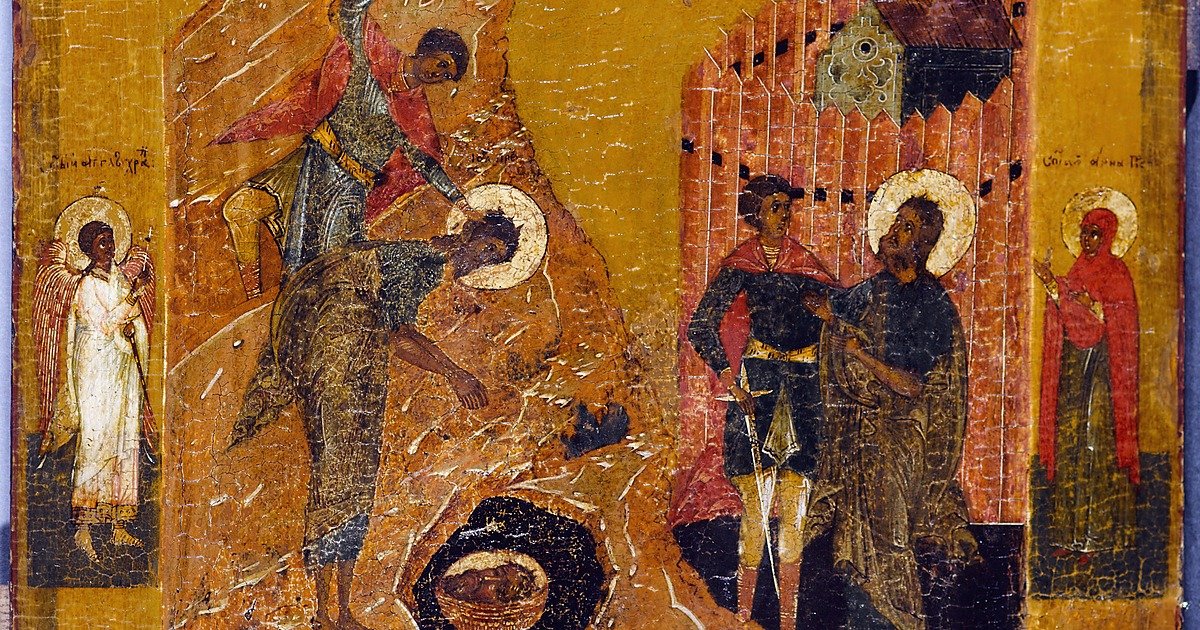
On 29 August the Church commemorates the killing of the Forerunner and appoints a fast on the feast day itself. What happened, what the sources say, and why the hymns call this death a divine dispensation.
On 29 August the Church commemorates the beheading of Saint John the Baptist. On this day, by order of Herod, the man of whom the Saviour said that none greater had arisen among those born of women was put to death (Matthew 11:11). The feast has an unusual rule attached to it: it is a fast day. The Church does not honour the Forerunner with a laden table but with abstinence, because his death took place in the middle of a banquet.
It is also the last great feast of the church year, which ends on 31 August, with another beginning on 1 September. The liturgical year draws to its close, then, with the memory of the man who went before the Lord.
What the Gospels record
Saint Mark tells the killing at length (Mark 6:14-29), Saint Matthew more briefly (Matthew 14:1-12). Both are read at the services of the feast.
Herod had imprisoned John on account of Herodias, “his brother Philip’s wife, for he had married her” (Mark 6:17). John had said to his face, “It is not lawful for thee to have thy brother’s wife” (Mark 6:18). For that word he was bound.
What follows in the account is unexpected. Herodias hated him and wanted him dead, but she could not have her way, “for Herod feared John, knowing that he was a just man and an holy, and observed him; and when he heard him, he did many things, and heard him gladly” (Mark 6:20). The man who held him in chains also protected him from death. He would send for him in prison and listen to him with pleasure.
Then comes the banquet. On his birthday Herod made a great supper for his officials, the commanders of his troops and the leading men of Galilee. The daughter of Herodias came in and danced, and her dancing pleased Herod and those who sat at table with him. Carried away, he promised her with an oath whatever she asked, “unto the half of my kingdom” (Mark 6:23). The girl went out and asked her mother what to request. Herodias had long been waiting for this moment, and she asked for the head of John the Baptist. The girl came back in haste and asked that the gift be brought at once, on a platter.
The king “was exceeding sorry,” yet “for his oath’s sake, and for their sakes which sat with him,” he would not refuse her (Mark 6:26). He sent a guard. John was killed in the prison, and his head was brought on a platter and given to the girl, who carried it to her mother. The Baptist’s disciples came, took the body and laid it in a tomb.
Who these people were
The Herod of the account is Herod Antipas, son of Herod the Great, who had ordered the killing of the infants of Bethlehem. Antipas ruled Galilee and Peraea with the title of tetrarch, a rank below that of king, meaning originally “ruler of a fourth part.” Saint Mark also calls him king, though this was not his official title.
Herodias was a granddaughter of Herod the Great and had been married to a half-brother of Antipas. The Gospels call him Philip; the Jewish historian Josephus calls him Herod, and modern historians often designate him Herod II or Herod Philip, to distinguish him from the other members of the family. He is not to be confused with Philip the tetrarch, who would later marry Salome.
Antipas had earlier been married to the daughter of Aretas IV, king of the Nabataeans, the neighbours to the east. When he resolved to take Herodias, he agreed with her to divorce his wife. The daughter of Aretas learned of the plan, however, and fled to her father. John’s rebuke therefore touched no hidden weakness of a private man but a public deed: Antipas was abandoning his wife for his brother’s wife.
Josephus, writing for Roman readers some sixty years after these events, also records the killing of John (Jewish Antiquities XVIII, 116-119). Of the rebuke over the marriage he says nothing. He says that Herod feared John’s influence over the crowds and feared an uprising, and that for this reason he sent him in chains to Machaerus, the fortress on the border between his own territory and that of Aretas, where he was put to death. He then adds something worth remembering: the Jews held that the defeat Herod later suffered in the war with Aretas was God’s punishment for the blood of John.
The two testimonies are not necessarily incompatible. The Gospels preserve the moral conflict caused by Herod’s marriage to Herodias and the immediate occasion of the killing; Josephus records the political fear of Antipas before the influence John had over the crowds. The two explanations may look at two sides of one decision, without our needing to make them identical.
The girl who danced at the banquet is not named in the Gospels. The name Salome comes likewise from Josephus (Jewish Antiquities XVIII, 5, 4), who says that Herodias had a daughter of that name by her first marriage.
A clarification of names belongs here as well. Some printed synaxaria and lives of the saints call the ruler of the account Herod Agrippa. This is a confusion, easily made among so many Herods. Herod Agrippa I was the brother of Herodias, reigned later, and is the one who killed the Apostle James with the sword (Acts 12:1-2). The man in whose prison the Baptist was held is Herod Antipas.
The fear of men
What brought Herod down was not a complete indifference towards holy things. He feared John, knew him to be just and holy, and listened to him gladly. Even after killing him, when he heard of the Saviour’s miracles, his first thought was that John had risen from the dead (Mark 6:16). Saint John Chrysostom dwells on this detail in his Homilies on Matthew (Homily XLVIII) and marvels at it: so great a thing is virtue, that Herod feared John even after he had killed him.
And yet he killed him. The Gospel says plainly why: for the oath, and for those who sat at table with him. A rash oath, sworn in the middle of a banquet, and a few dozen men watching him.
Saint John Chrysostom does not accept the excuse. He asks Herod how he came to fear having witnesses to a broken oath, yet did not fear having so many witnesses to a lawless murder. An oath that binds a man to evil does not bind. Whoever keeps it adds to the sin of the rash oath the sin of the deed itself.
So a man collapses who was not without good inclination. Herod did not come to murder by the road of hatred but by the road of shame. He was ashamed to draw back before his guests. He weighed what those at table would say against what God would say, and he chose the table.
Why the Church fasts on the feast day
The fast of 29 August is not a folk custom but a rule of the Church. The Menaion, the book containing the services of the saints for each month, also gives the reason: on this day it is fitting for us to be in sorrow rather than in the pleasure of the belly, because of the abstinent life of the Saint and because of the blood he shed.
The rule has its own logic. John died at a banquet. His head was carried on a platter among the dishes, like food brought to the table. The Church answers a banquet with a fast.
The day is kept as a fast day. According to the rule given in the Romanian Menaion, oil and wine are permitted. Meat, eggs, dairy and fish remain forbidden. In some places a stricter measure has been kept; anyone in doubt should follow the practice of his parish and the word of his spiritual father.
In some regions other customs have grown up alongside the fast: not eating round fruit, not cutting with a knife, not setting food on plates. These are local usages, not rules of the Church. No one sins by not keeping them, and no one fulfils the feast merely by keeping them. What the day asks for is fasting, prayer and honour towards the man killed for the truth.
A divine dispensation
The kontakion of the feast, in the fifth tone, says: “The glorious beheading of the Forerunner became an act of divine dispensation, for he preached to those in hell the coming of the Savior.”
This word needs explaining, so that it is not understood backwards. The Church does not say that God willed Herod’s deed. The deed was Herod’s, and the same kontakion openly calls it lawless murder and laments it, calling Herodias to mourning because she loved what is false and passing rather than the law of God. The Church says something else: that God ordained that this death, coming from the hand of man, should serve the very work for which John had been sent.
John was born six months before Christ. He preached before Him. He pointed to Him at the Jordan. And now he dies before Him and goes down, again before Him, to the place where all the departed then went. And there he does what he did all his life: he announces that the awaited One is coming.
The canon of the feast says the same thing through a likeness taken from the sky. It calls John the morning star, that is, the star which appears before the sun rises. The morning star does not bring the day; it announces that the day is coming. So John went on earth, before Christ, the Sun of righteousness. And so too, the canon says, he ran ahead into Hades, as the servant who announces the coming of the Master.
The troparion of the day bears the same witness: having contested for the truth, the Forerunner brought the good tidings even to those in Hades, of God made manifest in the flesh. And the synaxarion of the day puts it simply: as he went before the Lord in birth, so it was fitting that he should go before Him in death.
John went before the Lord as far as death. His service did not end in the prison at Machaerus; there it was fulfilled.
What the feast asks of us
John did not die for an opinion of his own. He died for a commandment of God’s law, spoken to the face of a ruler unaccustomed to hearing that anything was not lawful for him.
At the Liturgy of the feast, beside the Gospel of the killing, the Church sets a word spoken by Saint Paul in the synagogue at Antioch. Paul reminds his hearers what John was saying at the end of his course: “Whom think ye that I am? I am not he. But, behold, there cometh one after me, whose shoes of his feet I am not worthy to loose” (Acts 13:25). The crowds were wondering whether he might be the Messiah, and he told them plainly that he was not. A man defending his own place does not speak like that. The man who died for the truth had already lived pointing to Another.
Saint Cleopa of Sihăstria says of him that he never flattered anyone, and yet the people did not hate him, because he told them the truth for their salvation.
John has remained in many minds only as the harsh man of the desert, but the Gospel shows something else as well. When the crowds asked him what they should do, he asked nothing of them beyond their strength: whoever has two coats should give to him who has none, tax collectors should exact no more than is appointed them, soldiers should oppress no one and be content with their wages (Luke 3:10-14). He did not take the tax collectors out of their office, nor the soldiers out of the army. And Saint Luke closes his preaching thus: “And many other things in his exhortation preached he unto the people” (Luke 3:18). In the Gospel the Baptist’s word is called good tidings.
His severity had a target. He said “O generation of vipers” to those who came to him without fruits worthy of repentance and to those who relied on having Abraham for their father (Matthew 3:7-9). These words do not make John a harsh man, however. Gentleness is one of the fruits of the Spirit, and John was filled with the Holy Spirit from his mother’s womb (Luke 1:15). Severity was not his nature but the way he dealt with sin and with false self-justification.
This is clear from the way he dealt with his own. Two of his disciples left him to follow Christ, and he himself had pointed Him out to them (John 1:35-37). When the others came in vexation, telling him that everyone was going to the Other, he did not rebuke them and did not defend his place. He answered that he was the friend of the bridegroom, who stands and hears him and rejoices at his voice, and then added, “He must increase, but I must decrease” (John 3:26-30). A man’s nature shows where what he has is taken from him. Everything was taken from John, and he rejoiced. That even Herod listened to him gladly shows the same thing by another road: no one listens with pleasure to a man who only thunders. He rebuked the sin so that the man might turn.
That rebuke cost him his head, and the feast does not hide the price.
The hardest lesson of the day comes not from John, however, but from Herod. John shows us how high a man can rise. Herod shows us how little it takes for a man to fall from the height he had reached: a banquet, a rash oath, and the shame of drawing back before those who were watching him. Herod had listened gladly to the man he was to kill, and until then had protected him himself. It availed him nothing, because when the truth asked of him a price to be paid in front of men, he sold it. A man can honour the truth for a long time and lose it in a single evening.
On 29 August the Church bows before a severed head, carried on a platter in the middle of a party. Those at the table reckoned then that they had rid themselves of a troublesome voice. The voice did not fall silent. It went down among the departed and announced there too that Christ was coming.
For this reason the day is not one of mourning only. It is a day of fasting and of prayer to the one who now stands before the Lord: O holy Prophet John, Forerunner and Baptist of the Lord, pray to God for us.
Related articles
- Why the Church celebrates the Nativity of Saint John the Baptist — the feast of 24 June and the rare rule of birthdays kept as feasts.
- Saint Elias the Prophet: from fire to the still small voice — the man whom the hymns of the Church call a second Forerunner.
- Great and Little Blessing of Water — on the Baptism of the Lord in the Jordan and the rule of holy water.
Image: The Beheading of Saint John the Baptist, seventeenth-century Moscow School icon, Musée des Beaux-Arts de la Ville de Paris; public domain, via Wikimedia Commons.