
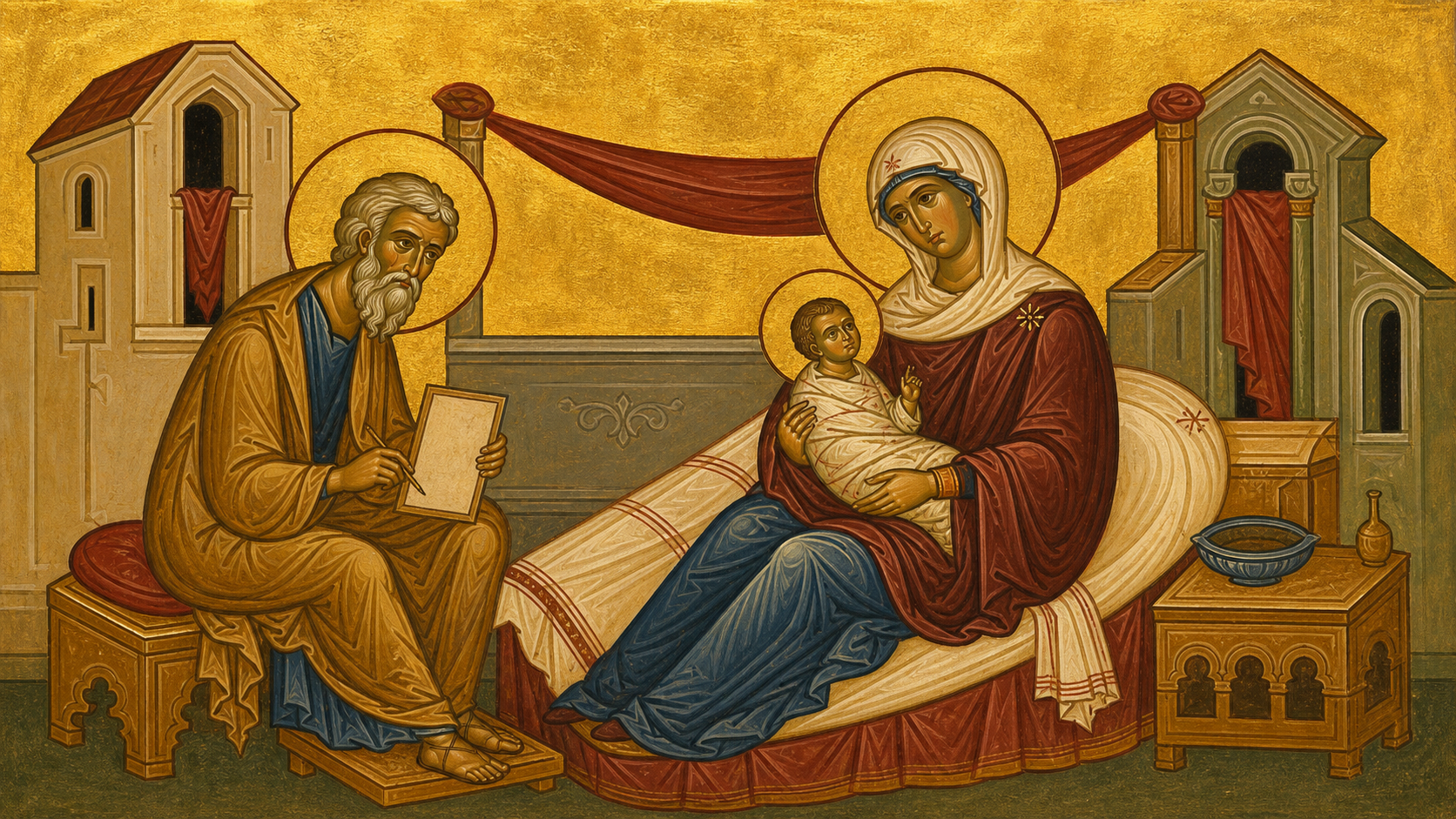
On the 24th of June, the Church celebrates the nativity of Saint John the Baptist. It is one of the few days in the entire liturgical year on which we commemorate not a saint’s passing from this life, but his coming into the world. This distinction, which at first glance seems a mere detail of order, in fact conceals an entire teaching about what holiness is and where it comes from.
For nearly all the saints, the Church celebrates the day of their repose — the day of bodily death, which tradition calls birth into the Kingdom. The reasoning is clear: a person’s life is weighed at its end. The saint struggled, endured, was purified, and at the last passed over the threshold to Christ. The day of death is the day of victory, because it is then that we see what a person has become after a lifetime of struggle. This is why the commemorations of the saints are, in the overwhelming majority, commemorations of the end, not of the beginning.
And yet three nativities have received in the Church’s calendar a special liturgical commemoration of universal observance. We celebrate the nativity of our Lord Jesus Christ, on the 25th of December. We celebrate the nativity of the Most Holy Theotokos, on the 8th of September. And we celebrate the nativity of Saint John the Baptist, on the 24th of June. The question that arises naturally from this order is: why John in particular? What is it about his birth that the Church places it among these feasts of the beginning, beside the nativity of the Lord and of His Mother, when for all the other saints she awaits the end in order to commemorate them?
The three nativities and what holds them together
To understand the place of the Forerunner, we must first see why the other two nativities are celebrated. The nativity of the Saviour is celebrated because it is the very entrance of God into the world: the Word becomes flesh, the Invisible One appears, and the history of salvation reaches its centre. Here no human life is weighed at its end, for the One who is born is true God, holy by His own nature, not through ascetic struggle. His birth is not the beginning of a road toward holiness, but the descent of Holiness itself into our midst.
The nativity of the Theotokos is celebrated for a kindred reason. She is chosen before the ages to be the Birthgiver of God, and her coming into the world opens the door through which Christ would enter human nature. And yet this election does not abolish her freedom. The Incarnation itself is bound to her free response: “Be it unto me according to thy word” (Luke 1:38). God proposes, but does not compel; the Virgin freely cooperates with grace. Her nativity is celebrated not as the commemoration of a holiness already perfected at the beginning, but because her whole life is, from her conception, ordered toward one thing: to bear the One whom the heavens cannot contain — something she will accomplish through obedience and cooperation, not apart from them.
A common thread is already visible, but it must be named with care. The three nativities are not united by an identical mode of holiness. Christ is Holy by nature, the very Source of holiness; the Theotokos and the Forerunner are creatures sanctified by grace, who respond freely to the divine calling. What holds them together, therefore, is not a single way of being holy, but their immediate connection to the mystery of the Incarnation. In all three, the coming into the world is bound in a unique way to the economy of salvation — whether as the entrance of God Himself, or as the immediate preparation for that entrance. It is precisely here that the Forerunner takes his place.
Sanctified from the womb
Saint John is not merely a saint whose holiness is revealed at the end of his life. In his case, Scripture testifies to God’s sanctifying work even before his birth. When the Archangel Gabriel announces to Zechariah, in the Temple, the birth of his son, he tells him something without parallel: the child “shall be filled with the Holy Spirit, even from his mother’s womb” (Luke 1:15). What is announced is not a holiness that John would acquire only at the end of his ascetic struggle, but a work of the Spirit that accompanies him before he sees the light of day. This does not abolish his later struggle; it grounds it. For only God is holy by nature — John is holy by grace, and grace, however early, works in a person without robbing him of his freedom.
This announcement does not remain an abstract promise. It is confirmed by an event that the Evangelist Luke recounts with shattering clarity. After the Annunciation, the Virgin Mary, already bearing the Saviour in her womb, goes to visit her kinswoman Elizabeth, who was with child with John. At the meeting of the two women something takes place that surpasses all nature: “when Elizabeth heard the salutation of Mary, the babe leaped in her womb; and Elizabeth was filled with the Holy Spirit” (Luke 1:41). The unborn child leaps. Before he has speech, before he has a formed mind, before he can know anything with the intellect, John rejoices in the womb at the drawing near of the Master, whom His Mother also bears in her womb.
Here something is revealed about John’s holiness. It does not wait for the end of life to appear; the working of grace upon him is made manifest from the very beginning. The leaping of the babe is no ordinary motion, but the first prophecy of the Forerunner — a prophecy made not with words, which he did not yet have, but with his very being. He proclaims the coming of Christ before he is born, because his entire being is, from conception, turned toward the One who comes. This is the ground on which the Church celebrates his nativity: not because holiness came to him ready-made, sparing him all struggle, but because his very coming into the world bears, from the beginning, the mark of the work for which he was brought here — a work he will then fulfil through the wilderness, obedience, confession, and martyrdom.
From this we also understand something about the order of commemorations in general. The Church does not celebrate the nativity of ordinary saints because, at birth, they are still at the beginning of the struggle: before them lies an entire road of ascetic labour and purification, and their holiness — if it comes — will appear only at the end. In John’s case, the difference is not that he is spared this road, but that his road is manifestly sanctified from the first step. The Forerunner is accompanied by grace from the beginning, because from the beginning he was to go before the Lord.
The boundary between Law and Grace
To understand fully why John occupies this unique place, we must set him where the Saviour Himself sets him: at the boundary between two ages of the world. Saint John is the last of the prophets. He brings to a close the long line of those who proclaimed, from afar, the coming of the Messiah — Isaiah, Jeremiah, Daniel, and all the others who looked toward Christ as toward a light that would one day rise. John is the end of this line. But he is not only the last to proclaim from afar; he is the first to point with his finger. The other prophets spoke of the One who was to come; John showed Him present, saying: “Behold the Lamb of God, which taketh away the sin of the world” (John 1:29).
In his person, then, two ages meet. Behind him stands the whole of the Old Law, with its prophets, its waiting, the shadow of the things that were to come. Before him opens Grace, with Christ made manifest in the flesh. John is the threshold. He closes one age of the world and opens the other. This is precisely why his nativity is not the nativity of an ordinary man, but the nativity of the boundary itself — the moment in which the last step of the Law is climbed, so that one may step into Grace.
This forerunning is inscribed even in the order of time. According to the chronology in the Gospel of Luke, John is born six months before Christ — the angel tells the Virgin, at the Annunciation, that Elizabeth “is in her sixth month” (Luke 1:36). This is why the calendar too makes him Forerunner: not only through his preaching and his pointing out of the Lamb, but through the very succession of the feasts. His nativity on the 24th of June goes before the Nativity of the Lord on the 25th of December, as the voice goes before the Word. Forerunning is not merely a service that John performs; it is woven into the very placing of his life within time.
Here something must be said plainly, so that no shadow remains: John’s greatness does not come from himself, but from his nearness to Christ. He is great because he is near to the Great One. All his worth lies in this, that he goes before the Lord and points Him out. The Forerunner has nothing that is his own and his alone; all that he has is a turning toward Another. And precisely in this lies, as we shall see, the deepest teaching that his life gives us.
The teaching born of silence
The nativity of the Forerunner is surrounded, in the Evangelist Luke’s account, by a silence that deserves a closer look, for it too says something about the order of this feast. When the angel announces to Zechariah, in the Temple, that he will have a son in his old age, the aged priest doubts. His advanced years and Elizabeth’s barrenness seem to him an obstacle that not even the angel’s word can overcome. And for this doubt, Zechariah is struck dumb: “thou shalt be dumb, and not able to speak, until the day that these things shall be performed, because thou believest not my words” (Luke 1:20).
Zechariah’s silence is not a meaningless punishment. It has a depth that the spiritual tradition reads clearly. Speech is taken from him precisely because he did not believe the word, and he remains in silence until the moment when, through obedience, he is loosed. For when the child is born and the question is raised what he should be called, those around them want to give him his father’s name, Zechariah. But Elizabeth resists, saying that his name shall be John. And Zechariah, asked by signs, calls for a tablet and writes: “His name is John” (Luke 1:63). In the moment he submits to the angelic word — in the moment of obedience — his tongue is loosed, and the first thing he utters is not an ordinary word, but a prophecy: the hymn the Church calls the Benedictus (Luke 1:68 and following).
This order has a meaning that reaches beyond Zechariah. The true word is not born of ceaseless speech, but of silence and of obedience. Unbelief, which wishes to speak before submitting, falls dumb; obedience, which is silent and receives, looses the tongue unto prophecy. It is an order deeply akin to the whole tradition of watchfulness: true prayer and the true word are born of the stillness that listens, and not of the mind that wishes to speak of itself.
And it is fitting that the very nativity of John should be surrounded by this silence that bears speech as its fruit. For John himself will be the voice — the voice of one crying in the wilderness, proclaiming the Word. And that voice is born, quite literally, of a silence: the silence in which his father was held until the hour of obedience. Before the voice of the Forerunner was heard in the wilderness of the Jordan, silence fell upon the house of Zechariah. The word comes after silence, never before it.
The paradox: the greatest and the least
Of no one did the Saviour speak loftier words than of John. “Verily I say unto you, Among them that are born of women there hath not risen a greater than John the Baptist” (Matthew 11:11). It is the greatest praise a man ever received from the mouth of Christ. And yet, in the same sentence, the Lord adds something that seems to take back all He has given: “notwithstanding he that is least in the kingdom of heaven is greater than he” (Matthew 11:11).
How are these reconciled? How can John be, in the same instant, the greatest of those born of women and less than the least in the Kingdom? The answer leads us into the very heart of what we celebrate at his nativity.
Saint Maximus the Confessor, in his Questions and Doubts (question 47), considers this saying and gives not a single interpretation, but four. According to the first, greater than John is the one who humbles himself more than he — a reading that binds greatness to lowliness, and not to any degree of knowledge. According to the second, the least knowledge of the life to come surpasses the highest knowledge of this present life. According to the third, the highest human theologian remains lower than the last of the angels, since the Kingdom, in John’s time, was not yet opened to men. And according to the fourth, the least degree of evangelical living is higher than the greatest degree of the Law. Four keys, not one — and each opens a different face of the same saying.
Two of them intertwine naturally and help us understand why John is, at one and the same time, summit and threshold. None of the prophets of the Old Covenant drew nearer to the fulfilment of the promise than the Forerunner; in this sense he is indeed the greatest of those born of women, the highest point to which human nature could climb before the coming of Grace. And yet the knowledge of God in the time of the Law, however high, remains a knowledge “in part,” a knowledge “as through a glass, darkly” (1 Corinthians 13:12). It looks toward Christ, but from a distance, through shadows and prophets. With the coming of Christ a knowledge of another kind is opened: not a beholding from afar, but communion; not shadow, but truth made present. And the least degree of evangelical life partakes of a fulfilment that the Law could only prefigure. This is why Saint Maximus says that even the very least knowledge of the life to come is greater than the highest knowledge of this present life.
Here, however, a clarification is in order, lest we draw from the saying more than it says. This interpretation concerns the height of the gift and of the evangelical economy, not the moral worth of each individual Christian. The saying shows how great is the gift brought by Christ — so great that the least degree of evangelical life attains what the Law only foretold. It does not say that any baptized person would be, by his mere belonging, holier than John. A Christian who lives unrepentant does not surpass the Forerunner by the name he bears. What is spoken of is the height of the gift, not a moral superiority gained without labour.
With this clarification, the paradox becomes clear. John is greater than all, because he climbed the highest step of the Law. And the least degree of the Kingdom surpasses him, because the Kingdom is a new age, in which man no longer beholds God from afar, but partakes of Him. John stands on the boundary: he attained the summit of all that was possible before Christ, in the time when the Kingdom was not yet opened to men. He points out the Door and finds himself, by his place in the economy, upon its very threshold. This is precisely why he is both the greatest and the least — because he is the boundary itself, the end of one world and the beginning of another.
It should be said, in fairness, that this is not the only reading the Tradition has given. Saint John Chrysostom, for instance, understands by “the least” Christ Himself — less than John in age and in the esteem of the crowd, but incomparably greater through His divinity. The Lord’s word is deep enough to bear several interpretations, without any one of them abolishing the others.
What the nativity of the Forerunner teaches us
The whole life of Saint John stands under a single word, which he himself spoke concerning his relation to Christ: “He must increase, but I must decrease” (John 3:30). In these words his entire being is contained. John never makes himself the centre. He does not come to gather disciples around himself, but to send them to Christ. When his own disciples are troubled at seeing the crowds begin to follow Jesus in his place, John does not defend himself, does not claim his position, but rejoices — for this was his whole work: to decrease, that Christ might increase.
Here today’s feast touches a teaching that reaches beyond history, straight into the heart of the spiritual life. True holiness never makes itself the centre. The one who comes to gather around himself, who seeks his own glory, who wishes to be beheld, has already stepped outside the order of the Forerunner. John shows us that the highest degree of holiness — for he is the greatest of those born of women — coincides with the deepest self-abasement. The greater he was, the more wholly he turned toward Another. His greatness and his self-abasement do not contradict each other; they are one and the same thing seen from two sides.
This is a touchstone for everything that bears the name of holiness. Wherever a person sets himself at the centre, wherever his spiritual work revolves around his own person, his own vision, or his own authority, something has gone wrong with the order that John embodies. The Forerunner is not the forerunner of Christ in history alone; he is the image of every true spiritual work, which does not live for itself, but withdraws from the centre and becomes transparent to Christ. For in holiness the person is not extinguished — John remains, living and confessing — but self-centredness is extinguished, the desire to be oneself the spectacle. The one who makes himself an object of beholding has missed forerunning itself, which is to say, has missed the very thing that makes a work be from God, and not from oneself.
This is why we celebrate, in rare fashion, a nativity: because this is not the nativity of a man who has yet to decide which way he will go, but the nativity of one whose life is, from the beginning, turned toward the One who comes. John comes into the world accompanied by grace, as the voice of a Word that is not his own — and he will fulfil this calling through the wilderness, through preaching, through the baptism of the Lord at the Jordan, and at the last through the blood of confession. In celebrating this day, the Church confesses a truth about the whole of life in Christ: that the greatest is the one who decreases, and that holiness, at its summit, is nothing other than to be wholly turned toward the Lord.
On the 24th of June, therefore, we celebrate the boundary. We celebrate the threshold between promise and fulfilment, between shadow and truth, between Law and Grace. And we celebrate the one who pointed out the Door before the mystery of the Cross and the Resurrection was fulfilled in history. Yet it must be said plainly, so that no shadow remains: that John stood upon this threshold concerns the time of his earthly life, before the Cross, the Resurrection, and Pentecost. He died before Pascha, but he did not remain outside the victory of Christ. On the contrary, the Church’s hymnography of the Beheading testifies that the Forerunner proclaimed to those in Hades as well the coming of the Saviour — that he went before the Lord there too, in the darkness of death, proclaiming to those below the coming of Life. His forerunning does not stop at the grave; it is fulfilled beyond it. John pointed out the Door to others while he lived, and through the risen Christ he himself entered the Kingdom he had proclaimed. He stood upon this threshold not in order to remain forever outside it, but in order to show us all the way into it.
The bond between the two great prophets is explored further in the life of the Holy Prophet Elijah, whom the Church’s hymns call the second Forerunner.
Related: The Forerunner’s nativity continues the biblical pattern of wombs opened in old age, also seen in the life and dormition of Saint Anna, mother of the Theotokos.