
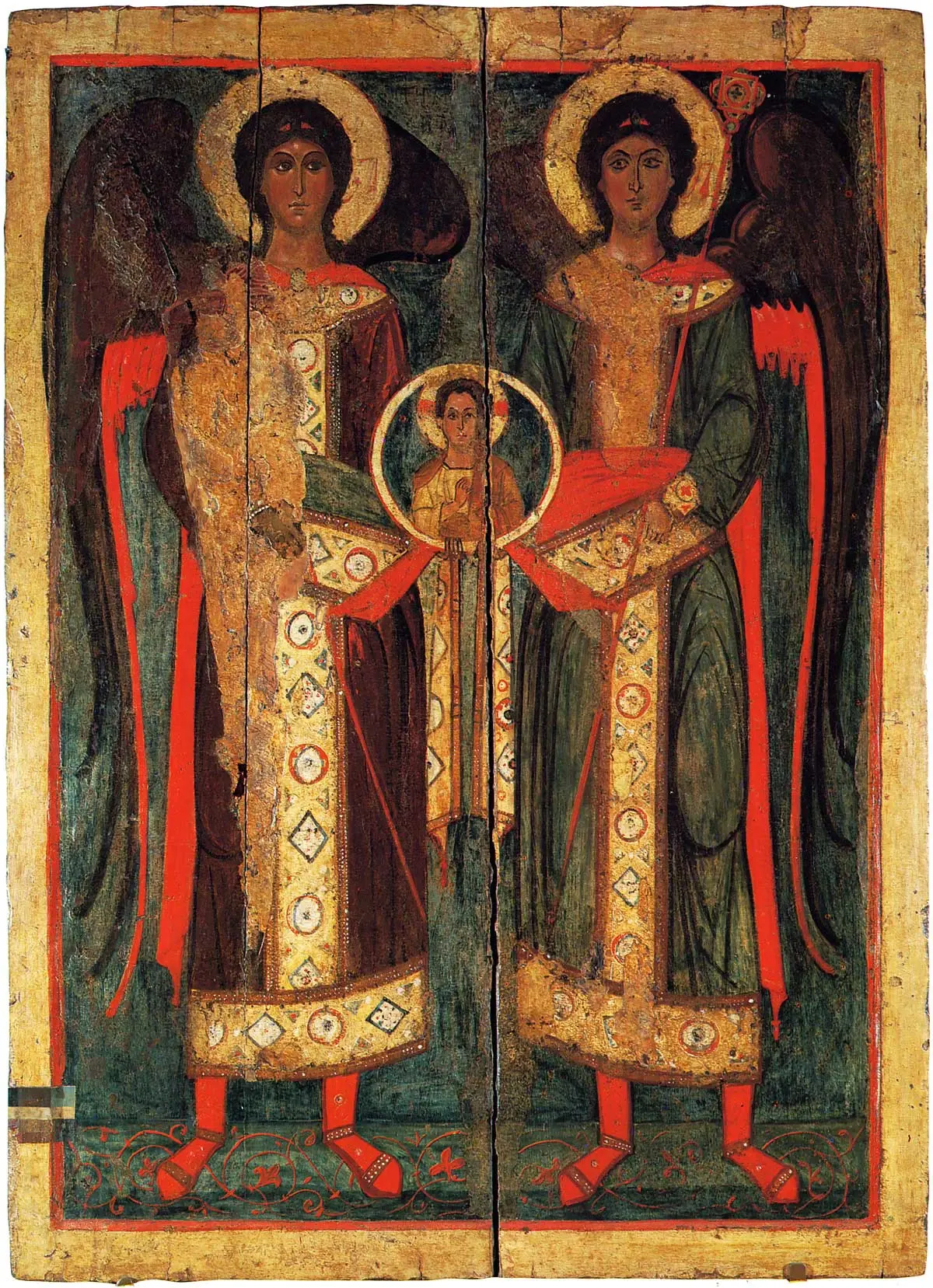
On 8 November (21 November for the Churches that keep the old calendar), the Church celebrates the Synaxis of the Archangels Michael and Gabriel and of all the Bodiless Powers of Heaven. The word "synaxis" means a gathering: on this day all the angels who remained faithful to God are honoured together, and at their head stand Michael and Gabriel, the archangels of whom Holy Scripture speaks the most. "Archangel" means chief of the angels, and the hymns of the Church also call these two Archistrategoi, that is, the commanders of the heavenly hosts.
In honouring them, the Church remembers that the unseen world stands very close to us. The angels serve the salvation of mankind, guard every believer, and rejoice in heaven when a sinner returns to God. The service of the feast, contained in the Menaion for November, the service book of the month, gives the faithful the words with which to honour them, and also shows where the feast takes its name from.
In this article
What "synaxis" means
The Synaxarion of the day, the short account read at Matins, begins with a fall. The most radiant of the angels grew proud against his Creator, wished to set his throne above the clouds, and fell, and the host that followed him fell with him. Then the Archangel Michael gathered the ranks that had remained in the light. The Lives of the Saints preserve the words with which he called them:
"Let us attend! Let us stand aright, let us stand with fear before Him Who made us, and let us think nothing contrary to God."
The faithful angels had seen how their brethren, created together with them and partaking of the same divine light, had become darkness through pride. Michael urged them to take heed of what these had suffered, and then, together with the Seraphim, the Cherubim and all the ranks, he began to sing: "Holy, holy, holy, Lord of Sabaoth; heaven and earth are full of Your glory!"
From this the feast takes its name. The Menaion says that such a gathering "was called the synaxis of the angels, that is, attention, and joining together, and union." The angelic synaxis was thus born of attention and of praise: those who remained faithful gathered around God and glorified Him with one voice.
We hear the words "Let us attend!" several times at every Divine Liturgy. In this way the Church on earth receives the same call that the Archangel addressed to the heavenly ranks.
Why in November, on the eighth day
The Lives of the Saints also explain the choice of the day. November is the ninth month if we count from March, which the old reckoning held to be the first month of the creation of the world, and the number nine signifies the nine ranks of angels. The eighth day turns our thoughts to the age to come, for the teachers of the Church call "the eighth day" the day of Judgement, when the Son of Man will come in His glory and all the holy angels with Him. Then, the same text says, all the angelic ranks will be gathered, and the Church prays that on that day we too may be gathered into the company of the Lord's elect.
The same account recalls that the feast was established after the Church had cleansed the veneration of angels of an old error. In the region of Colossae, which belonged to the Metropolis of Laodicea, some offered the angels a worship like that given to idols, and the Holy Fathers gathered in council at Laodicea condemned this worship. From then on, the text says, "the right faith and the worthy honour of celebrating the holy angels were established, as servants of God and guardians of the human race." Churches of the Archangel Michael were later built in that region, and at Chonae he appeared to Saint Archippus. The angels receive honour as servants of God, while worship as to God, which the Holy Fathers call latreia, belongs to Him alone.
Who the angels are
The name "angel" shows their service. The word comes from the Greek angelos, a messenger, one who is sent, and the Lives of the Saints say plainly that "the name angel does not show their very nature, but only their service. All, then, are angels, because all serve God." At Matins of the feast the verse of the psalm is sung: "Who makest Thine angels spirits, and Thy ministers a flame of fire."
Saint John of Damascus gives a clear definition in his Exposition of the Orthodox Faith: "An angel, then, is an intelligent essence, in perpetual motion, with free-will, incorporeal, ministering to God, having obtained by grace an immortal nature." And he explains at once what this means: "It is immortal, not by nature but by grace. For all that has had beginning comes also to its natural end."
The same Father takes up the teaching of Saint Dionysius the Areopagite, whom the Church honours as a disciple of the Holy Apostle Paul, on the nine ranks of angels, arranged in three orders. The order closest to God comprises the Seraphim, the Cherubim and the Thrones; the middle order, the Dominions, the Powers and the Authorities; the lowest, the Principalities, the Archangels and the Angels. Saint John of Damascus shows that "the higher share their brightness and knowledge with the lower," and the angels of the last rank are the nearest to men.
The Epistle read at the Liturgy of the feast adds something that fills us with wonder. It brings the words of the psalm: "What is man that you are mindful of him, or the son of man, that you care for him? You made him a little lower than the angels," and shows that the Son of God Himself became man in order to lead man to glory: "But we see Jesus, who was made a little lower than the angels, crowned with glory and honor because of the suffering of death" (Hebrews 2:6–9). There, too, it is said: "For it was not to angels that God subjected the world to come." The heavenly powers, so exalted, serve the salvation of a nature that Christ took upon Himself.
Michael: "Who is like God?"
The name Michael is interpreted from the Hebrew as "Who is like God?" The Prophet Isaiah speaks of the one who wished to rise above the stars, the morning star fallen from heaven, who said in his heart that he would set his throne above the stars of heaven and "I will be like the Most High" (Isaiah 14:14).
Set beside this thought, the Archangel's name sounds like an answer, for it carries the question before which all pride is scattered. He who stands at the head of the heavenly hosts has remained a servant. The Synaxarion says that, "keeping faith with the Master as a faithful servant," he was appointed by God chief over the noetic ranks, as the Menaion calls the bodiless powers. His humility is seen in Scripture too: the Apostle Jude relates that the Archangel, when he contended with the devil about the body of Moses, did not dare pronounce a reviling judgement upon him, and left the judgement to the Lord (Jude 9). The commander of the heavenly hosts fights with strength and claims nothing of the honour of the One Who sent him.
Scripture shows him protecting the people of God. In the book of Daniel, the angel sent to the prophet says that "Michael, one of the chief princes, came to help me" (Daniel 10:13), and further on calls him "Michael, your prince" (Daniel 10:21). Of the last times the same prophet proclaims: "At that time shall arise Michael, the great prince who has charge of your people" (Daniel 12:1). At Vespers of the feast we hear of Joshua, son of Nun, meeting the one who told him: "I am now come, the chief captain of the host of the Lord," and then commanded him: "Loose the shoe from your feet; for the place on which you stand is holy" (Joshua 5:13–15). The Synaxarion recognizes Michael in this chief captain. And in the Apocalypse, Saint John sees Michael and his angels waging war against the dragon, until the dragon, who is the devil, was cast out of heaven to the earth (Revelation 12:7–9).
The Gospel of the Liturgy of the feast brings the witness of the Lord Himself: "I saw Satan fall like lightning from heaven" (Luke 10:18). And the Doxastikon of the Praises shows what the Archangel's victory means for those who call upon him:
"Where your grace overshadows, O Archangel, from there the power of the devil is driven away; for the fallen Morning Star cannot bear to remain in your light."
Gabriel: the servant of the Incarnation
The name Gabriel is interpreted "man of God" or "strength of God". To him was entrusted the announcement of the greatest mystery.
Already in the Old Testament, Gabriel interpreted the prophet Daniel's visions and revealed to him the time when God's Anointed would come (Daniel 8:16; 9:21–27). In the New Testament he appears to the priest Zacharias beside the altar of incense and tells him that he stands before God and has been sent to announce to him the birth of John (Luke 1:11–19). Then he is sent to Nazareth, to the Virgin Mary, with the greeting that the Church has sung unceasingly ever since. The Menaion of the feast calls us to cry out with him: "Rejoice, O full of grace, the Lord is with you."
The Synaxarion gathers his whole ministry into a single sentence: "the divine Gabriel served the economy of the mystery of the Incarnation of the Word of God from beginning to end." The economy is the work by which God orders the salvation of man. The same Synaxarion adds that Gabriel announced to Joachim and Anna the birth of the Virgin, that he fed her in the Holy of Holies, that he announced to the shepherds the birth of Christ, and that he told Joseph to flee with the Child into Egypt. Many of the Church's teachers hold, as the Synaxarion also says, that he is the angel clothed in white who rolled away the stone from the tomb and announced the Resurrection to the myrrh-bearing women.
A sticheron of Vespers praises him thus: "Gabriel, the pre-eternal Mind set you as a second light, to illumine the whole wide world," and goes on to say that through him we learn the great mystery hidden from the ages: the One Who was without body took flesh in the Virgin's womb and became man in order to save man.
"The pre-eternal Mind" is God. As for "a second light", Saint John of Damascus explains that angels "are secondary intelligent lights derived from that first light which is without beginning." Whenever we honour the Mother of God with the greeting "Rejoice", we share in the joy that Gabriel was the first to bring to earth.
The angels beside each one of us
The canon of the feast thanks Christ for a care that we receive every day without seeing it: "As the Merciful One, You have appointed angels as guardians of men, and shown them to be ministers of the salvation of Your servants, O Christ." The Lord speaks of the little ones whose angels always behold the face of the Father in heaven (Matthew 18:10), and the Apostle calls all the angels ministering spirits, sent forth to serve for the sake of those who are to inherit salvation (Hebrews 1:14). Saint John of Damascus says of them, quite simply: "They govern all our affairs and bring us succour."
The Lives of the Saints describe this ministry with tenderness:
"They are set to guard us, each one of the faithful. Those of us who are good, they hold up so that we do not fall; and those of us who fall, they raise up. They never leave us, though we sometimes sin, and they are always ready to help us, if only we ourselves are willing."
The closing words, "if only we ourselves are willing," show how the guardian angel works. He does not snatch us out of sin against our will; he goes with us, raises us when we fall, and waits for us to stretch out our hand towards his help.
The Oikos of the feast sets before us the joy that repentance brings: "You said, O Lover of mankind, in Your Scriptures, that multitudes of angels rejoice in heaven over one man who repents, O Immortal One." The Lord said this in the parable of the lost coin (Luke 15:10). The angels, who remain steadfast in good, rejoice over every man who weeps for his sins and returns to the Father. The same Oikos ends by confessing: "for the Commanders of the bodiless ones intercede for us all."
The Church has appointed Monday of every week to be dedicated to the holy angels, and the canon of the feast confesses the union into which Christ has brought us: He ineffably joined the heavenly with the earthly and made one Church of angels and men.
What the feast asks of us
The Lord, having said that He saw Satan fall like lightning, gave His disciples an instruction that concerns us all: "Nevertheless do not rejoice in this, that the spirits are subject to you; but rejoice that your names are written in heaven" (Luke 10:20). Victory over the evil spirits comes from God, and the true joy of a Christian lies in being written in heaven, together with the angels who did not fall.
A sessional hymn of Matins shows how we truly honour the angels:
"Desiring to praise the ranks of the bodiless, let us who are on earth imitate their holiness as far as we can, putting to death all the members of the body, and asking them, as defenders and guardians, to deliver us from every deceit of the invisible enemy."
To put to death the members of the body here means to slay the passions, those of the body and those of the soul alike, while the body itself, a creature of God, remains called to holiness together with the soul. The honouring of the angels therefore begins with our own life: with fasting, with prayer, and with attention to the thoughts that enter the heart. In this way we return to the word from which the feast was born. The first thing the faithful angels did after the fall of the proud was to attend, and to gather around God with fear and with praise. The Church asks the same of us at every Liturgy, when she calls us to attend and to stand with fear before Him Who made us.
Those who bear their names
On this day those who bear the names of the archangels, Michael and Gabriel, and the feminine forms of these names, celebrate their name day. The custom belongs to the whole of Orthodoxy and begins at Baptism, when a Christian receives the name of a saint who will be his protector and example all his life. The name day is therefore the feast of one's patron, and whoever keeps it honours him first of all.
Whoever bears the name of Michael carries within him the question "Who is like God?", and whoever bears the name of Gabriel is called to receive and to pass on the good news that the Archangel brought to the Virgin. The most beautiful way to honour this day is to go to the Divine Liturgy, to receive Holy Communion if one has prepared with one's spiritual father, and to ask one's patron for shelter and deliverance from troubles, as the troparion of the feast sings.
The prayer of the feast
The troparion of the day gathers all this into a prayer that we can say every day:
"Commanders of the heavenly hosts, we who are unworthy beseech you, by your prayers encompass us beneath the wings of your immaterial glory, and faithfully preserve us who fall down and cry to you: 'Deliver us from all harm, for you are the commanders of the powers on high!'"
Those who "fall down" are those who bow before the archangels and pray to them with all their heart, not those who fall into sin. The troparion asks of the archangels what is natural to them: to shelter us, as wings protect, and to deliver us from harm through their prayers to God.
The canon of the feast also teaches us with what voice to praise them: with lips of clay, let us honour with fear in our songs those who are immaterial. We know ourselves to be made of clay, while they are like fire and light; and yet our song reaches them, for the same Church embraces angels and men, and the same praise rises from heaven and from earth to the consubstantial Trinity.
Holy Archangels Michael and Gabriel, and all the heavenly powers, pray to God for us.
