
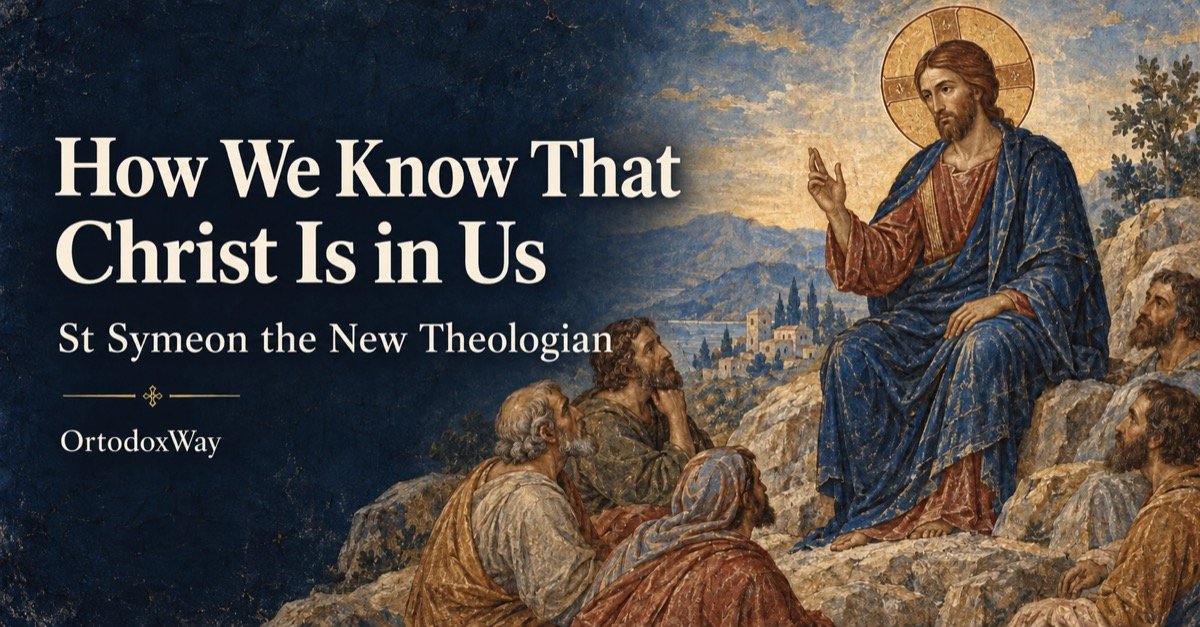
How the Beatitudes Spoken on the Mount Can Lead Us to Him
How can we know whether Christ is in us? St Symeon the New Theologian answers this question in the Second Discourse of the Romanian edition of his teachings. A discourse is a teaching given to disciples. In this one the Saint speaks to “fathers and brethren”, calls them to examine their souls by signs, and tells them: “Let us know from the signs that have been shown whether Christ is in us.”
St Symeon was born in 949 in Paphlagonia, a province of Asia Minor, and came to Constantinople while still a child. He was ordained priest in 980, that is, he received the mystery of the priesthood, and he then led the Monastery of St Mamas in Constantinople as its hegumen, that is, its abbot, until 1005. In 1009 he was sent into exile to Paloukiton, on the eastern shore of the Bosphorus, where there stood a small house of prayer dedicated to St Marina. There he fell asleep in the Lord, on 12 March 1022.
The Church calls him the New Theologian. The word theologian means “one who speaks of God”, that is, one who speaks of God because he has come to know Him. In this Discourse St Symeon calls St John “the Theologian”. The Church has honoured three saints with the name of Theologian: St John the Evangelist, St Gregory of Nazianzus and St Symeon, the third of them.
Whoever wishes to find God
The Saint begins with an exhortation: whoever wishes to find God must deny himself and not spare himself. He describes this self-denial as a race towards a goal: the runner masters his thoughts, keeps his eyes wakeful and his palate restrained, and does not turn back to what he has left behind, until he reaches the place towards which he runs.
From the very beginning, the Saint asks you to set enmity between yourself and those who walk after the flesh, that is, who live by the desires of the flesh. This enmity shows itself as keeping away: the soul keeps away from their urgings and their blandishments, from sitting together with them and from evil talk, which poisons it and throws it to be dashed against evil thoughts and the memory of them. This keeping away does not stand against love: further on, the same Saint will place among the signs by which Christ is known in us the love of enemies and prayer for them.
The Saint gives an image from fishing: “O man, fear the bait with the hook.” The fish sees the bait and does not see the hook. Such are the urgings and blandishments of those who walk after the flesh: pleasant at first, while the hook appears only after the soul has bitten. That is why the Saint says: “flee far from them, so that you do not bring your soul down into hell again.”
Then he tells the one who struggles, that is, who fights the spiritual fight, not to receive the one who slips into his mind a thought like this: “Why so much toil and so much vain wretchedness?” A year has passed, two, even three, since the man began to struggle, and no profit can be seen. The Saint answers with a word of comfort before any command: “No, my brother.” He tells him that this thought is a snare by which a man sells his salvation, and he urges him to persevere with even greater zeal in the work of good deeds, without disregarding the teachings of his spiritual fathers.
The resolve he asks for is stern: better to die than to stop the work that brings life. He adds an observation: had the man begun this way from the beginning, God would not have overlooked him and would have granted his request.
Christ in place of all things
What does the one who perseveres receive? The Saint answers: if you wish to obtain the good things of God and to become, from a man, “an earthly angel”, love the toil of the body, “kiss affliction”, that is, the enduring of hardships, and love temptations, that is, trials, for they bring you every good. In his words, an earthly angel is the man who has left the care of earthly things and keeps his mind fixed on Christ; his inner disposition is that of the angels.
Why do temptations bring every good? The Saint answers with three questions. What can be more beautiful than a soul that bears its afflictions with understanding? What can be stronger than a broken and humble heart, which easily drives away the hosts of demons? What can be more glorious than spiritual poverty, that is, humility, through which a man is made worthy of the Kingdom of Heaven?
This commandment is above nature, he says, but the rewards too are beyond words: in place of all things, “Christ Himself takes the place of all”. The name “Christ” is short, but the Saint urges: “do not look at the simplicity of the word”, but understand the glory of the Godhead, which surpasses mind and thought: its ineffable dominion, its measureless mercy and its unattainable and incomprehensible riches, which are given in abundance and glory. All this is enough, for we have received the very “Cause and Giver of every good”.
Whoever has been found worthy to see Him and to receive Him desires nothing else, and the one whom the love of God has filled can no longer love anything on earth.
Where could we flee from His face?
The Saint sees how much people toil for things that pass away: they endure labours, set out on distant journeys and neglect even their families, only to fulfil their desire. If for these temporal and corruptible things people give their very souls, then, he asks, shall we not give our souls and bodies for the King of kings and Lord of lords?
He goes on to ask where we shall go and where we shall flee from His face. The Psalmist had asked the same question: “Where can I go from Your Spirit? Or where can I flee from Your presence? If I ascend into heaven, You are there; If I make my bed in hell, behold, You are there. If I take the wings of the morning, And dwell in the uttermost parts of the sea, Even there Your hand shall lead me, And Your right hand shall hold me” (Psalm 138:7–10; 139 in the Hebrew numbering). The Saint takes it up in almost the same words: in heaven we find Him, in hell He is present, and at the shores of the sea we do not escape Him, for in His right hand He holds our souls and bodies.
If we cannot flee from His face, the road left to us is to give ourselves as slaves to the Lord, “Who took the form of a slave and died for us”. The Saint calls the brethren to humble themselves under His mighty hand, which grants eternal life through the Holy Spirit to those who seek it.
Here the Saint confesses his pain: “with how much pain and sorrow my soul has been filled”. He has proclaimed to them the wonders and the ineffable beauty of God, so that they might understand His glory, and he sees none of them paying heed with longing to what was said. Therefore, he says, he remains “without voice” and can no longer speak of the glory of Christ or interpret it.
His pain then turns into trembling: “O my trembling, and the greatness of the gifts of God!” God has passed over the wise, the great and the rich of the world and has chosen the weak, the foolish and the poor, out of His great goodness. Men hate them, the kings of the earth cannot bear to see them, and the rich pass them by. God, Whom countless heavenly powers serve, did not shrink from becoming “father, friend and brother” to these “outcasts and castaways”. He was even pleased to take flesh and to become like us in all things except sin, so as to make us partakers of His glory and His Kingdom.
Shaken in this way, the Saint asks the brethren: why do we not run to the One Who has loved us so much, why do we not go even unto death for the One Who died for us, why do we fear the departure from the body?
The seal of Christ
To the fear of death the Saint answers with the seal. A seal is the sign by which a master marks what belongs to him. Christ, says the Saint, is the Great Shepherd, Who has sealed His sheep. The Christian receives the seal at Chrismation, the mystery that follows Baptism: the priest anoints the newly baptized with the Holy Chrism, that is, oil mixed with fragrant spices and consecrated by bishops for this mystery, and says: “The seal of the gift of the Holy Spirit. Amen.”
The Saint asks whether hell can seize the souls of those who hope in Christ, and whether death can rule over souls “sealed with the gift of the Most Holy Spirit and with the Blood of Christ”. His answer is: “By no means.” He urges those who are sealed to run, and the unsealed to hasten to be marked with the sign of the Holy Spirit. In the Romanian edition, the word “unsealed” carries an explanation in brackets: “unknowing”.
Who is unsealed? The Saint answers: the one who fears death. And the unmarked one is he who does not know well the sign of the seal, for the one who has known the divine sign through faith has “unashamed hope”.
Those of whom he speaks are baptized Christians, and he himself tells how it came about. We were sanctified as infants, without being aware of it, and in our youth we defiled ourselves. Christ is the One Whom we put on in Baptism and Whom we put off through evil deeds. The way back is repentance: to do all that is pleasing to Christ and, sealed by Him, to live from now on without fear, so as to receive mercy from His hand.
The knowledge of the mysteries of Christ, to which this return leads, is not learned only from word and hearing. It shows itself in work and in deed.
The poor in spirit and those who mourn
How is the knowledge of Christ seen in us? The Saint begins from the word that Christ cries out every day through His Gospel:
Blessed are the poor in spirit, For theirs is the kingdom of heaven.
— Matthew 5:3
According to the edition’s note, the poor in spirit are the humble. The Saint asks for an examination: let us hear this word as a question put to us, and let us see whether we are truly so poor that the Kingdom of Heaven is ours. Of the Kingdom the Lord said:
For indeed, the kingdom of God is within you.
— Luke 17:21
The sign that the Kingdom is within someone is that he desires nothing of what is seen and corruptible: wealth, glory, pleasure or any other sweetness of this world, worldly or bodily. How far such a man withdraws from these things the Saint shows by two comparisons. Those who shine with royal honour and glory feel disgust towards those who are in a house of harlotry, and those clothed in clean garments and perfumes turn away from stench and filth. In the same way the one who has the Kingdom within himself withdraws from visible things. Whoever looks after visible things has not seen the Kingdom of Heaven, has not felt it and has not tasted its goodness and sweetness.
Then the Saint brings the Lord’s second word:
Blessed are those who mourn, For they shall be comforted.
— Matthew 5:4
Again he asks for an examination: let us see whether we truly have mourning within ourselves. Mourning here is the pain of the soul that sees its powerlessness before the commandments of God, a pain that shows itself in tears.
The Saint himself raises a question. The poor in spirit have the Kingdom and do not bind their minds to earthly things. What would be left to mourn for the one who has left the world in his thought, desires nothing of what is seen and has the Kingdom of Heaven, in which he rejoices?
The answer lies in the way a man sees himself. The believer who heeds the commandments of God and fulfils them keeps his mind at their height, that is, he leads a blameless life, in purity. Looking then at himself, he sees that he is powerless and cannot rise to the height of the commandments. Then he counts himself “very poor”, unworthy to receive God, as one who has “nothing good” of his own. Whoever thinks thus of himself mourns with the mourning “that is truly blessed”, which brings consolation and makes the soul meek.
This consolation is, in the Saint’s words, “an earnest of the Kingdom of Heaven”. An earnest is the part of a payment given in advance, which guarantees the rest. The consolation of the present is the beginning and the pledge of the Kingdom. It comes through the working of the Holy Spirit in the souls of those who mourn, and it is the very coming of God among them, Who grants them humble-mindedness, that is, a humble thought about oneself.
These things are born one from another. Where there is true humility, there is the depth of humble-mindedness. Where there is humble-mindedness, there are the illuminations of the Holy Spirit, and where the illuminations of the Spirit are, there is the outpouring of divine light and the revelation of the knowledge and the mysteries of God. Where these are, there is the Kingdom of Heaven and, together with it, the sense of spiritual poverty. And where this sense is found, there is the mourning that gives joy, and unceasing tears flow, which cleanse the soul and illumine it.
This is the solution. The Kingdom and the sense of spiritual poverty are found together, and from the sense of poverty come tears. That is why the man who has the Kingdom can mourn, and his tears are the blessed ones.
The Beatitudes in their order
From tears the Saint ascends through the other Beatitudes, in the order in which the Lord speaks them:
Blessed are the meek, For they shall inherit the earth.
Blessed are those who hunger and thirst for righteousness, For they shall be filled.
Blessed are the merciful, For they shall obtain mercy.
Blessed are the pure in heart, For they shall see God.
Blessed are the peacemakers, For they shall be called sons of God.
— Matthew 5:5–9
In the Saint’s words, the Beatitudes are linked one to another, and each is born from the one before. The soul that is unceasingly cleansed and richly nourished with tears calms its irascible part, that is, the part of the soul that is kindled by anger, and becomes meek. Then it hungers and thirsts and desires to learn the statutes of God, that is, His ordinances. It becomes merciful and compassionate. Through all these its heart is cleansed, and it comes to the vision of God: it can see His glory “according to the promise”.
Those who have so formed their souls are peacemakers and are called “sons of the Most High”. They know their Father and Master purely and love Him with all their soul. For His sake they endure reproach, slander and affliction, for the righteous commandment which He has commanded us to keep, and they rejoice that they have been counted worthy to be dishonoured by men for His love.
Humility and tears
Here the Saint calls on his brethren: “Learn, brethren, the true imprint of the seal of Christ.” The imprint is the mark that the seal leaves on the soul. The true seal, he says, is “the radiance of the Spirit”, which works in many ways and has many good works.
The first of them, and the most necessary, is humility, “as that which is the beginning and the foundation”. For this the Saint brings a word of the Lord which we find in Isaiah: “But on this one will I look: On him who is poor and of a contrite spirit, And who trembles at My word” (Isaiah 66:2).
The second is mourning and the fountain of tears. He would like to say much about them, but finds himself “poor in words”. Here a wonder takes place: tears flow perceptibly from the eyes and invisibly wash the soul of the filth of its sins. They fall to the ground, they burn and confound the demons, and they set the soul free from the invisible bonds of sins.
Then he addresses the tears themselves: “O tears […] that open Heaven.” He confesses that he speaks of them again and again, “with sweetness and longing”.
Where there are many tears, joined to true knowledge, there is found the radiance of the light. And where the radiance of the divine light is, there is the gift of all good things and the seal of the Holy Spirit set upon the heart, from which all the fruits of life grow. A man becomes meek with the meekness of Christ, has peace, gives alms, becomes merciful, good and beneficent, believes and is self-controlled. From the seal there also springs the love of enemies: a man prays for them, rejoices in their good and gives his soul for his brethren, even unto death.
The examination
“Let us see then, O brethren,” says the Saint, “and let us examine ourselves diligently” whether this seal is found in our souls. He rouses the brethren and asks them to take heed whether the light has shone in their hearts, whether they have seen the great light of knowledge, whether the Dayspring from on high has visited them. With these last words he takes up the Gospel according to Luke:
Through the tender mercy of our God, With which the Dayspring from on high has visited us; To give light to those who sit in darkness and the shadow of death, To guide our feet into the way of peace.
— Luke 1:78–79
Whoever finds the light does not stop, but feeds it: the Saint asks us unceasingly to give glory and thanks to the Master Who has granted it to us, and through the working of the commandments to kindle in ourselves ever more divine fire.
But if we have not received Christ and His seal, and do not see in ourselves the signs that were shown, the Saint says what is found in their place: the world lives in us and we live in it. We count temporal things great, we are troubled and grieved over losses, and we rejoice in pleasure and wealth. Then he laments together with the brethren: “woe to our wretchedness and insensibility, which enslaves us and drags us down to the earth”.
The one who is in this state, with the world in him and himself in the world, is, says the Saint, an enemy of God, for passionate attachment to the world is enmity against Him. Passionate attachment is the binding of the soul to a thing as to a passion, that is, to an evil desire that has taken hold of it. The Saint relies on the word of the Apostle John:
Do not love the world or the things in the world. If anyone loves the world, the love of the Father is not in him.
— 1 John 2:15
Then the Saint asks, one by one, what remains of the Beatitudes in a man ruled by some passion. Will the lover of human glory count himself the last of all, humble himself, break his heart? Can the one enslaved by the love of money still be merciful? When will the one enslaved by the passions of the body become pure in heart, and how will he see God? And how will the one estranged from God be a peacemaker? These passions close the Beatitudes one by one: love of glory closes that of the poor in spirit and of those who mourn, love of money that of the merciful, the passions of the body that of the pure in heart, estrangement from God that of the peacemakers.
For St Symeon, the peacemaker is first of all the one who is at peace with God. Whoever wars against Him by transgressing the commandments remains His enemy, even if he were to reconcile all men with one another, for he does not make this reconciliation according to God’s good pleasure. Whoever has enmity towards someone cannot know what is pleasing to him, and the one who is far from God does not know what pleases Him and cannot teach others the way of reconciliation.
A passion grown old, that is, kept long in the soul, acquires the strength of nature: the evil that lingers in the soul becomes a habit, and the soul can no longer free itself from it. Then, in this soul, “light turns into darkness and goodness into wickedness”, and it “is sick beyond healing”.
The light
What, on the other hand, does the one see who is united with God through faith and knows himself through deeds? The Saint says that he is counted worthy also to see Him, and that he “sees things that cannot be written”. His mind is illumined and transformed “into the form of light”. The mind itself is light, it sees all things as light, and this light is living and gives life to the one who sees it. The mind sees itself united with the light; when it withdraws from it, it beholds it from afar, and when it turns within, it finds it again. It finds no word by which to tell what it has seen. Here the Saint, whom the Church calls “Theologian”, reaches the limit of words.
Then he asks who will not marvel on hearing these mysteries and not run to Christ, who will not desire to see the wonders of God and not love the One Who grants such gifts.
The Saint calls us to examine ourselves by these signs: whether we no longer desire visible things, whether tears cleanse us, whether meekness, mercy and love of enemies grow in us from them, and whether, at the end, the mind sees the light that it cannot put into words. These signs do not stand apart from one another: they are born one from another, from humility up to the light.
Only man remains
From all this the Saint comes to a simple exhortation: the best thing is to have nothing of the things of the world and to seek nothing beyond what the body needs. What the body needs we know: bread and water, clothing and shelter. The Apostle Paul says:
And having food and clothing, with these we shall be content.
— 1 Timothy 6:8
If we need anything else, God, Who has given us the greatest things, will give it to us; we have only to cast off what endangers our soul: vainglory, that is, the desire to be praised by men; envy; strife; guile; grumbling, that is, discontent shown in murmurs and criticism; irritation, that is, the stirring up of anger; and all that is hateful to God. In their place the Saint sets what God has commanded us: spiritual poverty, that is, humility, and unceasing mourning, day and night, from which flow the joy and consolation of the soul. Through them those who struggle come to meekness, and a man becomes merciful, pure in heart, full of peace and strong in temptations. All these, says the Saint, “come from unceasing mourning”. From it comes hatred of evil, and from it too there is kindled in the soul “divine peace”, which does not let it grow slack or incline to evil, but fills it with strength to endure all hardships to the end.
Therefore the Saint urges: “Let us run until we lay hold of what is steadfast, what does not pass away”, for all the things of the world decay and pass like a dream. Nothing of what is seen is steadfast: the sun, the stars, heaven and earth pass away, “man alone remains”. What can visible things profit us at the hour of death, when we leave everything behind and leave the body dead?
After it leaves the body, the soul no longer sees it, nor is it seen by it, and its mind turns only towards the things unseen. It no longer has any care for the things of this world, that is, for the visible things it has left behind. Two cares remain to it: the Kingdom of Heaven and eternal glory, or Gehenna, eternal condemnation and the torments of fire. One of them it will inherit for eternity, according to the worth of what was done here.
Now, not after death
Therefore, says the Saint, let us flee from the deceit of life and from its “seeming joy”, and let us run to Christ alone, the Saviour of our souls. Let us strive to find Him Who is present everywhere, and if we find Him, let us hold Him fast, fall at His feet and kiss them with the fervour of our soul.
“So I pray,” says the Saint: let us strive, while we are alive, to see Him and to behold Him. If we are truly counted worthy to see Him here, “we shall not die, and death shall have no dominion over us”. The Saint does not say that the body will not die: a little before, he speaks of the body that we leave dead. With these words he answers the question he asked when speaking of the seal: can death rule over sealed souls? Death no longer has dominion over the one who has seen Christ. That is why he no longer fears it. And the vision is not put off until the life to come: the Saint asks us to struggle so that “we may see Him now”.
The Saint also fears a delusion: that we may think we have Christ in us when in fact we have nothing, and so leave this life “with empty hands”. Then we would hear the heavy word by which even “what he seems to have” is taken from a man, and we would weep with eternal grief. Thus in this Discourse two kinds of weeping stand face to face: the blessed mourning of the present, which brings consolation, and the weeping of the hereafter, of those who have departed with empty hands. The Saint prays to God that this may not happen.
The Saint speaks to people who have renounced the world: “we who have renounced the whole world and have run to Christ”. Yet the foundation of his words is the seal of Baptism and Chrismation, which every Christian bears, and therefore his question concerns us all.
The Saint ends with a prayer. He asks God to grant us to keep His commandments and to be cleansed through tears and repentance, so that even here we may see the divine Light, that is, Christ Jesus Himself, and that He may abide in us. He asks that through His Spirit He may nourish our souls and raise them up, so that we may taste the sweetness of the good things of His Kingdom, of which may we all be made worthy in Christ Jesus our Lord, to Whom belongs glory unto the ages of ages. Amen.
The text follows the Second Discourse in the book Din învățăturile Sfântului Simeon, Noul Teolog (From the Teachings of St Symeon the New Theologian), edited by the Monastery of the Holy Archangels Michael and Gabriel and printed with the blessing of His Grace Calinic, Bishop of Argeș (pp. 6–19). The biographical dates follow the edition’s note, and the exile of 1009 follows the Romanian newspaper Ziarul Lumina. The quotations from the edition are short and have been translated from the Romanian; the rest is given in paraphrase. Scripture taken from the New King James Version®. Copyright © 1982 by Thomas Nelson. Used by permission. All rights reserved.