
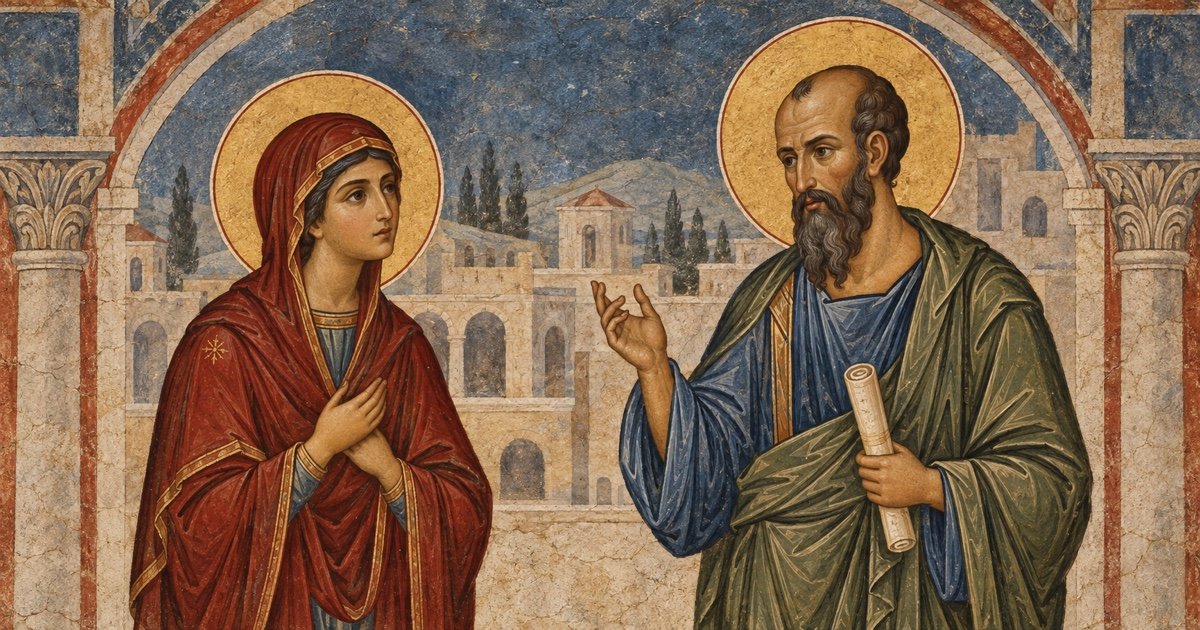
On 24 September the Church commemorates Saint Thecla, whom she calls Protomartyr and Equal-to-the-Apostles. She is called Protomartyr because she was the first woman to suffer torments for confessing Christ, even though God delivered her from them. She is called Equal-to-the-Apostles because she preached the Gospel and brought many to the faith, as the Apostles did. The Churches that keep the old calendar celebrate her on the same day according to the Julian calendar, that is, on 7 October.
Thecla was the disciple of the holy Apostle Paul. From the day she heard his word, she sought him with perseverance. She followed him into prison, looked for him from the midst of the fire, and crossed from city to city to find him. There were many Christians around her, but she bound herself to Paul. This bond becomes clear when we look at something the Fathers knew well: the disciple remains with the one who gave him new birth in Christ. In the deserts of Egypt, such a spiritual father was called Abba, a word that means “father”.
On the Sources of Her Life
The life of Saint Thecla has been preserved mainly in an ancient writing called the Acts of Paul and Thecla. It is not part of Holy Scripture. Around the year 200, Tertullian wrote that its author, a presbyter in Asia, was removed from his ministry, even though he confessed that he had composed it out of love for Paul. Tertullian’s objection was aimed above all at those who appealed to Thecla’s example to allow women to teach and to baptise. The Church did not place this writing beside the books of Scripture, but she kept the memory of the saint. The Synaxarion, the book in which the Church gathers the lives of the saints for each day, tells her life following the thread of this writing, without some of its details. At the church of Saint Thecla in Seleucia, pilgrims were already hearing her acts read aloud in the fourth century. The reader receives her life as the Church received it: with reverence for the saint and with sound discernment toward the source.
At the Window in Iconium
Thecla was born in Iconium, a city of Asia Minor, today Konya in Turkey. Her parents were wealthy and of noble family. She had been betrothed to a prominent young man of the city named Thamyris.
When the Apostle Paul came to Iconium, a Christian named Onesiphorus received him into his home. The Church of the city gathered in his house; there the bread was broken and the word of God was preached. Thecla’s house stood nearby. From her window she could hear the voice of the Apostle, who spoke of purity, of prayer, and of the resurrection of the dead.
Thecla sat down at the window and listened day and night. She would not move from it. Her mother, Theocleia, called the betrothed and told him that the girl had not risen from the window for three days and three nights, neither to eat nor to drink. The two of them wept, and the servants of the house wept with them. Thecla did not turn toward them and went on listening.
She had never seen Paul. She had only heard his voice. She saw women and virgins going in to him, and she longed to be counted worthy to stand before him and hear the word of Christ. Her faith was born from hearing. Thecla had not attached herself to a man’s face, for she did not know his face. She had attached herself to the word that was opening her heart to Christ.
Many Instructors, One Father
Thecla was not alone in the new faith. In the house of Onesiphorus were his wife, Lectra, their children, and all who came to listen. They were devout people, who would later leave all the things of the world to follow the Apostle.
Onesiphorus had never seen Paul in the flesh. When he learned that the Apostle was coming to Iconium, he went out to wait for him by the road from Lystra. He recognised him from the description given to him by Titus, Paul’s disciple. All of these were Thecla’s brothers and sisters in the faith. Her father, however, was the one through whose word she had been born into the new life.
Being near Paul did not make anyone a disciple. Two men travelled with him, Demas and Hermogenes, who showed themselves his friends but were full of hypocrisy. It was they who advised Thamyris to bring the Apostle to trial.
Paul himself wrote of the difference between an instructor and a father: “For though ye have ten thousand instructors in Christ, yet have ye not many fathers: for in Christ Jesus I have begotten you through the gospel” (1 Corinthians 4:15).
At His Feet, in Prison
Thamyris denounced Paul to the governor of the city. Before the court, the Apostle confessed the living God, who sent His Son to save the world. The governor ordered him bound and shut in prison.
That night Thecla took off her bracelets and gave them to the doorkeeper of the house, so that he would open the door for her. At the prison she gave the jailer her silver mirror. She went in to Paul and sat at his feet. There she heard the great things of God. Paul feared nothing, and her faith grew. Thecla kissed the chains he wore for Christ.
The next day they found her there and brought her to the court. The governor asked her why she would not marry Thamyris according to the law of the city. Thecla gave no answer. She stood looking at Paul. Then her mother cried out that she should be burned, so that all the women the stranger had taught would be afraid. Paul was scourged and driven out of the city. Thecla was condemned to the fire.
On the Pyre
They led her into the theatre of the city, where the crowd had gathered. Thecla searched for Paul with her eyes, as a lamb in the wilderness looks for its shepherd. And she saw the Lord sitting among the crowd in the likeness of Paul. She gazed at Him until He went up into heaven.
Then she made the sign of the cross and climbed onto the pyre. A great fire was kindled, but it did not touch her. The earth shook, a cloud covered the theatre and poured down rain and hail, and the fire was quenched.
In that hour the depth of her bond with the Apostle becomes visible. Thecla was looking for Paul, and Christ came to her in his likeness. For the disciple, the spiritual father is the man through whom Christ has been made known to him. Seeking Paul, Thecla found Christ. Paul had shown her the way, and Christ delivered her from the fire.
“I Will Follow You Wherever You Go”
Paul had not gone far. He was hiding with Onesiphorus and all his household in a new tomb on the road to Daphne. For six days he had been fasting and praying for Thecla. When the bread ran out, he sent a boy to buy more. The boy met Thecla on the road. She told him that she had escaped the fire and was going after Paul.
When she reached the tomb, she found the Apostle on his knees, praying that the fire would not touch her, for she belonged to Christ. Thecla stood behind him and gave thanks aloud to God for having saved her so that she might see Paul. The Apostle rose, saw her, and he too gave thanks to God, who had heard his prayer. They had five loaves, some herbs and water, and they rejoiced together.
Then Thecla told Paul that she would cut her hair and follow him wherever he went. The Apostle feared for her. The times were full of shamelessness, and she was beautiful. He told her that a temptation worse than the first might come upon her. Thecla asked him to give her the seal in Christ, that is, Baptism, and then temptation would not touch her. Paul answered that she should wait with patience, for she would receive the water of Baptism. Thecla accepted his word and waited.
In Antioch, a powerful man of the city named Alexander tried to take her by force. Thecla rejected him in the middle of the street and was condemned to the beasts. A woman of great standing, Tryphaena, who had lost her daughter, took her under her protection and loved her as her own child. In the arena, a lioness lay down at her feet. The beasts did not touch her. Seeing a pool of water, Thecla threw herself into it, saying that she was baptised in the name of Jesus Christ on the last day of her life. Bound afterwards between two bulls, she remained unharmed, for fire burned through the ropes. The governor asked her who she was. Thecla answered that she was the servant of the living God and that she had believed in the Son of God. The women of the city cried out with one voice that there is one God, the God of Thecla.
Thecla stayed eight days in Tryphaena’s house and taught her the word of God. Most of the maidservants of the house believed as well. She now had a household that loved her and people whom she herself had brought to Christ. Even so, she went on looking for Paul.
“Go and Teach the Word of God”
She learned that the Apostle was in Myra of Lycia. She sewed her garment into the shape of a man’s cloak and set out, together with young men and maidens. She found Paul preaching the word of God. The Apostle was alarmed when he saw her, thinking that some new temptation had come upon her. Thecla said to him: “I have received Baptism, Paul; for He who worked with you for the Gospel has worked in me also for my Baptism.”
Paul took her to the house of a man named Hermeias and heard from her all that had happened to her. Thecla told him that she was returning to Iconium. The Apostle answered: “Go and teach the word of God.” All the gold and clothing that Tryphaena had sent her, Thecla left with Paul for the poor.
The decision to go to Iconium was Thecla’s own. Paul blessed her and gave her the work: to teach the word of God. The disciple who had sought him in order to hear the word now went out to proclaim it herself. The road took her far from Paul, but the word she had received from him went with her.
In Iconium, Thecla went into the house of Onesiphorus. She fell down on the floor where Paul had sat when he taught her, and she prayed with tears. She called Christ her God and the God of that house, where He had made the light shine upon her. She thanked Him for having been her help in the fire and her help among the beasts. Thamyris had died. Her mother was still alive, and Thecla spoke to her about the living Lord in heaven.
In Seleucia
From Iconium, Thecla went to Seleucia in Isauria, on the southern coast of Asia Minor. She lived in a cave, feeding on herbs and water. She enlightened many with the word of God, and through her prayer the sick were healed.
She healed without payment. The pagan physicians of the city lost their patients and envied her. They believed that her power to heal came from the goddess Artemis, and they sent dissolute men to defile her. Thecla was by then an old woman. She prayed to Christ, who had guarded her in the fire and among the beasts. The rock opened before her and closed after she had entered. The Synaxarion says that she was then almost ninety years old.
An ancient tradition, preserved in one of the versions of her life, adds a more mysterious ending. Thecla is said to have passed beneath the earth as far as Rome, to see Paul, and to have found that he had fallen asleep in the Lord. Not long afterwards she too fell asleep. She was buried two or three stadia, that is, a few hundred paces, from the tomb of her teacher. Other manuscripts, like the Synaxarion, end her life in Seleucia. The tradition that brings her to Rome keeps the same bond: the disciple wished to rest beside her father.
In Seleucia, the place of her ascetic labours became a place of prayer for all of Christendom. In the year 374, Saint Gregory the Theologian withdrew there, to her church. Ten years later, a pilgrim from the West, Egeria, found around the church countless cells of men and of women. Over the cells of the virgins was a holy deaconess named Marthana. The disciple of Paul had become, in her turn, a mother to others.
The Disciple and Her Abba
A disciple does not choose his father from among instructors as one chooses among the goods of a market. He remains with the one through whom he was born anew. Paul asked his disciples: “Be ye followers of me, even as I also am of Christ” (1 Corinthians 11:1). Thecla took this word exactly as it was spoken. She followed Paul on the roads, into prison and into suffering, because Paul was following Christ.
Paul had other disciples bound to him in the same way. He calls Timothy “my beloved son, and faithful in the Lord” (1 Corinthians 4:17). In his last epistle, the Apostle reminds Timothy that he had followed him in his sufferings as well: “Persecutions, afflictions, which came unto me at Antioch, at Iconium, at Lystra; what persecutions I endured: but out of them all the Lord delivered me” (2 Timothy 3:11). These are the very cities through which Thecla also passed. Paul’s disciples were bound to him also through the persecutions they bore together with him.
The Church has kept this bond in her hymnody. In the service of Saint Thecla, as it is sung in the Greek and Russian Churches, the troparion begins by saying that she was enlightened by the words of Paul. Her kontakion in the Slavonic service says that her heart was wounded by the love of Christ, that she dared to enter the fire and shut the mouths of the beasts, and that, once delivered from them, she persevered in seeking Paul.
The Fathers honoured her as an example of the virgin consecrated to Christ. Saint Gregory of Nyssa relates that his mother, before giving birth to his sister, Saint Macrina, saw in a dream someone whose form and garments shone more brightly than any man’s. Three times he named the child Thecla, after the Thecla renowned among virgins. This name was used only in secret. Saint Gregory says that the vision was meant less to choose a name than to foretell the life of the child, who would follow the same way of life as Thecla. The virgin of Iconium had become an example for the virgins of the centuries after her.
The Bride Who Sought the Bridegroom
Thecla sought Paul from the prison to Myra. In the troparion the Church sings on her day, she calls Christ her Bridegroom and says that it is He whom she seeks:
Thy lamb, O Jesus, Thecla, cries out with a loud voice: I love Thee, my Bridegroom, and seeking Thee I suffer torments; I am crucified with Thee and buried with Thee in Thy Baptism; I suffer for Thy sake, that I may reign in Thee; I die for Thee, that I may live in Thee. Accept me as a spotless sacrifice, for with love I offer myself to Thee. Through her prayers, save our souls, for Thou art merciful.
She followed Paul because he had led her to this Bridegroom. At the window in Iconium, Thecla listened to the voice of the Apostle. Through his voice, Christ was calling her.
Holy Thecla, Protomartyr and Equal-to-the-Apostles, pray to Christ our God for us.
Image: AI-assisted illustration created for OrtodoxWay, inspired by Byzantine frescoes.