
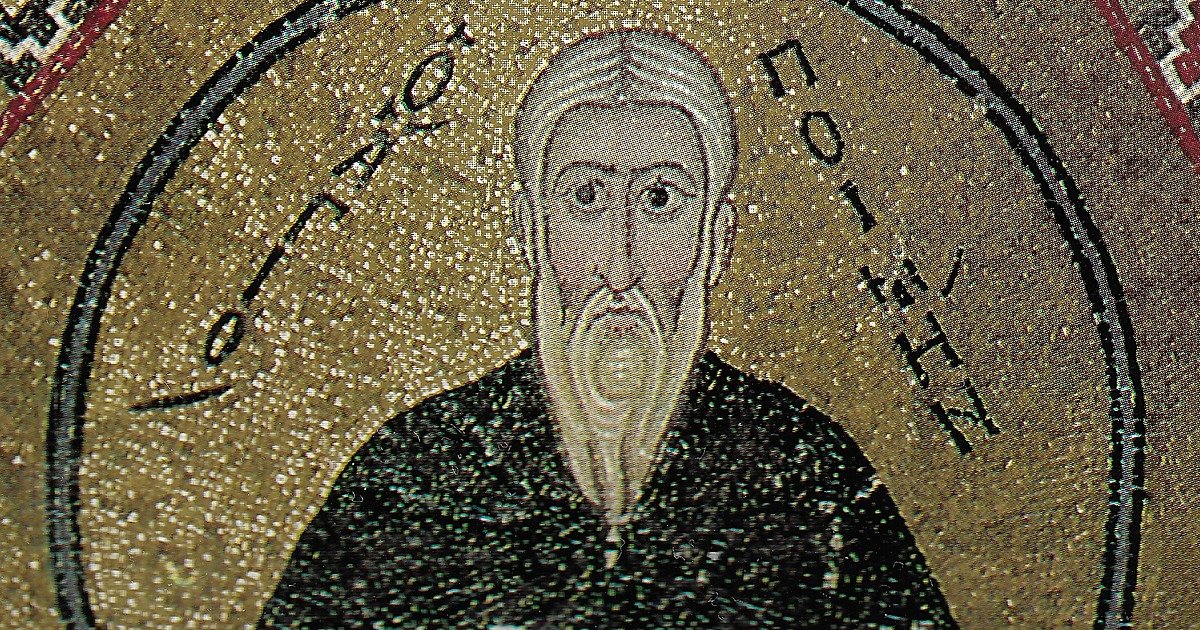
Saint Poemen the Great was an Egyptian monk who struggled in the desert in the second half of the fourth century and the first half of the fifth. The Church commemorates him on 27 August. His Greek name means “shepherd,” and that is what he became in the Church: a father to whom the other monks came in order to ask how the soul is cleansed of the passions.
The words he spoke were gathered into the Egyptian Paterikon, the collection of short answers that the fathers of the desert gave to those who came to them. Such an answer is called an apophthegm. In the Alphabetical Collection of the Paterikon more apophthegms are ascribed to Abba Poemen than to any other father — close to two hundred, the number varying slightly from one edition to another. Those who have studied how these collections took shape hold that the earliest of them were gathered around him and his close disciples.
His life
Poemen was born in Egypt. At fifteen he left for the desert of Scetis, where his six brothers were already living the ascetic life; the eldest of them was Abba Anoub. Scetis was the monastic settlement in the desert of Lower Egypt, a scattering of separate cells in which each monk lived alone, while on Saturday evening all gathered at the church and kept vigil until Sunday.
The Synaxarion relates that as a young man he went to an elder to ask him about three thoughts that were troubling him, but on the way home he realised that one of them had slipped his mind during the conversation. He turned back at once and walked the whole distance a second time in order to speak it. Seeing with what care he guarded his soul pure before God, the elder told him that his name would be spoken throughout Egypt and that he would become in truth the shepherd of a great flock.
Around the year 407 the Mazices, a nomadic people from the western desert, fell upon Scetis and laid it waste. The brothers escaped with their lives and settled at Terenuthis, on the bank of the Nile. There Poemen’s fame grew, until people were leaving the elders they usually went to in order to come to him. He himself, however, would not speak in the presence of his older brother, nor would he speak after another elder had spoken.
Learning where her sons had withdrawn, their mother came to see them. They did not open to her. When she stood before the locked door and began to weep, Poemen spoke to her from within the cell and asked whether she wished to see them here or in the world to come. She answered that she was their mother and that her hair had gone white. He told her that if she held back her longing now, she would see them for ever hereafter. The woman went away rejoicing (Paterikon, Poemen 76).
The governor of the district also wished to see him, and in order to force him he imprisoned his sister’s son, reckoning that the elder would come to plead for the young man. Poemen was not moved even by his sister’s weeping, but answered that he had fathered no child, and sent word to the governor to judge according to the law. The governor released the young man.
He fell asleep in peace a short time after Saint Arsenius the Great, that is, after the year 449, without having seen Scetis again. Some synaxaria give the years 340–450 and an age of a hundred and ten; these figures come from tradition and cannot be verified from documents.
Measure
In his early years Poemen fasted severely and would sometimes go two or three days without eating. In time he laid the severity aside and began to eat a little every day, so as to fall neither into pride nor into greed. When Abba Isaac found him putting a little water on his feet and asked how it was that some afflict the body with hardness, he answered that they had not been taught to be killers of bodies, but of passions (Poemen 183). He often said that whatever goes beyond measure comes from the devil.
One of the traits that stands out most clearly in his words is discernment, that is, the power to distinguish what is fitting, for whom, and in what measure. It is not indulgence towards oneself. Poemen was temperate in asceticism and unyielding where the loosing of worldly ties was concerned, and he regarded his cell as a tomb, in which the monk must remain a stranger to all earthly things.
Poemen did not discover this work; he received it from the beginning of the desert. Saint John Cassian records in the Second Conference, through the mouth of Abba Moses, that certain elders had come to Saint Anthony the Great to ask him about perfection, and that the discussion lasted from evening until morning. They were seeking the virtue that keeps the monk unharmed from the snares of the enemy, and each proposed something different. In the end, the judgement of Anthony and of the others was that discernment is what leads the monk to God, step by step, because it gives birth to all the other virtues, guards them and governs them. In the Paterikon, Anthony says the same thing more briefly: some have worn out their bodies with asceticism, but because they lacked discernment, they remained far from God (Abba Anthony 8).
What Anthony utters in a single sentence, Poemen shows at length, in every answer he gives. First upon himself, when he leaves severe fasting for the daily measure. Then upon those who came to him.
When someone came to discuss lofty matters with him, he kept silent. When he was asked about the passions and about the way the soul is healed, he answered gladly. To each he spoke according to the measure of his understanding.
Thoughts
He was asked about thoughts many times, and his answers all run in the same direction. Three of them stand one after another.
A brother came to him and told him that he had many thoughts and was endangered by them. The elder led him outside under the open sky and told him to stretch out his arm and hold back the winds. The brother answered that he could not do this. Then the elder told him that neither could he stop the thoughts from coming, but that it is another matter to stand against them (Poemen 28).
Abba Anoub asked him on another occasion about the unclean thoughts that the heart of man gives birth to, and about vain desires. Poemen answered him with a word of the prophet Isaiah: does the axe grow weak apart from the one who cuts with it? But do not give them room, he said, nor take pleasure in them, and they remain without effect (Poemen 15).
Another brother asked him about the trouble of thoughts. It is like a man who has fire on his left and a cup of water on his right, the elder answered; when the fire flares up, he takes water from the cup and puts it out. The fire is the seed of the enemy. The water is the casting of oneself before God, that is, prayer (Poemen 146).
The coming of the thought does not rest with us. The consent rests with us. The quenching comes through prayer.
Unceasing attention to what draws near the heart is called, in the language of the Church, watchfulness. Poemen kept it strictly at every moment, knowing that the beginning of all evils is the scattering of the mind. When he had to leave his cell, he would first sit for a while and put his thoughts in order.
Abba John, the one later sent into exile by the Emperor Marcian, used to tell how he had come from Syria with others to ask Poemen about the hardness of the heart. The elder did not know Greek, and they found no interpreter. Seeing them distressed, he suddenly began to speak in Greek and told them that the nature of water is soft and that of stone hard, yet a jug hung above the stone, dripping a little water at a time, hollows out the stone; so too the word of God is soft and our heart hard, but the man who hears it often opens his heart to the fear of God (Poemen 182).
Humility
Poemen said that a man has need of humble-mindedness and of the fear of God at every moment, as he has need of the breath that comes out of his nostrils (Poemen 49).
When he was asked whether it is good to cover the fault of a brother whom he sees sinning, he answered that in whatever hour we cover our brother’s fault, God covers ours, and in whatever hour we make his known, God makes ours known (Poemen 64). The brother who dozed off in church he did not rebuke; he would take his head and lay it on his knees, letting him rest (Poemen 92).
Of himself he spoke without sparing. He confessed that he placed himself beneath all the brute creatures, because they have nothing to reproach themselves with. When they asked him how he could reckon himself lower even than a murderer, he answered that the murderer had committed that sin once, whereas he sinned every day.
This is self-reproach — not a poor opinion of oneself, but the habit of examining one’s own fault first. Out of it is born, in his teaching, the rest of the heart in every circumstance.
One day he saw a woman weeping at a grave, whose husband, son and brother had died, and he said to his brother Anoub that no one can become a monk who has not reached such a measure of mourning (Poemen 72). And when one of those close to him found him caught up out of himself and asked him afterwards where he had been, he answered that his thought was there where the Mother of God stood weeping beside the Cross of the Saviour, and that he would wish to weep in that way at every hour.
Why we read him today
The hesychast tradition, founded upon the search for inward stillness and upon unceasing prayer, did not appear out of nothing. Many of the works it would set at its centre — the guarding of thoughts, watchfulness, mourning, self-reproach and discernment — are plainly present in the Egyptian monastic tradition of the fourth and fifth centuries. In Poemen’s words they do not appear as a system, but as short answers, born out of the experience of ascetic labour.
The same tradition of the desert passes into the ascetic literature of the following centuries and is found again, developed and set in order, in many of the authors later gathered into the Philokalia.
The Painter’s Manual of Dionysius of Fourna directs that he be depicted as a very old monk, with a long beard parted in two, holding in his hand the words: teach your heart to do what your mouth teaches.
The service of the day
Troparion, tone 8 (the common troparion of monastic saints, with the saint’s name):
With the streams of your tears you cultivated the barren desert, and with sighs from the depths you made your labours bear fruit a hundredfold; and you became a luminary to the world, shining with miracles, Poemen our father. Pray to Christ God that our souls may be saved.
Kontakion, tone 4:
Today the holy memory of your radiant struggles has come, venerable father, gladdening the souls of the faithful, Poemen, our God-minded father.
Notes
On the references. The apophthegm numbers have been verified in the Romanian edition of the Egyptian Paterikon, under the letter P. In the Alphabetical Collection translated by Benedicta Ward the numbering does not agree throughout: the episode of speaking Greek appears there as 183, and the washing of the feet as 184. In that translation the question of the Syrians is also rendered as concerning purity of heart; the Greek text and the Romanian both have “hardness of heart,” and the image of the stone and the water requires the latter.
On the date. The commemoration falls on 27 August. Churches that follow the Julian calendar keep it on the same day of their church calendar, which at present falls on 9 September in the civil calendar.
On the liturgical texts. The troparion and kontakion above are translated from the Romanian service books. Readers may wish to use the English texts customary in their own jurisdiction.
Holy Father Poemen, pray to God for us.
Image: mosaic of Saint Poemen, eleventh century, Daphni Monastery; unknown artist, public domain, via Wikimedia Commons.