
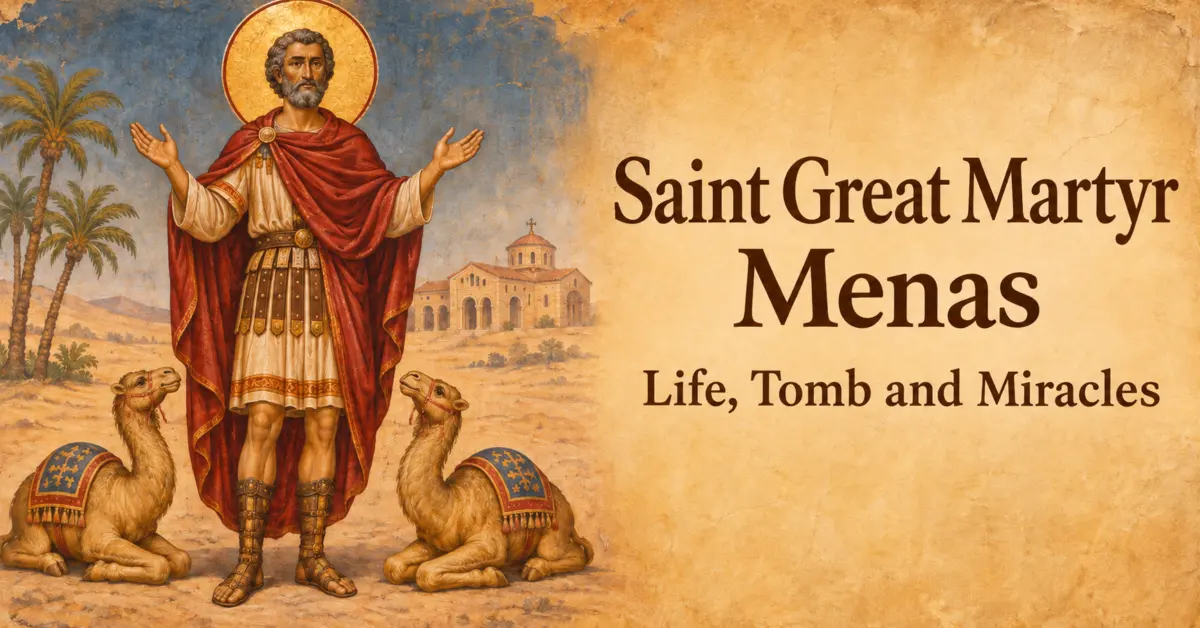
On 11 November the Orthodox Church celebrates the Holy Great Martyr Menas, an Egyptian soldier of the Roman army who was put to death for Christ in the city of Cotyaeum in Phrygia, in Asia Minor, in the days of the emperors Diocletian and Maximian. His body was taken to Egypt and buried in the desert near Alexandria. For several hundred years the sick and the afflicted came to this tomb from every part of the Christian world, and the healings and deliverances that took place there made Saint Menas one of the best-loved martyrs of the Church.
Most Christians know two things about him: that he suffered terribly, and that he helps those who have been robbed or wronged. Both are true. But the ancient sources, Greek and Egyptian, together with what has been dug up at his tomb over the last century, tell us a great deal more. We have gathered here what can be known, and we say each time where it comes from.
In this article
The soldier who came down from the mountain
The oldest surviving account of the passion of Saint Menas is in Greek. The year in which it was written cannot be fixed, but it is far older than the reworking made by Saint Symeon Metaphrastes in the tenth century, and scholars hold that such a text already existed in the fifth century, when the church at the tomb was in full flower. From it come the version of Metaphrastes and, later, the Lives of the Saints that we read today.
The Passion says that Menas was an Egyptian by birth and served in the army under a tribune named Firmilian. His unit had been moved from Egypt to Cotyaeum, a city of Phrygia. Older Lives call it Cotuan, and today it is the town of Kütahya in Turkey. When the imperial order arrived that compelled every soldier to sacrifice to the idols, Menas laid aside his military belt and went away into the mountains. There he lived for a time in fasting and prayer, far from men.
No one came looking for him in the wilderness. He returned of his own accord. On the day of a great pagan festival, when the whole city was gathered for the spectacles and the horse races, Menas came down from the mountain, went into the midst of the crowd and climbed to a high place where all could see him. He cried out the word of the Prophet Isaiah about God, Who lets Himself be found by those who did not seek Him (Isaiah 65:1). The crowd fell silent and turned towards him. Brought before the governor Pyrrhus, he confessed that he was a servant of Jesus Christ, and one of the soldiers recognised him and said that this was Menas, who had served under the tribune Firmilian.
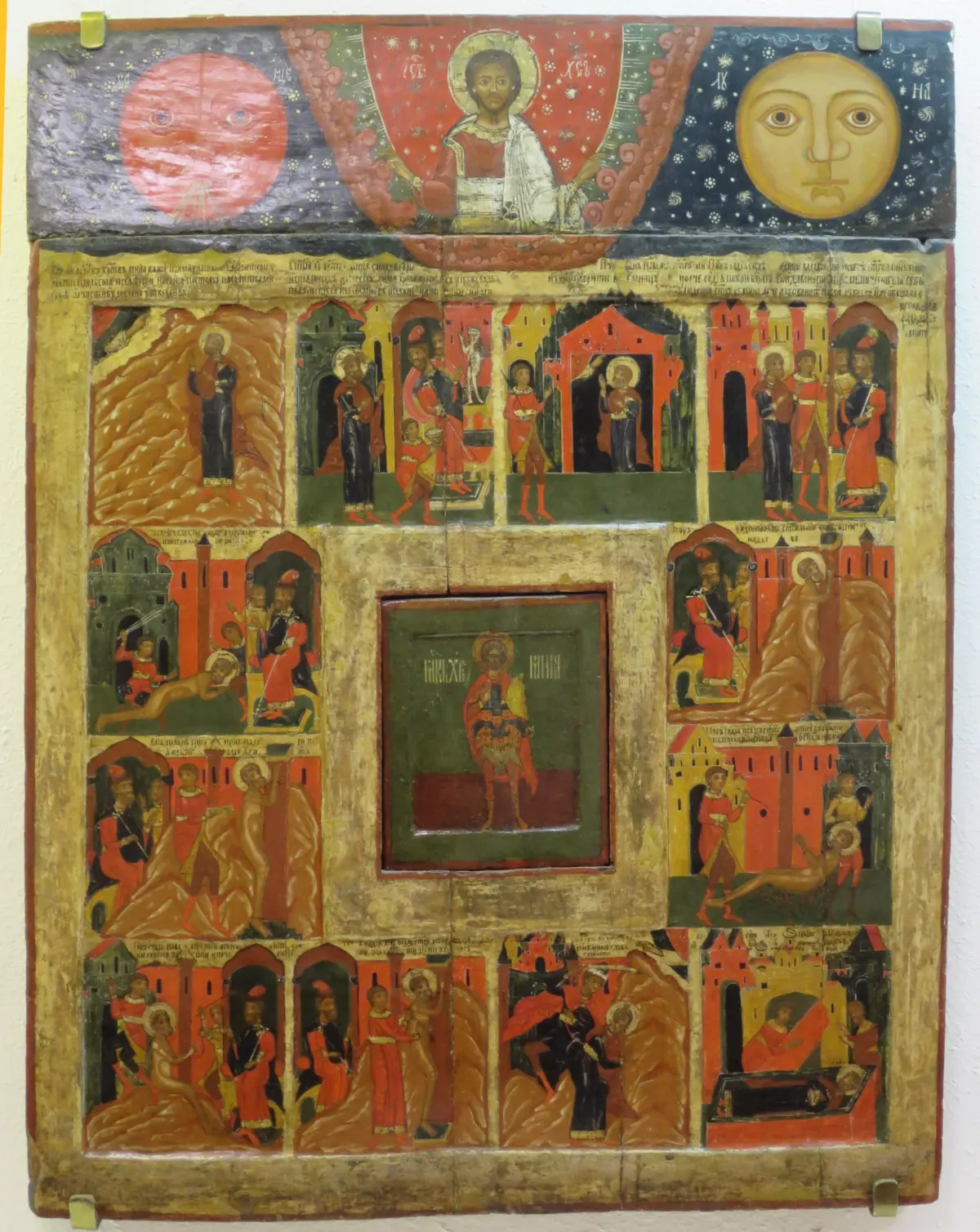
The governor kept him in prison until the festival was over. Then he tried to win him with promises of honours and gifts. When he saw that he could not move him, he handed him over to torture. The martyr was beaten with ox sinews, hung upon a post, and his body was torn with iron claws. His wounds were rubbed with rough haircloth, he was burned with torches and dragged over iron spikes. Through all of this he confessed Christ and answered his tormentors with the Saviour's words about those who can kill the body but cannot touch the soul (Matthew 10:28). At the end he was beheaded outside the city and his body was thrown into the fire. The Christians took from the fire what remained and kept the holy relics with honour.
The sources do not agree about the year. The Greek Passion places his death at the beginning of Diocletian's reign. The tradition of Egypt gives the year 296. In more recent writings one also meets the year 309. The day of his commemoration is 11 November. The Egyptians call it, by their own calendar, the 15th of the month of Hathor, a day that now falls on 24 November by the civil calendar. On that same 24 November he is also celebrated by the Orthodox Churches that keep the old calendar, because for them that day is 11 November.
What the tradition of Egypt preserves
The Greek Passion says nothing about the martyr's childhood. These things we learn from the writings preserved in Egypt: a Passion in Coptic; an encomium that bears the name of a Coptic archbishop John of Alexandria, of the seventh or eighth century, who had earlier been steward of the church at the tomb; and the Egyptian and Ethiopian synaxaria, which follow that encomium.
According to them, Menas was born in the city of Nikiu, in the Nile Delta. His father, Eudoxius, was an official, and his mother was called Euphemia. Both were Christians, and for a long time they had no children. On a feast of the Mother of God, Euphemia prayed with tears before her icon that a son might be given to her, and she heard a voice say, "Amen." From this word, the tradition says, the child was given the name Menas.
Eudoxius was falsely accused by his own brother and was sent as an official far from home, to Phrygia. There the child grew up, learning the Scriptures from his father. At eleven he lost his father, and soon afterwards his mother. He gave away to the poor what they had left him. At fifteen he was taken into the army, and for his worth he soon became second to the commander.
It is also the tradition of Egypt that tells of the vision in the wilderness. While he was struggling in solitude, Menas saw heaven opened and the martyrs receiving crowns, and a voice promised him three crowns: one for virginity, one for the endurance of torments and one for martyrdom. After this vision he went back to the city.
How the Passion came to be written
An attentive reader of the Greek Passion will notice something that scholars pointed out more than a hundred years ago. The scene in the theatre, with the horse races forgotten by the crowd and the cry taken from the Prophet Isaiah, is found almost word for word in the encomium that Saint Basil the Great delivered for the Martyr Gordius of Caesarea in Cappadocia. Gordius too had been a soldier, he too had withdrawn into the wilderness, and he too had come down into the midst of the city on a feast day.
The man who set down the passion of Saint Menas in writing lived many decades after the martyr's death and did not have a witness's notes before him. He had the memory kept by the Church: an Egyptian soldier, killed for Christ in Phrygia, on 11 November. He clothed this memory in the words of a great teacher of the Church, as was the custom of the time. For that reason the details of the scene should not be read as a report made on the spot.
The Church of Alexandria herself knew that Saint Menas had been written about in many ways. Archbishop John opens his encomium by saying that many had written about the martyr without understanding. He rejects, for instance, the opinion of some that Menas had been a camel herder, an opinion that other Egyptian writings nevertheless keep. Some of these writings do not mention Phrygia at all and place the martyr's life and death in the region of Mareotis itself, where his tomb is.
So it should be said plainly what belongs to the telling and what stands on firm ground. The names of his parents, the age at which he entered the army, the words exchanged with the governor and the journey of the relics we have only from these writings, which do not wholly agree with one another. The disagreements concern the way people have told the martyr's life. They do not touch what the Church has confessed from the beginning: that Menas gave his life for Christ, and that he is alive and quick to help. And for the age and the reach of his veneration we have witnesses that no single man wrote: the churches raised over the tomb, the inscriptions, and the little flasks that pilgrims carried, for three hundred years, throughout the Christian world.
The road to Egypt and the tomb at Mareotis
How the martyr's body came from Phrygia to Egypt, the tradition tells as follows. The troops in which Menas had served were sent back to defend the region of Mareotis, near Alexandria, against the raids of the desert tribes. The Christian soldiers took the relics with them as a protection. At sea, beasts with long necks, like camels, rose from the deep and stretched towards the ship. Fire came forth from the holy relics and drove them away.
When the danger of invasion had passed, the commander wished to take the relics further. The camel on which they had been laid would not get up. They brought another, and then another, and none of them would stir. The men understood that the saint had chosen his place, and they buried him there, in the desert, south-west of Alexandria.
From this comes the way Saint Menas is depicted in the oldest icons: he stands in soldier's dress, his hands raised in prayer, and at his feet, one on either side, two camels kneel. Archbishop John writes that the first icon was made on a wooden board by the commander himself, and that the animals at the saint's feet are the beasts of the sea. Most people have seen in them the camels that would not leave his side.
For a time the place was forgotten. The Synaxarion tells that a shepherd saw one of his sheep, which was covered in scab, roll in the dust of that place and get up healed. The encomium says that the first healing was that of a boy lame from birth, who fell asleep beside the tomb, beneath the burning lamp. The news spread and the sick began to come. Over the tomb there rose at first a small chapel with a lamp that burned unceasingly. From its oil the pilgrims took some home for their sick.
The marble city in the desert
What followed was one of the greatest places of pilgrimage that ancient Christendom ever had. Today it is called Abu Mena, and it lies some forty-five kilometres south-west of Alexandria.
Egyptian tradition connects the first church with Saint Athanasius the Great and the emperor Jovian. Archaeologists have found the earliest traces of veneration at the tomb at the end of the fourth century, and the first church built over it in the first half of the fifth. The excavations have also shown that the tomb lay in a burial vault cut into the rock, with several chambers, older than the coming of Christianity to the region. The martyr, then, was laid in a burial place that was already there. The encomium says that under Archbishop Theophilus and the emperor Arcadius the church was enlarged, because it could no longer hold the crowds. The emperor Zeno, towards the end of the fifth century, built a city around it, stationed there a garrison of twelve hundred soldiers against the robbers of the desert, and endowed the church with revenues. Under the emperor Anastasius, a prefect built on the shore of Lake Mareotis a harbour with guest-houses, markets and watering-places for those who came by boat from Alexandria. Under Justinian, a new church with four apses was raised above the tomb.
The excavations have brought all of this to light: the Great Basilica, the church above the crypt, a baptistery rebuilt three times, baths, hostels for pilgrims, colonnaded streets and potters' workshops. The German archaeologist Peter Grossmann, who worked there for decades, showed that Abu Mena was a pilgrims' town grown up around a tomb, and not a monastery.
The place suffered in the Persian invasion of the seventh century, and after the Arab conquest the pilgrimage dwindled. The town was still inhabited until about the eleventh or twelfth century; then the sand covered it. It was found again only in 1905, by Carl Maria Kaufmann. Since 1979 it has been on the World Heritage List. In 2001 it was placed among the monuments in danger, because irrigation water had raised the water table and was bringing down the walls. After work to lower the water, it was taken off that list in July 2025.
The pilgrims' flasks
No one who came to Abu Mena went away without a blessing. The potters there made small, flattened clay flasks with two handles, stamped with the figure of the saint between the two camels. On some of them is written in Greek: "Blessing of Saint Menas." In them the pilgrims carried home water or oil from the tomb. The flasks were made from about the year 480 until about 650.
They are the clearest witness to how far devotion to Saint Menas had travelled. They have been found throughout Egypt, in Constantinople, in Thessalonica, on the Dalmatian coast, at Aquileia, in Pannonia and in the Crimea. They have also been found on the Lower Danube: one in the fortress of Capidava and three at Tomis, today's Constanța in Romania. Archaeologists connect them with pilgrims, or with merchants who sailed between that coast and Alexandria. A few others are kept in the museums of Timișoara and Sibiu, but it is not known for certain where those were found.
We do not know who brought them, nor what was still in them when they arrived. We do know that, as early as the sixth and seventh centuries, flasks bearing the image of Saint Menas were reaching the Lower Danube. Devotion to him entered those lands long before our own times.
The miracles and the protection of the wronged
The priests at the tomb gathered the saint's miracles in writing. The Greek collection, which bears the name of Archbishop Timothy of Alexandria, has thirteen miracles. The most recent research places its beginning at Abu Mena, in the second half of the sixth century, and the form with thirteen miracles after the year 614. Before 641 it had already been translated into Coptic, where it was placed under the name of Theophilus and grew to seventeen miracles. The collection survives in dozens of Greek manuscripts and was later translated into Armenian, Ethiopic and Slavonic. Several of these miracles have come down, through the Lives of the Saints, into the books that Orthodox Christians read today.
Whoever reads them one after another understands where the name "protector of the wronged" comes from. Most of them are about people who have suffered injustice.
A rich man from Isauria was on his way to venerate the tomb and stopped for the night at an inn on the shore of the lake. The innkeeper killed him for his purse, cut his body in pieces and hid it in a basket. The saint came on horseback, in the likeness of an imperial officer, asked for the basket, prayed, and raised the murdered man to life. The murderer confessed his deed before everyone and remained a monk at the tomb until his death.
A Jewish merchant of Alexandria left a purse of gold with a Christian friend for safekeeping. On his return, the Christian denied that he had ever received it and swore falsely in the saint's own church. The martyr then appeared, on horseback, to the wife of the man who had sworn, and made her send the purse back. The Jew was baptised. The Christian gave half his fortune to the church and lived from then on in repentance.
A rich man stole the only sheep of a poor widow and swore at the tomb that he had not taken it. As he came out of the crypt his hands and feet stiffened, and he confessed the theft.
A woman named Sophia was travelling alone to the tomb, and on the road a soldier tried to violate her. She called upon the saint. The martyr appeared, delivered her, and led the soldier to the church, where he wept for his sin all his life.
A man had promised the saint a silver vessel and then kept it for himself. His servant fell into the sea with the vessel in his hands and was brought alive to shore. Another had promised the foal of a barren camel and forgot his promise. A pilgrim was snatched from the jaws of a crocodile. A lame man and a mute woman were healed on the same night beside the tomb.
In all these Saint Menas comes swiftly, most often on horseback, and does justice to the weak. But one should also see how the guilty end. The murderer becomes a monk. The man who swore falsely gives away his wealth and repents. The soldier stays beside the church until his death. The saint does not deliver the wrongdoers to destruction. He stops them, exposes them and brings them to repentance. To the one who was robbed he gives back what was taken, and to the one who robbed he gives back his soul.
Why he is called a Great Martyr
In the persecution of Diocletian thousands of Christians died for Christ. Many endured torments as heavy as those of Saint Menas, and of most of them not even the name has come down to us. One may ask why the Church calls him a great martyr and others simply martyrs.
This name does not measure torments, and it does not measure holiness. Their measure is known to God alone. The Church has never ranked the saints by decree, and she has had no rule by which to grant this title. Over time she has kept the name of great martyr for some of the martyrs whose confession, suffering and veneration came to have a special significance in her life. They are those to whom the whole Christian world has run, and not only the city in which they suffered: George, Demetrius, Theodore, Panteleimon, Catherine, Barbara, Menas. In all of them the same thing is seen: many miracles after death and an entire people calling upon them for help.
In the case of Saint Menas, the reasons his veneration spread so far are plain in the sources. The first is the miracles at the tomb. The crowds came for healing, and the writings about his life were composed later, for those who came. The second is the place. The tomb lay near Alexandria, one of the greatest ports of the world of that time, and the merchants and sailors who passed through carried the news to the ends of the empire. The third is the flasks, through which the saint's blessing reached the homes of people who had never seen Egypt. The fourth is the book of miracles, translated into almost every language of the Christian East. And the last is the kind of help he gives. He does justice to those who have been robbed, cheated and wronged, and every person has a share of such troubles.
Beyond all these reasons there remains the will of God, Who reveals His saints as He wills. Some He makes known to the whole world, for the benefit of many. Others He keeps hidden until the last day. Their glory in heaven does not depend on how well they are known on earth. That is why the Church has appointed the Sunday of All Saints, on which she honours also those whose names she does not know.
His veneration throughout the world
Devotion to Saint Menas quickly passed beyond Egypt. In Rome, in the sixth century, there was a church of his on the road to Ostia, close to the tomb of the Holy Apostle Paul. In Christian Nubia, a manuscript of the tenth to twelfth centuries preserves a miracle of the saint in Old Nubian, with his figure on horseback drawn on one of its leaves. Ethiopia celebrates him on the same day as Egypt. In Russia, his miracles entered the Great Menaion Reader of Metropolitan Macarius.
On the island of Crete, Saint Menas is the protector of the city of Heraklion. On the night of Pascha in 1826, while the Christians were gathered in his church for the service of the Resurrection, the Turks of the city were preparing to kill them. An old horseman with a drawn sword rode around the church and put them to flight. The Turks thought he was one of their own notables, but that man had not left his house that night. The miracle is commemorated in Heraklion every year on Bright Tuesday.
Another miracle is told of the year 1942. The German army had reached El Alamein, on the road to Alexandria. The Greek synaxaria relate that, on the night before the battle, some saw Saint Menas come out of the ruins of his church and enter the German camp at the head of a line of camels. On 11 November 1942, the Orthodox Patriarch Christophoros II of Alexandria gave thanks to God, on the saint's feast, for the deliverance of the city.
Beside the ruins of Abu Mena, the Coptic patriarch Cyril VI laid the foundation of a new monastery in November 1959. In 1962 a part of the relics was brought there, relics that the Egyptians had kept for centuries in a church of the saint in Cairo.
Portions of the relics of Saint Menas are found today in many places: in Heraklion, on Mount Athos, in Cyprus, in Russia. In Bucharest, the church of Saint Menas (Sfântul Mina-Vergu), built in 1724–1725, has housed since 1874 portions brought from the Prodromos Skete on Athos, and on the feast day thousands of people stand in line to venerate them. Portions are also kept in the metropolitan cathedral of Iași and in Suceava.
A few clarifications
Because much is written about Saint Menas, and in haste, a few mistakes have multiplied by repetition.
Phrygia, where the saint suffered, is a region of Asia Minor and not a province of Africa. The confusion comes from the way the name was written in the Arabic and Ethiopic sources.
The city of Nikiu, where tradition says he was born, lay in the Nile Delta, and not at Memphis.
Saint Menas could not have met Saint Macarius of Egypt in the desert, as one reads on some pages. Saint Macarius was born around the year 300, that is, in the very years in which Saint Menas was receiving the crown of martyrdom.
The Church honours another martyr of the same name: Saint Menas of Alexandria, called Kallikelados, "the Eloquent", who suffered together with Hermogenes and Eugraphus and is commemorated on 10 December. They are two different saints. The protector of the wronged is the one of 11 November.
The place-name El Alamein means "the two flags" in Arabic and does not come from the saint's name. The place lies some seventy kilometres from Abu Mena.
How we pray to Saint Menas
To ask Saint Menas for help when you have been robbed, cheated or wronged in court is an old and good thing. The Christians of Alexandria did so fifteen hundred years ago, and the miracles at the tomb are precisely the answer to such prayers. The Church has never been ashamed to ask a saint for a particular thing.
Something else spoils the prayer. Prayer to him is not a formula which, said three times a day, grants any wish, as some pages promise. And the custom, met with here and there, of setting the candle upside down so that evil may fall on one's enemy has nothing of the spirit of the Church. It is the very opposite of what the saint did. He brought thieves and murderers to repentance. Whoever prays to him about his own loss owes a prayer also for the one who caused it, that God may turn him back.
There is one more thing we learn from him, greater than any help in trouble. Saint Menas was hidden in the mountain and no one was looking for him. He could have stayed there. He came down into the city of his own accord, on the day when all were making merry without God, and said aloud Whose he was. Then he bore the blows, the iron and the fire without taking back his word. It is for this confession that the Church calls him a great martyr.
Holy Great Martyr Menas, pray to Christ our God for us.
Sources and further reading
- The Greek Passion of Saint Menas (BHG 1254), ed. K. Krumbacher, Miscellen zu Romanos, Munich, 1907; summary and commentary in the database The Cult of Saints in Late Antiquity, University of Oxford, record E06942.
- The Miracles of Saint Menas, under the name of Timothy of Alexandria (BHG 1256–1269), ed. I. Pomialovskii, 1900; The Cult of Saints in Late Antiquity, records E07440–E07449 and E07454.
- J. Drescher, Apa Mena. A Selection of Coptic Texts Relating to St. Menas, Cairo, 1946 (the Coptic Passion, Miracles and Encomium); The Cult of Saints in Late Antiquity, records E01222 and E01223.
- E. A. Wallis Budge, Texts Relating to Saint Mêna of Egypt and Canons of Nicaea in a Nubian Dialect, London, 1909 (the Nubian manuscript and the Ethiopic texts).
- The Coptic Encyclopedia, article "Menas the Miracle Maker, Saint".
- P. Grossmann, "The Pilgrimage Center of Abû Mînâ", in D. Frankfurter (ed.), Pilgrimage and Holy Space in Late Antique Egypt, Leiden, 1998; excavation reports of the German Archaeological Institute.
- E. Wipszycka, "The Birth of the Cult of St Menas", Vox Patrum 94 (2025), pp. 9–34.
- P. Piwowarczyk, "Prolegomena to the Study of the Miracles of St Menas", Vox Patrum 94 (2025), pp. 35–64.
- The other studies in Vox Patrum 94 (2025), an issue devoted to the miracles of Saint Menas in the traditions of the Christian East (J. and F. Doroszewski, J. Stradomski, R. Zarzeczny, M. Cichoń, N. Aleksidze, A. Deptuła, H. Miyokawa).
- D. Tănase, "Observații cu privire la ploscuțele de pelerini cu reprezentarea Sfântului Mina…", Analele Banatului, S.N., XXVI, 2018, pp. 65–77.
- Saint Basil the Great, Homily on the Martyr Gordius (PG 31, 489–508).
- Martiriul Sfântului și slăvitului Mare Mucenic Mina, Romanian translation by the nun Parascheva Enache, in Canoane la Sfântul Mare Mucenic Mina, Doxologia, Iași, 2024.
- UNESCO, World Heritage Committee, 47th session (Paris, July 2025), decision on Abu Mena.
