
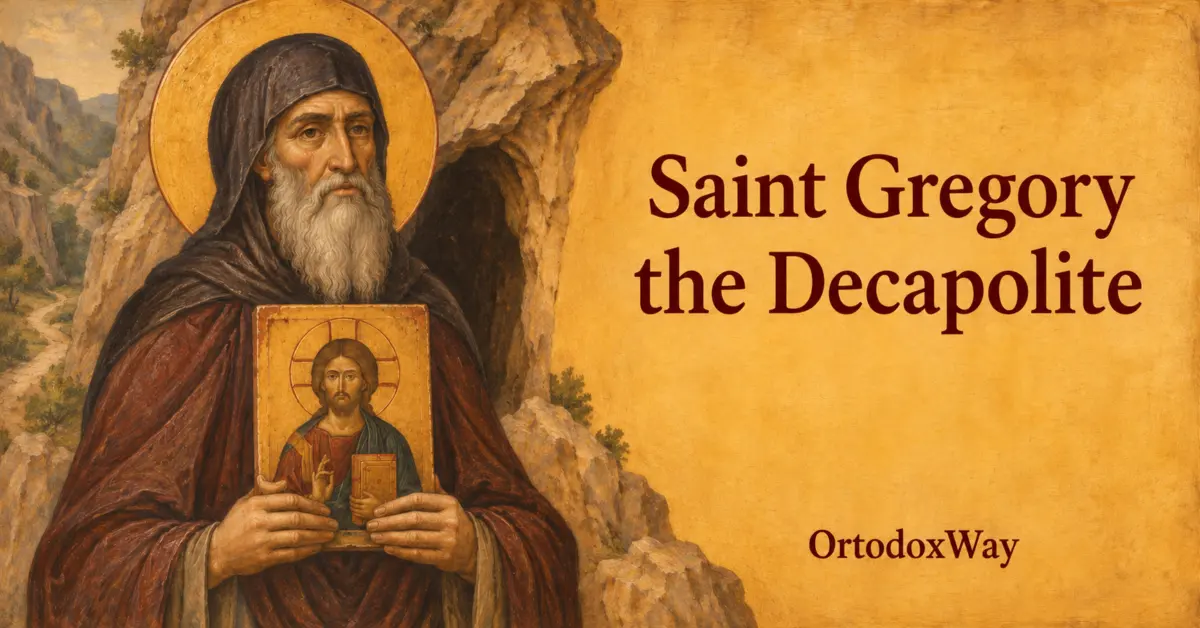
On 20 November, on the eve of the feast of the Entry of the Most Holy Theotokos into the Temple, the Orthodox Church commemorates our Venerable Father Gregory the Decapolite. He was a ninth-century monk who spent much of his life on the road, from Asia Minor as far as Rome and Sicily. He lived in the years when the iconoclast emperors — those who held that honouring icons was the worship of idols — were removing icons from the churches and persecuting those who venerated them. Wherever he went, Saint Gregory strengthened the faithful to remain in the right faith. For more than five hundred years his relics have rested at Bistrița Monastery in Wallachia, in today's Romania, where thousands of people come to him every year.
In defending the holy icons, Gregory was confessing the truth of the Incarnation of the Son of God. Christ truly became man, lived among men and could be seen; for this reason His human image can be painted. The honour given to an icon passes to the person depicted in it, while worship belongs to God alone. This teaching had been confessed by the Seventh Ecumenical Council, held at Nicaea in 787. In the following century, however, the persecution of icons was renewed, and Gregory was among those who defended the faith of the Church in this new trial.
In this article
Childhood in Irenopolis
The name "Decapolite" comes from the region where he was born. "Decapolis" means "ten cities" in Greek. It was a group of ten towns in Isauria, in the south of Asia Minor, in what is now Turkey, and it should not be confused with the Decapolis mentioned in the Gospel, near the Sea of Galilee.1 Gregory was born in one of these cities, called Irenopolis, towards the end of the eighth century.
His father was named Sergius and was a man ruled by his passions, who took no care for the salvation of his soul. His mother, Maria, was, in the words of the Lives of the Saints, "devout, loving God and loving her children." So in the same house there lived side by side a man bound to earthly things and a woman who prayed for her own. The child grew up under the eyes of both, but he followed his mother's example. From her the saint grew as from a good root.
At the age of eight he was sent to school. He learned the Psalms, and their words kindled in him a longing for God. What he read did not remain a school lesson for him: the Psalms became his prayer, words through which a child was learning to speak with God. He ran to church whenever he could, and whatever he heard there for the good of his soul he tried also to fulfil, like someone who knows that a good word heard and not carried out is lost. He ate simple food, worked with his own hands and gave to the poor whatever he had left over. He would often withdraw to quiet places to pray alone. Here the future monk could already be seen: the young man was seeking silence, work and almsgiving.
Flight from His Father's House
When he came of age, his parents wished him to marry. Gregory left home in secret, leaving behind his family, his city and the future his people had prepared for him, and went into the mountains. There he met the former bishop of Irenopolis, who had been driven from his see because he had opposed iconoclasm. The bishop had lost his see and was living as a fugitive in the mountains, but he had kept the right faith. From this confessor bishop Gregory received his first blessing for the monastic life. From the very beginning, Gregory's road passed by people who were suffering for the icons.
Some time later his father died. His mother searched for him, found him and rejoiced at his choice. This devout woman now saw him in a monk's habit and did not ask him to come home. She asked only that he move to a monastery where his brother was. Gregory obeyed her.
Soon, however, he learned that the abbot of that monastery sided with the iconoclasts. A young monk might have kept silent, thinking it was not his place to judge his superior. Gregory rebuked him openly, and the abbot ordered him to be beaten. Obedience to an abbot could not go as far as the denial of the faith, and Gregory chose to suffer rather than keep silent. Then he left that place and went to the monastery of his maternal uncle, the archimandrite Simeon.
He lived in Simeon's monastery for fourteen years. Having left a place where he could not obey without betraying his faith, he found here a father to whom he could submit with his whole heart. He grew in obedience, in humility and in the patient bearing of hardships, and the brethren looked on him almost as an angel. The more they honoured him, the more deeply he humbled himself. The Lives of the Saints say of him that he had acquired love and mercy so fully that he no longer remembered the wrong anyone had done him.
The Cave in the Ravine
After these fourteen years, Gregory asked Simeon to let him live alone. The abbot gave him a cave in a deep ravine near the monastery, and appointed a brother to bring him what he needed.
There the demons rose up against him with force. While he lived in the monastic community, he had been protected by the order of the house, by the brethren and by the eye of his father. Now he was alone in a ravine, and the enemy tried to drive him out through fear. They appeared to him as scorpions, then as armed soldiers threatening him with death. When fear did not move him, they tried deception. Once they even came in the likeness of the Holy Forty Martyrs of Sebaste,2 to deceive him. Gregory made the sign of the Holy Cross, and they vanished. He did not fight them by his own strength. He set the Cross of Christ before them and stood his ground.
Then, for many days on end, the cave was filled with a heavenly light and a sweet fragrance. This is just the kind of thing that can fill a solitary man with pride after years of ascetic struggle. But Gregory had only just seen demons coming to him in the likeness of saints, and he knew that even light can be a snare. He did not trust what he saw. He wrote to Simeon, and the elder came to the cave and reassured him: the light was from God, and the fragrance had driven out the evil spirit. Here one sees the saint's care to submit his experiences to the scrutiny of his spiritual father, and this humility guarded him from delusion. From that time he was healed both of a bodily illness and of the warfare of the passions, and God gave him the gift of working miracles.
A Wanderer for Christ
One day Gregory heard a voice from on high calling him to leave his land and his kindred, as God had once called Abraham.3 He set out for Ephesus, intending to cross from there to Constantinople and fight against the heresy. The road to the capital was closed to him, and he understood from this that God wished him to be a wanderer. The author of his Life set beside this journey the word of the Apostle, that here we have no continuing city, but we seek the one to come,4 and the example of the Lord, who had nowhere to lay His head.5
From here began a whole life of journeys. Gregory no longer had a monastery, a cell or brethren around him. He went with what he had on him and relied on God alone for each day's bread and shelter.
On the island of Proconnesus, in the Sea of Marmara, people were afraid to take him in, because an imperial order forbade giving shelter to monks. A poor man nevertheless received him into his house, in spite of the danger. His hospitality required courage, and not only mercy. From then on that man's house prospered in every good thing, and God returned to him in abundance what he had given.
At Ainos, in Thrace, a young man fell upon him and beat him. Gregory prayed for the one who was striking him, and the young man came to his senses and asked his forgiveness. The saint forgave him and asked only that he no longer do harm to anyone. He asked nothing for himself; his only concern was for those the young man might strike in future.
From Christopolis, the city known today as Kavala, he crossed to Thessalonica, and from there he went on foot to Corinth. At Corinth he boarded a ship for Rome. At Rhegium, in the south of Italy, he was offered gold. For a wanderer who did not know where he would sleep that night, such a gift might have seemed a sign of God's providence. But Gregory knew in the spirit that the money came from wealth unjustly gathered by an official, named in his Life as Mercurius, and he refused the gold. He would accept nothing that had been taken from those who had been wronged.
During the sea voyage, a man fell overboard close to the shore. He was in danger of drowning, and the saint's prayer brought him alive to land.
In Rome he spent three months shut in a cell, in silence. He had come to the great city, with its churches and its tombs of apostles and martyrs, and he sought neither people nor honour there. It was the enemy himself who revealed his secret: a possessed man cried out aloud that a man of God was there. Gregory cast the evil spirit out of him. When people began to honour him as a saint, he left the city. Human praise drove him away faster than persecution.
In Sicily, at Syracuse, he shut himself in a tower in the harbour. The demons burned the mat he slept on and fell upon him, but prayer drove them away. There he brought to repentance a woman who drew sailors into sin. She lived on the sin of others and was the ruin of many. Yet the saint's word reached her heart. The woman became a nun, and her house, where so much sin had been committed, became like a monastery.
On his way back, at the port of Otranto in the south of Italy, he was taken for a Saracen spy. The suspicion is understandable given the danger of Arab raids in the region. He was beaten and brought before the bishop like a criminal. The one who cast out demons and healed the sick was treated as a spy. Before the bishop he showed the injustice that had been done to him. And when the bishop wished to punish those who had beaten him, Gregory asked that they be forgiven.
After he left Otranto, a Saracen soldier — as the Byzantines called the Muslim Arabs — raised his spear on the road to kill him. His hand froze in the air. The soldier, who had come to kill, ended up begging mercy from the man he had meant to slay. Gregory held nothing against him for what he had intended to do. He touched his arm and made it whole.
In Thessalonica, at the Monastery of Saint Menas
Returning to Thessalonica, Gregory settled in the Monastery of Saint Menas. He lived in complete poverty, with a single garment on his back. At first he sometimes ate at other people's tables, but then he resolved no longer to live at anyone's expense. He remained in the church fasting and waited for God to provide for him. A devout widow, moved by God, began to bring him food every day. Her help recalls the widow of Zarephath, through whom God provided for the Prophet Elijah.6 Gregory, who had placed his hope in God, now received what he needed through the mercy of a human being.
A poor woman came to him to ask for help in rebuilding her little house. He told her to begin digging and to trust in God. The woman obeyed, and pitch welled up from the ground in abundance. She sold it, rebuilt her house and had enough to live on. The saint also foretold the death of a stylite — a monk who lived his ascetic life on top of a pillar — near the monastery, and the end of other people.
In Thessalonica he was ordained a priest. He served the Divine Liturgy with a humble and contrite heart. Here, too, disciples gathered around him. Among them was the young monk Joseph, whom the Church honours today as Saint Joseph the Hymnographer. Joseph later wrote a great many of the canons we sing in the Menaia, the service books appointed for each day of the year.
Among his disciples was also the Venerable John, whom the Church commemorates on 18 April. Gregory tonsured him a monk and guided him in obedience and ascetic struggle. John was with him in Constantinople as well. After his teacher's death he continued the same life of prayer, and when he too reposed, Joseph the Hymnographer buried him beside Gregory.
Having reached the measure of dispassion — that is, the cleansing of the heart from the passions — Gregory was found worthy to hear the singing of the angels glorifying the Most Holy Trinity. He who had sung the Psalms from childhood at last heard the hymn that the Church's singing follows here on earth. While still in the body, he tasted the joy from on high. In a vision by night, an angel gave him a sword of fire, for cutting off the passions and resisting heresy.
In Constantinople and on Olympus
From Thessalonica, Gregory went to Constantinople together with his disciple Joseph, to strengthen the persecuted Orthodox of the capital. From there he sent Joseph to Rome to seek help for the persecuted. On the way, Joseph fell into the hands of pirates and was held captive for years in Crete.
Gregory then spent some time in ascetic struggle on the Bithynian Olympus, a mountain in Asia Minor where many monks lived at that time. Afterwards he returned to the region of Thessalonica.
The Last Journey
In his final years he passed through grievous sufferings, named in his Life as epilepsy and dropsy, which he bore with patience and prayer. The dropsy had changed his appearance so much that those who knew him recognised him only by his voice.
When the illness had weakened him, his uncle and spiritual father Simeon sent him a letter, asking him to come so that they might see each other once more. Gregory did not leave his father without an answer and, with great toil, set out for Constantinople. He found Simeon released from the prison in which he had suffered for the faith. Many years had passed since the young monk had left his uncle's monastery. Now two confessors met: one had endured prison for the icons, the other had wandered the world for them. They embraced and comforted one another with spiritual words. The man who had received him in his youth and raised him in the monastic life was close to him also at the end of the road.
Twelve days beforehand, Gregory knew the day of his death. He asked the brethren to carry him to a house that received strangers and the sick. There he ended his earthly wandering, borne to the very end by God's providence and by the love of those who accompanied him. He departed in peace to the Lord on 20 November, most probably in the year 842.7 He did not live on earth to see the day in 843 when the icons were restored to the churches, on the first Sunday of Great Lent, which the Church has kept every year since then as the Sunday of Orthodoxy. Yet the faith for which he had wandered his whole life prevailed, and he is numbered among those who prepared that victory.
Miracles took place at his tomb straight away. A bent man who could no longer stand upright was made straight. A possessed man was delivered from the evil spirit, and a monk tormented by the warfare of the flesh found peace after praying there. Joseph had not been present at his teacher's death. When he returned from Crete, after years of captivity, he touched his body and found it whole. The disciple had not been able to bid his father farewell, but God granted him this consolation. Later, Joseph gathered the relics of Gregory and of John in the monastic house he himself had founded.
From Constantinople to Bistrița
According to tradition, in 1453, when Constantinople fell to the Turks, the relics of Saint Gregory were taken by a Turkish official and carried to the lands of the Danube. Another tradition says that monks rescued them even before the city's fall, bringing them into the Balkans. News of the miracles worked through them reached Barbu Craiovescu, the Great Ban of Craiova — that is, the official who governed Oltenia on behalf of the ruling prince of Wallachia. Bistrița Monastery, in today's Vâlcea County in Romania, was the foundation of the Craiovescu brothers, attested in documents in 1494. Barbu bought the relics for a great sum and placed them in the monastery's main church in 1497 or 1498, according to different sources.
Since then, Bistrița Monastery has remained the place where his relics are kept and venerated. Ban Barbu Craiovescu, who had brought them to his foundation, would later himself receive the monastic tonsure, with the name Pachomius.
In 1656, Prince Constantin Șerban and his wife, Lady Bălașa, donated the silver reliquary, and their names are preserved in its inscription. In times of danger the monks hid the relics in the nearby cave. At other times they carried them in procession and prayed together with the people for deliverance from sickness and drought. In this way the relics were brought to Bucharest during the plague of 1765, and to Craiova in 1779, when the region was suffering from drought and locusts. An inscription on a silver candlestick, given by the boyars and merchants of Craiova, preserves the memory of this last procession.
The faithful still come to him today in sickness, in danger and in trouble. They know him as a swift helper and ask him to guard their fields from drought and their homes from fire. Mother Olga Gologan gathered in a small book the miracles and healings he has worked in these lands. On his feast day the crowd is so great that the reliquary is carried out of the church and placed under a canopy, so that everyone can venerate it.
The Wanderer Who Found Rest
Gregory left his home in his youth and never again had a place of his own. He slept in caves, in other men's cells, in a harbour tower, and gave up his soul in a house for strangers. Now he has a place of rest, and people come to him from far away. Along the roads he once walked to strengthen others, others now walk to find him.
From his life we can take a few things within our own measure. He obeyed his father and did not trust his own visions. He forgave those who beat him and prayed for them. He accepted illness as a visitation from God and did not let it stop him from serving the Church. He kept the right faith in times when imperial power was persecuting the defenders of the icons.
His troparion in Tone 3, as sung in the Romanian Church, gathers all this into a few lines:
You became an image of self-restraint and enlightened all through the Divine Spirit. You finished the race of the right faith, enlightened the world with your teachings and rebuked the thoughts of those of evil belief. O Venerable Father Gregory, pray to Christ God to grant us great mercy.
Holy Venerable Father Gregory, pray to God for us!
Notes
- The Decapolis of the Gospel is mentioned in Matthew 4:25, Mark 5:20 and Mark 7:31. It was a different region of ten cities, lying east of the Jordan and the Sea of Galilee. ↩︎
- The Holy Forty Martyrs were Christian soldiers who, in the year 320, were left to freeze to death in a lake near the city of Sebaste, in Lesser Armenia, because they would not deny Christ. The Church commemorates them on 9 March. ↩︎
- Genesis 12:1. God commanded Abraham to go out from his land, from his kindred and from his father's house, and to go to the land He would show him. Abraham obeyed and set out without knowing where he was going. ↩︎
- Hebrews 13:14. ↩︎
- Matthew 8:20; Luke 9:58. ↩︎
- 3 Kingdoms (1 Kings) 17:8–16. In a time of famine, God sent the Prophet Elijah to a poor widow in Zarephath who had only a handful of flour and a little oil left. She gave first to Elijah out of her little, and her flour and oil did not run out until the famine ended. ↩︎
- The exact year of his death has not been established with certainty. The dating to 842, upheld by Francis Dvornik, is followed by many Church accounts; other scholars have proposed 841 or an earlier date. The year 816, found in some synaxaria, does not fit the overall information about the saint's life and his ties with Joseph the Hymnographer. ↩︎
