
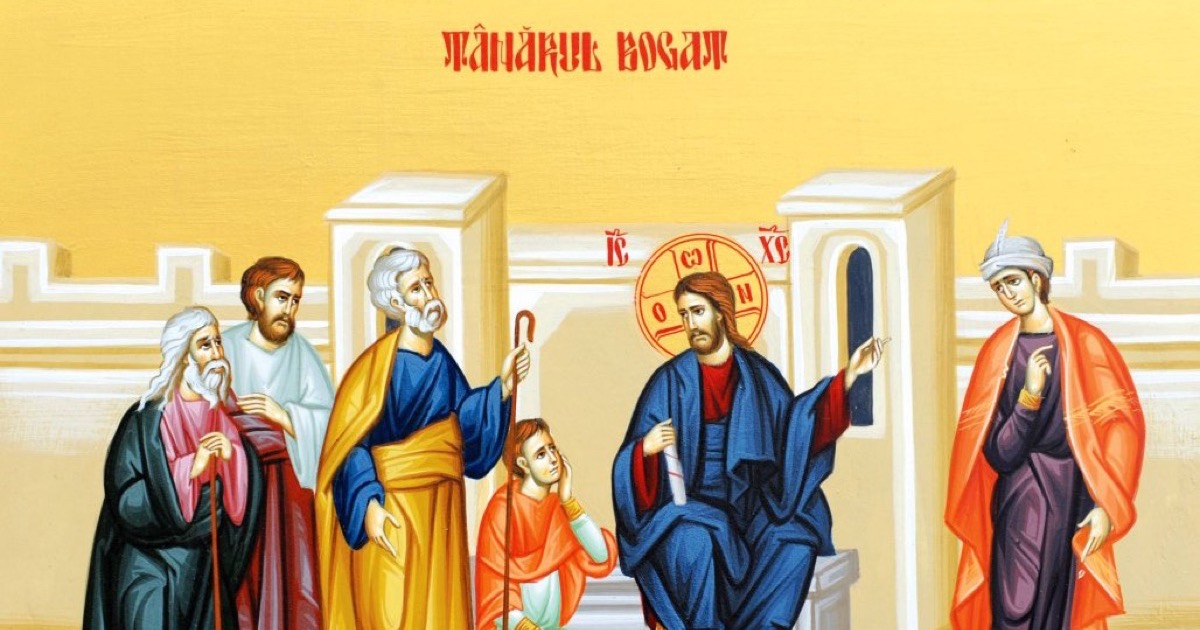
The Twelfth Sunday after Pentecost (Matthew 19:16-26), at the Leave-taking of the Dormition of the Mother of God
Today’s Sunday and its two Gospels
On the twenty-third of August two orders of service meet. The first is that of the Sunday in course, the twelfth after Pentecost, with the Epistle from 1 Corinthians 15:1-11 and with the Gospel of the Lord’s meeting with the rich young man (Matthew 19:16-26). The second is that of the Leave-taking of the Dormition, to which belongs the Gospel appointed for the feasts of the Mother of God (Luke 10:38-42; 11:27-28). How much of each is read at the Liturgy depends on local usage, but both belong to this day.
The Leave-taking is the day on which the feast begun on the fifteenth of August is brought to a close. It does not add a second Dormition; it seals the first. It is the last day on which the order of services still stands inside the feast: the hymns of the Dormition return, the troparion is sung again, and afterwards they pass out of the daily offices. This year the Leave-taking falls on a Sunday, so that the two orders are woven together, and the Dormition is heard in the light of the Resurrection.
Set side by side, the two Gospels are read one through the other. A man comes to Christ and asks what he still lacks; and in the other Gospel the Lord says: one thing is needful.
A man who asks about eternal life
Most of those who drew near to Christ in the Gospels were asking for healing, for themselves or for their own. This young man asks for something else. He asks about eternal life, and he asks with a haste that the Gospel according to Mark preserves: he runs, kneels, and pleads (Mark 10:17).
Saint John Chrysostom, expounding this Gospel, begins from what is about to bring everything down. Great is the tyranny of wealth, he says, and it is seen precisely here: though a man be sound in all else, this passion alone ruins it all. For this reason the Apostle Paul called it the root of all evils (1 Timothy 6:10).
And of the young man who asks, Saint John gives an image that stays in the mind: the ground was good and rich, but the multitude of thorns choked the seed.
“Why callest thou Me good?”
The Lord’s word — “Why callest thou Me good? there is none good but one, that is, God” — was used by the Arians against the divinity of the Son, and for that reason the Fathers examined it with care.
Saint John Chrysostom shows first why the Lord answers in this way: the young man had approached Him as a man, as one of the teachers of the Law, and received an answer measured to the manner of his asking. Christ does not, however, put Himself outside the number of the good. He did not say, “I am not good,” but “none is good,” that is, none among men, and this by comparison with the goodness of God. He added “but one, that is, God,” and not “but My Father,” because He had not yet revealed Himself to the young man. And the whole answer is pedagogical: it unfastens him from flattery and fastens him to God, so that he may seek not a good teacher among teachers, but the fountain of goodness.
Theophylact supplies the ground: man is not good by nature, since he changes and turns aside easily, and human goodness, set beside the goodness of God, is reckoned as nothing.
The commandments counted and the commandment beyond counting
The Lord recites the commandments to him: thou shalt not kill, thou shalt not commit adultery, thou shalt not steal, thou shalt not bear false witness, honour thy father and thy mother. All of them concern one’s conduct toward the neighbour. Over them the Lord sets one that is not numbered among the ten but contains them: “thou shalt love thy neighbour as thyself” (Leviticus 19:18).
The young man answers that he has kept them from his youth, and asks further: “What lack I yet?”
Here Theophylact makes an observation that cuts deep. Some, he says, accuse the young man of boasting, since a rich man cannot possibly have fulfilled the commandment to love his neighbour: whoever loves his neighbour as himself does not remain wealthier than his neighbour. The young man reckoned that he had kept every commandment, and had not noticed that the last of them, the one the Lord had added, was the one that condemned him. He had held the letter and had not seen what it asks.
“One thing thou lackest”
The Gospel according to Mark preserves the answer in its clearest form: “One thing thou lackest: go thy way, sell whatsoever thou hast, and give to the poor, and thou shalt have treasure in heaven: and come, take up the cross, and follow me” (Mark 10:21).
The Lord asks two things, and the Fathers dwell on both.
The first is separation from possessions. Theophylact observes that it is asked all at once: the Lord did not say “give continually to the poor,” keeping back something from which to give again, but “sell” and “give,” so that you are left stripped. Repeated almsgiving preserves the owner; selling abolishes him.
The second is the following. Theophylact says why it was added: because there are some who distribute their wealth and go on living in every uncleanness. Emptying oneself of possessions opens a space but does not fill it. Saint John Chrysostom carries the demand to its end: it is not enough to despise wealth; one must also feed the poor and, above all, follow Christ, that is, be ready for death every day, according to the word, “If any man will come after me, let him deny himself, and take up his cross, and follow me” (Matthew 16:24). To cast away money, he says, is the smaller of the two.
The young man hears and departs. The Evangelist gives the reason in a single clause: “for he had great possessions.” Saint John notices something here too: he answered nothing further. The one who had come running and asking has nothing left to say. A passion does not argue with Christ; it simply carries the man out.
The camel and the eye of the needle
Then comes the word that terrified the disciples: “It is easier for a camel to go through the eye of a needle, than for a rich man to enter into the kingdom of God.”
Saint John Chrysostom and Theophylact read an impossibility here, not a difficulty. Saint John shows the movement of the word: the Lord first said it was hard, then, going further, showed that it is impossible, and impossible in the highest degree. Theophylact says the same: see how He first called it difficult, and here complete impossibility.
Precisely because it is so severe, this word has been softened over the centuries along two paths, and both are worth examining.
The first turns the camel into a rope. It is said that in place of the Greek word for camel there stands one almost identical to it, naming the thick cable with which sailors make fast their anchors. Theophylact knows the opinion and passes it on as belonging to others — “some say” — without making it his own. And where he expounds the same episode as told by Luke, he shows that the change helps nothing: neither the camel nor the ship’s cable passes through the eye of a needle. The impossibility remains whole.
The second path is more widespread and more misleading. It is said that “the eye of the needle” was the name of a small gate in the wall of Jerusalem, so narrow that a camel could pass through it only when unburdened and on its knees. The explanation is attractive and is often preached, but it has no foundation. No source is known from the time of the Saviour or before Him that gives such a name to any gate of Jerusalem. A study published in New Testament Studies (2022) traced the origin of the legend: the earliest known witness is an anonymous gloss preserved in the Catena aurea of Thomas Aquinas and attributed to Anselm of Canterbury, from the eleventh or twelfth century; it is found next in Hugh of Saint-Cher in the thirteenth century and in the pilgrim Joannes Poloner in the fifteenth, and in the nineteenth century it spread until it came to be taken for received interpretation.
The same study clears up a misattribution that circulates widely: Theophylact is often named as the source of the gate legend. He nowhere speaks of any gate. What has been ascribed to an Eastern commentator is in fact a late Western gloss.
It is worth saying why this matters. The gate legend moves the word from impossibility to difficulty, and from there follows a comforting calculation: if it is only hard, then it can be done by human effort. The rope version changes the image, but in Theophylact it does not change the conclusion, since a rope does not pass through a needle’s eye either. The Lord, however, did not leave the disciples with an effort. He left them a word that cut away every hope in themselves, so that He could give them the true hope.
“With God all things are possible”
The disciples were terrified and asked: “Who then can be saved?”
The question seems strange coming from poor men. Saint John Chrysostom explains their fear by their compassion: they were afraid for everyone, having taken upon themselves the heart of teachers. Theophylact says the same — they were not asking for themselves, but for all mankind.
Clement of Alexandria, who left one of the oldest extended commentaries on this encounter, gives a second reason. The disciples had left their nets, their hooks and their boats, that is, everything they had, and they were resting their hope on their poverty. But when they heard the word, they realised that they had not yet renounced the passions, and they began to fear. For the rich man is both the one who has possessions and the one who is full of passions, and both alike are shut out of heaven. One may find a poor man who begs his daily bread and is drunk with desires, just as one may find a man of means who is temperate and poor in indulgences.
The Lord’s answer — “With men this is impossible; but with God all things are possible” — has perhaps been misunderstood more often than the word about the camel. Saint John Chrysostom removes that reading at once: Christ did not say it so that you should let the matter go and draw back as from something impossible, but so that, measuring how great the work is, you should run to it with zeal and ask God for help in the struggle.
Both then show how one begins, and here the patristic reading becomes suddenly gentle.
Saint John Chrysostom counsels you not to seek everything at once, but to climb this ladder that leads to heaven step by step, cutting off first what is superfluous; whoever begins this way goes on more easily. And to the one who asks how the desire can be quenched, he sets before him an image taken from medicine: in those seized by fever, the bitter bile is not calmed by food and drink but inflamed; so too greed is not put out by adding, but by taking away. The man who despises wealth quiets his desire; the man who adds to it makes it burn, and after ten thousand talents he desires as many again.
Theophylact numbers the steps: whoever merely begins to cease from greed will advance to reducing his surplus, and from there he will come to do without even what is necessary, and he will prosper along the way, God working together with him.
This last phrase — God working together with him — is the key to the whole passage. The impossibility remains an impossibility; what changes is that the man is no longer working alone.
The wealth that cannot be seen
If wealth were only what can be counted, this Gospel would concern few people. The ascetic tradition reads it otherwise.
Saint John Climacus places the love of money in the sixteenth Step of The Ladder and calls it a tyrant with a thousand heads, showing that whoever is ruled by it worships graven images in place of God. The passion is not measured by what you have, but by what holds you.
Saint Cleopa of Sihăstria (Elder Cleopa Ilie, †1998) says the same thing with a severity that leaves no way out: there are many poor people in the world, some without even a family, who still do not follow Christ with their whole heart, because they cannot renounce the hidden passions — the thought of pride, vainglory, unchastity, the love of money, sloth, and above all their own will. Whoever does not renounce his own will, he says, cannot do the will of Christ, and cannot carry Him in a heart full of the idols of the passions.
Saint Cleopa also distinguishes the two ways that this Gospel sets out. The first is the way of the commandments, binding upon all, and the Lord answers along it at the beginning of the conversation: “if thou wilt enter into life, keep the commandments.” The second is the way of perfection, which the Gospel calls the way of counsel, and which is not commanded but proposed: “if thou wilt be perfect.” Along this way went the apostles, the martyrs and the venerable fathers, and it requires both steps — voluntary poverty and the following of Christ.
This distinction spares us two errors at once. It does not permit the layman to think that the Gospel does not concern him, since the commandment to love the neighbour was spoken to him too in the same conversation. And it does not permit anyone to regard perfection as a greater work added to the others, since it begins with an emptying.
The man who heard this Gospel and did not go away sorrowful
This word drew one man out of the world and opened the desert.
Saint Athanasius the Great relates, in The Life of Antony, that Antony was about eighteen or twenty years old when his parents died, leaving him the care of a younger sister and of the household. Not six months had passed when, going to church as usual, he was thinking on the way how the apostles had left all and followed the Saviour. He entered the church just as the Gospel was being read, and heard the Lord’s word to the rich man: “If thou wilt be perfect, go and sell that thou hast, and give to the poor, and thou shalt have treasure in heaven: and come and follow me.” It seemed to him that the reading had been made for him. He went out and gave the land to the villagers. And later, hearing another word — “take therefore no thought for the morrow” — he distributed what remained and entrusted his sister to virgins known to him.
The same words, the same reading, two answers. One went away sorrowful, the other went away stripped. Antony was not the first to take up the ascetic life — his own Life recounts that he went to learn from an old man who had lived alone from his youth, and from other strugglers nearby. But out of his answer would grow the desert of Egypt as the Church came to know it.
“One thing is needful”
Here the second Gospel of the day comes in.
Martha receives the Lord into her house and busies herself with much serving, while Mary sits at His feet and listens. When Martha complains, the Lord answers her: “Martha, Martha, thou art careful and troubled about many things: but one thing is needful: and Mary hath chosen that good part, which shall not be taken away from her” (Luke 10:41-42).
The two Gospels touch each other in their very words. The young man had “great possessions”; Martha was troubled “about many things.” The young man asks “what lack I yet,” and the Lord answers him, in the Gospel according to Mark, “one thing thou lackest”; to Martha He says, “one thing is needful.” What is lacking is not a work added to the others, but the One for whose sake the others are left.
The Gospel of the feast goes further. A woman in the crowd cries out: “Blessed is the womb that bare thee!” And the Lord answers: “Yea rather, blessed are they that hear the word of God, and keep it” (Luke 11:27-28). At first hearing this answer seems to diminish the praise offered to His Mother. It deepens it. The Church reads this Gospel at the feasts of the Mother of God precisely because it sees in her the first who heard the word and kept it, before ever bearing Him in the body: “Behold the handmaid of the Lord; be it unto me according to thy word” (Luke 1:38).
Set side by side, the two Gospels show the same call received in two ways. The young man had kept the commandments; but when Christ asked him no longer for something, but for himself, he went away. The Mother of God did not know where her word would take her — the incomprehension of those around her, the flight into Egypt, the sword foretold by Symeon, the Cross of her Son — and still she did not take it back.
Where the choice leads
The last sentence of the Sunday Gospel is heard differently on this day.
Nothing is more impossible to man than to overcome death. He cannot save himself, nor rise from the grave by himself. And the feast that closes today proclaims exactly this: what is impossible with men is possible with God. This is why the troparion of the Dormition does not stop at the tomb but sings the passing over: “Thou wast translated to life, O Mother of Life.”
The young man’s question remains the question of every one of us, and it is not asked once only, but whenever Christ asks for something we are not ready to give. The answer is heard twice today: once before a man who would not receive it, and once in Martha’s house — one thing is needful.
Image: the Orthodox icon The Rich Young Man, via Ziarul Lumina.